


IoT communication protocols are sets of rules that determine how connected devices transmit, route, and secure data across networks. These standards bridge the gap between physical sensors, edge compute nodes, and cloud platforms. They ensure that hardware built by different manufacturers can interoperate within a single infrastructure.
Selecting the correct protocol determines system battery longevity, data throughput, latency, and vulnerability to network attacks. Because no single standard fits every use case, engineers analyze tradeoffs across four operational vectors: range, data speed, power consumption, and networking layer placement.
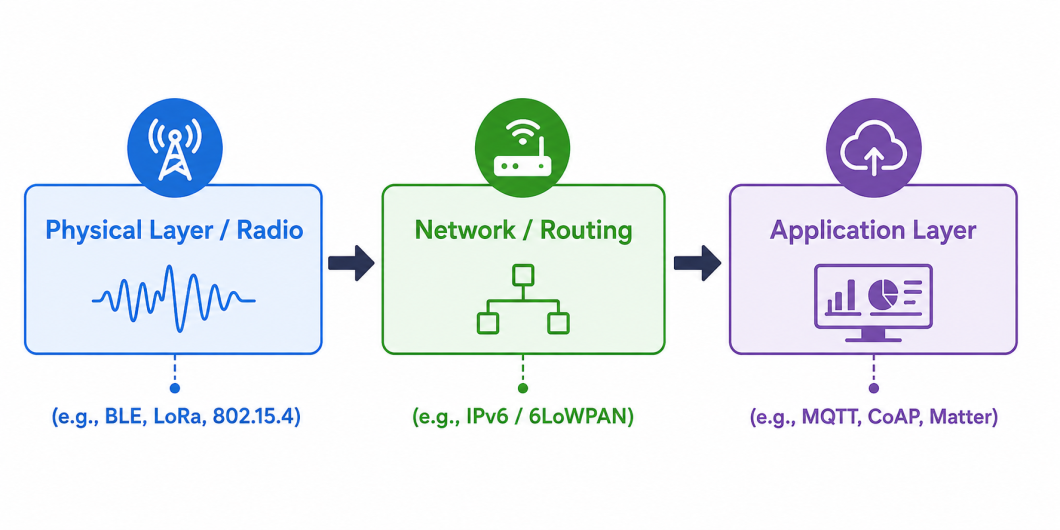
Unlike enterprise IT networks, IoT deployments often use resource-constrained hardware in environments with severe radio interference. IoT-specific protocols minimize processing overhead, compress data payloads, and optimize radio wake-sleep cycles to turn unstable physical environments into predictable data pipelines.
Table of Contents
Technical Selection Framework
When choosing a protocol stack, balance these five operational constraints:
- Network Range: Local Area Networks (LAN) or Personal Area Networks (PAN) handle short hops under 100 meters. Low-Power Wide-Area Networks (LPWAN) and cellular systems cover long-range paths up to 15 kilometers.
- Power Consumption: Active nodes require main power lines. Passive or sleeping nodes run on coin-cell batteries or energy-harvesting modules for several years.
- Data Throughput: Low-bandwidth channels process intermittent text or telemetry bursts (bytes). High-bandwidth channels support continuous video or high-frequency telemetry streams (Megabits per second).
- Network Topology: Point-to-point topologies connect devices directly. Star topologies route all signals through a central hub. Mesh networks use peer nodes to route data across self-healing pathways.
OSI Layer Placement: Hardware-driven standards handle physical radio modulation, while software-driven application layers manage messaging structures and access tokens.
Top IoT Communication Protocols
Choosing the right communication protocol is one of the most important decisions in IoT architecture, as it directly affects device performance, scalability, security, and power consumption. Below are the most widely used IoT communication protocols that enable reliable data exchange between connected devices, gateways, and cloud platforms.
1. Wi-Fi (IEEE 802.11)
- OSI Layer: Physical & Data Link Layers
- Frequency Bands: 2.4 GHz, 5 GHz, 6 GHz
- How it works: Wi-Fi provides local area network connectivity using high-frequency radio waves. It connects devices directly to local wireless routers to access IP networks.
- Advantages: High data transfer speeds (Gigabits per second) and native IP routing. Devices connect to cloud servers without translation gateways.
- Limitations: High power consumption drains batteries quickly. It has limited range and poor signal penetration through concrete and steel structural walls.
- Ideal Use Case: Smart security cameras, residential appliances, and high-volume industrial data logging systems connected to main power lines.
2. Bluetooth Low Energy (BLE)
- OSI Layer: Physical, Data Link, & Network Layers
- Frequency Bands: 2.4 GHz ISM Band
- How it works: BLE uses a fast channel-hopping scheme. It transmits brief data bursts and then immediately returns the radio transceiver to a low-power sleep state.
- Advantages: Low energy consumption allows small devices to operate for years on a single coin-cell battery. It features universal native support in consumer smartphones and tablets.
- Limitations: Limited operational range (typically 10–30 meters indoor; up to 1000 meters with BLE 5.0 LE Coded PHY in free space) and low data payload capacity. It cannot handle media streaming or continuous bulk file transfers.
- Ideal Use Case: Wearable medical monitors, fitness trackers, smart door locks, and indoor localization beacons.
3. ZigBee (IEEE 802.15.4)
- OSI Layer: Network & Transport Layers (built on 802.15.4 Physical/MAC)
- Frequency Bands: 2.4 GHz ISM Band
- How it works: ZigBee builds a local mesh network. Every line-powered node works as a router to pass data packets across the network to a central coordinator.
- Advantages: Highly scalable architecture that supports thousands of nodes on one network. Self-healing routing paths ensure network stability if individual nodes fail.
- Limitations: Low data transmission rates (maximum 250 Kbps). It requires a dedicated central gateway to translate ZigBee packets into internet-routable IP traffic (similar to Thread’s border router requirement).
Ideal Use Case: Industrial building automation, smart lighting networks, and residential utility sub-metering.
4. Thread
- OSI Layer: Network & Transport Layers (built on 802.15.4 Physical/MAC)
- Frequency Bands: 2.4 GHz ISM Band
- How it works: Thread is an IP-addressable, low-power mesh networking protocol. It uses 6LoWPAN to bring IPv6 addressing directly to every endpoint node.
- Advantages: Eliminates proprietary translation gateways. It has no single point of failure because the network automatically elects border routers to handle internet traffic.
- Limitations: Limited to short-range mesh environments with typical throughput of ~125 Kbps (PHY rate: 250 Kbps). It requires hardware compatible with the IEEE 802.15.4 radio standard.
- Ideal Use Case: Matter-compliant smart homes and modern building management systems.
5. Near Field Communication (NFC)
- OSI Layer: Physical, Data Link, & Application Layers
- Frequency Bands: 13.56 MHz (HF)
- How it works: NFC uses electromagnetic induction between two loop antennas placed close together.
- Advantages: High security because data cannot be intercepted from a distance. Passive tags require no internal batteries; they run on power drawn from the reader’s magnetic field.
- Limitations: Operates only over very short distances (less than 4 centimeters) with minimal data throughput.
- Ideal Use Case: Contactless access badges, secure asset pairing, and inventory asset tracking.
6. LoRaWAN (Long Range Wide Area Network)
- OSI Layer: Network & Application Layers (built on LoRa Physical)
- Frequency Bands: Sub-GHz Bands (e.g., 868 MHz, 915 MHz)
- How it works: LoRaWAN uses Chirp Spread Spectrum (CSS) modulation to transmit data across long distances to regional gateways in a star-of-stars topology.
- Advantages: Long transmission range (2–5 km urban; 5–15 km rural; up to 50 km with LR-FHSS in open areas) with excellent penetration through soil and walls.
- Limitations: Very low data transmission rates (50 Kbps maximum) with high latency. It is unsuited for real-time control loops or frequent updates.
- Ideal Use Case: Agricultural soil telemetry, environmental monitoring, and municipal water meter systems.
7. MQTT (Message Queuing Telemetry Transport)
- OSI Layer: Application Layer
- Transport Dependency: TCP/IP
- How it works: MQTT uses a Publish/Subscribe messaging model. Client devices publish data to specific topics managed by a central message broker, which distributes the data to subscribers.
- Advantages: Lightweight fixed packet header (as small as 2 bytes) minimizes network overhead. Built-in Quality of Service (QoS) profiles guarantee packet delivery across unstable connections.
- Limitations: High resource overhead because it relies on persistent TCP connections. A central broker introduces a single point of failure if not configured in a cluster.
- Ideal Use Case: Cloud data ingestion, industrial SCADA systems, and remote vehicle telematics.
8. CoAP (Constrained Application Protocol)
- OSI Layer: Application Layer
- Transport Dependency: UDP
- How it works: CoAP is a document-transfer protocol designed to translate easily to HTTP rest architectures while reducing packet overhead via UDP transport.
- Advantages: Low connection overhead and minimal latency because it avoids TCP handshakes. It supports native multicast commands to update multiple devices simultaneously.
- Limitations: Lacks TCP-level message acknowledgement guarantees, though it has built-in confirmable message mechanism. It requires Datagram Transport Layer Security (DTLS) to secure data.
- Ideal Use Case: Resource-constrained devices on low-bandwidth networks that need low-latency RESTful interaction.
9. Cellular IoT (NB-IoT and LTE-M)
- OSI Layer: Physical, Data Link, & Network Layers
- Frequency Bands: Licensed Cellular Spectrum
- How it works: Cellular IoT technologies use existing mobile carrier infrastructure to connect devices directly to wide-area networks without local gateways.
- Advantages: Wide geographic coverage, strong security, and reliable connectivity in remote locations. NB-IoT provides deep indoor penetration, while LTE-M supports device mobility and higher data rates.
- Limitations: Higher operational costs due to carrier subscriptions. Power consumption is generally higher than LPWAN alternatives such as LoRaWAN.
- Ideal Use Case: Smart utility metering, fleet tracking, connected healthcare devices, and large-scale smart city deployments.
IoT Protocol Comparison Matrix
| Protocol | OSI Layer | Maximum Range | Power Profile | Data Throughput | Ideal Topology |
| Wi-Fi | Physical / Link | ~50 meters | High | Up to 1+ Gbps | Star |
| BLE | Phys / Link / Net | ~30 meters | Ultra-Low | 2 Mbps | Point-to-Point |
| ZigBee | Network / Trans | ~100 meters | Low | 250 Kbps | Mesh |
| Thread | Network / Trans | ~100 meters | Low | 250 Kbps (PHY); ~125 Kbps typical | Mesh |
| NFC | Mixed Stack | < 4 centimeters | None (Passive) | 424 Kbps | Point-to-Point |
| LoRaWAN | Network / App | ~15 kilometers | Ultra-Low | 50 Kbps | Star-of-Stars |
| MQTT | Application | Network Dep. | Medium | Payload Dep. | Broker Pub/Sub |
| CoAP | Application | Network Dep. | Low | Payload Dep. | Request/Response |
Target Deployment Architectures
The ideal IoT communication protocol often depends on the deployment environment, network requirements, and operational constraints of the system being built.
Smart Home Ecosystems (Matter & Thread)
Modern smart home architectures rely on the Matter application layer standard to ensure cross-brand interoperability. Matter uses Thread for low-power, battery-operated devices (like switches and sensors) and Wi-Fi for mains-powered, high-bandwidth endpoints (like smart displays and cameras). This removes the need for isolated proprietary hubs.
Industrial IoT (IIoT) & Manufacturing
Heavy industrial sites use MQTT or CoAP running over Private 5G or hardwired Ethernet connections. These configurations provide sub-millisecond response times for local control loops. They also run Edge AI models locally to compress sensor data, using low-bandwidth connections to report only system anomalies to cloud systems.
Remote Asset Logistics
Cross-border logistics systems use Cellular IoT networks (NB-IoT and LTE-M). LTE-M supports cell tower handovers for moving cargo, while NB-IoT provides deep signal penetration inside shipping containers. Local tracking inside warehouses uses low-power BLE location beacons.
Smart City Infrastructure
Municipal deployments deploy LoRaWAN or NB-IoT to manage assets across vast urban areas. These protocols allow towns to install parking sensors, water main monitors, and trash bin fullness sensors directly into physical structures. The devices operate for over a decade without battery replacements or gateway modifications.
Conclusion
No single IoT communication protocol is best for every deployment. The right choice depends on network coverage, power consumption, security requirements, latency targets, and device density. Protocols such as BLE, ZigBee, Thread, LoRaWAN, MQTT, CoAP, and Cellular IoT each address different connectivity challenges. Organizations that evaluate these trade-offs early can build IoT systems that remain scalable, secure, and cost-effective over the long term.

Frequently Asked Questions
1. What is the difference between ZigBee and Thread?
ZigBee requires a specialized translation gateway to convert its data packets into internet-routable IP traffic. Thread uses 6LoWPAN to assign native IPv6 addresses directly to every connected node, removing the need for a central translation hub.
2. Why is MQTT preferred over HTTP for IoT applications?
HTTP requires a high overhead because of its large text headers and persistent TCP connection handovers. MQTT uses a compact binary header (down to 2 bytes) and a Publish/Subscribe model, which reduces data bandwidth requirements and processor utilization on edge devices.
3. Can an IoT device use multiple communication protocols simultaneously?
Yes. Many multi-protocol system-on-chip (SoC) modules feature co-existing radios. For example, a smart lock can use BLE for initial local provisioning via a smartphone, and Thread for daily mesh network operations.
4. Is LoRaWAN a cellular technology?
No. LoRaWAN operates in unlicensed sub-GHz radio bands using a star-of-stars network architecture managed by local gateways. Cellular systems run on licensed radio frequencies managed by commercial telecommunication carriers.
5. What is the function of an IoT gateway?
An IoT gateway bridges local non-IP wireless networks (such as ZigBee or Bluetooth) with IP-based wide-area networks (such as Ethernet, Wi-Fi, or Cellular). It handles protocol translation, data payload packaging, and security enforcement.