


Salesforce Agentforce is changing how businesses automate customer service, sales, and operational workflows. Unlike traditional automation tools that follow predefined rules, Agentforce uses autonomous AI agents that can understand requests, access business data, make decisions, and take action with minimal human involvement.
As organizations look to improve productivity and customer experiences in 2026, Agentforce is emerging as a powerful solution for scaling operations without increasing workloads. This guide explains how Salesforce Agentforce works, its key features and benefits, real-world use cases, implementation best practices, and how it compares with traditional Salesforce automation.
Table of Contents
What is Salesforce Agentforce?
Salesforce Agentforce is a suite of autonomous AI agents designed to execute business tasks across the entire Customer 360 lifecycle without continuous human intervention. Operating within Salesforce’s secure trust layer, these agents can understand complex requests, analyze relevant data, and trigger native platform actions to resolve customer or employee issues.
Unlike traditional conversational AI or old-school chatbots that rely on pre-scripted dialogue trees, Agentforce uses agentic AI. This means it can interpret natural language, understand the user’s intent, break a request down into smaller logical goals, and dynamically choose the correct tools or workflows to accomplish those goals.
How Agentforce Differs from Traditional Automation
Traditional automation is strictly linear: If Event A happens, execute Action B. If a customer deviates from the exact path specified by an administrator, the automation breaks or forces an immediate escalation to a human agent.
Agentforce operates on intent and capability. Instead of a fixed script, you provide an agent with specific business parameters, a library of available actions (like looking up an order, issuing a refund, or scheduling an appointment), and clear operational guardrails. The agent then analyzes the available context and selects the most appropriate action or workflow based on the user’s request.
How Salesforce Agentforce Works
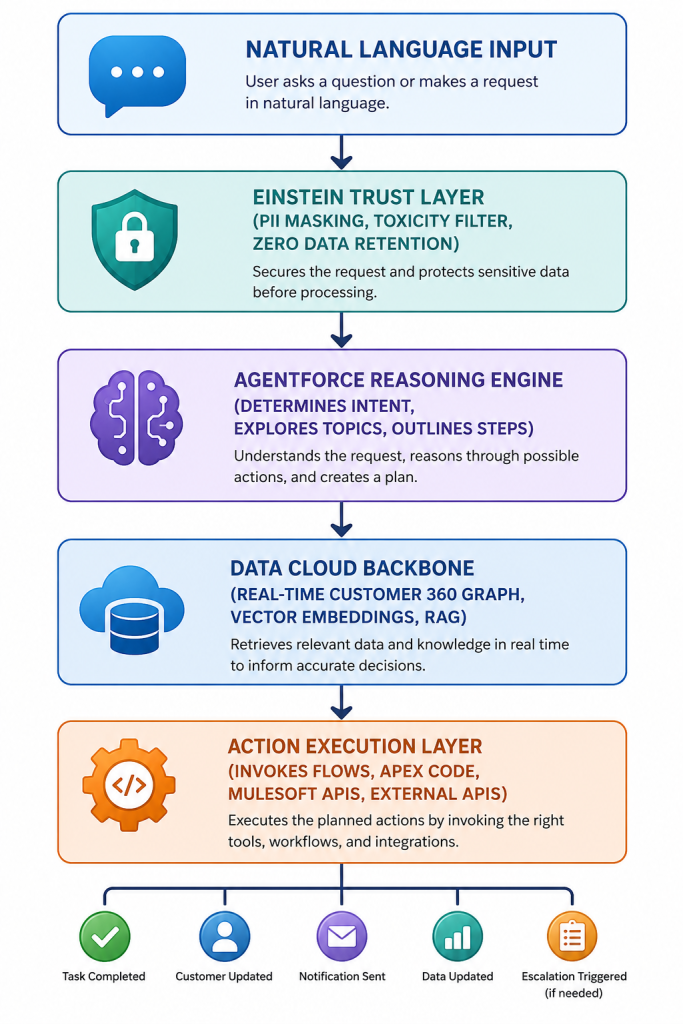
To trust autonomous agents with your live customer data and core business workflows, it helps to understand the underlying technical architecture. Agentforce relies on an integrated stack where data, intelligence, and execution logic operate in unison.
1. The Core Components
An Agentforce agent is built using four key pillars:
- Topics: These define the agent’s scope of work (e.g., “Order Management” or “Lead Qualification”).
Instructions: Written in plain, natural language, instructions define the agent’s role, behavior, preferred tone, and objectives. - Actions: The specific capabilities given to the agent. These are built using native Salesforce mechanisms like Flows, Apex classes, MuleSoft APIs, or external system integrations.
- Guardrails: Hard operational boundaries that prevent an agent from discussing unrelated topics, processing unapproved changes, or missing critical human escalation points.
2. The Salesforce Data Cloud Backbone
An AI agent is only as good as the data it can access. Agentforce uses Salesforce Data Cloud as its unified data backbone. Data Cloud ingests, harmonizes, and processes unstructured data (PDFs, emails, chats) and structured data (SQL databases, CRM records) across hundreds of touchpoints in real time.
Through Retrieval-Augmented Generation (RAG) and native vector search, an agent can securely fetch up-to-date customer metrics or technical support articles instantly. This helps ground responses in actual business data, reducing the risk of LLM hallucinations.
3. Einstein AI and the Trust Layer
Security remains a non-negotiable factor for enterprise AI. Agentforce is routed through the Einstein Trust Layer, which provides:
- PII Masking: Data masking is disabled for agents to improve performance. However, the zero-data-retention policy still applies, and sensitive information is protected in transit and not used to train external LLMs.
- Zero Data Retention: Guarantees third-party LLM providers never cache or use your proprietary enterprise data to train their base models.
- Toxicity & Bias Filtering: Continuously scans interactions to help maintain safety, compliance, and professional communication standards.
Key Features of Salesforce Agentforce
Agentforce includes a range of built-in capabilities that help organizations build, customize, and manage AI agents with minimal development effort.
- Autonomous Task Execution: Agents don’t just answer questions; they perform operational changes, such as modifying contract records, routing service cases, or issuing credits.
- Multi-Channel Native Engagement: Deploy your digital agents uniformly across SMS, WhatsApp, Web Chat, Slack, Facebook Messenger, and even Agentforce Voice for real-time phone support.
- Agent Builder: A low-code setup panel inside Salesforce where administrators can easily drag, drop, test, and refine topics, action logic, and prompting guardrails.
- Federated Grounding: The ability to query external data sources in real time through External Objects, allowing agents to combine CRM context with external product catalogs or inventory spreadsheets without duplicating data.
- High-Fidelity Observability: In-depth execution logs map exactly why an agent chose a specific action, its containment performance, and where a conversation shifted to a human teammate.
Top Benefits of Salesforce Agentforce for Businesses
By automating repetitive tasks and routine workflows, Agentforce helps businesses improve operational efficiency, reduce response times, and scale support more effectively.
- Drastic Reduction in Case Volume & Costs: By handling routine support requests, Agentforce can reduce manual workloads, improve response times, and help lower operational costs.
- True 24/7/365 Scalability: Your capacity is no longer tied to headcount or shift calendars. Digital agents can handle large volumes of customer interactions simultaneously, helping businesses maintain service levels during peak demand periods.
- Reduced Employee Burnout: By outsourcing repetitive tasks, like simple password resets, order updates, or basic lead data entry. Human workers can dedicate their focus to complex problem solving and high-tier account management.
- Maximized Personalization Accuracy: Built on Data Cloud’s real-time identity matching, agents can access relevant customer history, including previous interactions, preferences, and account information.
Salesforce Agentforce Use Cases
To help accelerate deployment planning, Salesforce provides pre-built templates for standard employee-facing and customer-facing roles. Businesses can deploy these directly or build tailored variations across industry verticals.
Customer Service
The Agentforce Service Agent acts as an always-on first responder. It fields tier-1 technical problems, manages billing inquiries, updates shipping details, and executes returns. If a customer displays frustration, sentiment analysis flags the event and cleanly hands off the entire conversation transcript to a live support representative.
Sales & Lead Qualification
The Agentforce Sales Development Agent (SDA) monitors inbound channels, answers product spec questions, evaluates a prospect’s purchase authority, and books qualified meetings directly on a sales representative’s calendar, preventing warm leads from cooling off.
Marketing Automation
The Marketing Engagement Agent updates target segments dynamically. It initiates tailored conversational follow-ups based on real-time triggers, such as an abandoned e-commerce cart, an event registration, or specific content downloads.
Industry-Specific Deployments
- E-Commerce: Tracks inventory variations, processes secure order cancellations, handles complex return exchanges, and suggests relevant product pairings natively.
- Financial Services: Assists customers with basic balance checks, details billing discrepancies, explains mortgage application status, and guides users through initial fraud dispute logging.
- Healthcare: Maximizes operational speed by scheduling medical checkups, checking insurance eligibility variables, and directing patients to medical knowledge articles securely.
- Manufacturing: Monitors supply chains, handles automated partner dealer quote requests, provides hardware spec documentation, and triggers on-site field maintenance flows.
Agentforce vs. Traditional Salesforce Automation
| Evaluation Criteria | Traditional Salesforce Automation (Flows/Approvals) | Salesforce Agentforce (Autonomous Agents) |
| Decision-Making | Strictly deterministic; depends on rigid conditional “if/else” logic branches. | Semi-autonomous; reasons using LLMs to choose actions dynamically. |
| Human Dependency | Requires manual code or logic building for every possible scenario. | Runs completely hands-free until an explicit guardrail trigger occurs. |
| Learning Capabilities | Static; rules never adapt or update without an administrator rewriting code. | Dynamic; adapts contextually using real-time RAG and live customer graphs. |
| Automation Complexity | Complex logic structures quickly turn into unmanageable design blocks. | Cleanly maps complex workflows into modular, intent-driven “Topics.” |
| Customer Interaction | Form-based inputs or rigid, button-clicking chatbot loops. | Fluent, multi-turn natural language across text and live voice channels. |
Scalability | Limited by system validation rules, execution limits, and manual human handoffs. | Supports large-scale concurrent interactions through usage-based cloud infrastructure. |
| Speed to Deployment | Days to weeks spent engineering, debugging, and tracing conditional flows. | Minutes to hours via pre-built out-of-the-box system templates. |
| Core Business Value | Drives operational consistency for uniform, repetitive transactional tasks. | Acts as digital labor, augmenting workforce bandwidth at massive scale. |
Which Businesses Benefit Most?
While any team using Salesforce can find value, Agentforce delivers the highest return on investment for organizations facing high customer case volumes, variable lead-generation traffic, or complex internal systems where human staff spend significant time hunting down data across siloed data objects.
Salesforce Agentforce Implementation Guide
Deploying an autonomous agent requires an organized, step-by-step strategy to keep operations safe, accurate, and completely aligned with your underlying business goals.
Step 1: Define Your Business Objectives
Avoid building an agent just for the sake of using AI. Identify your core operational friction point. Is it a low first-contact resolution rate in customer service? Are inbound sales leads dropping off due to slow human response times? Establish a baseline metric (e.g., target a 30% reduction in simple support tier queues).
Step 2: Assess and Clean Workflows
Document the exact manual steps a human employee takes to resolve the target issue. Strip out unnecessary administrative redundancies. Remember: An AI agent relies on existing logic. If your internal step-by-step resolution process is disorganized, an agent will execute that disorganized process faster, compounding your operational problems.
Step 3: Integrate and Ground Your Data
Connect relevant object structures to Salesforce Data Cloud. Ensure your knowledge bases, customer profiles, and external relational schemas are accurately mapped. Use semantic vector indexing so your agent can search and discover relevant answers using simple natural language processing context.
Step 4: Configure the Agent in Agent Builder
Navigate to Setup and launch the Agent Builder. Name your digital assistant, declare its persona, and assign pre-made or custom Topics. Next, select the specific Actions (Flows, Apex scripts, or APIs) the agent is allowed to invoke when dealing with a customer request.
Step 5: Establish Stringent Guardrails
Write explicit boundary constraints in Prompt Builder. Specify the topics the agent must completely avoid (e.g., competitors, legal opinions, policy pricing negotiations). Set definitive rules outlining when the system must instantly hand the interaction over to a live human employee.
Step 6: Rigorously Train and Test
Run extensive simulated conversations in the Agent Builder testing sandbox. Throw unusual inputs, typos, and edge-case complaints at the agent to see if it breaks context, skips steps, or tries to execute unapproved actions. Refine your system instructions based on the sandbox output logs.
Step 7: Deploy and Monitor Performance
Launch your agent on a limited, low-risk channel first (such as an internal employee help desk or a soft-rolled web chat component). Track key success indicators carefully:
- Containment Rate: The percentage of conversations resolved entirely by the agent without human intervention.
- Average Handling Time: How fast the agent safely closes out an inquiry.
- CSAT Score: Post-interaction satisfaction ratings provided directly by your users.
Challenges and Considerations
While the upside of agentic workflows is clear, enterprise leaders must plan for specific implementation hurdles before launching full-scale production deployments.
- The Data Readiness Gap: If your Salesforce org has deep technical debt, duplicated records, or unmapped custom objects, your agent won’t have the grounding context it needs. Cleaning data architecture is step zero for any AI initiative.
- Change Management and Culture: Employees often worry that autonomous agents are designed to replace them. Leadership must reframe agents as digital co-pilots intended to remove boring data entry, freeing up the team to focus on meaningful work.
- Active AI Governance: AI agents require continuous evaluation. Business rules, product prices, and corporate compliance standards shift over time. Teams need to appoint an internal product owner to audit agent transcript logs regularly and refine operational prompts.
Future of Salesforce Agentforce
As we move through 2026 and look toward the horizon, Agentforce represents a fundamental shift away from static software databases. We are moving toward hyperautomation, where software actively manages itself.
In the near future, independent digital workers will collaborate directly with other specialized AI agents across organizational boundaries. A Salesforce Sales Agent will communicate directly with a procurement agent from another enterprise to coordinate pricing structures, run legal compliance checks, and execute digital contracts operating entirely via secure, machine-to-machine application interfaces. Moving your data stack into an agent-ready framework today ensures your business remains competitive tomorrow.
Conclusion
Salesforce Agentforce shifts the paradigm of enterprise software from a static database that requires manual updates into an active, autonomous workforce layer. By combining natural language reasoning with real-time operational execution, Agentforce gives businesses the power to scale customer service, accelerate inbound sales pipelines, and eliminate operational bottlenecks at a fraction of traditional costs.
Success doesn’t require automating your entire operation overnight. Identify a high-volume, low-risk process within your workflow, ensure your underlying data is structured, and deploy a targeted pilot agent to measure its containment impact.
Frequently Asked Questions
1. What is Salesforce Agentforce?
Salesforce Agentforce is an enterprise platform used to build, manage, and scale autonomous AI agents. These digital workers reason through customer or employee requests using natural language, query real-time data via Data Cloud, and execute actions inside your CRM automatically.
2. How does Agentforce work?
The system utilizes an advanced reasoning engine to break down a user’s intent. It looks up information securely using Retrieval-Augmented Generation (RAG), runs the prompt through the Einstein Trust Layer to mask private data, and executes tasks using standard Salesforce tools like Flows, Apex code, and APIs.
3. Is Agentforce different from Salesforce Einstein?
Yes. Salesforce Einstein typically provides predictive analytics, next-best-action recommendations, and inline generative text generation for human workers to use. Agentforce is autonomous, meaning it acts independently as a complete digital worker, executing entire end-to-end multi-step processes on its own.
4. What industries can use Agentforce?
Agentforce is industry-agnostic, but it delivers immediate value to sectors dealing with high transactional interaction volumes or complex service requirements, such as retail e-commerce, banking, insurance, healthcare, telecommunications, and manufacturing.
5. Does Agentforce require coding?
No, it is primarily a low-code platform. Administrators can easily build, test, and deploy functional agents inside the graphical Agent Builder using natural language instructions. However, developers can write custom Apex code or integrate advanced MuleSoft APIs to grant agents hyper-specific technical capabilities.