


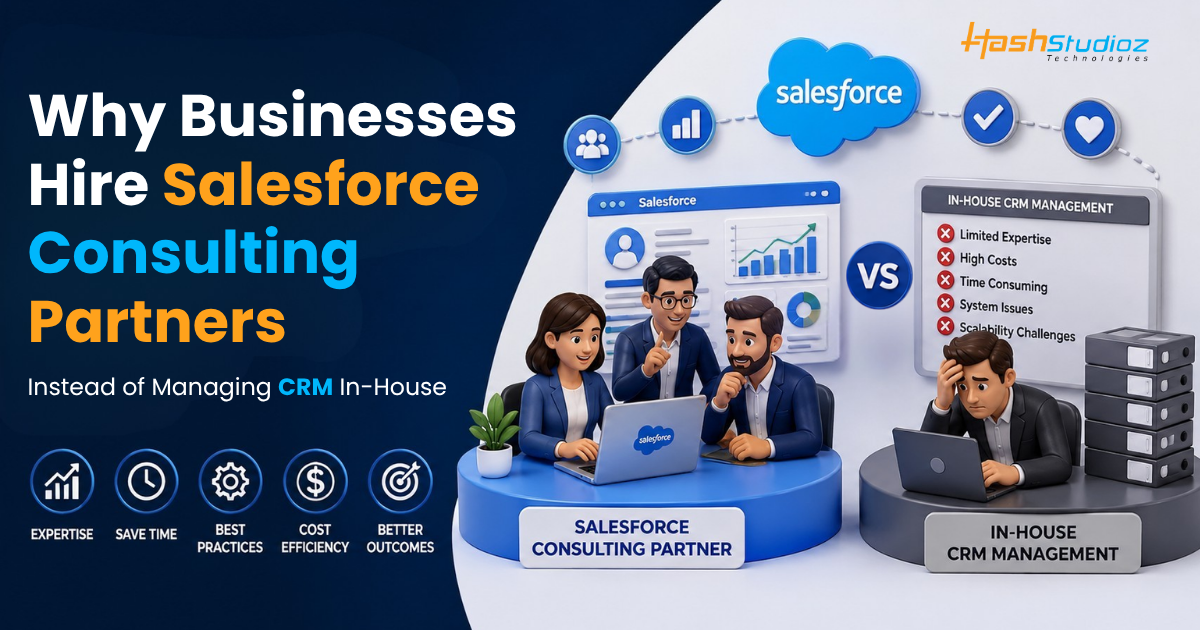
Choosing the right path for your Customer Relationship Management (CRM) system is a critical business choice. Many leaders face a tough decision when they buy Salesforce. They must choose between building an internal team or hiring external specialists.
The software offers vast potential, but it is highly complex. A poor setup can lead to major losses. Research by CIO Magazine shows that CRM project failure rates can reach up to 90%. Most of these failures occur because companies try to handle the setup alone.
Modern businesses rely on Salesforce Consulting to avoid these traps. Specialist firms provide deep platform knowledge that internal teams rarely possess. This explores why companies choose external Salesforce Consulting Services over managing the CRM in-house.
Table of Contents
The Hidden Complexity of the Salesforce Ecosystem
Salesforce started as a basic tool to track sales leads. It is now a massive, multi-cloud network powered by artificial intelligence and big data. The system includes specialized tools for sales, customer service, marketing, and e-commerce.
Each product uses its own architecture and code framework. A standard internal IT team cannot master all these separate areas. For instance, configuring Sales Cloud requires an understanding of sales pipeline pipelines. Setting up Marketing Cloud requires knowledge of digital data architecture and real-time triggers.
The platform also updates its system three times every year. These updates alter apex code, automation rules, and security permissions. Internal teams struggle just to maintain daily operations. They rarely have time to study these frequent technical changes.
External partners solve this issue. They employ dedicated specialists for each specific cloud product. This ensures your system uses the latest technical standards without stressing your internal staff.
Why Internal Teams Face Implementation Failures
Many leaders assume that their existing IT staff can manage a CRM deployment. This assumption often leads to major project delays. Software engineers are great at writing general code, but Salesforce requires precise, platform-specific knowledge.
1. The Problem of Over-Customization
In-house teams usually try to please every single business user. They build custom code for every minor feature request. This practice creates massive technical debt.
Too much custom code slows down page load times. It also breaks native system upgrades. Expert consultants know when to use standard features and when to write custom code. They protect the core system architecture from becoming messy and unmanageable.
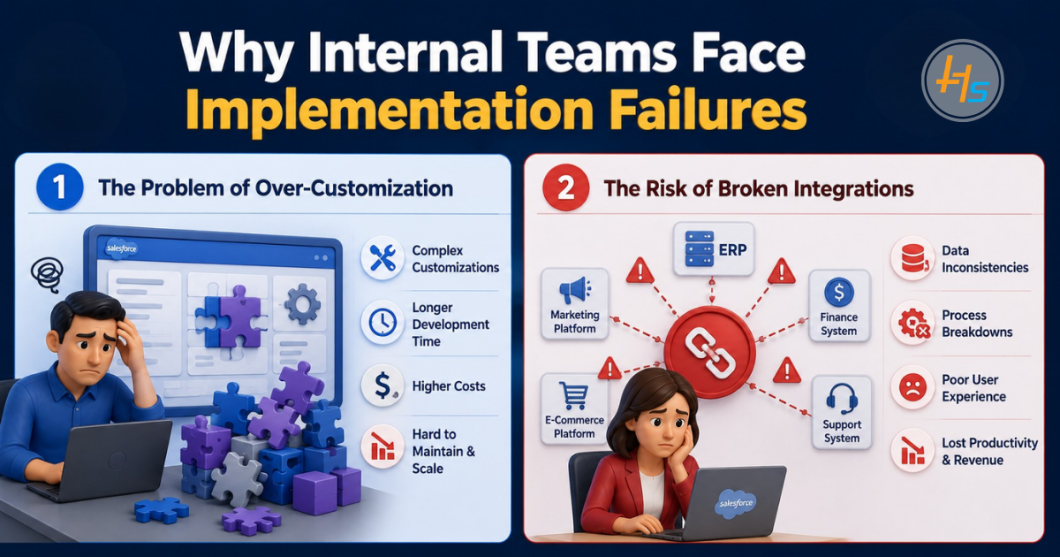
2. The Risk of Broken Integrations
Salesforce cannot sit alone in a digital silo. It must connect with your billing tools, ERP systems, and internal databases. A report by MuleSoft reveals that the average company uses 1,061 different applications. Shockingly, less than 30% of these applications connect with each other.
In-house teams often build weak point-to-point connections. These connections break whenever an application updates. Professional consulting services use stable, API-led frameworks to build secure data pipelines.
The True Cost of Building an In-House Salesforce Team
Managing a CRM system internally looks cheaper on paper, but the actual costs are incredibly high. Building an effective team requires several distinct, highly technical roles.
1. High Technical Salaries
You cannot run Salesforce with just one general IT worker. A basic in-house department requires multiple professionals:
- Salesforce Administrator: Manages user access, basic reports, and daily data updates.
- Salesforce Developer: Writes custom Apex code and builds Lightning Web Components.
- Technical Architect: Designs the overall system blueprint and maps data security.
The average salary for a certified technical architect exceeds $150,000 per year. Hiring this full team creates immense financial pressure.
2. Employee Turnover Risks
Salesforce professionals are in high demand across the globe. In-house experts frequently leave for higher-paying agency roles.
When an internal developer quits, your CRM progress stops completely. You lose critical knowledge about how your custom system was built. Hiring a consulting partner removes this human resource risk. The partner guarantees continuous support, even if individual engineers leave the project.
How Specialized Partners Maximize ROI
Companies do not buy CRM software just to store data. They invest to grow revenue, speed up sales, and improve customer satisfaction. External consultants know exactly how to turn software features into clear business profits.
| Business Goal | Partner Implementation Method | Measurable Outcome |
| Increase Sales Revenue | Automated lead scoring via AI tools | 25% to 32% gain in forecast accuracy |
| Reduce Manual Labour | Automated data workflows and API connections | Up to 80% fewer data input errors |
| Lower Support Costs | AI service bots for common queries | Up to 50% deflection of service requests |
Data from Nucleus Research shows that a properly configured CRM returns $8.71 for every single dollar spent. In-house teams rarely reach this financial milestone because they spend too much time fixing basic bugs. Consultants focus entirely on system value and business growth.
The Strategic Value of Specialized Salesforce Consulting
Hiring an external firm gives you access to years of cross-industry experience. A consultant has already solved the exact data issues your company is facing right now.
1. Access to Proven Blueprints
Internal teams usually design systems through trial and error. This approach wastes time and money.
Consultants bring pre-tested design blueprints to your project. They know which configurations work well for retail, manufacturing, or healthcare. This knowledge cuts down development time by months.
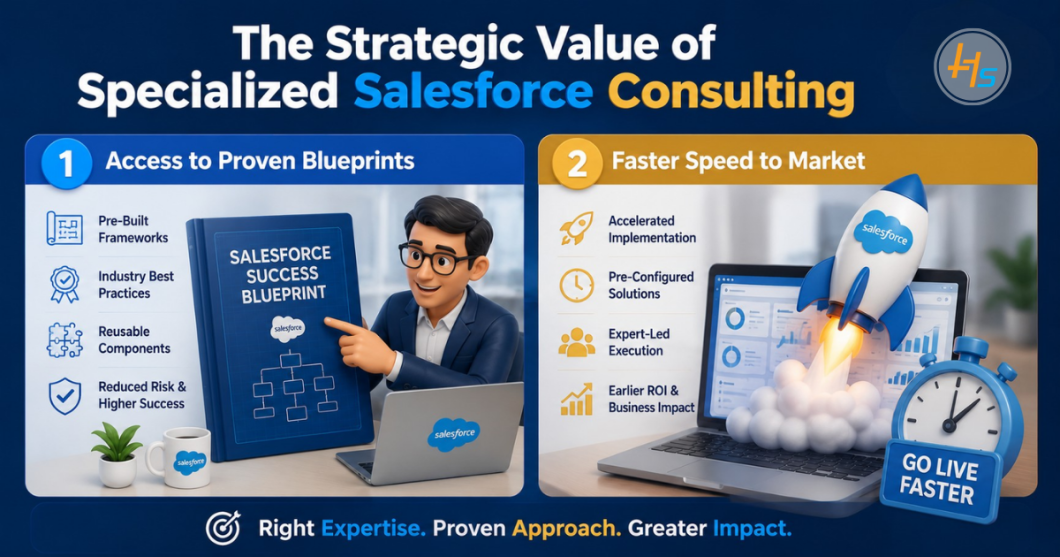
2. Faster Speed to Market
Building a CRM system from scratch takes a long time. Consulting firms maintain large libraries of pre-built code and integration templates. They do not need to invent new solutions for common problems. This existing library allows them to launch your system much faster than an internal team.
Overcoming User Resistance and Driving Software Adoption
A CRM system is completely useless if your employees refuse to use it. A study by Forrester shows that poor user adoption causes up to 70% of all CRM implementation failures.
Employees often hate new software because it feels complicated. In-house teams frequently build complex screens with dozens of confusing text fields. This heavy layout frustrates sales reps, driving them back to simple spreadsheets.
Salesforce Consulting Services include dedicated change management experts. These specialists interview your staff before building anything. They design clean user interfaces that show only relevant information.
Partners also build custom training programs for your teams. They create simple learning guides using tools like Salesforce Trailhead. This step ensures your staff feels confident using the new software on day one.
Advanced Technology Integration and AI Capabilities
The modern business landscape changes very fast. Companies now need advanced technologies like predictive artificial intelligence and real-time data analysis.
1. Deploying Agentic AI
Salesforce recently introduced Agentforce. This tool allows businesses to deploy autonomous AI agents that handle customer service tasks without human help.
According to the IBM Institute for Business Value, only 33% of corporate AI initiatives currently meet their ROI targets. Furthermore, 53% of business leaders cite poor data availability as their biggest barrier to AI adoption.
Consultants know how to prepare your system for AI. They clean your records, build proper data pipelines, and configure the Data Cloud. This preparation allows your autonomous agents to operate safely and effectively.
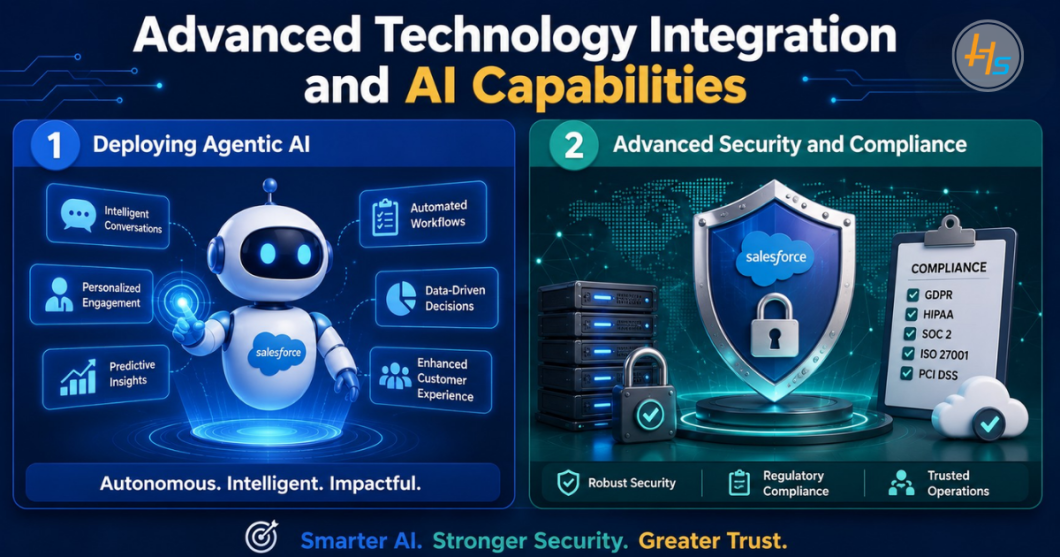
2. Advanced Security and Compliance
Data privacy laws are becoming more strict every year. Businesses must follow rigid rules like GDPR, CCPA, and HIPAA.
A single data leak can ruin a company’s reputation and cost millions in legal fines. Consulting partners understand complex Salesforce security models. They set up precise sharing rules, encryption protocols, and user permissions. This protects your customer data from both external hackers and internal misuse.
Key Questions to Ask Before Choosing Your Path
If you are still deciding between an in-house team and a partner, ask your leadership group these three basic questions:
- Do we have the internal skills to manage complex data integrations? If your customer data lives across multiple old databases, you need a partner to build secure APIs.
- Can we afford the ongoing costs of a full-time Salesforce team? Remember to calculate the costs of recruitment, employee benefits, and ongoing software training.
- How fast do we need this system to produce business results? If you need a fast setup to beat your competitors, hiring an expert partner is the quickest route.
Making the Right Decision for Your Business
Salesforce is a highly powerful tool that can transform your business operations. However, the software requires expert handling to deliver real financial value. Managing the system in-house often leads to messy customization, low user adoption, and broken integrations.
By utilizing professional Salesforce Consulting, businesses protect their technology investment. External partners bring specialized knowledge, proven design frameworks, and advanced AI skills to your project. This approach allows your internal IT staff to focus on your core business goals.
Hiring a consultant is not just an extra project expense. It is a smart strategic move that guarantees your CRM runs smoothly, scales efficiently, and drives continuous revenue growth.
Final Thoughts: The Path Forward
Choosing how to manage your CRM strategy is a defining moment for your business. While an in-house team offers a sense of direct control, the sheer technical depth of the modern Salesforce ecosystem makes self-management a high-risk gamble. The costs of hiring full-time specialists, coupled with the dangers of technical debt and broken integrations, frequently outweigh the perceived savings.
Partnering with a specialized firm removes these operational burdens. It shifts your focus away from fixing daily bugs and puts it back onto core business growth. Expert consultants provide the speed, security architecture, and AI readiness that internal teams rarely have the bandwidth to build.
Frequently Asked Questions (FAQs)
1. Why do businesses hire Salesforce consulting partners instead of managing CRM in-house?
Businesses hire Salesforce consulting partners because they offer specialized platform expertise, faster implementation, and better system management. Internal teams often lack deep knowledge of Salesforce architecture, integrations, and automation.
2. Is hiring Salesforce Consulting Services more cost-effective than building an in-house team?
Yes, in many cases. Building an in-house team requires hiring administrators, developers, and architects. This increases salary, training, and retention costs. Salesforce Consulting Services give businesses access to skilled professionals without long-term hiring expenses.
3. How do Salesforce consulting partners improve CRM performance?
Salesforce consulting partners improve CRM performance by setting up automation, reducing manual tasks, creating secure integrations, and improving data quality. They also help businesses use Salesforce features more effectively.
4. Can Salesforce consultants help with CRM integration?
Yes. Salesforce consultants connect CRM systems with ERP software, billing systems, marketing tools, and databases. They build secure API connections to improve data sharing across platforms.
5. How do Salesforce Consulting Services support long-term business growth?
Salesforce Consulting Services help businesses scale by improving system performance, supporting AI adoption, enhancing security, and increasing user adoption. This creates better customer experiences and supports revenue growth.