


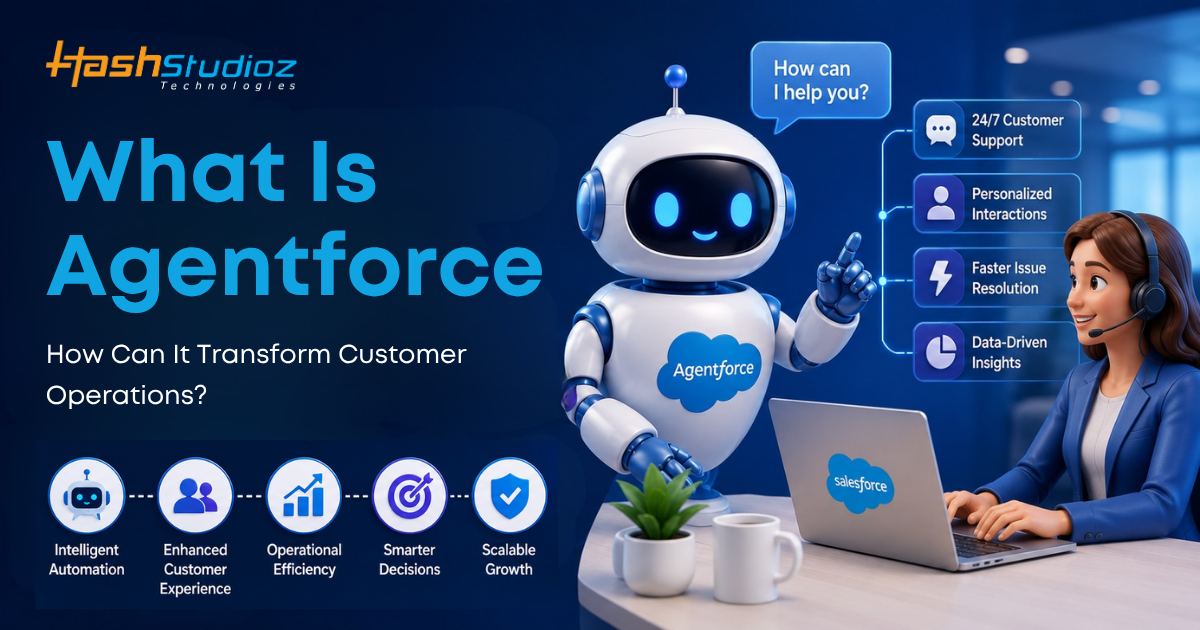
Customer expectations are rising faster than ever. Customers want instant responses, personalized experiences, and seamless support across every touchpoint. At the same time, businesses are under pressure to manage growing service volumes without increasing operational costs.
Traditional CRM automation and rule-based chatbots can handle simple tasks, but they often struggle with complex customer requests that require context, decision-making, and action. This challenge is driving demand for Agentforce Development Services, as organizations look to deploy intelligent AI agents that can automate customer operations more effectively.
Salesforce Agentforce introduces a new approach by enabling autonomous AI agents to understand requests, access real-time business data, and execute workflows independently. The result is faster service, improved efficiency, and a more scalable customer operations model.
Table of Contents
What Is Agentforce?
Agentforce is Salesforce’s autonomous AI agent platform that helps businesses automate customer operations, sales processes, and service workflows. Powered by advanced AI and real-time CRM data, Agentforce agents can understand requests, make decisions, and take action without relying on rigid, rule-based automation.
By working seamlessly across Salesforce and connected enterprise systems, Agentforce enables faster resolutions, greater efficiency, and more personalized customer experiences at scale.
Why Traditional Customer Operations Need an Upgrade
Legacy customer service frameworks are struggling under the weight of modern operational demands. According to Salesforce’s 2026 research, 70% of organizations using AI service agents are already seeing measurable business benefits, with customer satisfaction emerging as the most improved performance metric.
The root causes of these operational strains include:
- Manual Processes: Human agents spend hours daily on repetitive support tasks like updating records, resetting credentials, or verifying order details.
- Slow Response Times: When spikes in ticket volumes occur, backlogs grow, directly leading to lower customer satisfaction (CSAT) scores.
- Data Silos: Vital customer information remains trapped across isolated platforms, preventing front-line representatives from obtaining a comprehensive, unified view of the customer.
- Operational Inefficiencies: Traditional automation frequently fails when customer inputs deviate even slightly from predefined scripts, routing the case back to a human queue and increasing total cost-to-resolution.
How Agentforce Works
To understand how Agentforce achieves autonomous execution, it helps to examine its core structural framework. The system operates across four primary operational layers, running seamlessly from initial data ingestion to final execution or human handoff.
1. Data Layer
Everything starts with data. Agentforce leverages Salesforce Data Cloud to harmonize structured and unstructured information across the entire corporate ecosystem. This means an AI agent possesses real-time visibility into past purchase records, active support cases, web interactions, and external ERP data, grounding every interaction in a secure, unified truth.
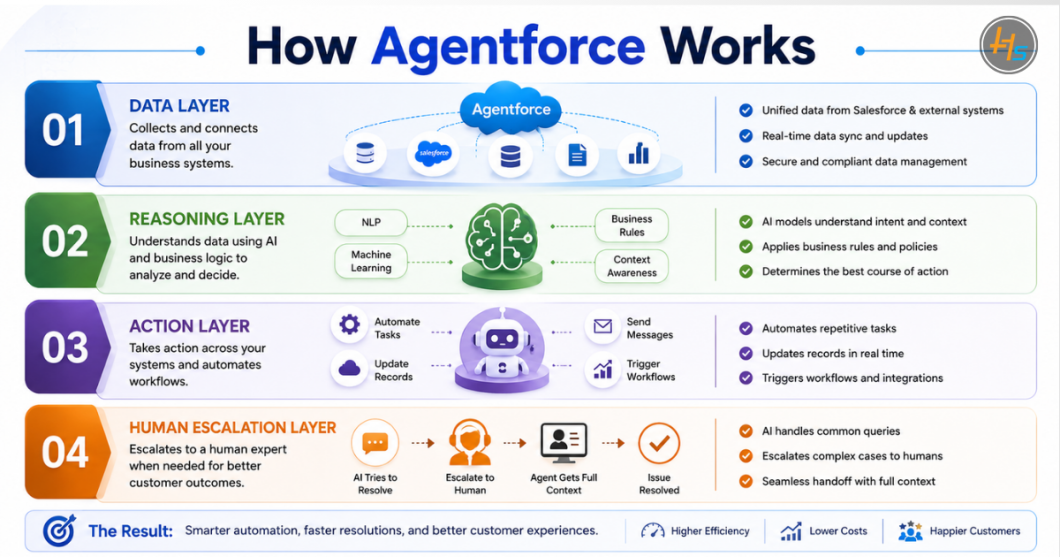
2. Reasoning Layer
The reasoning layer acts as the primary cognitive engine. When a customer submits a request via email, chat, or SMS, the agent uses its semantic understanding to identify intent. Instead of matching keywords to pre-written answers, it evaluates the customer’s unique situation, determines what information is missing, and maps out a logical sequence of actions to fulfill the goal.
3. Action Layer
Once a path forward is determined, the agent moves to the action layer. Rather than simply writing a text response, it actively invokes background tools. It can trigger a Salesforce Flow, execute an Apex script, or communicate with third-party software using MuleSoft APIs. This allows it to process refunds, update shipping addresses, or schedule service appointments directly.
4. Human Escalation Layer
Agentforce is built to collaborate with human teams, not isolate them. If an interaction becomes highly emotional, requires complex policy exceptions, or exceeds the agent’s authorized guardrails, it executes a clean, context-rich handoff to a human representative. The human worker receives the full conversation history, a concise summary of steps taken, and recommendations for next steps, eliminating any friction for the customer.
Key Ways Agentforce Transforms Customer Operations
Implementing Salesforce Agentforce unlocks a wide range of operational advantages across enterprise service environments.
1. 24/7 Intelligent Customer Support
Customer service inquiries do not stop at the end of the business day. Agentforce provides continuous, round-the-clock availability, resolving complex inquiries at 2:00 AM with the same accuracy and personalization as during peak business hours.
2. Faster Case Resolution
By handling data retrieval and workflow execution autonomously, these agents dramatically reduce Average Handle Time (AHT) and First Contact Resolution (FCR) rates. Routine issues that previously spent hours sitting in a human queue are settled in seconds.
3. Personalized Customer Experiences
Because the agents are natively tied to Salesforce CRM data, every response is deeply contextualized. They recognize customer loyalty tiers, reference past historical issues, and adapt their tone to deliver tailored AI-powered customer support.
4. Automated Workflow Execution
Agentforce does more than just talk; it drives customer operations automation. It handles multi-system tasks such as processing product returns, issuing service credits, and updating contract records completely behind the scenes.
5. Improved Agent Productivity
By offloading high-volume, low-complexity cases to autonomous systems, human service representatives can step away from repetitive data entry. This frees them to focus on high-value client accounts, strategic relationship management, and sophisticated troubleshooting.
6. Proactive Customer Engagement
Instead of waiting for an issue to turn into an incoming support ticket, Agentforce can identify anomalies such as an unfulfilled order delay or a failing device telemetry log—and reach out to the customer with solutions before they even notice a problem.
7. Consistent Omnichannel Experiences
Whether a customer chooses to reach out via WhatsApp, web chat, email, or a self-service portal, Agentforce maintains a single, cohesive memory of the interaction, preventing customers from ever needing to repeat themselves.
Real-World Success Story: Salesforce’s Own Agentforce Implementation
To illustrate the practical value of this technology, let’s explore how various industries leverage autonomous AI agents for CRM transformation.
Challenge: Salesforce needed to handle over 30,000 weekly customer conversations while maintaining high customer satisfaction scores.
Agentforce Solution: Deployed Agentforce AI service agents to autonomously resolve customer queries about orders, shipping, billing, and technical support across multiple channels.
Business Outcome:
• 85% of customer queries now resolved autonomously
• Agentforce manages 30,000+ weekly conversations
• Freeing human agents to focus on complex escalation cases
Additional Real-World Results from Other Companies:
Food Delivery Provider (Europe):
• 60% reduction in average wait times during peak ordering periods
• Automated standardized inquiries about delivery status and returns
reMarkable (Tech Company):
• 35% automation of contact volumes
• 7,350 fewer queries per month handled by humans
Healthcare Provider:
• Automated initial patient triage for appointment requests
• Agent checks for critical conditions, escalates to nurse when needed
Electronics Retailer:
• Reduced cart abandonment through proactive product recommendations
• Increased average order value via complementary product suggestions
Agentforce vs. Traditional CRM Automation
Understanding the shift to agentic AI requires evaluating how Agentforce compares directly against legacy workflows and standard chatbot configurations.
| Feature / Capability | Traditional CRM Automation | Agentforce AI Agents |
| Decision-making | Strictly follows hard-coded if-then logic paths. | Evaluates situations using LLM reasoning models. |
| Context awareness | Resets with each new session or single message. | Retains deep, multi-turn conversational history. |
| Workflow execution | Requires manual human triggers or fixed inputs. | Orchestrates and invokes backend flows independently. |
| Personalization | Limited to basic merge tags (e.g., first name). | Tailors responses dynamically based on user history. |
| Support capabilities | Limited to keyword matching and link sharing. | Solves unstructured, multi-part customer problems. |
| Scalability | Demands extensive script rebuilding for new rules. | Scales automatically across languages and channels. |
Challenges Businesses Face During Agentforce Adoption
While the potential returns are immense, executing a successful Agentforce implementation requires navigating several technical and organizational hurdles.
- Data Quality Issues: If your underlying Salesforce data is fragmented, inaccurate, or outdated, your autonomous agents will struggle to perform correctly. Mitigation: Clean up your records, consolidate fields, and build a unified data foundation using Salesforce Data Cloud before launching your agents.
- Security Concerns: Enterprises cannot risk exposing sensitive customer data or intellectual property through public AI channels. Mitigation: Leverage the built-in Salesforce Einstein Trust Layer to mask personally identifiable information (PII) and enforce strict role-based access controls.
- Governance & Compliance: Giving AI platforms the authority to take actions inside enterprise systems requires strict oversight. Mitigation: Set explicit operational limits, define spending caps, and require human sign-off for high-risk actions.
- Integration Complexity: Connecting agents to older, on-premise systems can occasionally cause workflow friction. Mitigation: Use MuleSoft APIs to standardize and secure integrations between Salesforce and external platforms.
- User Adoption: Internal teams may worry about job security or resist relying on automated systems. Mitigation: Position AI agents as helpers designed to handle tedious tasks, and run comprehensive training programs to show employees how to use them effectively.
Why Businesses Need Professional Agentforce Development Services
Successful Agentforce implementation requires more than enabling AI agents. It demands the right strategy, data architecture, integrations, and governance framework. Professional Agentforce Development Services help businesses design intelligent workflows, connect enterprise systems, and ensure secure, reliable performance.
By partnering with experienced experts, organizations can build custom AI agents tailored to their operational needs, maximize automation opportunities, and achieve faster returns on their Salesforce investment.
How HashStudioz Helps Businesses Implement Agentforce
HashStudioz helps businesses unlock the full potential of Agentforce with end-to-end implementation and customization services. Our Salesforce and AI experts design, integrate, and optimize autonomous agents that align with your business goals and operational workflows.
From strategy and system integration to deployment and ongoing optimization, we ensure a secure, scalable, and results-driven Agentforce implementation. Whether you want to enhance customer service, automate business processes, or improve operational efficiency, HashStudioz delivers solutions tailored to your needs.
Ready to transform customer operations with AI-powered automation? Explore our Agentforce Development Services and discover how HashStudioz can help accelerate your digital transformation journey.
Conclusion
The future of customer operations relies on scalable, intelligent automation. As handling workloads manually becomes increasingly unsustainable, shifting toward autonomous AI platforms is no longer optional—it is a vital step for staying competitive.
By integrating autonomous agents directly into your CRM, your business can resolve routine tickets instantly, streamline complex backend workflows, and empower human teams to focus on high-value client relationships. Partnering with proven experts ensures you navigate data cleanup, security configuration, and API connections smoothly, allowing you to maximize your technology investment.
Take the next step in transforming your customer operations. Contact HashStudioz today to learn how our specialized development services can help you design, deploy, and scale Agentforce to drive long-term business growth.
Frequently Asked Questions
1. What is Salesforce Agentforce?
Salesforce Agentforce is an enterprise AI platform that lets businesses build and manage autonomous agents within their CRM. Using advanced reasoning, these agents understand natural language, pull real-time insights from Salesforce Data Cloud, and execute multi-step workflows to resolve customer and sales needs without constant human oversight.
2. How is Agentforce different from chatbots?
Traditional chatbots rely on rigid, pre-programmed decision trees and only match specific keywords to generic answers. In contrast, Agentforce agents use large language models to understand conversational context, build execution plans on the fly, and interact with backend APIs to complete complex tasks autonomously.
3. Can Agentforce automate customer support?
Yes, Agentforce excels at customer operations automation. It independently handles high-volume tasks like processing refunds, updating order statuses, tracking shipments, and scheduling appointments. If a case requires a policy exception or becomes too complex, the agent executes a smooth, context-rich handoff to a human team member.
4. What industries benefit most from Agentforce?
Any industry managing high volumes of customer interactions or complex workflows can benefit from Agentforce. It delivers high value across retail, e-commerce, financial services, healthcare, manufacturing, and technology sectors by cutting operational costs, speeding up case resolutions, and removing data bottlenecks.
5. How long does Agentforce implementation take?
A basic Agentforce implementation can take anywhere from a few weeks to a couple of months. The timeline depends on your underlying data quality, the complexity of your business workflows, and how many external legacy systems you need to connect via APIs.