


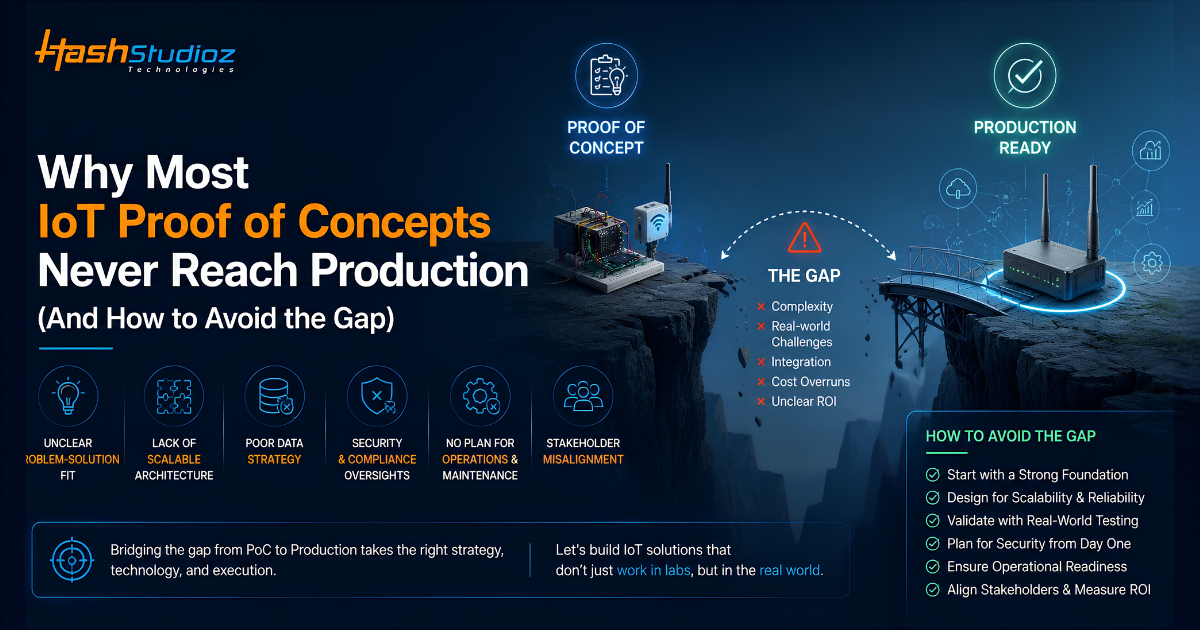
The global market for connected devices is growing rapidly. By the close of 2025, active IoT endpoints reached 21.1 billion globally, according to IoT Analytics. Enterprise investments reflect this growth, as companies seek data-driven visibility. Yet, a stark boundary lies between testing a concept and deploying it across an enterprise.
Industry data from McKinsey shows that roughly 80% of industrial IoT initiatives never progress beyond the pilot phase. Organizations build initial working models, only to find the solution stalls before wide deployment. This is one reason many businesses turn to an experienced IoT Development Company to address technical, operational, and scalability challenges early in the process.
The transition from a small-scale test to an enterprise system reveals hidden technical, financial, and organizational barriers. Moving forward requires understanding why this boundary exists and how to design systems that survive real-world operational demands.
Table of Contents
The IoT Production Gap Explained
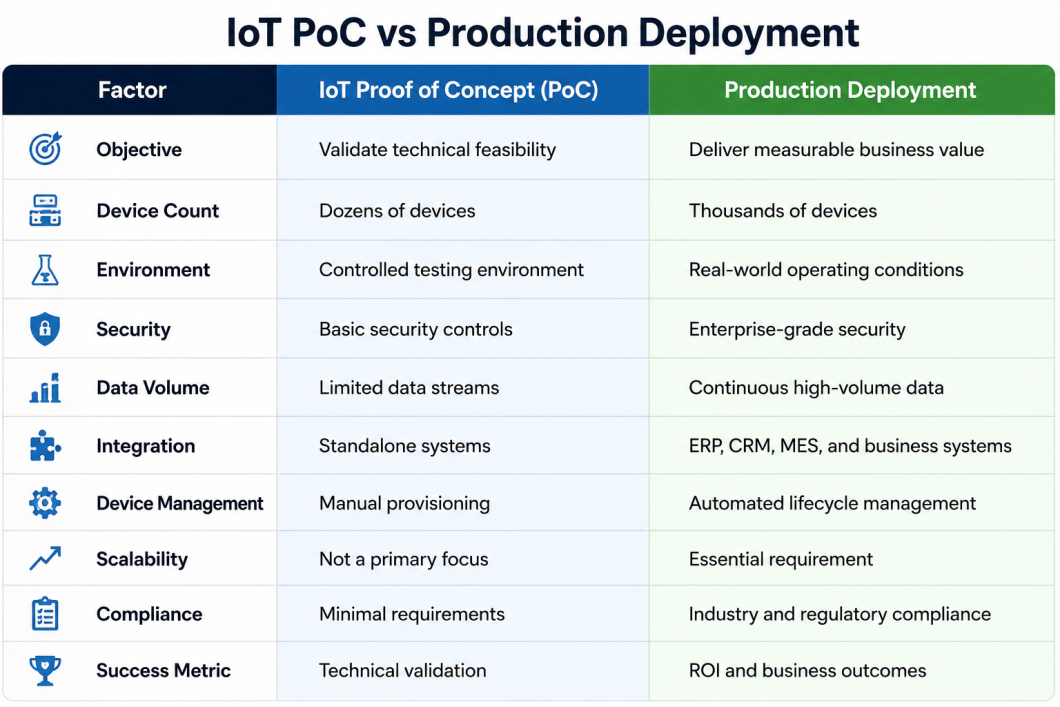
An IoT Proof of Concept (PoC) is a small-scale, short-term exercise designed to validate a basic technical hypothesis. Its main goal is to prove that a specific device can collect data and transmit it to a central endpoint under ideal conditions. A PoC operates in a controlled environment, often using a small group of devices, a single network protocol, and manually provisioned configurations.
In contrast, production deployment is the fully scaled, permanent implementation of that technology across an enterprise operational footprint. Production systems must run continuously, handle variable network conditions, process massive data volumes, and integrate into legacy IT ecosystems while maintaining strict security compliance.
The production gap is the systemic failure to design the initial pilot with these enterprise realities in mind. A solution that functions on a laboratory bench often fails when exposed to industrial power fluctuations, multi-tenant network environments, and continuous data streams. Bridging this gap requires shifting focus from basic functional validation to long-term architectural endurance.
Why Most IoT Proof of Concepts Fail to Reach Production
The collapse of an IoT project during expansion is rarely caused by a single component failure. Instead, it stems from design omissions and operational friction.
Lack of Clear Business Objectives
Many IoT pilots begin as technology experiments rather than business initiatives. Teams focus on connectivity but fail to define measurable goals. Without clear KPIs, such as reduced downtime or improved asset tracking, it becomes difficult to prove business value. According to IDC, 31% of IoT projects delivered minimal returns due to poor alignment with business objectives. As a result, many projects lose support before deployment.
Scalability Is Ignored During PoC
A solution that works for twenty devices may fail at twenty thousand. During a PoC, teams often prioritize speed over scalability. As deployments grow, data volumes increase, and system performance declines. According to Gartner, IoT’s unique volume, variety, and velocity characteristics present significant scalability and integration challenges, often requiring architectural realignment for enterprise deployments. Without planning for growth, production deployment becomes difficult.
Poor Device Management Planning
Managing a few devices manually is simple. Managing thousands across multiple locations is not. Many PoCs overlook automated provisioning, monitoring, and firmware updates. As deployments expand, operational complexity rises, and maintenance costs increase. This often delays or halts production rollouts.
Security Is Added Too Late
Many IoT pilots treat security as a later-stage requirement. Teams may use hardcoded credentials or unencrypted communication to speed up development. However, security gaps become much harder to fix at scale. Forescout’s 2024 research found IoT vulnerabilities increased 136% since 2023, with 33% of IoT devices analyzed containing vulnerabilities. Organizations rarely approve production deployments with unresolved security risks.
Data Integration Challenges
IoT data delivers value only when it connects with business systems. During a PoC, teams often rely on standalone dashboards. Production deployments require integration with ERP, CRM, and other enterprise platforms. Legacy systems, data silos, and incompatible protocols often create major roadblocks during expansion.
Connectivity Problems in Real Environments
A laboratory environment features stable, high-bandwidth Wi-Fi. A production environment, such as a deep underground mine, a sprawling concrete manufacturing plant, or a moving logistics fleet, does not. PoCs regularly fail to plan for intermittent connectivity, packet loss, and localized network constraints. When a simple device encounters a real-world network drop, it may experience buffer overflows, data loss, or continuous reboot cycles. Without edge processing capabilities to store and forward data locally, the system collapses under real-world environmental stress.
Cost Estimates Change During Expansion
The financial model of a prototype is deceptively low. Component costs for a few devices are minimal, and cloud data ingestion fees stay well within promotional tiers. However, scaling introduces non-linear cost multipliers. Expenses for industrial-grade hardware housing, cellular data subscriptions, edge computing infrastructure, and long-term cloud storage accumulate quickly. Microsoft enterprise surveys indicate that nearly one-third (32%) of organizations cite high scaling costs as the primary barrier for IoT project failures at the pilot stage. Organizations find that the business case is valid at twenty units but becomes financially unviable at thousands of units.
Regulatory and Compliance Requirements
Local test environments rarely trigger compliance reviews. Real-world enterprise deployments, however, must adhere to strict regulatory standards, such as GDPR for data privacy, HIPAA for healthcare infrastructure, or localized industrial safety mandates. Industrial IoT applications face rigid compliance demands; for instance, 2026 manufacturing data highlights that emergency and incident management applications hold nearly a quarter of the software market share due to workplace safety regulations.
Lack of Cross-Functional Collaboration
IoT initiatives require cooperation across three distinct corporate domains: Operational Technology (OT) engineers who manage physical machinery, Information Technology (IT) teams responsible for network infrastructure, and executive business leaders. Many failed pilots are driven entirely by a single group in isolation. If the OT team builds a connected solution without consulting IT, the project will eventually be blocked by IT security policies. Successful deployment requires a structured organizational framework where all three business units participate from day one.
Choosing Technology Without Long-Term Planning
When teams prioritize speed over long-term stability, they often build on niche IoT platforms or bind their software tightly to proprietary cloud vendor ecosystems. This creates severe technical debt and vendor lock-in. If the chosen platform provider changes its pricing structure, alters its API architecture, or goes out of business, the enterprise faces a costly, complex system rewrite. Selecting core technical components based on short-term convenience rather than open, interoperable industry standards introduces long-term operational risks.
Signs Your IoT Project May Not Scale
Recognizing issues early can prevent costly delays and failed deployments. The following warning signs often indicate that an IoT project is not ready for production:
- Device onboarding requires manual setup and configuration.
- Firmware updates cannot be deployed remotely.
- Data remains isolated in standalone dashboards.
- Multiple devices share the same credentials or access keys.
- Devices stop functioning when network connectivity is lost.
- The platform struggles to handle increasing data volumes and device counts.
How to Move From PoC to Production Successfully
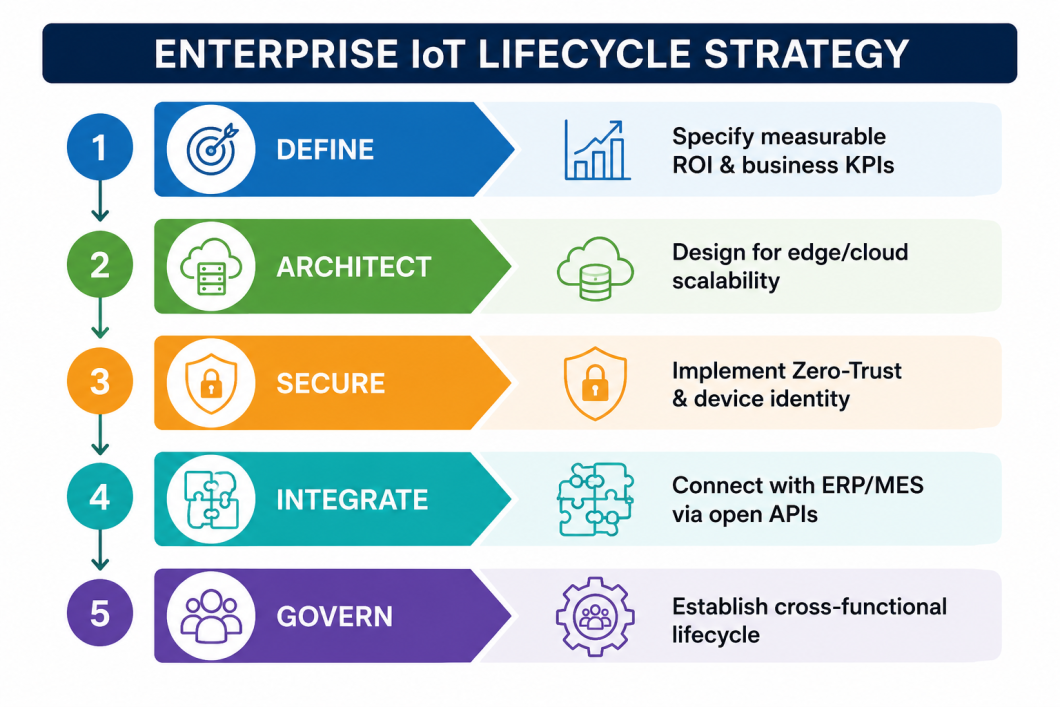
Overcoming the production gap requires a structured approach that prioritizes long-term scalability and business integration from the very beginning of the project planning phase.
Define Measurable Business Outcomes
Before purchasing any hardware or writing software code, establish clear operational success metrics. Work directly with business leaders to determine exactly what problems the technology will solve. Frame the project around specific deliverables, such as a 12% reduction in maintenance costs or an automated 15-minute improvement in supply chain asset tracking. These explicit goals guide architectural decisions and provide unambiguous proof of value to executive stakeholders when requesting expansion funding.
Design for Scale From Day One
Assume from the start that the system will eventually support tens of thousands of concurrent devices. Replace rigid, monolithic code structures with modern, event-driven architecture. Utilize microservices and distributed messaging queues (such as MQTT or Kafka) to decouple device data ingestion from downstream analytical applications. This modularity ensures that a sudden surge in edge network traffic will not cause a complete system outage or slow down user interfaces.
Build Security Into Architecture
Adopt a zero-trust model across the entire IoT solution development cycle. Every connected device must possess a unique, hardware-backed identity certificate generated by a secure enclave or trusted platform module (TPM). Ensure all data is encrypted both while moving across networks and while sitting in databases. Enforce strict mutual authentication protocols between edge hardware and cloud endpoints, making security a baseline architectural requirement rather than a future add-on.
Establish Device Lifecycle Management
Plan for automated, large-scale device operations from the start. Choose an enterprise-grade device management platform that supports zero-touch provisioning, allowing remote hardware to register securely the moment it powers on. Build and thoroughly test a robust, secure OTA firmware update process. The update mechanism must include automated fail-safe recovery protocols, ensuring that if a remote update is interrupted by a network failure, the device safely rolls back to its last working software state.
Create a Data Strategy
Look beyond basic data collection dashboards and establish an integrated enterprise data management plan. Use edge computing architectures to process, filter, and clean raw sensor data locally on the device or gateway. This localized handling reduces network bandwidth demands and cloud storage costs by transmitting only meaningful anomalies or summarized metrics to central servers. Ensure all stored data utilizes open, standardized formats that integrate easily into core enterprise resource planning (ERP) systems via secure APIs.
Conduct Pilot Testing
Before launching a wide deployment, transition from a laboratory PoC to a multi-stage pilot test in a live operational environment. Deploy a mid-sized group of devices into actual working facilities for several months. Use this phase to deliberately test how the system responds to real-world operational challenges, including ambient temperature swings, industrial electromagnetic interference, patchy cellular coverage, and daily physical wear.
Develop Governance Frameworks
Create a clear, structured management framework that defines ownership across the entire lifecycle of the deployed technology. Establish explicit protocols determining which teams handle physical hardware maintenance, which engineers manage network connectivity, and who oversees cloud data security. Bring IT, OT, and business compliance officers together into a unified operational group to ensure the project continuously respects corporate security and regulatory boundaries.
Partner with Experienced Vendors
Avoid trying to build every single layer of an enterprise IoT ecosystem in-house from scratch. Designing custom hardware, embedded firmware, scalable cloud networks, and deep enterprise data integrations requires a broad range of highly specialized technical skills. Partner with an experienced IoT development company to leverage proven architectural frameworks, avoid common deployment mistakes, and significantly speed up your path to market.
Hidden Challenges Companies Discover After a Successful PoC
A successful proof of concept does not guarantee a successful deployment. Many organizations encounter new challenges only after they begin scaling their IoT initiatives across locations, teams, and devices.
Hardware Maintenance Costs Increase Fast
Managing a handful of devices is relatively simple. However, large deployments require ongoing maintenance, sensor calibration, battery replacements, and hardware repairs. These costs often exceed initial expectations and affect long-term project viability.
Vendor Lock-In Creates Long-Term Risk
Many PoCs rely on proprietary platforms or cloud services to accelerate development. While this approach speeds up testing, it can limit flexibility later. Migrating data, applications, or devices to another platform may require significant time and investment.
Data Ownership Becomes a Business Issue
As IoT deployments grow, organizations collect large volumes of operational data. Questions around data ownership, storage locations, access rights, and compliance requirements become increasingly important. Without clear policies, these issues can slow deployment plans.
Supply Chain Delays Impact Expansion
Scaling an IoT solution often depends on the availability of sensors, gateways, and communication modules. Hardware shortages, certification requirements, and supplier delays can extend deployment timelines and increase costs.
Why Partnering With an IoT Development Company Matters
Enterprise IoT success requires deep expertise across multiple distinct engineering disciplines. A specialized IoT development company bridges these technical gaps by providing cross-functional engineering teams who understand how hardware, software, networks, and enterprise data repositories interact at scale.
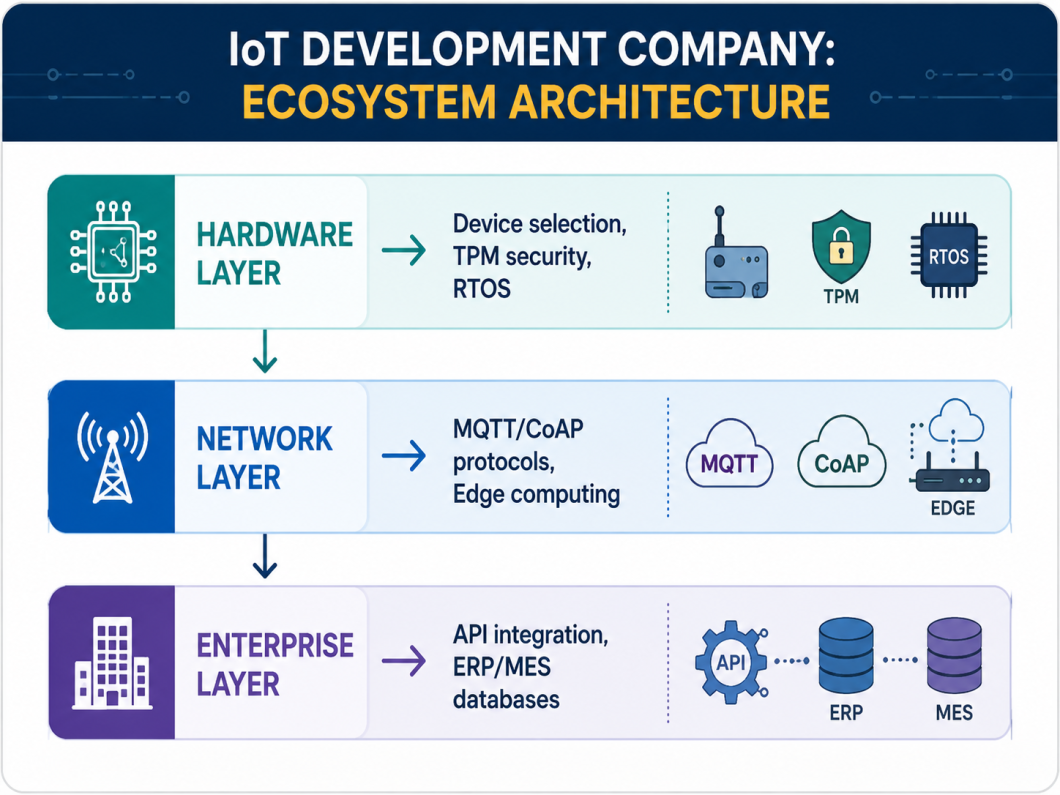
When scaling an enterprise ecosystem, professional IoT development services provide essential advantages across key areas of system design:
- Architecture Planning: Replacing brittle, single-server systems with cloud-native microservices and distributed messaging infrastructure built specifically for high-velocity streaming data.
- Device Ecosystem Selection: Navigating complex hardware supply chains to select appropriate industrial-grade sensors, gateways, and edge processors that match your precise operational environment.
- Security Implementation: Setting up robust, hardware-backed device identities, end-to-end encryption pipelines, and secure zero-trust network authentication protocols.
- Integration Expertise: Building reliable enterprise-grade APIs to break down data silos and sync real-world sensor telemetry directly into legacy ERP, CRM, and MES systems.
- Scalability Planning: Implementing smart hybrid architectures and edge computing strategies to process data locally, minimizing network bandwidth strain and cloud storage costs.
- Long-Term Maintenance: Delivering proven frameworks for automated over-the-air firmware updates, proactive device health monitoring, and long-term technical support.
By working with an established partner, enterprise technology leaders can shift their internal focus away from solving basic connectivity bugs and toward driving core operational value.
Conclusion
The high failure rate of IoT proofs of concept is not a reflection of flaws in connected technology itself. Instead, it highlights a common business mistake: treating an enterprise-wide integration project as a simple hardware experiment. Bridging the production gap requires moving away from short-term prototypes and focusing completely on long-term scalability, data integration, and zero-trust security from day one.
Successfully scaling a connected network requires deep technical experience and disciplined cross-functional planning. Enterprise leaders can de-risk their digital investments by collaborating with a proven IoT development company. This partnership ensures that early technical validations can successfully expand into durable, enterprise-scale production systems that deliver measurable business returns.
FAQs
1. How can companies successfully scale an IoT proof of concept?
Companies can scale an IoT proof of concept by defining measurable business objectives, designing for scalability from the start, implementing strong security controls, automating device management, and integrating IoT data with existing business systems. Pilot testing in real-world environments also improves deployment success.
2. What is the difference between an IoT proof of concept and a production deployment?
An IoT proof of concept is a small-scale project that tests whether an idea works. A production deployment is a fully operational solution that supports large numbers of devices, integrates with enterprise systems, maintains security standards, and delivers measurable business value over time.
3. What is IoT prototyping?
IoT prototyping is the process of building an early version of an IoT solution to test its functionality and feasibility. It allows businesses to validate device connectivity, data collection, communication protocols, and user requirements before investing in large-scale development. A successful prototype helps reduce risks before production deployment.
4. Why do most IoT proof of concepts fail to reach production?
Most IoT proof of concepts fail because they focus on technical validation rather than deployment readiness. Common challenges include unclear business objectives, poor scalability planning, security vulnerabilities, data integration issues, and rising operational costs. These factors often emerge when organizations attempt to scale beyond the pilot stage.
5. Which company is best for IoT development?
The best IoT development company depends on your project requirements, industry, and deployment goals. Businesses should look for expertise in hardware integration, cloud connectivity, security, data analytics, and large-scale deployment. Companies such as HashStudioz Technologies offer end-to-end IoT development services, including consulting, prototyping, firmware development, cloud integration, and enterprise IoT solutions across industries.