


Enterprise IoT deployments continue to grow rapidly, with global connected devices expected to reach approximately 21.9 billion by 2026. According to McKinsey, IoT could generate up to $12.5 trillion in economic value annually by 2030, making efficient device communication a critical factor in enterprise success. As organizations expand connected ecosystems across manufacturing, logistics, healthcare, and smart infrastructure, selecting the right communication protocol has become a key architectural decision.
For enterprise IoT deployments, the choice often comes down to MQTT, HTTP, and CoAP. Each protocol serves a different purpose. MQTT supports lightweight, real-time messaging between devices and cloud platforms. HTTP remains the standard for web-based integrations and APIs, while CoAP is designed for constrained devices operating on low-power networks. Choosing the wrong protocol can increase bandwidth consumption, introduce latency, reduce battery life, and create scalability challenges across large device fleets.
This article compares MQTT, HTTP, and CoAP from an enterprise perspective, examining their architecture, communication models, performance characteristics, security considerations, and ideal use cases. By the end, organizations will have a clearer understanding of which protocol best aligns with their technical requirements and business objectives.
Table of Contents
What Are IoT Communication Protocols?
IoT communication protocols are sets of rules that govern how connected devices exchange data over a network. Without these standardized rules, heterogeneous systems cannot parse payloads or maintain connections. In large enterprises, devices must communicate across different networks, firewalls, and cloud environments safely. Standardized protocols ensure data integrity, packet delivery, and efficient resource usage.
Common Challenges in Enterprise IoT Systems
Designing a robust network requires engineers to solve several complex challenges:
- Network Reliability: Remote assets often operate on unstable cellular or satellite networks.
- Device Constraints: Microcontrollers frequently have limited RAM, flash memory, and processing speed.
- Latency: Real-time industrial automation requires sub-second data transmission.
- Security: Unencrypted data channels invite cyber threats and operational espionage.
- Power Consumption: Battery-operated sensors must survive for up to a decade without maintenance.
What Is MQTT?
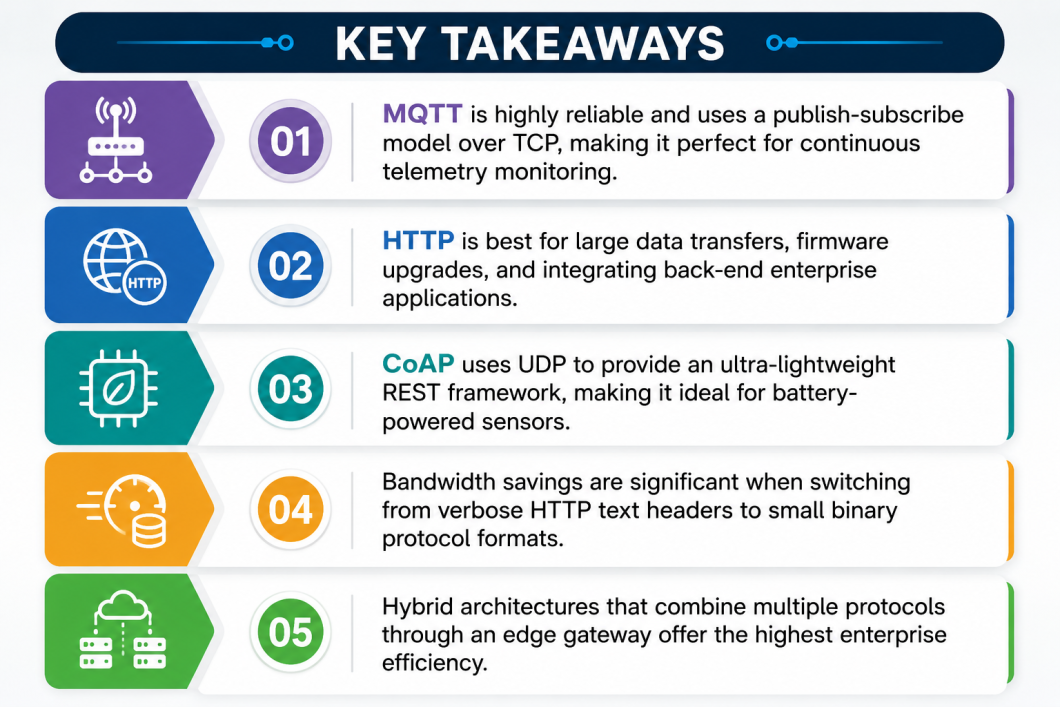
MQTT (Message Queuing Telemetry Transport) is a lightweight, open-source publish-subscribe messaging protocol. It operates over TCP/IP and is designed for constrained devices and low-bandwidth, high-latency, or unreliable networks.
How MQTT Works
The MQTT protocol in IoT relies on a central broker to manage message distribution. Devices do not communicate with each other directly. Instead, clients publish messages to specific topics hosted on the broker. Other clients subscribe to those topics to receive the data. This architecture completely decouples the message producer from the consumer.
Key Features of MQTT
- Publish-Subscribe Model: Enables one-to-many message broadcasting.
EMQX - Small Protocol Header: Uses a minimum fixed header size of just 2 bytes.
- Persistent Sessions: Brokers can store missed messages for offline clients.
- Three QoS Levels: Offers QoS 0 (at most once), QoS 1 (at least once), and QoS 2 (exactly once).
Advantages of MQTT
MQTT provides exceptional reliability on unstable networks. Because it runs over TCP, the transport layer guarantees packet delivery. The protocol keeps connection overhead low after the initial handshake. Recent developer surveys show MQTT adoption has reached 56% in industrial settings.
Limitations of MQTT
MQTT requires a continuous, persistent TCP connection. This requirement forces devices to send regular keep-alive background packets. For devices that wake up rarely, keeping a socket open drains battery power. It also lacks native discovery mechanisms for topics.
Best MQTT Use Cases
- Smart Manufacturing: Tracking factory floor telemetry through centralized brokers.
- Fleet Tracking: Monitoring moving delivery trucks over fluctuating cellular networks.
- Asset Monitoring: Sending continuous diagnostic data from remote oil pipelines.
- Predictive Maintenance: Streaming vibration data from heavy machinery to cloud platforms.
What Is HTTP?
HTTP (Hypertext Transfer Protocol) is an application-layer request-response protocol used across the Internet. In IoT, it allows devices to communicate directly with web servers and cloud APIs using standard web methods like GET and POST.
How HTTP Works
The HTTP protocol for IoT follows a strict client-server model. The IoT device acts as a client. It opens a TCP connection, sends a formal request, receives a response from the server, and closes the connection.
Key Features of HTTP
- Stateless Architecture: Each request contains all the information needed to process it.
- Rich Header Metadata: Supports complex authentication, caching rules, and content types.
- Widespread Compatibility: Works natively with standard web servers, firewalls, and proxy systems.
- Extensive Tooling: Leverages mature libraries available in almost every programming language.
- Small Protocol Header: MQTT uses a compact 2-byte fixed header, which helps keep message overhead low.
- Three QoS Levels: MQTT offers three QoS levels: QoS 0 for best-effort delivery, QoS 1 for delivery with possible duplicates, and QoS 2 for exactly-once delivery.
Advantages of HTTP
HTTP is incredibly familiar to software engineers. It integrates perfectly with standard cloud platform APIs and enterprise web applications. It simplifies large data payloads, such as binary firmware images, by utilizing chunked transfer encoding.
Limitations of HTTP
HTTP headers are text-based and verbose, often exceeding 700 bytes per request. Sending a 2-byte sensor value wrapped in a massive HTTP header wastes immense bandwidth. It requires high processing power and forces heavy power consumption on small microcontrollers.
Best HTTP Use Cases
- Web Applications: Connecting user-facing management dashboards directly to cloud databases.
- Cloud Integration: Sending structured configuration data from gateways to enterprise systems.
- APIs: Exposing IoT data assets to third-party enterprise resource planning (ERP) systems.
InnoComm - Firmware Updates: Delivering secure, large over-the-air (OTA) updates using content delivery networks.
What Is CoAP?
CoAP (Constrained Application Protocol) is a specialized web transfer protocol for resource-constrained devices. It mirrors the REST design of HTTP but runs over UDP to minimize packet sizes and network overhead.
How CoAP Works
The CoAP protocol in IoT translates HTTP-style methods into a binary format optimized for microcontrollers. It uses GET, POST, PUT, and DELETE commands over UDP. It replaces the heavy TCP connection mechanics with a lightweight application-layer reliability system.
Key Features of CoAP
- UDP Transport: Eliminates the connection setup and teardown overhead of TCP.
- Binary Header: Uses a compact, fixed-size 4-byte binary header.
System Design Interview Roadmap – System Design Roadmap - Asynchronous Interaction: Supports a native “Observe” mechanism similar to publish-subscribe.
- Built-in Resource Discovery: Allows devices to query a node for its capabilities automatically.
Advantages of CoAP
CoAP consumes minimal power. Devices can wake from a deep sleep, transmit a single packet, and immediately turn off their radio. Studies show CoAP uses up to 67% less transmission energy than MQTT on cellular networks.
Limitations of CoAP
Because UDP is connectionless, packets can arrive out of order or get lost entirely. While CoAP handles reliability via confirmable messages, the firmware developer must manage complex retry logic. Many enterprise firewalls block unstandardized UDP traffic by default.
Best CoAP Use Cases
- Smart Homes: Linking battery-powered light switches, presence sensors, and thermostats locally.
- Utility Metering: Sending daily gas or water usage statistics from subterranean meters.
- Agriculture: Gathering soil moisture metrics from thousands of scattered field sensors.
- Battery-Powered Sensors: Running environmental monitors that must last a decade on small batteries.
MQTT vs HTTP vs CoAP: Side-by-Side Comparison
Selecting the correct architecture requires comparing technical metrics carefully. The table below outlines how these protocols perform across critical dimensions.
| Technical Metric | MQTT | HTTP | CoAP |
| Architecture | Publish / Subscribe | Request / Response | Request / Response (REST) |
| Transport Layer | TCP | TCP | UDP |
| Minimum Header Size | 2 Bytes | 700+ Bytes | 4 Bytes |
| Latency | Very Low | High | Low |
| Security | TLS / SSL | TLS / SSL | DTLS |
| Scalability | High (via broker clustering) | Moderate | High (via multicast) |
| Power Consumption | Moderate | Very High | Extremely Low |
| Reliability | Excellent (Built-in QoS) | High (via TCP) | Variable (Application-managed) |
| Bandwidth Usage | Low | Extremely High | Extremely Low |
| Cloud Integration | Excellent | Native | Requires Translation Gateway |
| Device Support | Wide | Universal | Specialized (Constrained MCUs) |
Choose MQTT for persistent, real-time data streaming over unreliable networks. Use HTTP for transactional data transfers, firmware upgrades, and web integrations. Opt for CoAP when deploying low-power, battery-dependent sensors over constrained networks.
Need Help Selecting the Right IoT Protocol?
Choosing the wrong protocol can affect scalability, network costs, and long-term system performance. Work with IoT specialists to evaluate the right communication architecture for your enterprise.
How Enterprise IoT Architectures Use MQTT, HTTP, and CoAP Together
Modern Enterprise IoT Systems rarely rely on a single communication technology. Complex deployments feature multiple device classes with varying power and data requirements. Instead of forcing one protocol across the entire system, architects use a layered approach.
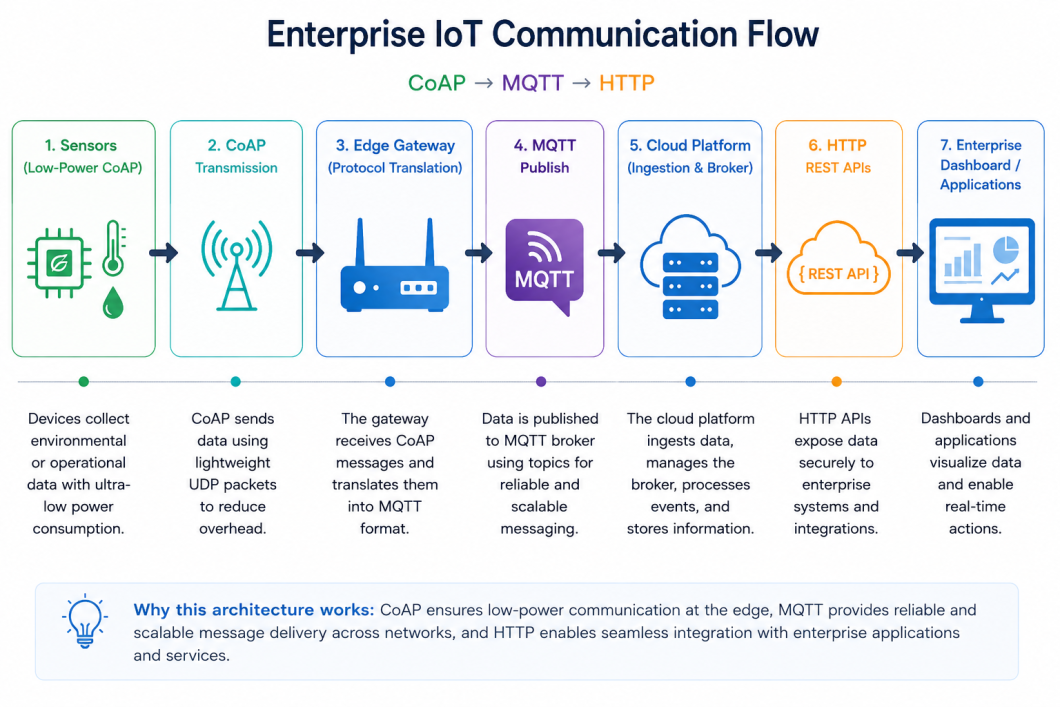
This multi-tier setup leverages the unique strengths of each technology. Deeply constrained sensors use CoAP to preserve their batteries. The edge gateway collects these UDP packets and translates them into MQTT messages.
The gateway then publishes this structured data to a cloud broker over a secure TCP channel. Finally, enterprise software and user dashboards read this data using standard HTTP APIs. This hybrid design ensures maximum performance, longevity, and ease of software integration.
Monitoring IoT Data in Real Time
Collecting sensor data is only the first step. Enterprises also need visibility into device performance, operational health, and system alerts. Real-time monitoring dashboards help teams track connected assets, detect anomalies, and respond to issues quickly.
Organizations often use dedicated IoT Dashboard Solutions to visualize MQTT, HTTP, and CoAP data streams in a single interface. These dashboards provide:
- Real-time sensor monitoring
- Device health tracking
- Alert and notification management
- Energy consumption analysis
- Predictive maintenance insights
For businesses that require mobile access, IoT App Development Services can extend monitoring capabilities to smartphones and tablets, allowing teams to manage devices remotely.
MQTT vs HTTP vs CoAP Security Comparison
Securing an enterprise network requires assessing how each option manages encryption, identities, and firewalls.
| Security Dimension | MQTT | HTTP | CoAP |
| Encryption Standard | TLS 1.2 / 1.3 | TLS 1.2 / 1.3 | DTLS |
| Handshake Overhead | High | High | Low to Moderate |
| Authentication | Username/Password, Token | API Keys, OAuth 2.0, Tokens | Pre-Shared Keys, Certificates |
| Firewall Friendliness | Requires opening ports (8883) | Uses standard web ports (443) | Often blocked by default ports |
| Device Resource Strain | Moderate | Severe | Low |
| Enterprise Readiness | High | Exceptional | Moderate |
Protocol Security Considerations
MQTT and HTTP both rely on TLS for transport encryption. While TLS is highly secure, its handshake requires multiple packet roundtrips. This process consumes considerable battery power and memory. CoAP uses DTLS over UDP, reducing the security handshake footprint. However, managing DTLS state machines on bare-metal hardware requires specialized development expertise.
Which Protocol Should You Choose?
Different industries present unique environmental constraints. Review this sector-based decision framework to align your strategy:
| Industry Sector | Recommended Protocol | Primary Engineering Reason |
| Manufacturing | MQTT | Supports high-frequency telemetry and decouples heavy factory floor data lines. |
| Logistics | MQTT | Maintains stable sessions as assets move across shifting cellular towers. |
| Smart Cities | CoAP + MQTT | CoAP handles thousands of street sensors; gateways push summaries via MQTT. |
| Healthcare | HTTP + MQTT | HTTP secures patient file records; MQTT monitors live wearable vitals. |
| Agriculture | CoAP | Minimizes power drain for remote sensors deployed deep in farm fields. |
| Utilities | CoAP + MQTT | Smart meters send low-power UDP updates to regional collection points. |
When planning these complex deployments, engineering teams must evaluate their long-term system roadmap. Utilizing professional IoT Development Services during the early design phase prevents costly structural re-engineering later.
Planning a Large-Scale IoT Deployment?
Enterprise IoT platforms often combine MQTT, HTTP, and CoAP with cloud services, edge computing, and analytics. A well-planned architecture reduces operational complexity as your deployment grows.
How Protocol Choice Affects IoT Infrastructure Costs
Your technology choice has long-term financial consequences. Operational expenses depend heavily on bandwidth, cloud compute cycles, and physical maintenance.
Bandwidth Costs
An HTTP-based sensor network sends megabytes of unnecessary text headers every month. Over a deployment of 10,000 cellular devices, these large headers increase data plan costs exponentially. MQTT and CoAP reduce data sizes dramatically, lowering monthly cellular bills.
Cloud Ingestion Costs
Cloud providers charge for data ingestion based on message counts or payload sizes. HTTP requires a new connection for every single sensor transmission, which increases compute billing. MQTT keeps a single connection open, dropping compute overhead.
Battery Replacement Costs
This is often the highest hidden cost in enterprise deployments. If a remote sensor uses HTTP, its battery might drain in six months. Changing thousands of batteries in the field requires manual labor and high travel expenses. Using CoAP can extend that same battery life to eight years, saving millions in maintenance.
Common Mistakes When Choosing IoT Communication Protocols
Avoid these frequent pitfalls during the architectural design phase:
- Choosing Based on Familiarity: Using HTTP for everything simply because your web developers understand it. This creates high-latency networks that drain batteries fast.
- Ignoring Battery Requirements: Failing to calculate the precise milliampere-hour (mAh) drain of long TCP handshakes on remote nodes.
- Ignoring Scalability Limits: Forgetting that thousands of devices requesting HTTP data simultaneously can crash standard cloud servers.
- Ignoring Security Overhead: Adding TLS encryption late in development only to find out the device microcontroller lacks the RAM to process it.
- Ignoring Network Conditions: Testing your system on fast office Wi-Fi instead of simulated, lossy cellular environments.
Future Trends in IoT Communication Protocols
The landscape continues to evolve as computing shifts toward the perimeter.
- Edge Computing Integration: Gateways now filter data locally before transmitting it, reducing cloud protocol strain.
- AI-Powered IoT (AIoT): Edge nodes use lightweight protocols to send processed AI inference metadata rather than raw data streams.
- Digital Twins: High-frequency MQTT streams are increasingly used to update real-time digital models of physical factories.
- Private 5G Networks: Ultra-low latency 5G networks allow MQTT connections to handle thousands of messages per millisecond safely.
- Hybrid Protocol Architectures: Software systems are adopting automated translation layers to read diverse incoming data types effortlessly.
How an IoT Development Company Can Help
Building a secure, enterprise-grade connected ecosystem requires balancing hardware limits with cloud scalability. Partnering with an experienced IoT Development Company ensures your architecture is engineered correctly from day one. Specialist architects help your team navigate protocol selection, firmware optimization, and infrastructure planning without guesswork.
A dedicated team delivers comprehensive Enterprise IoT Solutions that cover:
- Custom IoT Development: Tailoring firmware to use minimal binary headers on constrained microcontrollers.
- Industrial IoT Solutions: Upgrading legacy factory PLCs to safely stream data using secure MQTT brokers.
- Architecture Design: Creating a layered framework to combine low-power CoAP sensors with scalable cloud endpoints.
Choosing the right communication protocol is only one part of building a successful IoT ecosystem. HashStudioz provides end-to-end IoT Development Services, helping enterprises design secure, scalable, and high-performance connected solutions.
Turn Your IoT Vision into Reality
Whether you’re building Industrial IoT, smart manufacturing, healthcare, or connected products, the right architecture can improve performance, security, and long-term ROI.
Conclusion
Selecting the right technology in the MQTT vs HTTP vs CoAP matrix depends on your specific physical constraints. MQTT is the definitive leader for stable, reliable, real-time message streaming across industrial environments. HTTP remains essential for heavy web integrations, transactional API communication, and secure file downloads. CoAP provides an efficient solution for deeply constrained, battery-operated endpoints that require minimal packet sizes over UDP.
For the modern enterprise, the optimal path forward is rarely a single protocol. High-performance systems use a hybrid approach, assigning specific jobs to the technology best suited for them. Aligning your hardware realities with correct protocol choices lowers cloud costs and maximizes system uptime.
FAQs
1. Can MQTT, HTTP, and CoAP work together in one IoT system?
Yes. Many enterprise IoT deployments use CoAP for sensors, MQTT for device communication, and HTTP for cloud applications and dashboards.
2. Which protocol is best for Industrial IoT applications?
MQTT is often the preferred choice because it supports reliable communication, low bandwidth usage, and large-scale device connectivity.
3. How does protocol selection affect IoT costs?
The chosen protocol impacts bandwidth consumption, cloud processing expenses, battery life, and long-term maintenance costs.
4. Which protocol is best for battery-powered IoT devices?
CoAP is generally the best option for battery-powered devices because it uses minimal bandwidth and consumes less power.
5. What should enterprises consider when selecting an IoT communication protocol?
Key factors include device type, network reliability, security requirements, scalability needs, latency expectations, and battery constraints.