


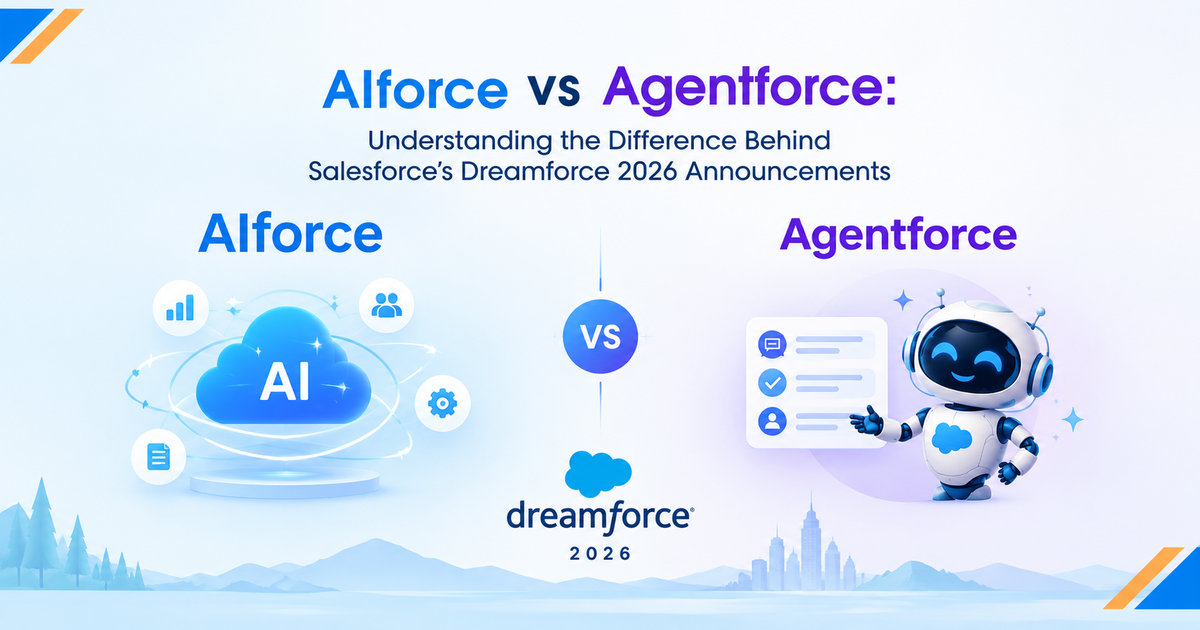
Salesforce Dreamforce 2026 made one thing clear: the future of CRM is moving beyond traditional application screens and rule-based automation toward an agentic enterprise, where AI can understand business context, reason through tasks, and take action.
Among the biggest announcements was AIforce, Salesforce’s new interface layer designed to bring Salesforce data, workflows, business logic, permissions, security, and governance into different AI interfaces. At the same time, Salesforce continued expanding Agentforce, its AI agent platform designed to perform work autonomously across sales, service, commerce, employee support, and other business functions.
This has created an obvious question for Salesforce customers and teams: AIforce vs Agentforce – what’s the difference?
The two are not competing products. They serve different roles within Salesforce’s broader Agentic Enterprise architecture. AIforce is primarily about where and how people and agents interact with Salesforce capabilities, while Agentforce is about the AI agents that reason, execute tasks, and perform business work.
Understanding that distinction is important because Dreamforce 2026 was not simply about adding another AI assistant to CRM. Salesforce is changing how users, agents, data, applications, and business processes interact.
Table of Contents
What Is AIforce?
AIforce is a new Salesforce live interface layer that brings the capabilities of the Salesforce platform to the places where people and AI agents already work.
Traditionally, using Salesforce meant opening Salesforce, navigating objects and records, finding the right dashboard or page, and then completing an action. Salesforce’s AIforce vision changes that model.
Instead of requiring users to always come to Salesforce, Salesforce capabilities can come to the user’s preferred interface.
Salesforce describes AIforce as bringing the platform’s data, workflows, business logic, semantics, permissions, security, and governance into AI interfaces. Its initial implementations include Claudeforce, Slackforce, and Agentforce Coworker.
For example, an employee could potentially interact with Salesforce information through an AI interface, ask a natural-language question, retrieve relevant CRM context, update records, or trigger an approved workflow without navigating through multiple Salesforce screens.
This makes AIforce less about creating another AI agent and more about changing the interface through which Salesforce capabilities are accessed.
Salesforce’s broader message at Dreamforce 2026 was that enterprise software no longer has to be tied to a fixed user interface. Instead, interfaces can become dynamic, intelligent, and composable around the work being performed.
What Is Agentforce?
Agentforce is Salesforce’s AI agent platform.
Rather than simply answering questions, Agentforce agents can understand business context, reason through requests, retrieve information, and take actions based on the permissions, instructions, data, and tools available to them.
Salesforce describes Agentforce as a platform for autonomous AI agents that can operate across customer and employee experiences. Its current use cases include customer service, contact center, field service, employee service, sales, appointment scheduling, product recommendations, and more.
The fundamental idea is:
Data + reasoning + actions = an AI agent that can perform work.
For example, a sales development agent could qualify an inbound lead, answer product questions, handle objections, schedule a meeting, and synchronize the interaction back to CRM.
A service agent could understand a customer’s issue, retrieve relevant information, perform an approved action, and escalate the case when human intervention is necessary.
This makes Agentforce the digital workforce layer of Salesforce’s Agentic Enterprise architecture.
Read to Know More About : What Is Agentforce and How Can It Transform Customer Operations?
AIforce vs Agentforce: What’s the Difference?
The easiest way to understand AIforce vs Agentforce is to think about their roles.
| Factor | AIforce | Agentforce |
| Primary role | Interface layer | AI agent platform |
| Main purpose | Bring Salesforce capabilities to different AI interfaces | Build and operate AI agents |
| Focus | Where people and agents interact with Salesforce | What AI agents can do |
| Interaction | Natural-language and dynamic interfaces | Autonomous task execution |
| Business logic | Makes Salesforce logic accessible through interfaces | Uses business logic to perform actions |
| Agents | Provides an interface for accessing Salesforce capabilities | Creates and operates agents |
| Examples | Claudeforce, Slackforce, Agentforce Coworker | Sales agents, service agents, commerce agents, employee agents |
| Relationship | Connects Salesforce capabilities to different surfaces | Performs work using Salesforce context and actions |
In simple terms:
AIforce is about bringing Salesforce to the interface. Agentforce is about bringing AI agents to the work.
That is why they should not be treated as alternatives.
AIforce does not replace Agentforce. Instead, it expands where Salesforce capabilities and Agentforce experiences can be accessed.
How Do AIforce and Agentforce Work Together?
The relationship becomes clearer when you look at Salesforce’s overall architecture.
Salesforce positions its Agentic Enterprise around several layers.
Data 360 provides unified and harmonized data, metadata, and memory.
Customer 360 provides application and semantic intelligence, including business processes, permissions, and actions.
Agentforce provides the digital workforce — the AI agents that can perform tasks.
AIforce brings this foundation to different AI interfaces.
A simplified model looks like this:
Business Data → Salesforce Context & Logic → Agentforce → AIforce / Interface → User or Agent
Imagine a sales manager wants to understand why several opportunities are at risk.
Instead of opening several Salesforce reports, filtering opportunities, checking activities, reviewing customer history, and manually creating follow-up tasks, the manager could interact with an AI interface.
The interface can access Salesforce’s governed context. An Agentforce agent can reason through the relevant information, identify the appropriate actions, and execute approved tasks.
The interface and agent therefore play different roles.
AIforce provides the doorway. Agentforce performs the work.
Biggest Salesforce Dreamforce 2026 Announcements
Salesforce’s official Dreamforce recap highlighted 21 announcements spanning AI interfaces, agents, reasoning models, agent optimization, voice, testing, orchestration, and more.
Here are some of the most important developments:
1. AIforce Brings Salesforce to Any Interface
AIforce was arguably one of the biggest architectural announcements.
Salesforce is moving toward a model where users do not necessarily need to open Salesforce to access Salesforce.
AIforce brings Salesforce capabilities into interfaces such as Claude, Slack, and Salesforce itself. Salesforce says these experiences can work with existing Salesforce data, apps, workflows, and business context while respecting established permissions and governance.
The initial AIforce experiences include:
- Claudeforce inside Claude
- Slackforce inside Slack
- Agentforce Coworker inside Salesforce
This represents an important change in how Salesforce thinks about the application layer.
2. Agentforce Coworker Becomes an AI Teammate
Agentforce Coworker is designed to operate as an autonomous AI teammate inside Salesforce.
Users can ask it questions across CRM, Slack, and other connected sources. When asked to complete work, it can create a plan, execute tasks, and coordinate other agents.
This is different from a traditional chatbot.
A chatbot generally responds to a question.
An AI coworker is expected to understand the objective and work through the steps required to achieve it.
3. Job-Ready Agents Expand Agentforce
Salesforce also introduced a broader portfolio of job-ready agents.
The idea is straightforward: organizations do not always need to build an AI agent from scratch.
Salesforce’s Dreamforce announcements included agents designed for specific roles and business functions, including sales development and customer service. These agents come with skills and actions designed for their intended jobs and can be customized as they operate in real-world environments.
This could make enterprise AI adoption faster because organizations can start with a purpose-built foundation instead of designing every agent from zero.
4. Long-Horizon Agents Can Pursue Goals
Another major development is the move toward long-horizon agents.
Traditional AI interactions are usually short:
Prompt → response → finished.
Long-horizon agents are designed to pursue a larger goal across multiple steps and sessions.
For example, a business could assign an objective such as re-engaging at-risk opportunities. The agent can create a multi-step plan, execute it over time, maintain memory, recover from failures, and request approval when required by defined guardrails.
This is a significant shift because it moves AI from single-task assistance toward ongoing business execution.
5. Agent Optimizer Helps Improve Agents
Salesforce also introduced Agent Optimizer to help organizations build and improve their agents.
Instead of manually examining every agent interaction, Optimizer can analyze production sessions, identify recurring failure patterns, rank issues by impact, and help teams create and test improvements.
This is important because deploying an agent is only the beginning.
Enterprise AI systems need continuous evaluation, monitoring, testing, optimization, and governance.
6. Koa Introduces CRM-Specific Reasoning
Salesforce also introduced Koa, its CRM reasoning model for Agentforce.
According to Salesforce, Koa is built on NVIDIA Nemotron and is designed specifically for agent reasoning, tool use, and decision-making in CRM scenarios. Salesforce says its training uses synthetic scenarios rather than real customer data.
The broader idea is that not every AI task requires the same model.
A general-purpose model can be useful for many things, but a model optimized for specific enterprise reasoning tasks may provide advantages for particular CRM workflows.
7. AI Skills Make Agent Capabilities Reusable
Dreamforce 2026 also introduced AI Skills.
AI Skills turn repeatable work into reusable, governed instructions that can be used across agents. Salesforce says skills can be created conversationally and managed through Agentforce Studio.
This matters because organizations need more than isolated agents.
They need reusable capabilities that can be applied consistently across multiple agents and business processes.
8. Multi-Agent Orchestration Connects Specialized Agents
Salesforce is also expanding multi-agent orchestration.
Instead of relying on one large agent to handle everything, organizations can use specialized agents that collaborate on complex tasks.
A higher-level agent can understand the user’s intent, break the request into smaller tasks, and coordinate specialized agents behind the scenes.
This creates a model closer to a digital workforce, where different AI agents have different responsibilities but work together toward a shared outcome.
AIforce vs Agentforce: Are They Replacing Traditional CRM?
Salesforce CRM is still the underlying system where organizations manage customer information, processes, permissions, workflows, and business logic.
What is changing is how users and AI access and interact with that system.
Traditional CRM often looks like:
User → Salesforce UI → Data → Decision → Manual Action
AI-assisted CRM changes this to:
User → AI Assistant → Salesforce Data → Recommendation → User Action
Agentic CRM takes another step:
User/Goal → AI Agent → Context + Reasoning → Action → Outcome
AIforce adds another dimension by allowing that interaction to happen through different interfaces.
The result is not necessarily the disappearance of CRM.
Instead, CRM becomes more of a business intelligence, context, workflow, and action foundation operating underneath dynamic AI experiences.
How Dreamforce 2026 Is Changing the Future of CRM?
The biggest takeaway from Dreamforce 2026 is that Salesforce is moving CRM beyond the traditional application interface.
1. CRM Is Becoming Less Interface-Dependent
For decades, employees were expected to learn how to navigate enterprise software.
AIforce challenges that model.
Instead of requiring every employee to understand Salesforce’s objects, tabs, reports, fields, and page layouts, users can increasingly interact with business capabilities through natural language and AI interfaces. Salesforce describes this as software coming to the user rather than requiring the user to come to the software.
2. Agents Are Becoming Active Participants
Traditional automation waits for predefined triggers.
Agentic systems can reason about goals, evaluate information, create plans, and take actions within defined boundaries.
Dreamforce 2026’s announcements around long-horizon agents, Agentforce Coworker, job-ready agents, orchestration, and Agent Optimizer show Salesforce moving toward this model.
3. Natural Language Is Becoming an Enterprise Interface
Employees may no longer need to know exactly where a particular record, report, field, or workflow lives.
They can increasingly describe what they want.
The AI system then interprets the request, retrieves relevant business context, and determines what actions are available.
This does not mean every business process should become completely autonomous. It means natural language can become an increasingly important access layer to enterprise systems.
4. Governance Becomes More Important, Not Less
More autonomous AI also means more responsibility.
When AI can access customer data, update records, trigger workflows, communicate with customers, or execute business processes, organizations need strong controls.
Salesforce emphasizes permissions, security, governance, trusted context, and controlled actions as core elements of its Agentic Enterprise architecture.
This means CRM data quality and architecture become even more important in an agentic environment.
What Does Dreamforce 2026 Mean for Salesforce Businesses?
The impact will differ depending on the business function.
1. Sales Teams
Sales teams can use AI agents to qualify prospects, manage follow-ups, summarize opportunities, answer questions, and support pipeline activities.
The bigger shift is that AI can move from simply generating recommendations toward completing defined sales tasks.
2. Customer Service Teams
Service organizations can use agents to handle customer questions, resolve cases, retrieve information, perform actions, and escalate complex situations.
Agentforce already supports use cases across chat, messaging, voice, and other service channels.
3. Marketing Teams
Marketing teams can use AI to support campaign planning, personalization, content generation, optimization, and customer engagement.
As agents become more capable, the marketing workflow can become increasingly goal-oriented rather than focused only on individual content-generation tasks.
4. Commerce Teams
Commerce teams can use AI agents for product recommendations, buyer assistance, merchandising, customer engagement, and other ecommerce workflows.
This could eventually make commerce experiences more conversational and personalized while connecting customer interactions directly with underlying Salesforce data and business processes.
5. Salesforce Admins and Developers
For Salesforce administrators and developers, the shift toward AI interfaces and agents creates a new responsibility.
They are no longer only configuring screens and workflows.
They increasingly need to think about:
- Data quality
- Permissions
- Agent actions
- Business rules
- AI Skills
- Integrations
- Agent testing
- Observability
- Governance
- User experience
The Salesforce platform becomes part of an organization’s AI operating layer, not simply a CRM application.
6. IT and Enterprise Architecture Teams
IT teams will need to evaluate how AI agents connect with existing enterprise systems.
This makes APIs, integration architecture, identity, data governance, security, and system interoperability increasingly important.
Salesforce’s Headless Toolkit and AgentExchange direction also reflect this move toward an open architecture where builders can use MCPs, APIs, plugins, skills, and developer tools to create AI experiences around Salesforce.
Ready for Agentic CRM?
HashStudioz can help you turn Salesforce’s latest AI innovations into practical business solutions.
How Businesses Can Prepare for the Agentic CRM Era?
The announcements from Dreamforce 2026 are exciting, but organizations should not jump directly into deploying agents everywhere.
A strong foundation matters.
1. Clean Your Salesforce Data
AI agents are only as reliable as the business context they can access.
Duplicate records, incomplete fields, outdated information, inconsistent processes, and disconnected systems can negatively affect AI-driven workflows.
2. Review Existing Automations
Before introducing autonomous agents, understand what your current Flows, Apex, integrations, approval processes, and automations already do.
Agents should complement existing architecture rather than create unnecessary duplication.
3. Identify High-Value Agent Use Cases
Start with specific business problems.
For example:
- Lead qualification
- Case classification
- Customer service resolution
- Appointment scheduling
- Opportunity follow-up
- Employee support
- Product recommendations
A clearly defined use case makes it easier to measure whether an agent is actually delivering value.
4. Strengthen Governance
Define what an agent can read, what it can change, which actions require approval, and when a request should be escalated to a human.
Governance should be designed before autonomous execution expands.
5. Review Your Integration Architecture
Agentic CRM does not exist in isolation.
Agents may need information from ERP systems, ecommerce platforms, customer support tools, data warehouses, communication systems, and other enterprise applications.
A strong integration strategy becomes increasingly important as agents take on more responsibilities.
6. Plan for Continuous Optimization
Deploying an agent is not a one-time project.
Businesses should monitor performance, evaluate outcomes, identify failures, test improvements, and continuously refine agent behavior.
The introduction of Agent Optimizer, Agent Health Monitoring, testing capabilities, and observability at Dreamforce 2026 reinforces this point.
Conclusion
The AIforce vs Agentforce discussion becomes much easier to understand once their roles are separated.
Agentforce is the AI agent platform and digital workforce. AIforce is the interface layer that brings Salesforce capabilities into the places where people and agents work. They are complementary rather than competing technologies, and that distinction reflects the bigger message from Salesforce Dreamforce 2026.
Salesforce is moving toward a CRM model where data, business logic, applications, AI models, agents, interfaces, and governance work together. The CRM may increasingly operate behind the scenes while users interact with business capabilities through natural language and dynamic AI experiences.
For businesses, the opportunity is significant. But realizing it will depend on more than adopting the latest AI product. Organizations will need reliable data, strong Salesforce architecture, secure integrations, clear governance, and a thoughtful strategy for deciding which work should remain human-led and which work can safely be delegated to AI agents.
FAQs
1. What is the difference between AIforce and Agentforce?
AIforce is Salesforce’s live interface layer that brings Salesforce data, workflows, business logic, permissions, security, and governance into different AI interfaces. Agentforce is Salesforce’s AI agent platform for building and operating autonomous agents that can reason and take actions.
2. Is AIforce replacing Agentforce?
No. AIforce and Agentforce have different roles. AIforce expands where Salesforce capabilities can be accessed, while Agentforce provides the AI agents that perform business tasks. Salesforce positions both as components of its broader Agentic Enterprise architecture.
3. What did Salesforce announce at Dreamforce 2026?
Major announcements included AIforce, Agentforce Coworker, job-ready agents, long-horizon agents, Agent Optimizer, Koa, AI Skills, multi-agent orchestration, expanded voice capabilities, agent testing and observability, and other Agentforce updates.
4. How does AIforce work with Salesforce CRM?
AIforce makes Salesforce’s underlying data, workflows, business logic, permissions, security, and governance accessible through AI interfaces. This allows users and agents to interact with Salesforce capabilities without always relying on the traditional Salesforce interface.
5. What does Dreamforce 2026 mean for the future of CRM?
Dreamforce 2026 points toward a more agentic CRM model in which AI agents can reason over trusted business context and execute tasks, while dynamic AI interfaces make CRM capabilities accessible wherever people and agents work. This makes data quality, governance, security, integrations, and agent management increasingly important.