


Businesses increasingly rely on multiple digital platforms to manage customer interactions, analyze user behavior, and execute marketing campaigns. However, managing these activities across disconnected systems can create data gaps and make it difficult to deliver consistent customer experiences. CleverTap helps businesses track customer behavior across websites and mobile applications, analyze user interactions, and understand engagement patterns. Meanwhile, Salesforce Marketing Cloud (SFMC) enables businesses to automate marketing campaigns, manage customer journeys, and deliver personalized communications across supported channels. When these platforms operate separately, transferring customer information and coordinating marketing activities can become challenging. CleverTap and Salesforce Marketing Cloud integration connects customer engagement insights with marketing automation workflows. By synchronizing relevant customer profiles and behavioral data, businesses can improve audience segmentation, streamline campaign execution, and develop more connected customer engagement strategies.
Table of Contents
What Is CleverTap?
CleverTap is a customer engagement platform that helps businesses understand user interactions and manage engagement activities across digital channels. It collects information about customer activities through its SDKs and APIs, allowing businesses to analyze user behavior and build audience segments.
CleverTap organizes customer information through user profiles, properties, and events. A user profile contains identifiers and attributes, while events record actions performed by users, such as viewing a product, launching an application, or completing a purchase. Businesses can use this information to understand customer activity and create targeted engagement campaigns.
Key Features of CleverTap
- Customer Behavior Tracking: Records user activities through events to help businesses understand interactions with applications and websites.
- User Segmentation: Supports audience grouping using customer profile attributes and behavioral activity.
- Event-Based Engagement: Allows businesses to configure campaigns based on specific customer actions.
- Customer Journey Management: Helps plan engagement activities around customer behavior and lifecycle stages.
- Campaign Analytics: Provides event and campaign-related insights to evaluate customer engagement.
What Is Salesforce Marketing Cloud (SFMC)?
Salesforce Marketing Cloud Engagement is a marketing platform that helps businesses manage customer communications, automate marketing activities, and coordinate customer journeys. It provides APIs and tools for working with contacts, campaigns, messaging, and Journey Builder.
Salesforce Marketing Cloud Engagement supports REST and SOAP APIs that use OAuth 2.0 authentication. Businesses can use these APIs to connect external applications with marketing functions and exchange information according to their integration requirements. Its marketing automation capabilities also help teams organize data processing and customer communication workflows.
Key Features of Salesforce Marketing Cloud
- Email Studio: Supports email marketing activities and campaign communication.
- Mobile Studio: Provides mobile messaging capabilities, including supported SMS and push communication features.
- Journey Builder: Helps marketers design and automate customer journeys using defined entry sources, activities, and decision criteria.
- Contact Builder: Supports the organization and management of customer contact information.
- Automation Studio: Automates marketing and data management activities, including queries, imports, and email sends.
- Data Extensions: Store structured information that can be used for segmentation, personalization, and journey entry.
Why Integrate CleverTap with Salesforce Marketing Cloud?
CleverTap and Salesforce Marketing Cloud serve different but complementary purposes. CleverTap focuses on collecting and analyzing customer engagement information, while SFMC provides tools for marketing automation and customer journey management. When businesses manage these platforms independently, relevant customer information may remain separated across systems.
This separation can make it difficult for marketing teams to use behavioral insights when planning communication campaigns. Manual data transfers can also introduce additional operational steps and delay the availability of updated customer information.
Integrating these platforms creates a way to transfer relevant customer profiles and behavioral events into the configured Salesforce Marketing Cloud environment. Marketing teams can then use synchronized information to define audience segments, configure journey entry criteria, and coordinate communication activities.
The integration can support several business objectives:
- Connected customer information: Make relevant customer attributes and behavioral events available across the configured systems.
- More relevant targeting: Use customer activity and profile information to define campaign audiences.
- Automated workflows: Reduce dependence on repetitive manual data transfers.
- Consistent communication: Use available customer information to coordinate marketing activities.
- Improved campaign planning: Connect customer engagement signals with defined marketing workflows.
The exact benefits depend on the selected integration architecture, data availability, and marketing requirements.
How Does CleverTap and Salesforce Marketing Cloud Integration Work?
CleverTap and Salesforce Marketing Cloud integration generally requires an integration layer that connects the APIs and manages the exchange of customer information. The integration architecture depends on the business requirements, available API capabilities, and intended direction of data transfer.
Understanding the Data Flow
The data flow can be organized into the following stages:
- Customer Interaction: A customer performs an activity on a website or mobile application, such as viewing a product, registering an account, or completing a purchase.
- Data Collection: CleverTap records the relevant customer activity as an event and associates available information with the user profile.
- Data Processing: The integration layer retrieves the required information and applies the defined field mapping and transformation rules.
- Data Synchronization: The integration transfers the selected customer profiles and event information to the configured Salesforce Marketing Cloud destination.
- Marketing Automation: SFMC uses the available information in Data Extensions, audience segmentation, and configured Journey Builder entry events.
- Campaign Execution: Contacts entering the configured journeys can receive communications through the selected marketing channels.
CleverTap provides APIs for retrieving event and user profile data, while Salesforce Marketing Cloud provides APIs for managing contacts and interacting with Journey Builder.
Important: This architecture describes a possible Custom integration. The actual data direction, synchronization mechanism, and destinations must be defined during implementation. Bidirectional synchronization should not be assumed.
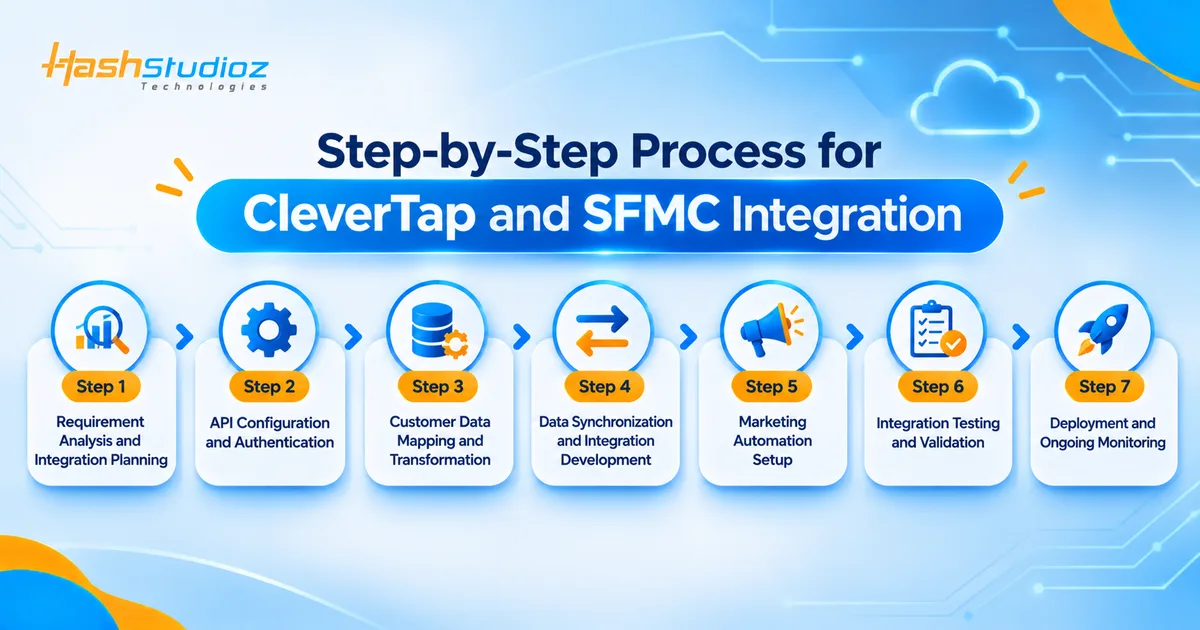
Step-by-Step Process for CleverTap and SFMC Integration
Integrating CleverTap with Salesforce Marketing Cloud requires proper planning, API configuration, data mapping, and validation. HashStudioz approaches this process by aligning the integration architecture with business objectives and technical requirements.
Step 1. Requirement Analysis and Integration Planning
HashStudioz begins by evaluating the existing CleverTap and Salesforce Marketing Cloud environments to understand business objectives and integration requirements.
The team identifies which customer profiles, behavioral events, and attributes need to be exchanged. This includes defining customer identifiers, required data fields, synchronization frequency, and intended marketing workflows.
The integration direction is also established. For example, a business may require customer engagement events from CleverTap to be transferred into Salesforce Marketing Cloud for campaign automation. Based on these requirements, HashStudioz defines the integration architecture and identifies the appropriate APIs and data destinations.
Step 2. API Configuration and Authentication
The next step involves establishing communication between both platforms. CleverTap provides APIs for retrieving event and user profile information, while Salesforce Marketing Cloud supports REST and SOAP APIs for accessing its capabilities.
HashStudioz reviews the available API endpoints and configures the required authentication credentials and access permissions. Salesforce Marketing Cloud API integrations use OAuth 2.0 authentication, with credentials obtained through an installed package containing an API Integration component.
The team validates API connectivity and permissions before proceeding with data exchange. Credentials are stored securely rather than exposed in client-side applications.
Step 3. Customer Data Mapping and Transformation
Data mapping establishes how information from CleverTap corresponds to the fields available in Salesforce Marketing Cloud.
HashStudioz identifies the relevant attributes, such as customer IDs, email addresses, phone numbers, profile properties, and behavioral event details. These fields are mapped to the appropriate Salesforce Data Extension structure.
The team also defines transformation and validation rules to maintain compatible data formats. Customer identity matching, missing values, duplicate records, and field requirements are considered during this stage.
CleverTap supports unique user identifiers, additional identifiers, custom profile properties, and event properties. These data structures help determine which information can be included in the integration.
Step 4. Data Synchronization and Integration Development
Once the mapping structure is finalized, HashStudioz develops the integration logic to transfer the required information between platforms.
Depending on the architecture, data synchronization can use API requests, webhook-based communication, scheduled processes, or an integration middleware layer. The selected mechanism depends on whether the business requires event-driven transfers or periodic data updates.
For example, relevant CleverTap events can be retrieved and processed before being transferred to designated Salesforce Marketing Cloud Data Extensions. The integration can also include error logging, retry mechanisms, and response validation to manage unsuccessful requests and synchronization issues.
CleverTap documents both data retrieval APIs and event-triggered webhooks, while Salesforce provides REST and SOAP APIs for Marketing Cloud Engagement.
Step 5. Marketing Automation Setup
After data synchronization, the available customer information is configured for marketing activities within Salesforce Marketing Cloud.
HashStudioz helps establish the required Data Extensions, define audience segmentation criteria, and configure Journey Builder entry events. A sendable Data Extension can serve as a journey entry source when it meets the platform’s requirements.
For example, customer information associated with a particular event can be transferred into an appropriate Data Extension. A configured entry event can then admit eligible contacts into a customer journey, where marketers define communication activities and decision criteria.
Salesforce documents API-based Journey Builder entry events and Data Extension entry sources for this purpose.
Step 6. Integration Testing and Validation
Before deployment, HashStudioz validates the integration to identify potential issues in data exchange and marketing workflows.
Testing includes:
- API Authentication: Verify that both platforms accept the configured authentication credentials.
- Field Mapping: Check whether customer attributes and event properties reach their corresponding fields.
- Data Synchronization: Validate that the selected records are transferred to the intended destinations.
- Duplicate Handling: Check how repeated customer records and events are processed.
- Error Handling: Test API failures, unsuccessful requests, and configured retry mechanisms.
- Journey Validation: Verify that eligible contacts enter the intended Journey Builder workflows.
These checks help confirm that the integration behaves according to the defined requirements before production deployment.
Step 7. Deployment and Ongoing Monitoring
After successful testing, HashStudioz prepares the integration for production deployment. This includes configuring the production credentials, synchronization schedules, API endpoints, and required permissions.
Following deployment, the team can monitor synchronization activity, API responses, and error logs to identify unsuccessful data transfers or other integration issues. Maintenance activities can address changes in API requirements, data structures, and business workflows.
A monitoring and maintenance approach helps keep the integration aligned with evolving technical and operational requirements.
Ready to Integrate CleverTap with SFMC?
Talk to HashStudioz today and turn disconnected customer data into connected marketing workflows.
Key Benefits of CleverTap and Salesforce Marketing Cloud Integration
Connecting CleverTap with Salesforce Marketing Cloud can help businesses combine customer engagement information with marketing automation capabilities. The benefits depend on how the integration is configured and how marketing teams use the synchronized information.
1. Unified Customer Information
The integration makes selected customer attributes and behavioral information available within the configured Salesforce Marketing Cloud environment. This helps marketing teams work with relevant customer information when planning communication activities.
2. Personalized Marketing Campaigns
Businesses can use available customer attributes and behavioral events to define campaign audiences and communication criteria. This supports more relevant messaging based on customer interactions and preferences.
3. Improved Customer Segmentation
CleverTap captures customer profile information and behavioral events. Transferring selected data into Salesforce Marketing Cloud allows marketing teams to use these attributes when defining audience segments and journey entry conditions.
4. Automated Marketing Workflows
Integrating the platforms can reduce the need for manual data transfers. Once the synchronization and entry criteria are configured, relevant customer information can support automated marketing workflows.
5. Better Customer Engagement
Marketing teams can use customer activity information to plan communication around specific interactions and lifecycle stages. For example, a relevant product interaction can be used as an input for a configured follow-up journey.
6. Improved Marketing Efficiency
Connecting customer data with marketing automation can simplify certain operational processes. Teams can use synchronized information instead of repeatedly collecting and transferring the same attributes manually.
Real-World Use Cases of CleverTap and SFMC Integration
Businesses across industries can use customer engagement data to support marketing automation. The following examples illustrate how the integration can be applied to different business workflows.
1. E-commerce and Retail
E-commerce businesses can track customer activities such as product views, cart additions, and purchases through CleverTap events. Relevant information can be synchronized with Salesforce Marketing Cloud to create targeted customer segments and configure follow-up journeys.
For example, businesses can use shopping activity to identify eligible customers for abandoned-cart reminders or product-related promotional campaigns.
2. Banking and Financial Services
Financial institutions can use customer interactions with their digital applications to understand engagement patterns. Selected behavioral information can be transferred to Salesforce Marketing Cloud to support customer segmentation and relevant communication workflows, subject to applicable consent and data-handling requirements.
3. Travel and Hospitality
Travel businesses can track booking searches, customer preferences, and other relevant interactions. This information can support targeted travel promotions, booking-related reminders, and follow-up communication through configured marketing journeys.
4. SaaS and Technology Companies
SaaS businesses can track product usage, feature interactions, and customer engagement through CleverTap. When synchronized with SFMC, selected information can support onboarding communication, product updates, and customer retention campaigns.
5. Education and E-learning
Educational platforms can track course registrations, application activity, and learner engagement. Marketing teams can use synchronized information to segment learners and configure enrollment reminders, course updates, and other relevant communications.
Common Challenges in CleverTap and SFMC Integration
Although integration connects customer engagement information with marketing automation, businesses must address several technical considerations during implementation.
| Challenge | What needs to be addressed |
| Data inconsistency | Standardize customer attributes and data formats. |
| Identity matching | Establish reliable identifiers across platforms. |
| API limitations | Consider API permissions, request limits, and endpoint requirements. |
| Duplicate records | Define appropriate record matching and deduplication rules. |
| Synchronization delays | Select an appropriate data transfer frequency. |
| Data security | Protect authentication credentials and customer information. |
| Integration failures | Implement error logging, response validation, and retry handling. |
These challenges can affect data accuracy and the reliability of marketing workflows. Proper integration planning, data validation, and monitoring help businesses identify and manage potential issues.
Best Practices for Successful CleverTap and SFMC Integration
A well-planned integration requires attention to data quality, API security, and synchronization reliability. Businesses should consider the following practices:
- Define clear integration objectives: Identify the business processes and customer information that need to be connected.
- Maintain consistent customer identifiers: Establish appropriate matching rules for customer records across platforms.
- Standardize data mapping: Define compatible field names, data types, and transformation rules.
- Use secure API authentication: Follow the authentication requirements of both platforms and protect API credentials.
- Validate data before synchronization: Check required fields, formats, and customer records before transferring information.
- Implement error handling: Configure logging and suitable retry mechanisms for unsuccessful requests.
- Test customer journeys: Verify entry conditions and communication workflows before activating campaigns.
- Monitor integration performance: Review synchronization activity and address changes in API or business requirements.
Following these practices helps maintain a more reliable integration and supports consistent marketing operations.
Conclusion
CleverTap and Salesforce Marketing Cloud integration helps businesses connect customer engagement insights with marketing automation workflows. CleverTap provides customer profiles and behavioral event information, while SFMC supports audience management and automated customer journeys. Connecting these platforms can help businesses improve segmentation, coordinate campaigns, and build more relevant customer communication processes. However, successful implementation depends on accurate data mapping, secure API connectivity, reliable synchronization, and proper testing. Businesses looking to connect these platforms can work with HashStudioz to explore custom integration solutions aligned with their technical requirements and marketing objectives.
FAQs
1. What is CleverTap and Salesforce Marketing Cloud integration?
CleverTap and Salesforce Marketing Cloud integration connects customer engagement information from CleverTap with the marketing automation capabilities of SFMC. It allows businesses to transfer selected customer profiles and behavioral events for audience segmentation and customer journey management.
2. What are the benefits of integrating CleverTap with SFMC?
The integration can support:
- Customer data synchronization.
- Behavioral audience segmentation.
- Personalized marketing campaigns.
- Automated customer journeys.
- Reduced manual data handling.
- More connected customer engagement workflows.
3. How does data flow between CleverTap and Salesforce Marketing Cloud?
Data can flow through APIs, webhooks, or an integration middleware layer, depending on the implementation. Relevant CleverTap customer profiles and events are retrieved, processed, and transferred into configured Salesforce Marketing Cloud destinations, such as Data Extensions.
4. Can CleverTap customer events trigger Salesforce Marketing Cloud journeys?
Yes. Relevant CleverTap events can be transferred to Salesforce Marketing Cloud and used with configured Journey Builder entry events. This requires appropriate event definitions, data destinations, and integration logic.
5. Is custom development required for CleverTap and SFMC integration?
Custom development may be required depending on the available connectors, API capabilities, data structures, and business requirements. Businesses requiring specific synchronization logic or customized workflows may need an API-based integration solution.

Harshita Rawat is a digital marketing and SEO professional specializing in SEO content, Salesforce, CRM, and technology topics. She writes practical, research-driven content to help businesses understand emerging technologies and digital strategies.