


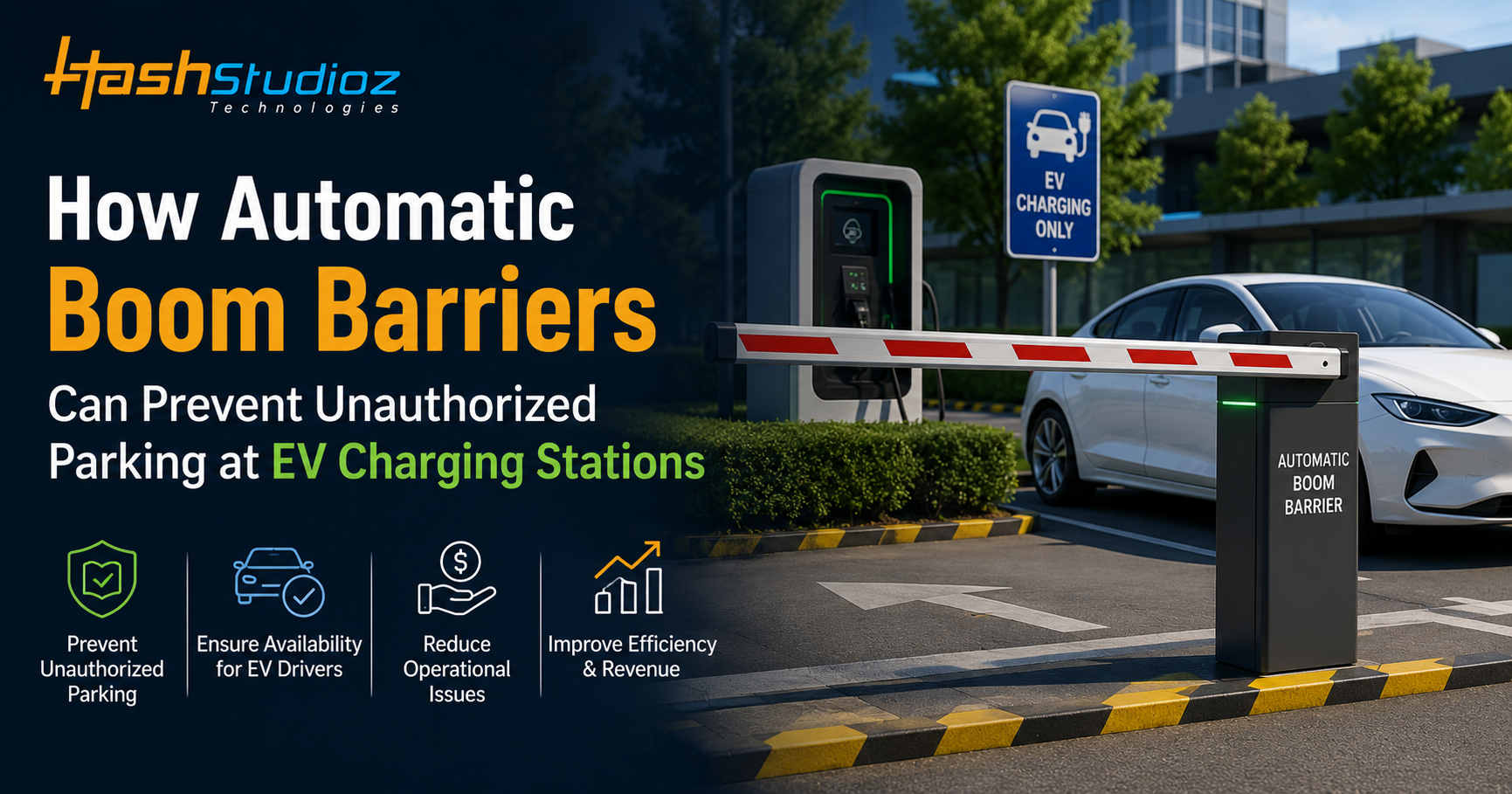
Imagine driving an electric vehicle (EV) with your battery down to 5%. You pull into a commercial parking lot, relieved to see an open EV charging bay on your app. But as you get closer, your heart sinks. A standard Internal Combustion Engine (ICE) gas car is parked right in the bay, completely unattached to the charger.
This frustrating situation is known as “ICEing,” and it is one of the biggest challenges facing the electric vehicle industry today.
For EV charging station operators, mall owners, and facility managers, unauthorized parking is more than an annoyance, it is a direct hit to the bottom line. Every minute a non-charging vehicle blocks a bay, revenue drops, charger utilization goes down, and customer frustration rises. While simple painted signs and pavement markings rarely work, smart parking systems offer a reliable answer.
Integrating automatic boom barriers with EV charging infrastructure secures parking bays, keeps chargers open for paying customers, and protects infrastructure investments.
Table of Contents
How Can Automatic Boom Barriers Prevent Unauthorized Parking at EV Charging Stations?
Automatic boom barriers prevent unauthorized parking by physically blocking individual EV charging bays. The barrier remains down until a driver authenticates through an EV charging management system using an RFID card, QR code payment, mobile app, or ANPR license plate camera.
By restricting entry to verified, paying EV drivers, these smart gates keep non-charging and regular gas vehicles out. This simple automation eliminates manual enforcement, protects charging revenue, and ensures bays are always open for paying customers.
Key Takeaways
- Physical Enforcement Works: Visual signs and painted lanes fail to stop unauthorized parking. Physical boom barriers completely solve the problem.
- Eliminate Revenue Loss: Keeping non-charging vehicles out of bays ensures a steady flow of paying EV drivers, protecting daily revenue.
- Boost Charger Utilization: Automated parking turnover increases the number of vehicles using each charger daily.
- Smart Access Control Technologies: Systems like RFID, QR codes, ANPR, and mobile apps easily integrate with existing hardware to automate access.
- No Manual Staffing Needed: Automation removes the need for security guards to monitor parking bays or issue fines.
- Improved Driver Experience: EV drivers are much happier when they can trust that a spot marked “available” on an app is physically open when they arrive.
- Data-Driven Management: Connected barriers track exact entry, exit, and charging times, giving operators clear insights into utilization.
The Growing Problem of Unauthorized Parking at EV Charging Stations
As electric vehicles become more popular, the demand for public and commercial charging infrastructure is growing fast. However, parking spaces equipped with EV chargers are often treated as premium parking spots by drivers of regular gas-fueled vehicles because they are usually located close to building entrances.
This misuse takes a few common forms:
- ICEing: Regular gas cars parking in dedicated EV spots.
- Squatting: An EV driver leaves their vehicle parked in the bay long after the charging session is complete, blocking other drivers.
- Unauthorized Fleet/Long-Term Parking: Unregistered vehicles using residential or commercial charging spaces for long-term storage without charging.
This issue causes major operational problems across different properties:
Shopping Malls and Retail Centers
During peak holiday hours or busy weekends, drivers grow desperate for parking. Unregulated EV spots quickly fill up with non-electric vehicles, frustrating EV drivers who chose that location specifically to charge while shopping.
Corporate Office Complexes
Employees with standard vehicles often take over EV charging slots when regular spaces are full. This prevents colleagues who commute in EVs from charging their cars during the workday.
Residential Societies and Apartments
In shared residential parking, spaces with chargers are frequently blocked by neighbors’ secondary gas vehicles or long-term visitors, leading to constant management complaints.
Fleet Depots and Logistics Hubs
For commercial delivery companies or transit operations, charging schedules must be precise. If an unauthorized vehicle blocks a high-powered fleet charger, it can delay delivery routes and disrupt business operations.
Why Unauthorized Parking is a Major Business Problem
For property owners and charging point operators (CPOs), an unmanaged charging bay is a financial leak. Leaving these spots open to anyone creates real business challenges:
1. Lost Charging Revenue
EV charging stations generate income based on energy delivered and time spent connected. A blocked bay cannot generate money. If a non-charging vehicle sits in a bay for four hours, the operator loses out on multiple paid charging sessions.
2. Reduced Charger Utilization
The primary metric for EV infrastructure success is utilization—how many hours a day a charger actively transfers power. When unauthorized cars block a bay, utilization rates drop, extending the time it takes for the owner to earn back their initial hardware investment.
3. Poor Customer Experience
EV drivers rely heavily on mobile apps to find functional, open chargers. If an app says a charger is “Available,” but the driver arrives to find a gas car blocking the spot, they leave frustrated. This poor experience harms the reputation of the property and the charging network.
4. Increased Operational Complaints
Property managers and customer support teams spend valuable time dealing with angry drivers, tracking down car owners, and arranging towing services. These manual tasks pull focus away from regular business operations.
5. Negative Impact on EV Adoption
When drivers cannot rely on public charging infrastructure because spots are constantly blocked, it creates range anxiety and slows the broader transition to electric mobility.
How Automatic Boom Barriers Solve the Problem
Automated boom barriers replace passive signage with active, physical enforcement. Instead of asking drivers to follow rules, the system makes compliance automatic.
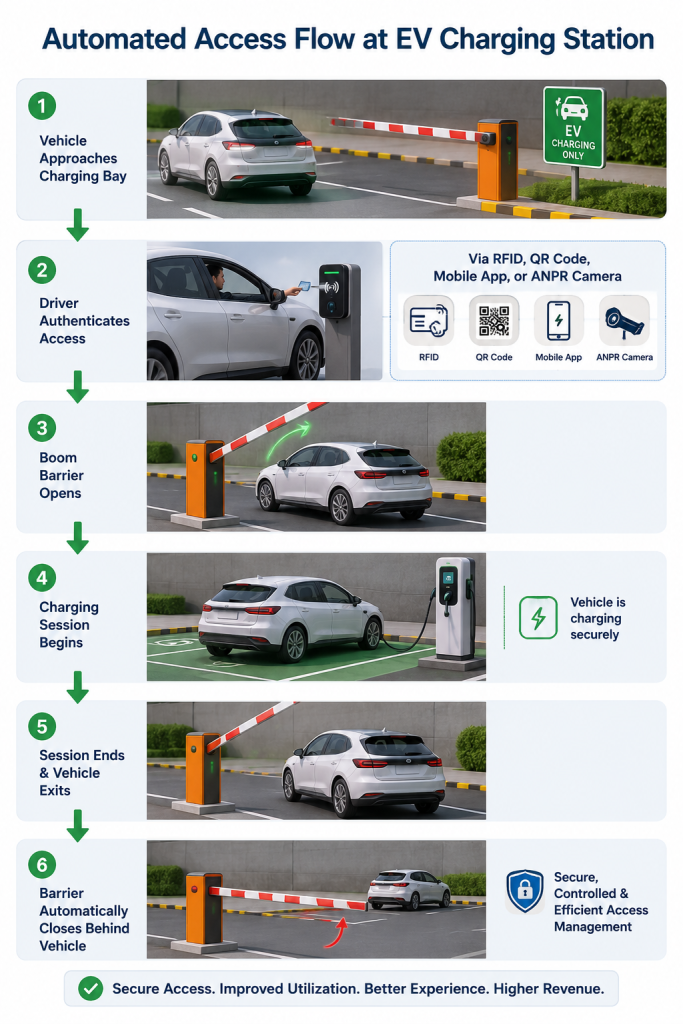
The process is built around simple automation:
- Controlled Vehicle Entry: The barrier arm stays down, blocking access to the charging bay by default.
- Reserved Access for Authorized Users: Only drivers who verify themselves through an approved method can trigger the barrier to open.
- Automated Entry and Exit Management: Safety loops or ground sensors detect when a vehicle has cleared the gate, lowering the barrier immediately to prevent trailing cars from slipping in.
- Real-Time Access Validation: The hardware communicates directly with backend parking and charging software, confirming the vehicle has a valid reservation or payment method before opening.
- Reduced Manual Monitoring: The entire system runs automatically, removing the need for regular lot patrols, security guard checks, or physical tickets.
Access Control Technologies Used with EV Charging Stations
To match a property’s specific operational needs, managers can couple Smart Access Control Systems with several types of vehicle validation technologies.
RFID-Based Access Control
Radio-Frequency Identification (RFID) relies on physical keycards, key fobs, or windshield tags. The driver taps their card against a reader mounted on a post or the charger itself, signaling the RFID Access Control Solution to raise the barrier.
- Advantages: Extremely reliable, works offline, low deployment cost per user, and processes access in under a second.
- Best Use Cases: Employee parking lots, fleet depots, and private residential communities where the same group of drivers uses the stations regularly.
QR Code-Based Access Control
With this approach, a dynamic or static QR code is placed near the bay entrance or displayed on a digital screen. Drivers scan the code with their smartphone camera to open a web portal or app, enter payment details, and unlock the barrier.
- Advantages: No physical cards required, easy for visitors to use, and works with any smartphone.
- Best Use Cases: Commercial shopping centers, public parking garages, and hotels hosting temporary guests.
ANPR (Automatic Number Plate Recognition)
ANPR uses specialized high-definition cameras aimed at the charging bay entrance. As a vehicle pulls up, the camera snaps a photo of the license plate, reads the characters using optical software, checks it against an approved database, and commands the ANPR Solution to lift the barrier.
- Advantages: Completely hands-free, seamless driver experience, and removes the need to roll down windows or use a phone.
- Best Use Cases: Premium office spaces, airports, commercial fleet hubs, and high-traffic smart cities.
Mobile App-Based Access Control
This option connects the physical hardware to an IoT-Based Parking Management Solution. Drivers reserve a specific charging bay in advance through an EV network app. When they arrive, they tap a “Link/Open Barrier” button in the app, which sends a secure cellular or Bluetooth command to lift the gate arm.
- Advantages: Allows drivers to book spots ahead of time, integrates with map routing, and handles payment processing in one place.
- Best Use Cases: Urban parking hubs, multi-tenant offices, and mixed-use real estate developments.
Access Control Technology Comparison
| Feature | RFID Access | QR Code Access | ANPR Camera | Mobile App Access |
| Hardware Cost | Low | Low | Medium to High | Low to Medium |
| Ease of Deployment | Very Simple | Simple | Requires Alignment | Software Setup |
| Security Level | High (Hard to Clone) | Medium | High | High (Encrypted) |
| User Convenience | High for Members | Medium (Requires Scan) | Highest (Hands-Free) | High (Remote) |
| Scalability | Medium | High | High | Highest |
| Best Use Case | Offices, Fleets | Public Malls | Airports, Fleets | Public EV Networks |
Real-World Implementation Examples
As EV adoption grows, operators are increasingly turning to automated access control to manage charging spaces more effectively. The following examples illustrate how boom barriers, RFID, QR codes, and ANPR technologies help prevent unauthorized parking and improve charger availability.
1. PoGo Charge Cwmbran Ultra-Rapid Hub (UK, November 2025)
The Cwmbran town centre charging hub in Wales experienced widespread ICEing, with petrol and diesel vehicles blocking its 16 ultra-rapid 200kW charging bays. PoGo Charge partnered with Intelli-Park to install ANPR cameras (View360 system) with smart enforcement, restricting access to EVs only. Non-EVs now receive a Parking Charge Notice (PCN), while EV drivers can charge for up to 90 minutes.
The system is now live and has improved availability for genuine EV drivers.
2. Corporate Office EV Parking Area
Employees often left vehicles parked in charging bays long after charging was complete, limiting access for others. The company implemented RFID-based access control integrated with employee ID cards, helping improve charger rotation and availability.
3. Fleet Charging Hub
A logistics company needed to keep charging bays available for its growing electric vehicle fleet. Using ANPR-enabled boom barriers, only authorized fleet vehicles could access charging areas, ensuring reliable overnight charging and uninterrupted operations.
Benefits of Automatic Boom Barriers for EV Charging Stations
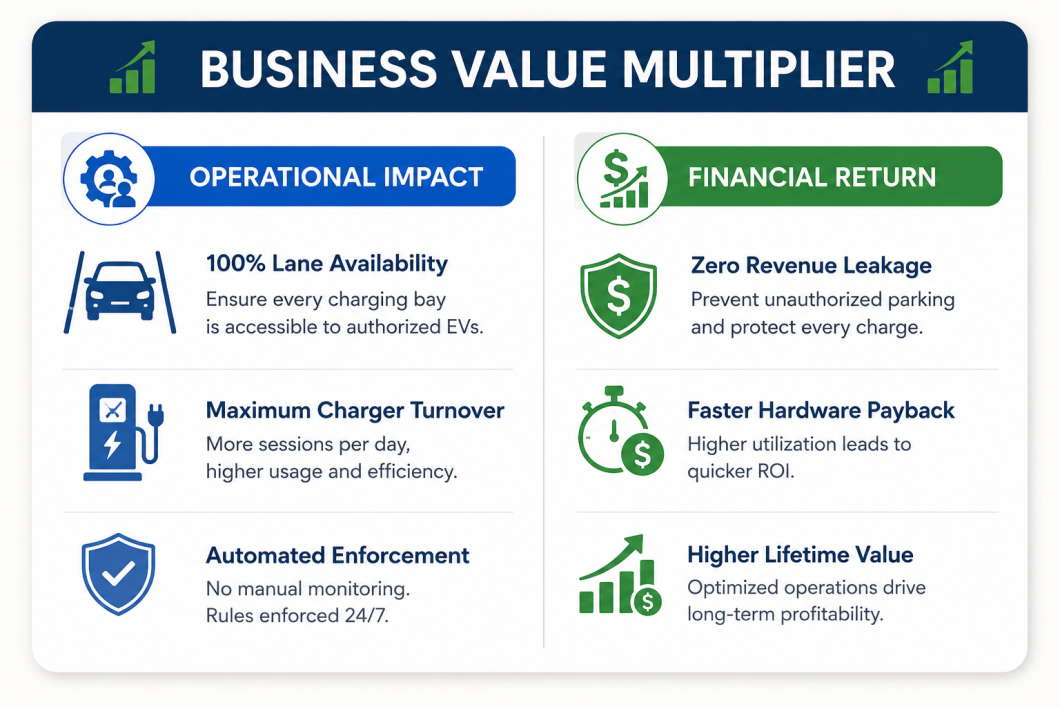
Investing in automated physical barriers provides clear operating advantages:
- Improved Charger Availability: True EV drivers do not have to worry about blocked lanes when traveling to a charging site.
- Higher Charger Utilization: Removing parked, non-charging vehicles opens up spots for a steady stream of paying cars throughout the day.
- Revenue Protection: Operators can capture every dollar of potential business, without losing out to drivers who misuse parking stalls.
- Better Customer Satisfaction: Drivers learn they can trust your location for an easy, predictable charging experience, turning them into repeat customers.
- Reduced Operational Costs: Eliminates the need to hire parking attendants, print violation tickets, or manage expensive towing logistics.
- Enhanced Security: Physical barriers act as a visible deterrent against vandalism, theft, and unauthorized dumping of old equipment around expensive charging stations.
- Scalable EV Infrastructure Management: A single central dashboard can monitor and control hundreds of distributed barriers across multiple locations, making it easy to grow your business network.
Cost Savings and ROI: Are Automatic Boom Barriers Worth the Investment?
When reviewing project budgets, facility managers often ask if physical barriers are worth the extra upfront hardware cost. The answer becomes clear when looking at operational savings and revenue protection.
Blocked bays directly reduce revenue. While fast charger profit margins vary by location (typically 10–30% net margin) operators report significant ROI improvements after implementing access control.
By adding an automatic boom barrier, you recover that lost revenue. Furthermore, you eliminate the overhead costs of manual lot management. Instead of paying continuous labor costs for security sweeps or handling customer service disputes, a smart barrier automates enforcement day and night.
Most commercial operators see a full return on investment (ROI) on their access control hardware within 6 to 12 months of installation.
Industry-Specific Use Cases
The benefits of automated boom barriers extend beyond public charging stations. Organizations across various industries use them to improve charger availability and parking management.
1. Shopping Malls and Retail Spaces
Keeps high-turnover premium bays clear for shopping guests who intend to charge while spending money inside stores.
2. Airports and Transit Hubs
Prevents travelers from abandoning regular gas cars in short-term EV valet or charging lanes for days at a time.
3. Hotels and Hospitality
Allows front-desk teams to easily reserve charging bays for premium guests by issuing temporary access codes or pre-registering license plates.
4. Office Complexes
Enables facility teams to separate employee charging access, executive parking permissions, and public visitor use.
5. Residential Communities
Secures shared neighborhood charging facilities so only paying residents can access the power lines, preventing outside drivers from taking up spots.
6. Fleet Depots and Logistics Hubs
Secures critical delivery assets by ensuring high-voltage charging terminals are always open for commercial vans on tight schedules.
Implementation Best Practices
To get the most out of an automated parking access upgrade, consider these steps during planning:
- Define Access Policies Early: Decide who should use the spaces. Is the site open to the general public, restricted to building tenants, or reserved for paid club members?
- Choose the Right Authentication Method: Pick a validation system that matches your target audience. Use ANPR or mobile apps for public lots, and stick to RFID for restricted corporate or fleet depots.
- Integrate Hardware with EV Charging Software: Ensure your boom barriers communicate smoothly with your central EV Charging Management Solution via standard protocols like OCPP (Open Charge Point Protocol). This connection ensures the barrier lifts automatically as soon as a user starts a session or pays in the app.
- Monitor Usage Patterns: Review your system data regularly to check parking turnover times, peak utilization hours, and unexpected gate failures to continuously improve operations.
- Maintain Barrier Hardware Regularly: Schedule routine inspections for barrier arms, safety loop sensors, and motor drives so everything operates smoothly in extreme hot or cold weather.
- Educate Users: Put up clear, simple signs ahead of the charging bay area explaining exactly how to unlock the gate (e.g., “Scan QR Code to Open Barrier”). This keeps traffic moving smoothly.
Common Mistakes to Avoid
- Leaving Charging Bays Unrestricted: Relying entirely on driver courtesy or standard paint markings always leads to unauthorized parking and lost revenue.
- Using Signage Without Physical Enforcement: Warning signs without real consequences or physical barriers rarely deter determined drivers when parking spaces are scarce.
- Ignoring Utilization Data: Failing to connect your gate tracking logs with your main station dashboard prevents you from identifying hardware issues or tracking lost income.
- Poor Access Control Integration: Buying standalone barriers that do not talk to your EV charging app creates a frustrating, multi-step process for drivers.
- Lack of Maintenance Planning: Skipping regular physical tune-ups can lead to jammed barrier arms, creating long lines and hurting customer trust.
IoTStudioz Perspective: Why Modern EV Charging Stations Need Smart Access Control
As EV adoption grows, charging stations need better ways to manage parking access and charger availability. Unrestricted charging bays can lead to unauthorized parking, lower utilization, and lost revenue.
Smart access control solutions such as boom barriers, RFID, QR codes, and ANPR help ensure that charging spaces remain available for authorized users. As EV infrastructure expands, these technologies will become essential for efficient and scalable charging operations.
Conclusion
Leaving your EV charging bays unprotected is a significant risk for any modern infrastructure setup. Signs and floor paint simply cannot stop drivers from taking over premium spaces when parking is limited. Physical automatic boom barriers provide a complete, automated solution to this problem.
By preventing unauthorized parking, these smart entry gates protect your charging revenue, maximize daily charger use, and eliminate the hassle of manual parking enforcement. More importantly, they provide an organized, reliable charging experience that brings drivers back to your property.
As the EV landscape grows more competitive, securing your chargers with smart, automated access control is the best way to safeguard your infrastructure investment and keep your business moving forward.
FAQs
1. How do you stop unauthorized parking at EV charging stations?
The most reliable method is installing physical automatic boom barriers at the entrance of individual charging bays. These barriers block access by default and only open when a driver verifies they are driving an electric vehicle or starts a paid charging session through an integrated app, RFID card, or license plate camera.
2. What is an EV parking management system?
An EV parking management system is a smart combination of hardware and software designed to oversee charging spots. It uses ground sensors, automated gates, security cameras, and network software to track occupancy, handle payments, and ensure that only active, paying electric vehicles can access charging bays.
3. Can boom barriers be integrated with EV chargers?
Yes. Modern automatic boom barriers connect directly with EV chargers using industrial IoT gateways and standard communication protocols like OCPP. This integration allows a single action, like scanning an app or processing a charging payment – to trigger the barrier arm to lift automatically.
4. How does RFID access control work for EV charging stations?
An authorized driver holds a keycard or key fob near an active card reader mounted next to the charging slot. The reader validates the user’s ID credentials against a secure database. Once confirmed, the system signals the barrier gate to open and enables power to the charger.
5. What is ANPR in parking management?
ANPR stands for Automatic Number Plate Recognition. It uses specialized cameras and character-recognition software to read a vehicle’s license plate as it approaches a bay. The system instantly checks the plate against a database of authorized users or reservations to open the barrier hands-free.