


The Internet of Things (IoT) has moved beyond simple connected devices. Businesses now use connected technologies to monitor equipment, track assets, collect operational data, automate processes, and improve decision-making across industries.
However, building an IoT solution involves more than installing sensors and connecting them to the cloud. Businesses must consider hardware, connectivity, data management, cybersecurity, system integration, scalability, compliance, and long-term maintenance. Poor planning can lead to security risks, integration issues, unexpected costs, and performance problems.
IoT consulting can help. An experienced IoT consultant can evaluate business needs, identify practical use cases, recommend suitable technologies, design a secure architecture, and create a realistic implementation roadmap. Consultants can also help connect IoT systems with existing business platforms and support ongoing management.
In this IoT Consulting Guide, we will explain what IoT consulting involves, the services consultants provide, how the consulting process works, common implementation challenges, project costs, industry use cases, and how to choose the right consulting partner.
Table of Contents
What Is IoT Consulting?
IoT consulting is the process of helping businesses plan and build connected technology solutions based on their operational and technical requirements.
An IoT consultant looks at the complete picture rather than focusing only on individual devices. This can include sensors, embedded systems, connectivity, gateways, edge computing, cloud infrastructure, data platforms, applications, cybersecurity, and enterprise integrations.
For example, a manufacturer may want to monitor machines remotely and identify signs of equipment failure. The consulting process could involve deciding what machine data to collect, which sensors are suitable, how to transmit that data, where to process it, how to generate alerts, and how to connect the information to existing maintenance software.
The goal is to create an IoT solution that addresses a real business requirement and can continue to work as the project grows.
Why Businesses Need IoT Consulting
IoT projects bring together several areas of technology that normally require different types of expertise. Hardware, embedded software, networking, cloud platforms, cybersecurity, data engineering, and business applications all need to work together.
Without proper planning, businesses can end up with disconnected systems, unsuitable hardware, security gaps, expensive infrastructure, or an architecture that becomes difficult to scale.
IoT consulting helps businesses make important technology and architecture decisions before they commit heavily to development and deployment.
For example, a consulting team may help determine:
- What problem should the IoT solution solve?
- Which assets or devices need to be connected?
- What type of data should be collected?
- Which sensors and hardware are appropriate?
- Which connectivity option fits the environment?
- Should processing happen at the edge, in the cloud, or across both?
- How will IoT data connect with existing business applications?
- How will devices be secured and managed?
- What happens when the number of connected devices increases?
Answering these questions early can make the later development process more predictable and reduce costly changes.
Benefits of IoT Consulting
IoT consulting helps businesses turn connected technologies into secure, scalable, and measurable solutions that support long-term growth.
Better Technology Selection
There are many hardware, connectivity, cloud, and software options available for IoT projects. A consultant can evaluate those choices against the project’s actual requirements instead of selecting technology simply because it is popular.
A Clearer IoT Roadmap
An IoT idea often starts with a broad objective such as reducing downtime or improving asset visibility. Consulting can turn that objective into defined use cases, technical requirements, priorities, and implementation stages.
Lower Implementation Risk
Testing architectural assumptions before full-scale development can help identify problems with connectivity, hardware, integrations, security, or scalability earlier in the process.
Scalable Architecture
A solution designed for a small pilot may not perform the same way when thousands of devices are connected. IoT consulting considers future device volume, data growth, infrastructure requirements, and device management from the beginning.
Better Use of IoT Data
Collecting data is only one part of an IoT project. Businesses also need to determine how that data will be processed, visualized, analyzed, and used. Consulting helps connect data collection with actual operational decisions.
Stronger Security Planning
IoT security needs to be considered across devices, networks, applications, data, and user access. Addressing these areas during architecture planning is generally more effective than trying to fix security issues after deployment.
The Main Technologies Behind an IoT Solution
An IoT solution is made up of several interconnected layers. The exact architecture depends on the business use case, environment, device type, and deployment scale.
Devices and Sensors
Sensors collect information from physical assets and environments. Depending on the application, they may measure temperature, pressure, vibration, humidity, movement, location, energy consumption, or other conditions.
The choice of sensor depends on factors such as accuracy, operating environment, power requirements, measurement range, and expected lifespan.
Connectivity
Connected devices need a reliable way to communicate with other systems.
Depending on the project, this could involve Wi-Fi, Bluetooth, Ethernet, cellular networks, LPWAN technologies, or other communication methods.
The right choice depends on range, bandwidth, power consumption, coverage, mobility, and deployment conditions.
IoT Gateways
Gateways can sit between devices and larger networks or cloud platforms. They may collect information from multiple devices, translate protocols, filter data, and perform local processing.
They can be particularly useful when devices use different communication protocols or when some data needs to be processed locally.
Edge Computing
Edge computing allows certain processing tasks to happen closer to the source of the data.
This can be useful when an application needs low latency, local decision-making, reduced bandwidth usage, or continued operation when cloud connectivity is unavailable.
Cloud and IoT Platforms
Cloud infrastructure can support device management, data storage, processing, analytics, application hosting, monitoring, and other services required by an IoT ecosystem.
Data and Analytics
IoT devices can generate large volumes of information. Data pipelines, databases, dashboards, analytics systems, and machine learning models help turn that information into something useful.
Security
Security applies across the entire IoT lifecycle. Device identity, authentication, secure communication, access control, software updates, monitoring, and data protection all need to be considered.
Understanding IoT Architecture
A simplified IoT architecture can be represented as:
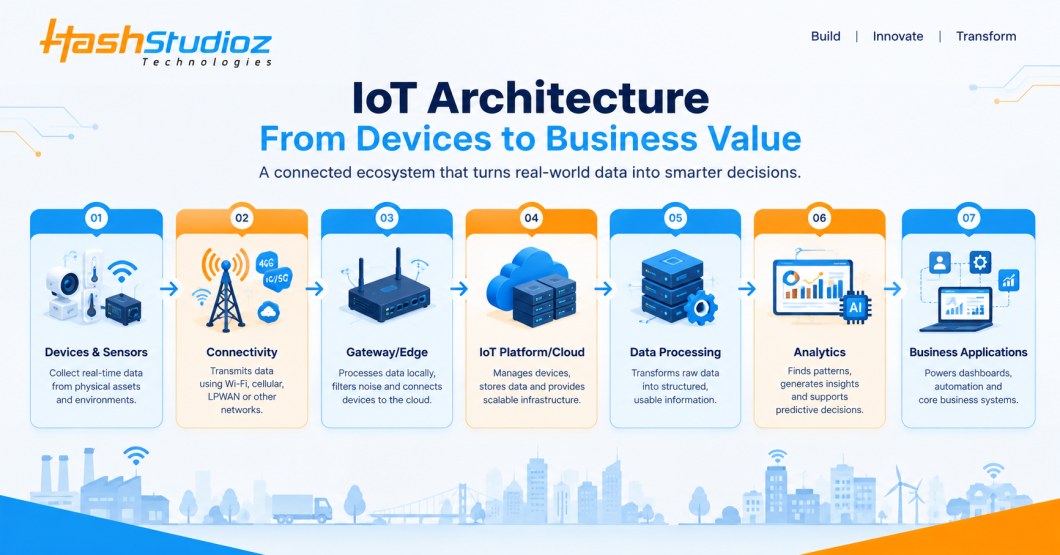
Each layer performs a different role.
Devices collect information from the physical environment. Connectivity moves that information between systems. Gateways or edge devices can process selected data locally. Cloud or IoT platforms manage devices and provide infrastructure for data processing and storage. Analytics systems turn data into insights, while business applications allow teams to use those insights.
Not every IoT solution requires every layer in the same way.
For example, a simple asset tracker may require a sensor, cellular connectivity, cloud infrastructure, and a dashboard. An industrial system may require multiple sensors, industrial gateways, edge computing, cloud services, analytics, enterprise integration, and real-time alerts.
This is why IoT architecture should be designed around the requirements of the application rather than copied from another project.
Key IoT Consulting Services
IoT consulting can cover different stages of a connected technology project, from initial planning to deployment and support.
IoT Strategy and Roadmap
The first step is often understanding what the business wants to achieve.
Consultants can identify potential use cases, evaluate their feasibility, prioritize projects, define technical requirements, and create a roadmap for implementation.
IoT Feasibility Assessment
Before development begins, a feasibility assessment can help determine whether a proposed solution is technically and commercially practical.
This may include evaluating hardware availability, connectivity, data requirements, integration requirements, security, infrastructure, and expected deployment conditions.
IoT Architecture and Design
Architecture consulting defines how devices, networks, gateways, edge systems, cloud services, databases, applications, and users will interact.
A good architecture also considers scalability, reliability, security, maintenance, and future expansion.
Hardware and Device Consulting
The right hardware depends heavily on the use case.
Consultants can help evaluate sensors, microcontrollers, gateways, communication modules, embedded systems, and other components based on performance, environment, power requirements, connectivity, cost, and expected production volume.
Connectivity Consulting
Connectivity decisions can affect device reliability, battery life, operating costs, and coverage.
An IoT consultant can help compare available connectivity technologies based on factors such as range, bandwidth, mobility, latency, power consumption, and network availability.
IoT Security Consulting
Security should be part of the architecture rather than an afterthought.
Consulting can cover device authentication, access control, secure communication, encryption, software updates, monitoring, vulnerability management, and other security considerations.
IoT Data Management and Analytics
Consultants can help define how data should be collected, transmitted, processed, stored, visualized, and analyzed.
The objective is to make sure the data generated by connected devices supports a useful business process rather than simply accumulating in a database.
IoT Integration
Many IoT projects need to connect with existing business systems such as ERP, CRM, supply chain platforms, manufacturing software, mobile applications, or analytics tools.
Integration planning defines how information should move between the IoT environment and these systems.
IoT Testing and Quality Assurance
Testing becomes particularly important when devices operate in different physical environments or communicate through multiple technologies.
IoT testing may cover hardware behavior, connectivity, interoperability, application performance, security, reliability, and scalability.
IoT Deployment and Support
After development, businesses still need to manage connected devices and infrastructure.
Ongoing support can include device monitoring, troubleshooting, software updates, security patches, performance improvements, and system expansion.
How Does IoT Consulting Work?
A typical IoT consulting process can include the following stages.
1. Business and Requirement Analysis
The consulting team first identifies the business problem, users, assets, processes, expected outcomes, and technical constraints.
2. Feasibility Study
The proposed solution is evaluated from technical, operational, and commercial perspectives.
3. IoT Strategy
The team defines the priority use cases, implementation roadmap, technology direction, and major project milestones.
4. Architecture Design
The required devices, connectivity, gateways, edge systems, cloud infrastructure, applications, data systems, and security controls are mapped out.
5. Proof of Concept
For projects with significant technical uncertainty, a proof of concept can be used to test critical assumptions before full-scale development.
6. Development and Integration
Hardware, firmware, cloud services, applications, dashboards, APIs, and integrations are developed according to the agreed architecture.
7. Testing
The complete system is tested under expected operating conditions, including connectivity, performance, security, interoperability, and scalability.
8. Deployment
The solution is introduced into the target environment and monitored closely during the initial deployment stage.
9. Optimization and Scaling
After deployment, the solution can be improved, expanded to additional devices or locations, and integrated with new systems as business requirements change.
When Should a Business Hire an IoT Consultant?
Not every IoT project requires external consulting. For a simple proof of concept, an experienced internal team may be able to manage the initial work.
Professional consulting becomes particularly useful when the project involves several technologies, systems, or deployment environments.
A business may benefit from IoT consulting when:
- It is starting a new connected product.
- Existing equipment needs to be connected.
- The team is unsure which hardware or connectivity technology to choose.
- A proof of concept needs to move into production.
- The solution requires cloud and edge computing.
- Multiple device types need to work together.
- IoT data must integrate with ERP, CRM, or other enterprise systems.
- The project has significant cybersecurity or compliance requirements.
- The solution needs to scale across thousands of devices.
- Internal teams do not have enough IoT architecture or implementation experience.
Getting these decisions right before development can reduce rework when the solution moves from a small pilot to a larger deployment.
IoT Consulting vs. IoT Development
IoT consulting and IoT development are closely connected, but they serve different purposes within a project.
Consulting focuses on strategy, planning, and technical decision-making, while development turns those decisions into a working solution.
During the consulting stage, an IoT expert may evaluate:
- Which sensors and devices are appropriate
- How connected devices should communicate
- Whether edge computing is needed
- Which cloud architecture fits the project
- How IoT data should be stored and processed
- How the solution will integrate with existing applications
- What security measures should be implemented
- How the system can scale as device numbers and data volumes grow
Once the technical direction is established, the development team can build and integrate the required components. This may include hardware integration, firmware, cloud services, APIs, dashboards, mobile applications, and other software.
For businesses with complex IoT requirements, working with a partner that offers both IoT consulting and development can create better continuity between planning and implementation. It also helps teams address technical decisions early and reduce communication gaps as the project moves toward deployment.
What Does IoT Consulting Cost?
There is no universal price for IoT consulting because the scope of an IoT project can vary significantly.
A consulting engagement may involve a short feasibility assessment, a detailed architecture project, a proof of concept, or support for a large-scale connected product.
Several factors can affect the cost:
- Project scope
- Number and type of devices
- Hardware complexity
- Connectivity requirements
- Cloud infrastructure
- Edge computing requirements
- Data volume
- Application complexity
- Third-party integrations
- Security requirements
- Compliance requirements
- Deployment size
- Ongoing support requirements
A business should therefore define its objectives and technical requirements before comparing consulting proposals.
The lowest initial consulting cost does not necessarily represent the lowest overall project cost. A solution that requires major architectural changes later can become more expensive than one that was properly planned from the beginning.
IoT Consulting Use Cases Across Industries
IoT has applications across industries because connected systems can collect information from physical assets and environments.
| Industry | Example Use Case | Business Objective |
| Manufacturing | Machine monitoring | Reduce unplanned downtime |
| Healthcare | Remote monitoring | Improve access to patient data |
| Logistics | Fleet and asset tracking | Improve asset visibility |
| Agriculture | Soil and environmental monitoring | Improve resource management |
| Retail | Connected inventory | Improve stock visibility |
| Energy | Equipment monitoring | Improve asset performance |
| Automotive | Connected vehicle systems | Improve vehicle insights |
| Smart Cities | Infrastructure monitoring | Support better public services |
The technology stack will differ between these applications.
For instance, an industrial IoT project may need edge processing, industrial protocols, rugged hardware, and integration with manufacturing systems. A fleet tracking system may place more emphasis on GPS, cellular connectivity, battery performance, and location data.
Common IoT Implementation Challenges
IoT projects can face technical and operational challenges at several stages.
Device Compatibility
Devices from different manufacturers may use different protocols, data formats, or communication methods. Without proper planning, integrating them can become difficult.
Connectivity Reliability
A connected solution is only useful when devices can communicate reliably. Physical location, network coverage, interference, bandwidth, and power limitations can all affect connectivity.
Data Management
IoT systems can produce large amounts of data. Businesses need to determine what information should be collected, processed, stored, analyzed, or discarded.
Security
Connected devices can introduce additional security considerations. Weak authentication, outdated software, insecure communication, and poor access controls can expose systems to unnecessary risks.
Scalability
An architecture that works for a pilot may struggle when the number of devices, users, locations, and data sources increases.
Legacy System Integration
Businesses often need IoT solutions to work with systems that were not originally designed to handle real-time device data. APIs, middleware, data transformation, and custom integration may be required.
Device Lifecycle Management
IoT planning should account for provisioning, monitoring, updates, maintenance, replacement, and eventual retirement of devices.
How to Choose the Right IoT Consulting Company
Choosing an IoT consulting company should involve more than checking the number of technologies listed on its website.
Start by looking at whether the provider understands your business objective and can translate it into a practical technical plan.
Consider whether the company can support:
- Business and technical requirement analysis
- IoT strategy and roadmap development
- Feasibility studies
- Architecture design
- Hardware and device integration
- Connectivity planning
- Cloud and edge implementation
- Data and analytics
- Cybersecurity
- Enterprise integrations
- Proof-of-concept development
- Testing and deployment
- Post-deployment support
It is also worth asking about the company’s development process, documentation, testing practices, communication model, project reporting, and experience with projects similar to yours.
A good consulting partner should be able to explain why a particular technology or architecture is appropriate rather than simply recommending a technology because it is widely used.
How HashStudioz Approaches IoT Consulting
At HashStudioz Technologies, our approach to IoT consulting starts with understanding the business problem behind the technology.
A connected solution should have a clear purpose. Whether the objective is asset monitoring, predictive maintenance, remote operations, connected products, real-time dashboards, or process automation, the technical architecture needs to support that objective.
Our IoT capabilities can support businesses across areas such as:
- IoT strategy and planning
- Feasibility assessment
- IoT architecture
- Hardware and device integration
- Connectivity
- Cloud integration
- IoT dashboards
- Data and analytics
- System integration
- IoT application development
- Testing and deployment
We can also support projects that move from consulting and architecture into actual IoT development. This can be useful for businesses that want to work with one technical partner across planning, development, integration, and deployment.
For businesses looking for IoT Consulting Services, HashStudioz can support the journey from initial strategy and feasibility assessment to architecture, integration, development, and deployment.
IoT Consulting Trends to Watch in 2026
The IoT landscape continues to evolve, and several technology areas are influencing how businesses plan connected solutions.
Edge Computing and Distributed Processing
More IoT applications are using local processing when response time, bandwidth, privacy, or network availability makes cloud-only processing impractical.
AI-Powered IoT
IoT data can be combined with AI and machine learning to support anomaly detection, predictive maintenance, forecasting, classification, and automated decision-making.
The value is increasingly shifting from simply collecting data to using that data to identify patterns and support business decisions.
Greater Focus on IoT Security
Security is becoming a lifecycle consideration. Businesses need to think about device identity, secure communication, updates, vulnerability management, access controls, monitoring, and device retirement.
Industry-Specific IoT Solutions
IoT architecture is increasingly being designed around specific industries and operational environments rather than relying on generic implementations.
Manufacturing, healthcare, logistics, agriculture, energy, and retail can have very different requirements even when they use similar underlying IoT technologies.
Connected Systems With AI and Automation
IoT, edge computing, analytics, and AI can work together to create systems that not only report what is happening but also help businesses respond to changing conditions.
IoT Lifecycle Management
As deployments become larger, managing devices throughout their lifecycle becomes increasingly important. Provisioning, monitoring, updates, security, maintenance, replacement, and retirement all need to be part of the overall strategy.
Key Takeaways
IoT consulting is not simply about selecting sensors or connecting devices to the cloud. It involves understanding the business objective and designing a complete technology approach around it.
The most important points to remember are:
- IoT consulting helps businesses plan and implement connected technology solutions.
- IoT architecture needs to account for devices, connectivity, data, cloud or edge infrastructure, applications, and security.
- Consulting can help businesses make technology decisions before development becomes expensive to change.
- IoT projects should be designed with scalability and device lifecycle management in mind.
- IoT consulting can support both new connected products and existing IoT environments.
- AI, edge computing, cybersecurity, and industry-specific solutions are shaping the future of IoT.
- The right consulting partner should be able to connect business requirements with practical technical decisions.
Final Thoughts
Successful IoT initiatives depend on more than selecting connected devices or collecting data. Businesses also need a clear understanding of their operational goals, integration requirements, security responsibilities, and long-term maintenance needs.
A structured consulting process helps bring these elements together. It can support better use-case prioritization, more informed technology decisions, smoother system integration, and a practical roadmap for implementation and future improvements.
Whether you are planning a new connected product, modernizing business operations, or expanding an existing IoT deployment, expert guidance can help reduce uncertainty and create a solution that delivers measurable value.
Explore HashStudioz IoT solutions and consulting capabilities to discuss your connected technology requirements.
Frequently Asked Questions
1. What is an IoT consulting company?
An IoT consulting company helps businesses plan, design, implement, and improve IoT solutions. Its services can include strategy, architecture, technology selection, security, integration, development, deployment, and support.
2. What does an IoT consultant do?
An IoT consultant evaluates business and technical requirements and recommends the right approach for building or improving a connected solution. This can include architecture design, technology selection, security planning, integration, and implementation guidance.
3. What are the main IoT consulting services?
Common IoT consulting services include IoT strategy, feasibility assessment, architecture design, hardware and connectivity consulting, security, data management, analytics, system integration, testing, deployment, and ongoing support.
4. Why do businesses need IoT consulting?
Businesses use IoT consulting to choose suitable technologies, reduce implementation risks, design scalable architectures, address integration and security challenges, and ensure their IoT investment supports clear business objectives.
5. How much does IoT consulting cost?
IoT consulting costs vary based on project scope, number of devices, hardware requirements, connectivity, cloud and edge infrastructure, integrations, security requirements, deployment scale, and ongoing support needs.
6. What is the difference between IoT consulting and IoT development?
IoT consulting focuses on strategy, planning, architecture, and technology decisions, while IoT development focuses on building the hardware, firmware, cloud services, applications, dashboards, APIs, and integrations needed for the solution.