



The global travel and tourism economy contributed USD 11.6 trillion to global GDP in 2025 and is forecast to reach around USD 12 trillion in 2026, accounting for roughly 9.8–9.9% of the world economy. The sector supported 366 million jobs in 2025 (about 1 in 9 jobs worldwide) and is expected to support 376 million jobs in 2026, also representing 1 in 9 jobs globally.
According to IATA, major crisis periods such as the COVID‑19 pandemic have caused airline revenue losses exceeding USD 100 billion, with later estimates surpassing USD 250 billion in lost passenger revenue. But the real issue is not disruption itself. It is outdated, manual‑heavy systems that cannot respond at digital speed.
In 2026, survival depends on digital maturity, API‑first architecture, and automated workflows. This guide outlines how OTAs, DMCs, and travel platforms can stay resilient and competitive in volatile conditions.
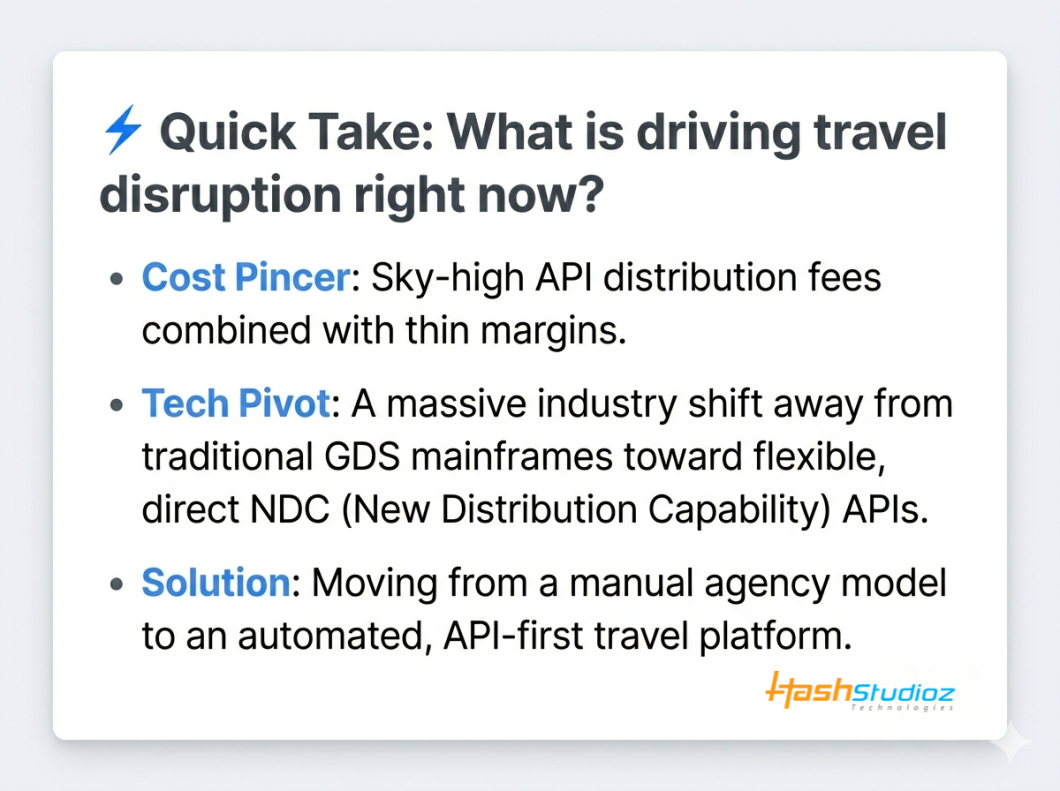
Table of Contents
Why Travel Businesses Face High Risk During Market Disruptions
To build a resilient operation, you must first diagnose where your infrastructure leaks cash and efficiency when a crisis strikes.
1. Structural Over-Dependency on Legacy Intermediaries
A significant portion of mid-market travel operators rely entirely on singular Global Distribution Systems (GDS) or rigid third-party wholesalers. This creates an immediate risk vector:
- Margin Compression: Layered intermediary fees drain profitability, leaving no financial cushion when volumes drop.
- Lack of Data Ownership: When a supplier modifies a policy or a route network, legacy intermediaries often suffer from data propagation latency, causing the travel agency to sell stale or invalid inventory.
2. The Cash Flow Imbalance and Liquidity Pressures
Travel businesses operate on unique working capital cycles: receiving advance client payments, utilizing supplier credit lines, and navigating delayed settlement windows. When market disruptions trigger a wave of cancellations, this cycle breaks. Without automation, managing the resulting refund backlogs can trigger an immediate liquidity crisis.
3. Asymmetric Support Volumetric Scaling
During market disruptions, booking cancellations and rescheduling requests spike exponentially. A legacy agency relying on manual customer service queues will see its support channels collapse under the volume. This leads to long hold times, brand erosion, and costly chargebacks.
4. Fragmented Digital Footprints
Many travel companies still manage operations across disconnected silos: a legacy website, a separate un-APIed CRM, and manual accounting spreadsheets. This lack of a unified data layer makes it impossible to pivot pricing strategies, re-target past customers, or audit multi-provider inventory in real time.
The Digital Maturity Vector: Industry telemetry shows that companies with mature CRM systems, unified API frameworks, and cloud-native booking infrastructures maintain better operational continuity during global disruptions. In contrast, manual-heavy operations often face severe delays, inefficiencies, and support backlogs.
Strategic Survival Framework: Technical Execution Roadmap
Transforming your travel business from a vulnerable intermediary into a resilient digital platform requires executing a multi-layered optimization strategy.
1. Architectural Transition to API-First Infrastructure
To insulate your platform from single-point-of-failure vulnerabilities, your system architecture must decouple the user interface (frontend) from the supply aggregation layer (backend).
Modern travel engines must integrate a multi-source orchestration layer capable of querying traditional GDS platforms alongside modern New Distribution Capability (NDC) channels and direct hospitality APIs simultaneously.
This abstraction layer standardizes highly disparate incoming data formats into a singular, clean JSON schema within your system, allowing you to route traffic dynamically based on provider stability, speed, and net cost.
2. Customer Retention and LTV Optimization
When customer acquisition costs (CAC) spike during a downturn, profitable operators pivot from aggressive acquisition to intensive customer lifetime value (LTV) preservation.
- Automated Travel Credits: Instead of processing cash refunds that deplete liquidity, configure your booking workflow to automatically offer a 110% tokenized travel credit voucher valid for 18–24 months.
- Dynamic Rebooking Engines: Deploy microservices that continuously track price changes on canceled paths, alerting customers with personalized options to rebook when rates drop in their favor.
3. Deploying Context-Aware Communication Frameworks
In moments of industry panic, communication bottlenecks destroy brand trust. Implement asynchronous, triggered messaging loops across high-accessibility networks like WhatsApp, SMS, and email. Use real-time webhooks hooked into flight-status aggregators to instantly push automated alerts to affected passengers before they arrive at the airport, cutting inbound support tickets at the source.
4. Workforce Optimization via Systemic Automation
During low-demand cycles, manual operations suffer high labor cost overheads. High-maturity organizations shift human capital away from repetitive data entry toward higher-value tasks by automating core workflows:
- Auto-Ticketing and Automated Queue Processing: Let software handle PNR generation, voiding windows, and standard ticket issuance.
- Data-Cleaning and CRM Enrichment: Use down-periods to write scripts that deduplicate customer records, build rich traveler profiles, and clean up historical booking histories.
5. Revenue Stream Diversification: Mitigating Single-Vertical Risk
A zero-hedged travel business focused solely on one niche (e.g., international leisure) is highly vulnerable to localized shocks. Broaden your transactional surface area:
- Corporate Travel Management (SME Focus): Build basic unmanaged or lightly managed B2B booking portals tailored for small businesses requiring flexible, last-minute travel.
- Subscription and Loyalty Programs: Introduce premium, tier-based membership models providing curated access to zero-markup ancillary products (lounge passes, premium insurance, expedited visa processing) in exchange for predictable, recurring monthly revenue.
The Tech Stack Pivot: GDS + NDC Hybridization
To understand why modern travel systems operate with higher efficiency, we must examine the data distribution paradigm shift occurring across the aviation ecosystem.
The Transition Metric
Traditional GDS platforms rely on decades-old EDIFACT syntax, requiring standard fare filing through third parties. This limits pricing agility and separates ancillary services (e.g., baggage, extra legroom, meals) from the core ticket booking. The IATA-backed New Distribution Capability (NDC) framework uses lightweight, modern XML/JSON schemas. This allows airlines to pass rich content and tailored bundles directly to your booking engine.
Architectural Performance Metrics (2026 Benchmarks)
- OTA Conversion Rates: 2% – 5%
- Cart Abandonment Rates: 60% – 80%
- Latency Reduction via Native API Pipelines: Up to 40% lower response times compared to legacy systems.
- Operational Efficiency Improvements via End-to-End Automation: 30% – 45% reduction in manual processing overhead.
Emerging Trends and Post-Disruption Recovery Models
Looking forward, the structural integration of artificial intelligence and lean API platforms will continue to reshape the competitive landscape.
1. Context-Driven AI Travel Assistants
Moving past basic rules-based chatbots, the next wave of travel assistants leverages natural language processing (NLP) architectures mapped directly to underlying booking APIs. Users can execute complex commands (e.g., “Find a flight to Lisbon under $600 with an outbound window after 6 PM, and add a 4-star hotel with a gym”) and receive single-checkout booking paths within a unified chat or voice interface.
2. Real-Time Algorithmic Pricing Engines
Rather than applying fixed margin markups, resilient travel platforms deploy programmatic pricing engines. These engines track localized demand curves, search frequency, and competitor prices to dynamically adjust margins, protecting booking volume during downturns and maximizing profitability during demand spikes.
3. API Consolidation and Unified Gateways
To eliminate the architectural complexity of maintaining dozens of distinct supplier endpoints, the market is shifting toward unified travel APIs. These meta-gateways abstract multiple airline, hotel, and car-rental pipelines into a singular endpoint, reducing code maintenance costs and boosting system stability.
Enterprise Resilience Matrix: Survivors vs. Attrition Risks
| Architectural Attribute | Resilient Survivors (Modern Digital Platform) | High-Risk Attrition (Legacy Travel Agency) |
| Data Flow Logic | Asynchronous, decoupled API microservices. | Synchronous, monolithic legacy architectures. |
| Operational Workflow | Programmatic automation for ticketing & refunds. | Manual processing of queues and Excel rosters. |
| Supplier Connectivity | Hybrid GDS + Direct NDC API pipelines. | Single-channel GDS reliance with high third-party exposure. |
| Pricing Execution | Real-time algorithmic dynamic adjustments. | Static, manual entry markup rule sheets. |
| Financial Risk Management | Automated customer credits & multi-gateway routing. | High vulnerability to refund backlogs and chargebacks. |
Conclusion: Building for Continuous Resilience
The transformation of the global travel market is not a cyclical phase; it is an architectural evolution. Travel companies that treat technology as a cost center rather than a core engine are highly vulnerable to market shocks and margin erosion.
To thrive through ongoing industry disruptions, your strategy must focus on building an automated, data-agile platform. By decoupling your infrastructure from legacy dependencies, adopting robust API orchestration, and automating your workflows, your business can turn operational friction into a scalable competitive advantage. Survival isn’t just about weathering the storm; it is about designing the systems built to navigate it.
FAQs
1. What is an API-first travel platform?
An API-first travel platform connects airlines, hotels, payment systems, and booking engines through real-time APIs. This improves automation, pricing accuracy, scalability, and operational efficiency.
2. Why are travel businesses moving from GDS to NDC?
Travel companies are shifting from traditional GDS systems to NDC APIs for better pricing flexibility, direct airline content, lower distribution costs, and personalized booking experiences.
3. How can OTAs reduce operational risk during market disruptions?
OTAs can reduce risk by using cloud infrastructure, workflow automation, diversified supplier integrations, automated refunds, and real-time customer communication systems.
4. Why is automation important for modern travel businesses?
Automation reduces manual processing, improves response times, minimizes operational costs, and helps travel companies handle cancellations, ticketing, and customer support more efficiently.
5. How do modern travel platforms improve customer retention?
Modern platforms use AI-driven recommendations, automated travel credits, personalized offers, and dynamic rebooking systems to improve customer experience and long-term retention.