


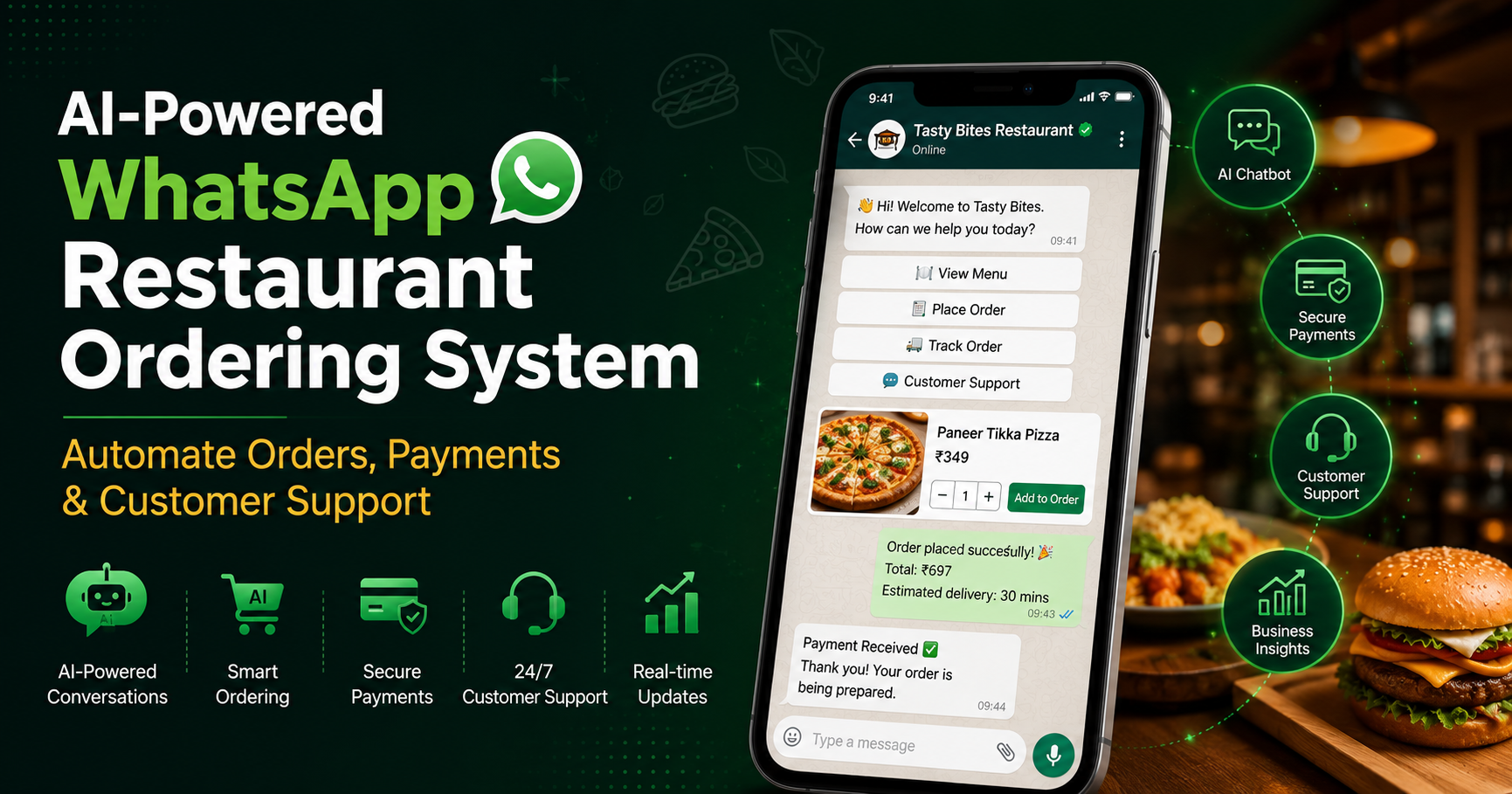
The way customers order food has changed significantly in recent years, with convenience and speed becoming major factors in decision-making. Customers increasingly expect instant responses, seamless ordering experiences, and real-time updates through the digital channels they already use every day.
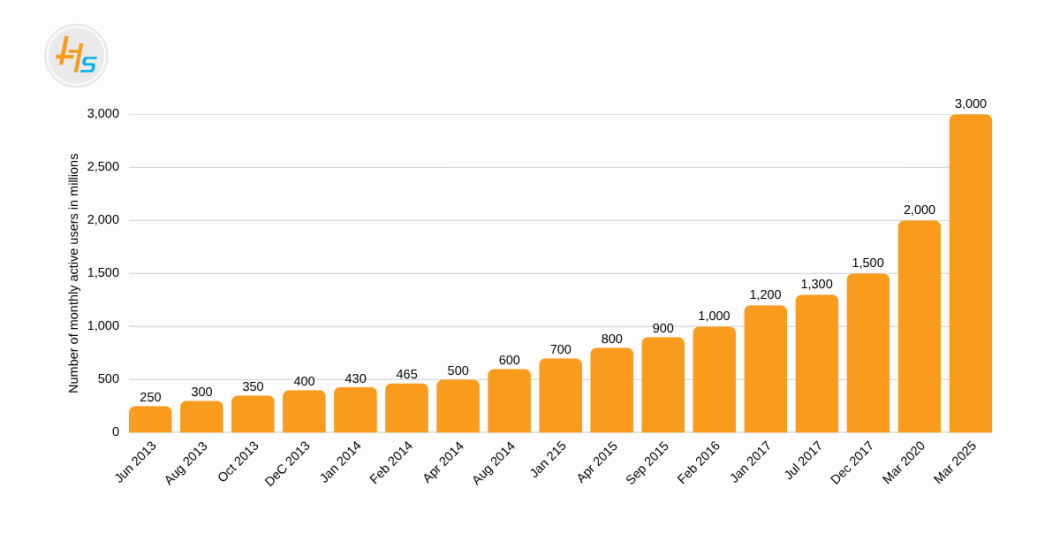
Strong market trends support the shift toward mobile-first communication. WhatsApp now serves more than 3 billion monthly active users worldwide, making it one of the most widely used messaging platforms globally. At the same time, businesses across industries are seeing growing customer demand for conversational interactions that reduce friction and simplify transactions.
For restaurants, this trend presents a significant opportunity. However, many establishments still rely on phone calls and manual order management processes that can create delays, increase staff workload, and contribute to order inaccuracies during busy periods.
AI-powered WhatsApp ordering systems address these challenges by automating customer interactions, order processing, payment collection, and status updates within a single conversation. As digital ordering continues to evolve, conversational commerce is becoming an important strategy for restaurants seeking to improve operational efficiency while delivering a more convenient customer experience.
Table of Contents
Why Traditional Restaurant Ordering Methods Are Falling Short
Restaurant operations have become more complex than ever before. Orders now arrive from multiple sources, including phone calls, websites, delivery marketplaces, social media platforms, and walk-in customers.
While these channels generate business, they also create operational challenges.
A phone-based ordering process depends entirely on staff availability. If employees are busy handling customers or managing kitchen operations, calls may go unanswered. Even when an order is received, manual entry increases the risk of mistakes.
Third-party delivery platforms solve some of these issues but introduce new concerns. Restaurants often pay significant commission fees and have limited control over customer relationships.
The result is a fragmented ordering experience that affects both efficiency and profitability.
| Common Challenge | Business Impact |
| Missed Calls | Lost Orders |
| Manual Order Entry | Higher Error Rates |
| Slow Response Times | Poor Customer Experience |
| Third-Party Commissions | Reduced Profit Margins |
| Disconnected Systems | Operational Inefficiencies |
Restaurants are now looking for solutions that simplify operations without creating additional complexity for customers.
What Is an AI-Powered WhatsApp Restaurant Ordering System?
An AI-powered WhatsApp restaurant ordering system allows customers to interact with a restaurant through natural conversations while automating much of the ordering process behind the scenes.
Instead of downloading an app or waiting for a phone call, customers can simply send a message through WhatsApp.
The AI handles menu navigation, order placement, payment assistance, delivery tracking, and support requests in a single conversation.
Unlike traditional chatbots that depend on predefined responses, modern AI systems can understand context and respond more intelligently. Customers can ask questions in different ways, request menu recommendations, or modify orders without following a fixed conversation path.
For restaurants, this creates a more scalable and consistent customer experience while reducing the workload placed on staff.
AI-Powered WhatsApp Ordering vs Traditional Ordering Systems
The difference between traditional ordering and AI-powered ordering becomes clear when restaurants start scaling operations.
Traditional systems often require additional staff to manage growing order volumes. AI-powered systems can handle thousands of customer interactions simultaneously without affecting response times.
| Feature | Traditional Ordering | AI-Powered WhatsApp Ordering |
| Order Handling | Manual | Automated |
| Customer Support | Limited Hours | 24/7 Availability |
| Personalization | Staff Dependent | AI Driven |
| Order Tracking | Manual Updates | Real-Time Notifications |
| Scalability | Limited | High |
| Customer Experience | Inconsistent | Consistent |
The objective is not to replace employees. Instead, AI handles repetitive interactions so restaurant teams can focus on service quality and operational excellence.
How an AI-Powered WhatsApp Ordering System Works
The customer experience may appear simple, but several technologies work together in the background.
The process typically follows this workflow:
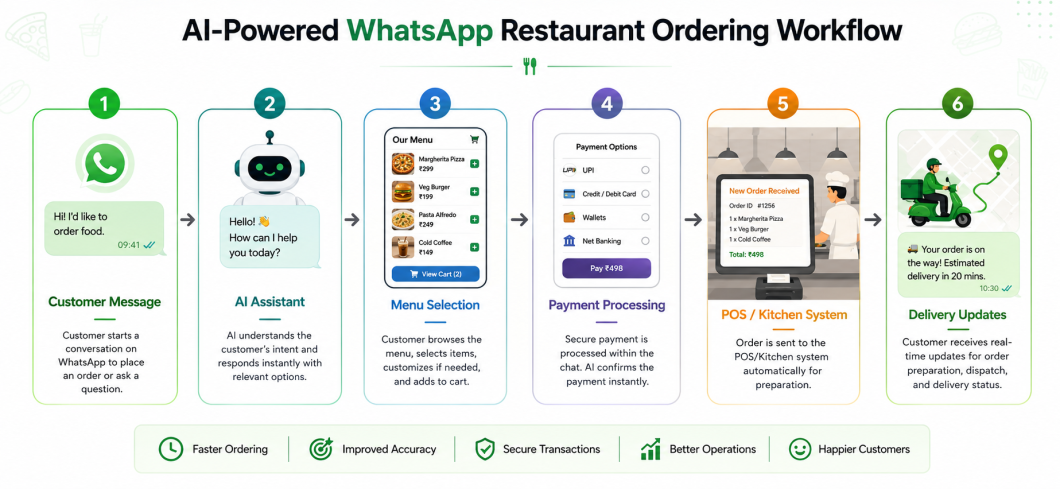
Once a customer starts a conversation, the AI identifies the request and presents relevant menu options. After the order is confirmed, payment processing begins automatically.
The completed order is then pushed to the restaurant’s operational systems. Depending on the setup, this could include the POS platform, kitchen display system, inventory software, or delivery management solution.
Throughout the process, customers receive automatic updates without needing to contact support teams for order status information.
This creates a faster and more transparent ordering experience.
Technical Architecture of an AI-Powered WhatsApp Ordering System
A successful solution depends on more than a chatbot. Multiple systems must work together to create a seamless customer experience.
A simplified architecture looks like this:
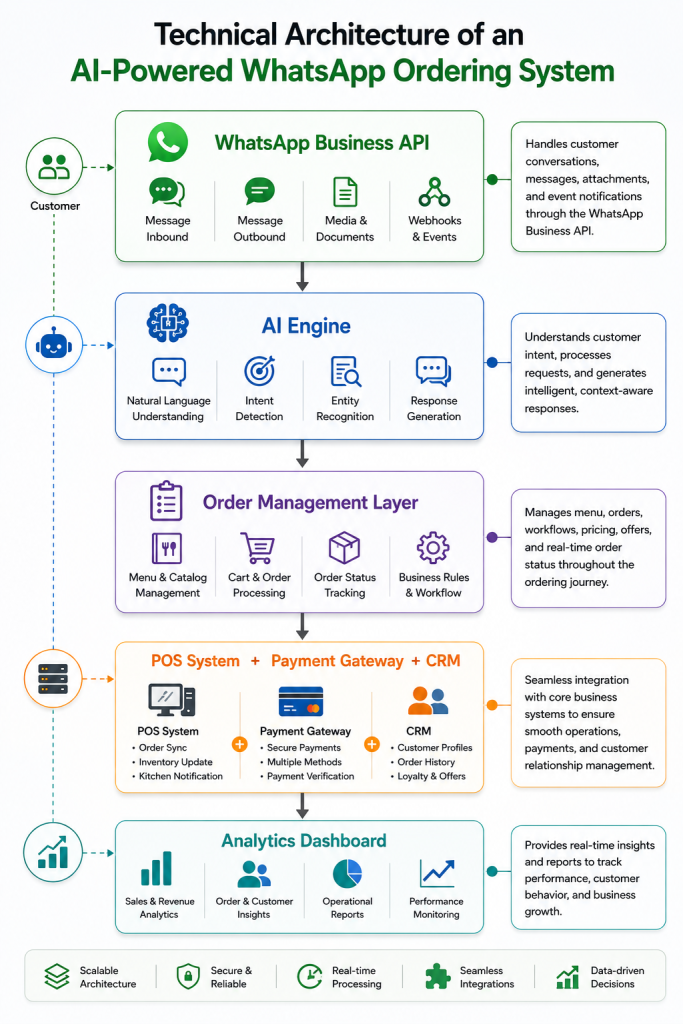
Each component plays a specific role.
The WhatsApp Business API manages customer communication. The AI engine understands requests and generates responses. Integration layers connect conversations to operational systems, while analytics dashboards provide visibility into customer behavior and business performance.
This architecture allows restaurants to automate workflows without disrupting existing operations.
AI-Powered Upselling and Revenue Optimization
Most restaurants focus on acquiring new customers. However, increasing the value of existing orders often delivers faster returns.
AI helps identify upselling opportunities during the ordering process.
For example, a customer ordering a pizza may receive recommendations for beverages, desserts, or combo upgrades based on previous ordering patterns and customer preferences.
Because these suggestions appear naturally within the conversation, they feel more helpful than promotional.
Over time, these automated recommendations can increase average order value while maintaining a positive customer experience.
For restaurants operating at scale, even a small increase in average order size can have a significant impact on revenue.
Restaurant Analytics and Customer Insights with AI
Every customer interaction generates data. The challenge is turning that data into actionable insights.
Traditional ordering channels often provide limited visibility into customer behavior. Restaurants may know what was sold, but they rarely understand why certain items perform better, when customers are most active, or what drives repeat purchases.
An AI-powered WhatsApp ordering system changes this by capturing valuable customer interactions in real time.
Restaurant managers can track:
- Best-selling menu items
- Peak ordering hours
- Customer retention rates
- Average order value
- Popular payment methods
These insights help businesses make informed decisions. A restaurant that identifies declining demand for a menu item can adjust promotions or update offerings before revenue is affected. Similarly, understanding peak ordering periods helps optimize staffing and kitchen operations.
Instead of relying on assumptions, restaurants can use data to improve both customer experience and profitability.
Multi-Location Restaurant and Franchise Management
Managing a single restaurant is challenging enough. Managing multiple locations introduces an entirely different level of complexity.
Franchise operators often struggle with inconsistent customer experiences, fragmented reporting, and inefficient order routing.
An AI-powered WhatsApp ordering system helps centralize operations while maintaining flexibility across locations.
For example, when a customer places an order through WhatsApp, the system can automatically identify the nearest branch based on the delivery location. Orders are routed to the appropriate restaurant without requiring manual intervention.
At the management level, decision-makers gain a unified view of performance across all branches.
This enables restaurant groups to maintain operational consistency while scaling efficiently.
AI-Powered Payments and Checkout Automation
A smooth ordering experience can quickly fall apart if the payment process becomes complicated.
Customers expect fast and secure transactions. Long checkout flows often result in abandoned orders and lost revenue.
AI-powered WhatsApp ordering systems simplify the process by integrating payment options directly within the conversation.
Customers can complete payments using UPI, digital wallets, debit cards, credit cards, or net banking without switching between multiple platforms.
The system can also verify successful transactions automatically and update order status instantly.
This reduces manual verification work for restaurant staff and ensures customers receive immediate confirmation of their purchase.
A faster checkout experience benefits both the customer and the business.
AI-Powered Customer Support on WhatsApp
Restaurants receive hundreds of repetitive customer questions every week.
Customers frequently ask about delivery status, menu availability, operating hours, offers, refunds, and order modifications.
Handling these requests manually consumes valuable staff time.
AI-powered support automation allows restaurants to respond instantly to common inquiries without requiring human intervention.
For example, if a customer asks, “Where is my order?”, the AI can retrieve the latest status update and respond within seconds.
When conversations become more complex, the system can transfer the interaction to a support representative.
This hybrid approach ensures customers receive fast responses while support teams focus on issues that genuinely require human attention.
Security and Compliance Considerations
Customer trust is critical in the restaurant industry. Any system that handles payments and personal information must prioritize security.
An AI-powered WhatsApp ordering platform should include secure authentication mechanisms, encrypted communication channels, and reliable payment integrations.
Beyond technical security, restaurants must also consider compliance requirements related to customer data privacy.
A well-designed solution helps protect:
| Security Area | Purpose |
| Customer Data | Prevent unauthorized access |
| Payment Information | Reduce transaction risks |
| Order Records | Maintain operational accuracy |
| Business Systems | Protect internal operations |
Security is not just a technical requirement. It directly influences customer confidence and brand reputation.
Cost Analysis: AI-Powered WhatsApp Ordering vs Mobile App Development
Many restaurant owners assume they need a dedicated mobile application to digitize their ordering process.
While mobile apps can be effective, they often require significant investment in development, maintenance, updates, and user acquisition.
WhatsApp-based ordering systems offer a more accessible alternative.
| Factor | Mobile App | WhatsApp Ordering System |
| Customer Onboarding | Requires Download | Instant Access |
| Development Cost | Higher | Lower |
| Maintenance Effort | Continuous Updates | Relatively Low |
| User Adoption | Depends on Installs | Uses Existing Platform |
| Time to Market | Longer | Faster |
For many restaurants, the biggest advantage is customer convenience. Since customers already use WhatsApp, there is no barrier to entry.
This often leads to higher engagement and faster adoption rates.
Build vs Buy: Choosing the Right WhatsApp Ordering Solution
When adopting WhatsApp automation, restaurants generally face two options: purchasing a ready-made platform or developing a custom solution.
Ready-made solutions offer faster deployment and lower initial investment. They work well for businesses with basic requirements and limited customization needs.
However, as operations grow, many restaurants require deeper integrations, advanced workflows, and unique customer experiences.
A custom-built solution provides greater flexibility.
| Business Requirement | Recommended Approach |
| Quick Deployment | Ready-Made Platform |
| Basic Ordering Automation | Ready-Made Platform |
| Custom Integrations | Custom Solution |
| Multi-Branch Management | Custom Solution |
| Advanced Analytics | Custom Solution |
| Long-Term Scalability | Custom Solution |
The right choice depends on business goals, operational complexity, and growth plans.
Real-World Use Cases of AI-Powered WhatsApp Ordering
The flexibility of WhatsApp ordering makes it suitable for different restaurant business models.
1. Quick Service Restaurants (QSRs)
QSRs benefit from faster order processing and reduced waiting times. AI helps manage high-volume orders without increasing staff workload.
2. Cloud Kitchens
Cloud kitchens operate entirely through digital channels. WhatsApp ordering creates a direct customer relationship while reducing dependence on third-party platforms.
3. Fine Dining Restaurants
Fine dining establishments can use AI to handle reservations, answer menu-related questions, and provide personalized customer assistance.
4. Restaurant Chains
Multi-location brands can centralize customer communication while routing orders to the most appropriate branch.
Each model benefits differently, but the objective remains the same: improving efficiency while enhancing customer experience.
Future Trends in AI-Powered Restaurant Ordering
The next generation of restaurant automation will go beyond simple order management.
AI systems are becoming increasingly capable of understanding customer preferences, predicting purchasing behavior, and delivering personalized experiences.
Emerging trends include:
- Voice-based ordering through WhatsApp
- AI-generated menu recommendations
- Predictive ordering suggestions
- Automated loyalty program management
- Hyper-personalized promotional campaigns
As AI technology continues to evolve, restaurants will gain new opportunities to improve customer engagement and operational performance.
Businesses that adopt these capabilities early are likely to gain a competitive advantage in an increasingly digital market.
Business Impact: What Restaurants Can Expect After Implementation
Investing in an AI-powered WhatsApp ordering system delivers benefits beyond simple automation. Restaurants can respond to customers faster, handle multiple conversations at once, and reduce the manual workload associated with order taking and support.
The system can also help increase revenue through personalized upselling and promotional recommendations during the ordering process. In addition, customer data and ordering trends provide valuable insights that support better decisions around staffing, inventory, and marketing.
The overall business impact often includes:
| Area | Expected Outcome |
| Customer Response Time | Faster customer interactions |
| Order Accuracy | Fewer manual errors |
| Support Workload | Reduced staff dependency |
| Average Order Value | Higher revenue per order |
| Customer Satisfaction | Improved user experience |
| Operational Efficiency | Better resource utilization |
| Customer Retention | Increased repeat orders |
While results vary based on business size and implementation strategy, restaurants that successfully adopt AI-powered WhatsApp automation are often better positioned to scale operations, improve customer engagement, and drive long-term growth.
Why Choose HashStudioz for AI-Powered WhatsApp Restaurant Ordering Solutions?
Building a successful WhatsApp ordering platform requires much more than chatbot development. It requires seamless integration between communication channels, payment systems, restaurant operations, and business intelligence tools.
HashStudioz develops custom AI-powered restaurant automation solutions tailored to specific business requirements.
Our expertise includes:
- AI chatbot development
- WhatsApp Business API integration
- Payment gateway integration
- POS and CRM connectivity
- Analytics dashboard development
- Restaurant workflow automation
Whether you operate a single restaurant, a cloud kitchen, or a multi-location franchise, our team can help create a scalable solution that supports growth while improving customer experiences.
Conclusion
Customer expectations continue to reshape the restaurant industry. Faster responses, convenient ordering, secure payments, and personalized interactions are no longer optional—they are becoming standard expectations.
An AI-powered WhatsApp restaurant ordering system helps restaurants meet these demands through automation, intelligent customer engagement, and streamlined operations.
By combining ordering, payments, customer support, analytics, and business intelligence within a single platform, restaurants can reduce operational complexity while creating a better experience for customers.
For businesses looking to modernize their ordering process and strengthen customer relationships, WhatsApp-powered AI automation offers a practical and scalable path forward.