


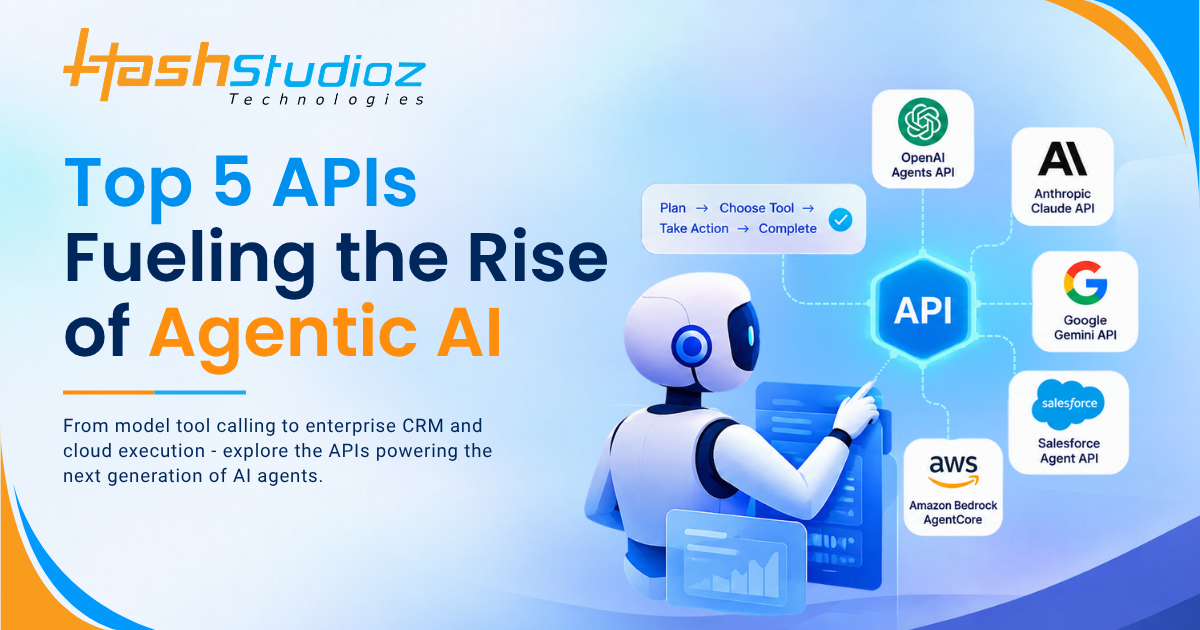
Agentic AI is changing how enterprises use artificial intelligence. Instead of only generating answers, AI agents can interpret goals, select tools, retrieve information, and perform actions across business systems.
APIs provide the connection between an agent’s reasoning and those systems. An agent may know that it needs to update a CRM record, check an order, query a database, or trigger a workflow, but it needs a controlled API to perform the action.
Enterprise adoption is moving quickly. McKinsey’s 2026 global AI survey found that 40% of respondents from organizations with more than $1 billion in annual revenue reported scaling AI agents, up from 27% the previous year. At the same time, Deloitte found that only 21% of surveyed enterprises had mature governance for agentic AI. This gap makes API architecture, access control, monitoring, and governance important parts of enterprise AI strategy.
This article examines five API ecosystems shaping agentic AI and explains where each fits into enterprise applications.
Table of Contents
What Makes an API Important for Agentic AI?
A conventional AI application can often operate with a simple request-and-response model. An agentic application needs a broader execution loop: understand the objective, decide what information or tool it needs, call the appropriate API, evaluate the result, and continue until the task is complete or requires human intervention.
This makes APIs an operational layer for agents. They provide structured access to CRM systems, databases, enterprise applications, search services, business workflows, and other tools. Well-designed agent APIs also define permissions, input schemas, authentication requirements, error handling, and observability.
For example, a revenue operations agent could identify stalled opportunities, retrieve account information, review customer interactions, and create follow-up tasks. The AI model handles reasoning, while APIs provide controlled access to the systems where those actions occur.
1. OpenAI Agents API
OpenAI introduced its Agents API in September 2026 as a public beta for building and running cloud agents with the Codex harness. The platform is designed to manage context, tools, subagents, files, code execution, and long-running agent workflows. This is significant because developers building autonomous applications often need more than model inference. They also need infrastructure to maintain context, coordinate multiple steps, execute tools, and keep long-running tasks operating reliably.
For enterprise teams, the Agents API can support workflows such as research, software engineering, document analysis, operational investigation, and multi-step business processes. Instead of building every part of the agent runtime internally, development teams can use a managed environment around the agent loop. The API also supports subagent coordination. That is useful when a complex workflow can be divided into specialized tasks.
For example, one agent could collect information, another could analyze it, and a coordinating agent could combine the results.
The main architectural consideration is control. Enterprises still need to determine which tools an agent can access, what data it can retrieve, which actions require approval, and how its activity will be logged.
Best fit: Long-running agents, multi-step workflows, research, coding, and applications requiring managed agent orchestration.
2. Anthropic Claude API
Anthropic’s Claude API provides tool-use capabilities that allow developers to connect Claude with external functions and systems. Developers define tools with names, descriptions, and input schemas. Claude can then determine when a tool is relevant and generate the structured input required for the application to execute it. This creates a clear separation between reasoning and execution. Claude can determine that it needs customer information, for example, while the enterprise application controls how the get_customer_account function actually retrieves that information.
The architecture works well for agents that need to combine reasoning with business tools. A sales agent could access account data, support history, product information, and contract details before preparing a recommendation. A research agent could use search and other tools to gather current information before producing an answer. Anthropic also supports server-side tools and parallel tool calling. Parallel execution can be useful when an agent needs several independent pieces of information. Instead of retrieving each source sequentially, the system can perform compatible tool calls concurrently.
For enterprise deployments, tool definitions and permissions deserve particular attention. A tool should expose a specific business capability rather than unrestricted access to an underlying system. This reduces the risk of an agent performing actions beyond its intended scope.
Best fit: Tool-heavy applications, research agents, knowledge workflows, coding agents, and multi-step reasoning systems.
3. Google Gemini API
Google’s Gemini API provides function calling that connects Gemini models with external tools and APIs. The model identifies when a function is required and returns the parameters needed for the application to execute that function. The important distinction is that the model does not directly execute the external function. The application receives the requested function and parameters, executes the operation, and sends the result back to the model. This creates a useful control boundary between AI reasoning and business-system execution.
Google identifies three major function-calling patterns: taking actions, augmenting model knowledge, and extending model capabilities. In an enterprise environment, these could include creating an invoice, checking inventory, querying a database, retrieving information from a knowledge base, or scheduling an appointment. Gemini also supports parallel and compositional function calling. An agent could retrieve several independent data points at the same time and then use those results to determine its next action.
For enterprise architects, this approach makes the API layer especially important. Function definitions should describe exactly what an action does, what parameters it accepts, and what the application should do with the result. Authentication and authorization should remain under application control rather than relying on the model to enforce access.
Best fit: Multimodal applications, tool-enabled assistants, data-connected agents, workflow automation, and applications that need structured function calling.
4. Salesforce Agent API
Salesforce is particularly relevant to enterprise agentic AI because CRM systems already contain the customer, account, opportunity, service, and revenue data that many business agents need. Salesforce’s current Agentforce developer platform includes an Agent API that allows applications to communicate with AI agents through REST. Developers can start sessions, send messages, receive responses, and end sessions programmatically.
This creates opportunities beyond conventional CRM chatbots. A revenue operations workflow could use an agent to examine opportunity information, customer history, and relevant business context before recommending or initiating a next action.
For example, an agent could help identify opportunities requiring attention, summarize account activity, answer product questions, or route qualified prospects to sales representatives. The key value comes from connecting AI capabilities with the CRM data and actions already used by the organization.
Salesforce’s own website implementation provides a real-world example. Salesforce reports that its Agentforce deployment has handled more than 100,000 conversations and generated more than 30,000 leads since launching in February 2025. Salesforce also reports a 40% year-over-year reduction in time to qualify opportunities. These figures are Salesforce-reported results rather than independent benchmarks.
For Salesforce Directors and RevOps leaders, the API question is therefore closely connected to process design. The objective is not simply to add an AI interface to Salesforce. It is to determine which CRM actions can be safely performed or assisted by agents and which decisions should remain with sales or operations teams.
Best fit: CRM automation, sales operations, customer service, lead qualification, account workflows, and Salesforce-native agent experiences.
5. Amazon Bedrock AgentCore APIs
Amazon Bedrock AgentCore approaches agentic AI from the runtime and infrastructure side. Rather than focusing only on model interaction, AgentCore provides infrastructure for running agents and tools in production environments. Its InvokeAgentRuntime API allows applications to send requests to agents or tools hosted in an AgentCore Runtime and receive responses, including streaming responses. The API also supports session identifiers and runtime-level permissions.
This matters because production agents behave more like distributed applications than traditional chat interfaces. They may need persistent sessions, controlled identities, tool access, runtime isolation, streaming responses, and operational monitoring. For organizations already using AWS, AgentCore can provide an infrastructure layer around agents while allowing teams to integrate them with existing cloud services and enterprise applications. It can also support architectures where different models or agent frameworks serve different business workloads.
A typical enterprise architecture might use a model API for reasoning, internal APIs for business actions, and AgentCore for runtime execution and infrastructure controls. This separation allows teams to change individual components without rebuilding the entire application. The main consideration is operational complexity. Agent infrastructure introduces new requirements around permissions, session management, observability, cost management, and failure handling. These need to be designed before an agent moves from a prototype into a production workflow.
Best fit: AWS-based enterprises, production agent infrastructure, runtime management, multi-service architectures, and organizations building agents at scale.
How These APIs Compare
These five API ecosystems address different parts of the agentic AI stack, so they should not necessarily be treated as direct substitutes.
| API ecosystem | Primary role | Enterprise relevance |
| OpenAI Agents API | Agent orchestration and long-running execution | Research, coding, complex workflows |
| Anthropic Claude API | Tool use and agent reasoning | Tool-heavy applications and knowledge workflows |
| Google Gemini API | Function calling and multimodal interaction | Data-connected and multimodal agents |
| Salesforce Agent API | CRM-native agent interaction | Sales, service, RevOps, and CRM workflows |
| Amazon Bedrock AgentCore | Agent runtime and infrastructure | Production deployment and AWS environments |
An enterprise architecture may use more than one of these technologies. For example, an organization could use a model API for reasoning, Salesforce APIs for CRM actions, and AWS infrastructure for deployment and monitoring.
The better architectural question is therefore not which API is universally preferable. It is which API provides the required capability, integration model, security controls, and operational characteristics for a specific workflow.
What Should Enterprises Consider Before Choosing an Agent API?
Model capability is only one part of the decision. Enterprise teams should evaluate the complete execution environment.
1. Tool integration is the first consideration. Check whether the API supports structured function calling, multiple tools, parallel execution, custom actions, and reliable error handling.
2. Identity and permissions are equally important. An agent should not automatically receive broad access to every system connected to an enterprise environment. Organizations need clear rules for which data an agent can access and which actions it can execute.
3. Observability should cover the complete agent workflow. Teams should be able to determine what request started the workflow, which tools the agent selected, what parameters it used, what systems returned, and what action followed.
4. Data and integration architecture also influence the outcome. McKinsey’s 2026 research notes that data limitations remain a major barrier to scaling agentic AI, while Deloitte’s August 2026 research found that 72% of surveyed leaders cited a lack of unified, accessible data as a challenge. These findings suggest that agent deployment cannot be separated from data architecture and integration work.
5. Cost and latency should be measured at the workflow level rather than only at the model level. An agent that makes several model calls and API requests may have a very different cost profile from a conventional chatbot. Enterprises should track cost per completed task, average execution time, failure rate, and human escalation rate.
Finally, governance needs to be part of the architecture from the beginning. Deloitte’s 2026 research found that only 21% of surveyed enterprises reported mature governance for agentic AI. Governance should define approval thresholds, restricted actions, data-access policies, audit requirements, monitoring, and escalation procedures.
How to Measure Agentic AI ROI
Agentic AI ROI should be measured against a specific business workflow. Suppose an organization processes 20,000 service cases each month. If the average case requires 15 minutes of employee time and the fully loaded labor cost is $30 per hour, manual handling represents approximately $150,000 in monthly labor capacity.
If an agent successfully handles 30% of those cases without human intervention, the theoretical labor capacity affected would be $45,000 per month, or $540,000 annually. This is an illustrative calculation, not a benchmark for typical agent performance. A production business case should subtract model usage, API calls, infrastructure, integration, monitoring, and human-review costs. It should also account for quality metrics such as successful completion rate, escalation rate, rework, customer satisfaction, revenue impact, and error frequency.
For RevOps teams, useful measures may include lead qualification time, opportunity coverage, seller hours saved, response time, conversion rate, and pipeline influenced by agent-assisted workflows.
Conclusion
APIs are becoming a foundational part of agentic AI because they connect AI reasoning with the systems where enterprise work actually happens. OpenAI, Anthropic, Google, Salesforce, and AWS are approaching this problem from different architectural angles, covering agent orchestration, tool use, function calling, CRM interaction, and production runtime infrastructure.
For CTOs and CIOs, the key decision is not simply which model or API has the most features. The more important question is how the API fits into the organization’s data, integration, identity, security, governance, and application architecture.
For Salesforce and RevOps leaders, the opportunity is particularly practical: agents can increasingly interact with CRM data and workflows instead of stopping at recommendations or generated text. The organizations that connect these capabilities to clearly defined business processes, measurable outcomes, and appropriate controls can evaluate agentic AI as an operational technology rather than another experimental AI interface.
Frequently Asked Questions
1. What is an API in agentic AI?
An API allows an AI agent to interact with external tools, applications, data, and business systems. Instead of only generating text, an agent can use APIs to retrieve information, update records, trigger workflows, or perform other authorized actions.
2. Which APIs are commonly used for agentic AI?
Major API ecosystems supporting agentic AI include OpenAI Agents API, Anthropic Claude API, Google Gemini API, Salesforce Agent API, and Amazon Bedrock AgentCore. Each serves different architectural needs, from model tool calling and agent orchestration to CRM integration and production runtime infrastructure.
3. How do APIs make AI agents more useful for enterprises?
APIs connect agents to the systems where business processes occur. An agent can use approved APIs to access CRM data, query databases, retrieve documents, create tasks, or trigger workflows. This allows organizations to move from AI-generated recommendations toward controlled task execution.
4. What should enterprises consider when selecting an agentic AI API?
Organizations should evaluate tool-calling capabilities, enterprise integrations, authentication, authorization, data handling, observability, latency, cost, scalability, and governance. The right choice depends on the specific workflow and existing technology architecture rather than model capability alone.
5. Are agentic AI APIs secure for enterprise applications?
They can be, provided organizations implement appropriate controls. Agents should receive only the permissions required for their tasks, while API calls should be authenticated, monitored, logged, and subject to approval policies where necessary. Sensitive actions should not rely solely on the AI model to enforce security.
6. How can businesses measure the ROI of agentic AI?
Businesses can measure metrics such as successful task-completion rate, processing time, human hours saved, cost per completed task, escalation rate, error rate, and revenue impact. Measuring these metrics against a defined business workflow provides a more useful ROI calculation than simply tracking the number of AI interactions.