


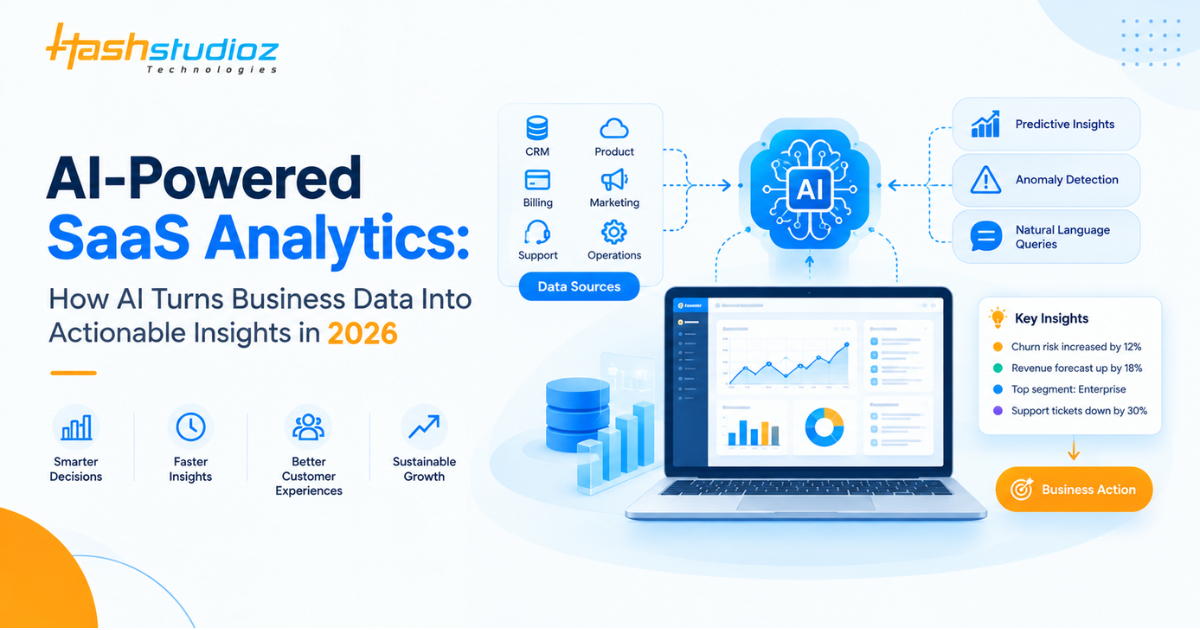
SaaS companies now generate data across product usage, subscriptions, sales, customer support, marketing, and operations. The challenge has shifted from collecting data to turning it into timely decisions. This is happening as enterprise AI investment continues to grow. Gartner forecasts $2.7 trillion in worldwide AI spending in 2026, a 49.5% increase from 2025. Gartner also reports that only 22% of organizations have successfully scaled AI across multiple business units or adopted an AI-first approach, showing the gap between investment and operational adoption. Meanwhile, McKinsey found that 88% of surveyed organizations used AI in at least one business function in 2025, but only 7% said they had fully scaled AI across their organizations.
AI-powered SaaS analytics addresses this gap by combining business intelligence, machine learning, predictive models, and natural-language interfaces. Instead of limiting teams to historical dashboards, modern analytics systems can detect unusual patterns, forecast outcomes, explain changes, and help users investigate business questions faster. The focus in 2026 is therefore moving from adding AI features to building reliable analytics systems that connect data, context, and business action.
Table of Contents
Key Takeaways
- AI-powered SaaS analytics combines SaaS data with AI and machine learning to generate business insights.
- It can support forecasting, anomaly detection, customer segmentation, churn analysis, and natural-language queries.
- The quality of AI analytics depends heavily on data quality, integration, governance, and business context.
- SaaS companies can apply AI analytics across product management, sales, marketing, finance, and customer success.
- Enterprise adoption requires more than an AI model; it also needs secure data architecture, monitoring, and measurable business goals.
- In 2026, AI agents, semantic data models, conversational analytics, and embedded analytics are becoming important areas of development.
What Is AI-Powered SaaS Analytics?
AI-powered SaaS analytics uses artificial intelligence and machine learning to analyze data generated by SaaS applications and business systems. It helps companies identify patterns, predict outcomes, detect anomalies, segment customers, and answer analytical questions.
Traditional SaaS analytics mainly explains what happened. For example, a dashboard may show monthly recurring revenue, active users, conversion rates, or churn. AI adds another layer by helping teams understand why a change occurred, what might happen next, and which patterns deserve attention.
A SaaS company could use this approach to identify customers whose usage has declined, forecast subscription revenue, detect an unusual increase in support tickets, or identify product features associated with stronger retention.
The goal is not to replace analysts or business leaders. Instead, AI reduces repetitive analysis and helps teams reach relevant information faster.
How Does AI SaaS Analytics Work?
An AI analytics platform usually connects several technical layers:
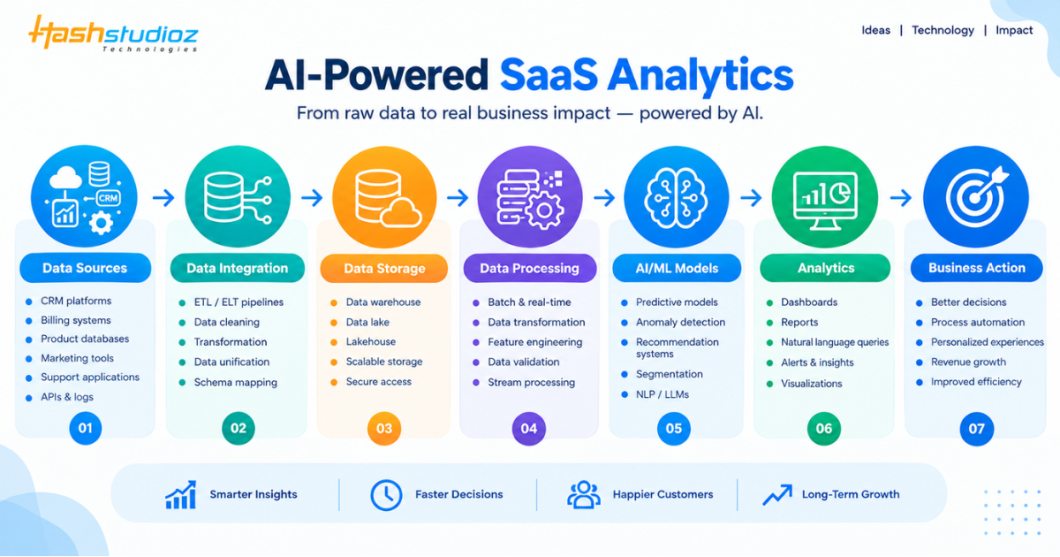
Data can come from CRM platforms, billing systems, product databases, marketing tools, support applications, APIs, and application logs. Integration pipelines then clean and combine the information so analytics systems can work with consistent datasets.
The AI layer depends on the business requirement. A company may use machine-learning models for churn prediction, anomaly detection for unusual activity, forecasting models for revenue planning, or natural-language technology for conversational analytics.
The final step connects insights to business workflows. For example, a churn signal can reach a customer-success platform, while a revenue anomaly can trigger an alert for the finance team.
AI Analytics vs. Traditional SaaS Analytics
| Capability | Traditional Analytics | AI-Powered Analytics |
| Historical reporting | Yes | Yes |
| Dashboards | Yes | Yes |
| Forecasting | Limited | Advanced |
| Anomaly detection | Rule-based | AI-assisted |
| Customer segmentation | Manual/rule-based | ML-assisted |
| Natural-language queries | Limited | Supported |
| Recommendations | Manual | AI-assisted |
| Predictive insights | Limited | Core capability |
| Automated explanations | Limited | Available |
Traditional analytics still plays an important role. AI-powered analytics adds predictive and contextual capabilities rather than making conventional reporting irrelevant.
Key Features of AI-Powered SaaS Analytics
AI-powered SaaS analytics combines traditional reporting with predictive and automated capabilities. The following features help SaaS teams move from simply monitoring past performance to identifying patterns, investigating changes, and making more informed decisions.
Predictive Analytics
Predictive analytics uses historical and current data to estimate future outcomes. SaaS companies can apply it to customer churn, revenue forecasting, demand planning, sales opportunities, and product engagement.
The reliability of these predictions depends on the quality of the underlying data. Businesses should therefore validate their event tracking, customer records, and metric definitions before relying on predictive models.
Anomaly Detection
Anomaly detection identifies activity that differs from an established pattern. It can help teams detect unusual changes in revenue, product usage, transactions, application performance, or customer behavior.
For example, an analytics platform could flag an unexpected decline in product activity among enterprise customers before the issue becomes visible in a monthly report.
Natural-Language Analytics
Natural-language analytics allows users to ask questions about business data without writing SQL or navigating multiple dashboards.
A user could ask, “Which customer segment had the highest churn last quarter?” The analytics system can interpret the question, retrieve the relevant data, and present the result in a conversational format.
This capability requires reliable business definitions and access controls. Without them, an AI system may produce an answer that sounds plausible but uses the wrong metric or dataset.
Customer Segmentation
AI can analyze customer behavior and identify groups based on usage, engagement, subscription activity, purchase history, or other signals.
These segments can support customer-success programs, product decisions, marketing campaigns, and personalized experiences.
AI-Generated Insights
AI can examine several related metrics and summarize important changes. Instead of showing only a revenue decline, a system might identify the customer segment, product behavior, or subscription activity associated with that change.
Organizations should keep important insights traceable to their underlying data so analysts can verify the results.
Common Use Cases
AI-powered analytics can support different stages of the SaaS business lifecycle, from acquiring and retaining customers to improving products and forecasting revenue. The most relevant use case depends on the type of data available and the business outcome the organization wants to improve.
Customer Churn Prediction
Churn models can analyze product usage, login frequency, feature adoption, support activity, subscription changes, and engagement patterns to identify customers who show characteristics associated with churn.
Customer-success teams can then investigate those accounts and decide whether an intervention is appropriate.
Revenue Forecasting
SaaS revenue depends on new customers, renewals, upgrades, downgrades, cancellations, and pricing changes. AI-assisted forecasting can combine these signals with historical data to produce more dynamic revenue estimates.
Finance teams can use these forecasts for budgeting, scenario planning, and resource allocation.
Product Analytics
Product teams can use AI analytics to study feature adoption, onboarding behavior, user journeys, and engagement patterns.
For example, an analytics model may reveal that customers who adopt a particular feature within their first month have higher long-term retention. Product teams can then investigate the finding and improve onboarding or feature discovery.
Sales Analytics
AI can analyze pipeline activity, customer interactions, historical deals, product usage, and CRM information to identify patterns in sales performance.
Sales teams can use these insights to examine conversion rates, pipeline health, and potential opportunities.
Marketing Analytics
Marketing analytics can connect campaign activity with leads, customers, product usage, and revenue. This provides a broader view of acquisition performance than impressions or clicks alone.
AI can also help identify customer segments that respond differently to campaigns or content.
Customer Support Analytics
Support conversations contain information about recurring product problems and customer concerns. AI can classify tickets, identify common themes, detect changes in issue volume, and connect support activity with customer behavior.
This can help product and customer-success teams investigate recurring problems.
AI SaaS Analytics Architecture
A practical architecture usually contains five major layers:
1. Data Sources: CRM, billing, product analytics, support, marketing, databases, APIs, and application logs.
2. Data Platform: ETL or ELT pipelines move and transform data into a warehouse, lake, or lakehouse.
3. Analytics and AI Layer: Machine-learning models, forecasting, anomaly detection, recommendation systems, and natural-language interfaces process the data.
4. Presentation Layer: Dashboards, reports, alerts, APIs, and conversational interfaces deliver results to users.
5. Business Workflow: Insights feed into CRM systems, customer-success processes, product decisions, financial planning, or other operational systems.
Security, data governance, monitoring, and access controls should run across all five layers.
What Data Does AI SaaS Analytics Need?
The required data depends on the business problem. Common sources include:
- Customer and account data
- Subscription and billing data
- Product usage events
- CRM records
- Sales pipeline data
- Marketing campaign data
- Customer-support records
- Application and operational logs
- Transaction data
The strongest analytical results often come from connecting several sources. For example, combining product usage with subscription data can provide a more useful view of customer retention than either dataset alone.
Benefits of AI-Powered SaaS Analytics
AI analytics can reduce the manual effort required to find patterns in large datasets. It can also help teams identify changes earlier and investigate business questions without depending entirely on specialized analysts.
For SaaS companies, the benefits can appear across several functions. Product teams can study feature adoption, finance teams can improve forecasting, customer-success teams can identify potential churn signals, and marketing teams can connect acquisition activity with customer outcomes.
Another important benefit is accessibility. Natural-language interfaces and embedded analytics can allow non-technical users to interact with business data while maintaining appropriate permissions and controls.
Challenges to Consider
Implementing AI analytics involves more than selecting an AI model or connecting a data source. SaaS companies must also address data quality, integration, security, model reliability, infrastructure costs, and governance to ensure that analytical results remain useful as the system grows.
1. Data Quality
Poor event tracking, inconsistent definitions, missing records, and duplicate data can produce unreliable results. AI does not correct these problems automatically.
2. Data Integration
SaaS businesses often use multiple systems with different identifiers and data structures. Connecting those systems can require significant data-engineering work.
3. Security and Privacy
Analytics platforms may process customer, financial, or operational information. Access controls, encryption, auditing, retention policies, and secure APIs should form part of the architecture.
4. Model Accuracy
AI predictions can become less accurate when customer behavior or market conditions change. Teams should monitor model performance and retrain or adjust models when required.
5. Cost and Scalability
Data storage, processing, model inference, and real-time analytics can increase infrastructure costs as usage grows. Architecture decisions should account for expected data volume and workload.
6. Governance
Organizations need clear ownership for data definitions, model behavior, access policies, and AI-generated outputs. Gartner reported in 2026 that organizations with successful AI initiatives invested up to four times more, as a share of revenue, in foundational areas such as data quality, governance, AI-ready skills, and change management.
How to Implement AI SaaS Analytics
A successful AI analytics implementation should start with a defined business objective rather than with a specific AI technology. A structured approach helps teams identify the right data, select suitable analytical methods, integrate insights into existing workflows, and measure whether the solution delivers the intended business impact.
1. Define the Business Problem
Start with a measurable objective rather than an AI feature. Examples include reducing churn, improving forecast accuracy, increasing feature adoption, or detecting operational anomalies.
2. Map the Data
Identify the systems that contain the information required for the use case. Check data quality, availability, ownership, and update frequency.
3. Build the Data Foundation
Create consistent data models, pipelines, definitions, validation rules, and access controls before introducing complex AI capabilities.
4. Select the Right AI Approach
Not every analytics problem requires generative AI. Depending on the use case, statistical models, machine learning, anomaly detection, recommendation systems, or language models may provide better results.
5. Integrate Analytics Into the Product
Present insights through dashboards, APIs, alerts, embedded analytics, or conversational interfaces based on how users work.
6. Measure the Results
Track technical performance and business outcomes. Review accuracy, adoption, cost, latency, and the effect on the target business metric.
AI SaaS Analytics Development Services by HashStudioz
HashStudioz Technologies provides AI, machine learning, data analytics, and SaaS development services for businesses building or upgrading analytics-driven products. Its capabilities include predictive analytics, business intelligence, custom dashboards, AI/ML integration, data engineering, and SaaS architecture. These services can support use cases such as predictive analytics, customer insights, natural-language analytics, and analytics integration within existing SaaS applications.
For companies planning to develop an AI-powered SaaS analytics platform or add advanced analytics to an existing product, HashStudioz can help with the data, AI, backend, API, and application layers required for production deployment.
Business Impact and ROI
AI analytics should have measurable objectives. A useful ROI model can compare the cost of the analytics program with improvements in measurable business or operational metrics.
For example, consider a SaaS company that spends 1,000 analyst hours each quarter preparing recurring reports. If automation reduces that workload by 30%, the company saves 300 hours per quarter. The financial value depends on the organization’s actual loaded labor cost.
Other measurable indicators can include:
| Business Metric | Possible Measurement |
| Reporting effort | Analyst hours saved |
| Churn | Change in customer churn rate |
| Revenue forecasting | Forecast error reduction |
| Product adoption | Increase in feature adoption |
| Support | Reduction in repetitive analysis time |
| Sales | Change in qualified pipeline or conversion |
| Infrastructure | Analytics cost per user or query |
| Decision speed | Time from data availability to action |
These figures should come from the organization’s own baseline. A generic ROI percentage cannot accurately represent every SaaS business.
AI SaaS Analytics Trends in 2026
AI is changing how SaaS companies collect, analyze, and interact with business data. In 2026, the focus is shifting toward conversational analytics, AI agents, embedded insights, semantic data models, and analytics systems that connect data with operational decision-making.
1. Conversational Analytics
Business users increasingly expect to interact with analytics through natural language. The key requirement is not only language understanding but also accurate retrieval, business context, permissions, and traceable results.
2. AI Agents
AI agents can perform multi-step analytical tasks, such as retrieving data, comparing metrics, investigating anomalies, and preparing summaries. Organizations need strong controls before allowing agents to take actions automatically.
3. Embedded Analytics
SaaS vendors are placing analytics directly inside their applications. This reduces the need for users to move between separate reporting tools and makes data part of the product experience.
4. Semantic Data Models
AI systems need consistent definitions for metrics such as active users, churn, revenue, and customer lifetime value. Semantic models can provide that context and reduce ambiguity when users ask analytical questions.
5. Data and Analytics Platform Convergence
Gartner identifies AI agents, advances in semantics, and convergence of data and analytics platforms among the major data and analytics trends for 2026. These developments point toward analytics architectures that connect data management, business context, AI, and decision workflows more closely.
Conclusion
AI-powered SaaS analytics is moving beyond static reporting. Modern platforms can combine historical analysis with prediction, anomaly detection, natural-language queries, and contextual business insights.
For SaaS companies, the strongest implementations begin with a clear business problem and a reliable data foundation. AI should then support specific analytical tasks and connect its outputs to the workflows where teams make decisions.
The technology will continue to evolve through 2026, but the fundamentals remain consistent: reliable data, clear metrics, secure architecture, appropriate AI models, measurable outcomes, and human oversight. Companies that build around these principles can create analytics systems that support better decisions without treating AI as a substitute for sound data practices.
Frequently Asked Questions
1. What is AI-powered SaaS analytics?
AI-powered SaaS analytics applies artificial intelligence and machine learning to SaaS and business data. It can support forecasting, anomaly detection, customer segmentation, recommendations, and natural-language analytics.
2. How does AI improve SaaS analytics?
AI can analyze large datasets, identify patterns, detect anomalies, forecast outcomes, and help users investigate business questions through natural-language interfaces.
3. Can AI analytics predict customer churn?
Yes. Churn models can analyze customer behavior and identify patterns associated with previous churn. Businesses should validate these predictions against actual customer outcomes.
4. Can AI analytics integrate with an existing SaaS product?
Yes. Integration can use APIs, data pipelines, embedded dashboards, machine-learning services, or conversational interfaces. The appropriate architecture depends on the existing product and data environment.
5. What are the main AI analytics trends in 2026?
Key areas include conversational analytics, AI agents, embedded analytics, semantic data models, predictive analytics, and tighter integration between data platforms and AI systems.