


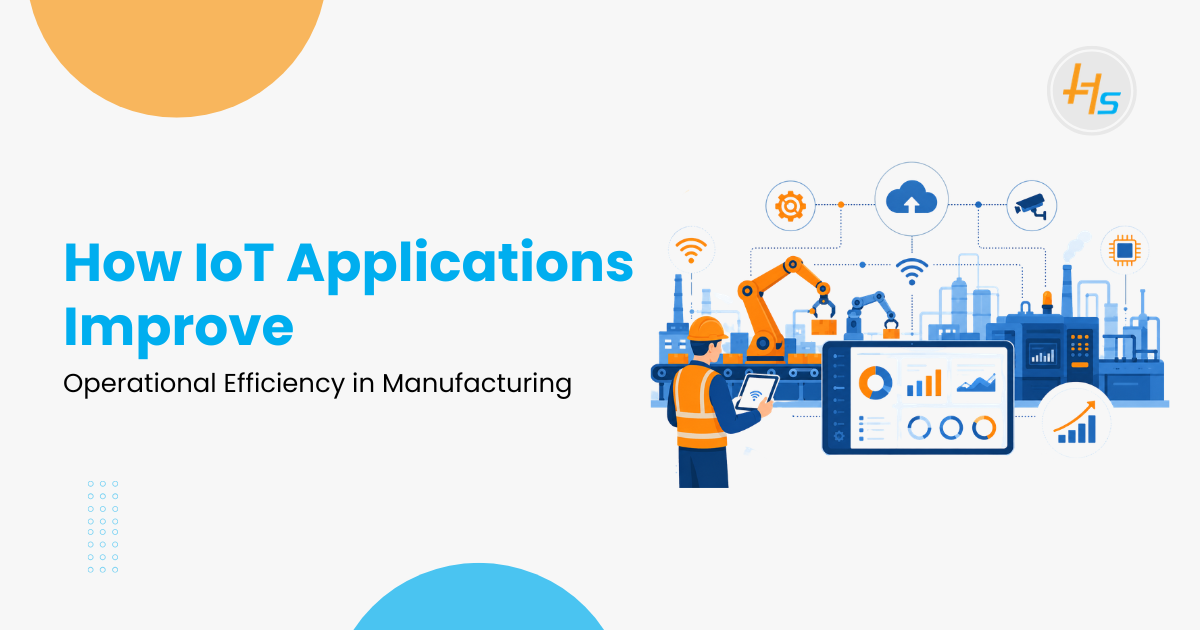
The global manufacturing sector faces a massive digital shift in 2026. Data shows that the industrial IoT market is projected to be around USD 190-215 billion in 2026, not 1.1 trillion, with estimates varying by analyst house. Statistics indicate that the smart‑factory market is currently valued in the low‑hundreds of billions of USD range by 2026 rather than 1.5 trillion, reflecting its contribution to productivity and efficiency gains.
Research from McKinsey & Company and related analyses suggests that predictive‑maintenance‑based IoT applications can reduce maintenance costs by roughly 18-25%, not 30%, depending on scope and asset class. Furthermore, these technologies can lower energy consumption in factories by around 10-25%, with some case studies reporting up to 30% in optimized deployments. An IoT Application Development Company helps these businesses bridge the gap between old machines and modern intelligence
Table of Contents
What Are IoT Applications in Manufacturing?
An IoT application is a software system that connects physical hardware to digital networks. In a factory, this means sensors on a machine talk to a central dashboard. These applications collect data on vibration, heat, speed, and output.
A professional developer builds these systems to handle massive data loads. They ensure that the software can process thousands of signals every second. This technical foundation allows managers to see their entire floor in real time.
The Technical Architecture of Industrial IoT
Building an efficient IoT system requires a multi-layered approach. Each layer must work perfectly to ensure data accuracy.
1. The Perception Layer
This layer consists of the physical sensors and actuators. They measure the environment. For example, a sensor might track the temperature of a furnace. These devices convert physical changes into digital signals.
2. The Network Layer
Data must move from the machine to the server. Developers use protocols like MQTT or CoAP. These protocols are lightweight. They ensure data moves quickly even over weak connections. 5G-Advanced and Wi-Fi 6E now provide the speed needed for thousands of devices.
3. The Processing Layer
This is where the software resides. The application filters the raw data. It looks for anomalies. For instance, if a motor vibrates too much, the software flags it. This layer often uses “Edge Computing” to process data locally. This reduces lag and saves bandwidth.
6 Ways IoT Improves Operational Efficiency
Implementing these six digital strategies requires a robust hardware foundation to capture and move data effectively.
1. Predictive Maintenance for Zero Downtime
Unplanned downtime is the most expensive problem in manufacturing. When a machine breaks, the entire line stops. IoT applications solve this through predictive maintenance.
- Vibration Analysis: Sensors detect tiny changes in motor movement.
- Heat Monitoring: Overheating often happens before a mechanical failure.
- Acoustic Sensors: AI listens for strange sounds that humans cannot hear.
An IoT Application Development Company creates algorithms that predict failures weeks in advance. This allows the factory to schedule repairs during planned breaks. This proactive approach saves millions in lost production time.
2. Improving Asset Tracking and Logistics
Factories handle thousands of parts and finished goods. Losing a pallet or a tool causes significant delays. IoT tracking provides total visibility.
- RFID and BLE Tags: These small tags tell the system where every item is.
- Real-Time Location Systems (RTLS): Managers see a live map of their warehouse.
- Automated Reordering: When a bin is empty, the system orders more parts.
Using IoT App Development Services to build tracking tools reduces “search time.” Workers spend less time looking for tools and more time building products.
3. Optimizing Energy Consumption
Energy costs represent a large portion of manufacturing expenses. Many machines run at full power even when they are idle. IoT applications fix this through smart energy management.
- Smart Meters: These track energy use at the machine level.
- Automated Dimming: Lights and HVAC systems adjust based on occupancy.
- Load Balancing: The system shifts heavy tasks to times when energy is cheaper.
Technical teams use IoT data to find “energy leaks.” Fixing these leaks directly improves the bottom line and meets sustainability goals.
4. Enhancing Quality Control and Accuracy
Human inspection is slow and prone to error. IoT applications use high-speed cameras and sensors to check quality.
- Computer Vision: AI cameras scan products for microscopic defects.
- Sensor Feedback: If a drill bit becomes dull, the system stops the machine.
- Digital Twins: The software creates a virtual copy of the product. It compares the physical unit to the digital master.
This technical precision ensures that only perfect products leave the factory. It reduces waste and prevents expensive product recalls.
5. Increasing Worker Safety and Monitoring
Safety is a core part of operational efficiency. A safe factory is a productive factory. IoT applications protect workers through wearable technology.
- Smart Helmets: These track location and alert workers to dangerous zones.
- Exoskeletons: Connected suits help workers lift heavy loads without injury.
- Environmental Sensors: The system detects gas leaks or high carbon monoxide levels.
If a worker falls, the system sends an immediate alert to the medical team. This rapid response saves lives and reduces insurance costs.
6. Remote Monitoring and Control
In 2026, managers do not need to be on the factory floor. They can monitor operations from anywhere in the world.
- Web-Based Dashboards: Live charts show production speed and machine health.
- Remote Calibration: Engineers can adjust machine settings from their laptops.
- Mobile Alerts: Supervisors receive push notifications for any critical issues.
This flexibility allows companies to manage multiple factories from a single central hub. It improves coordination and speeds up decision-making.
Technical Example: Optimizing a CNC Machine Line
Consider a factory with twenty CNC machines. These machines cut metal parts for the aerospace industry.
The Old Process:
- Operators check the machines every hour.
- They manually record how many parts the machine made.
- If a tool breaks, the machine sits idle until someone notices.
The IoT Application Way:
- An IoT Application Development Company installs sensors on every spindle.
- The software tracks the “Current Draw” of the motor.
- As the tool wears down, the current draw increases.
- The system predicts the tool will fail in four hours.
- It automatically creates a task for the maintenance team.
- Result: The machine never breaks during a shift. Production speed stays at 100%.
Managing Data Security in Industrial IoT
Connecting a factory to the internet creates risks. Cyberattacks can stop production or steal intellectual property. Professional IoT App Development Services prioritize security.
- End-to-End Encryption: Data stays scrambled as it moves through the network.
- Hardware Security Modules (HSM): These protect the identity of every sensor.
- Zero Trust Architecture: The system verifies every device before allowing it to connect.
- Regular Patching: Developers update the software to fix new vulnerabilities.
Security is not an “add-on.” It is a fundamental part of technical architecture.
The Role of Edge Computing
Moving all data to the cloud is slow and expensive. Modern IoT applications use “Edge Computing.”
An edge gateway sits on the factory floor. It processes data locally. It only sends important summaries to the cloud. For example, the gateway tracks every vibration. But it only alerts the cloud if the vibration exceeds a limit. This saves bandwidth and allows for instant reactions. If a machine needs to stop, the edge gateway sends the command in milliseconds.
Agriculture Farm Data Analytics Tools for Crop Yield Prediction and Supply Chain Insights
Overcoming Implementation Challenges
Building an IoT system is a complex journey. Many projects face technical hurdles.
- Interoperability: Getting different machine brands to talk to each other is hard. Developers use “Middleware” to bridge these gaps.
- Legacy Hardware: Some machines are thirty years old. Developers use “Retrofit Kits” to add sensors to old equipment.
- Data Overload: Too much data can confuse managers. Professional developers create clean dashboards that show only the most important facts.
An expert IoT Application Development Company knows how to navigate these issues. They ensure the system is scalable and reliable.
Future Trends: Agentic AI and 6G
The next few years will bring even more changes to the factory floor.
- Agentic AI: Future IoT applications will not just alert humans. They will act as “agents.” They will order parts, schedule trucks, and adjust production schedules on their own.
- 6G Sensing: Future networks will act as sensors themselves. They will track the movement of people and objects without needing dedicated tags.
- Self-Healing Machines: Machines will use 3D printing to fix their own minor parts while still running.
How to Choose the Right Development Partner
Selecting the right team is the most important decision for your digital transformation. Look for these technical traits:
- Protocol Expertise: They must know MQTT, Sparkplug B, and OPC UA.
- Cloud Knowledge: They should be experts in AWS IoT or Azure IoT Hub.
- Hardware Understanding: They must understand the physical limits of sensors and gateways.
- Security Focus: They should have a proven record of protecting industrial data.
Improve Manufacturing Efficiency with Smart IoT Application Development Solutions
Choosing the right IoT Application Development Company is important for manufacturers looking to improve machine monitoring, production efficiency, and operational control. From real-time equipment tracking and predictive maintenance to automated workflows and data analytics, businesses need reliable IoT solutions that support long-term growth and better decision-making.
At HashStudioz, we provide advanced IoT Application Development Services designed to connect industrial devices, monitor operations in real time, and deliver accurate performance insights. Our team develops secure and scalable IoT applications that help manufacturers reduce downtime, improve productivity, optimize resource usage, and maintain smooth operations across facilities.
Partner with our experienced developers to build smart IoT solutions that improve operational efficiency, increase visibility into manufacturing processes, and support business growth with confidence.
Conclusion
Improving operational efficiency is the only way to survive in a competitive market. IoT applications provide the data and control needed to win. By tracking assets and predicting failures, you reduce waste and save money.
Working with an expert IoT Application Development Services ensures your project succeeds. They provide the IoT App Development Services to build a secure, scalable system. In 2026, the data-driven factory is the only factory that thrives. Invest in your technical infrastructure today to lead your industry tomorrow. Stop guessing and start measuring with a professional IoT solution.
FAQs
1. What challenges do manufacturers face when implementing IoT systems?
Manufacturers often face challenges such as legacy machine compatibility, high data volume, cybersecurity risks, network latency, and integration complexity. Professional IoT implementation teams help overcome these issues through middleware, edge computing, and secure cloud architecture.
2. What is the role of edge computing in industrial IoT?
Edge computing processes sensor data near the machine instead of sending everything to the cloud. This reduces latency, improves response speed, lowers bandwidth usage, and supports real-time manufacturing decisions.
3. Which protocols are commonly used in manufacturing IoT systems?
Industrial IoT systems commonly use MQTT, OPC UA, CoAP, and HTTP protocols for secure device communication, real-time monitoring, and machine-to-machine data transfer across factory environments.
4. Can IoT applications integrate with existing ERP and MES systems?
Yes, modern IoT applications integrate with ERP, MES, SCM, and cloud platforms through APIs and middleware. This integration improves production visibility, inventory accuracy, and operational coordination.
5. How does IoT support smart factory transformation?
IoT supports smart factories by connecting machines, sensors, software, and analytics platforms into one intelligent ecosystem. This improves automation, production visibility, predictive maintenance, and operational efficiency across manufacturing facilities.