


A manufacturing plant operating across multiple production lines once reported a puzzling issue. Machines were functioning normally, sensors were active, dashboards were updating in real time, yet overall production efficiency kept fluctuating without clear alarms or alerts.
The problem wasn’t visibility. It was a system interpretation under scale.
This kind of gap is becoming increasingly common as enterprises adopt connected systems faster than they evolve the underlying architecture. According to Statista, global IoT device connections are expected to surpass 29 billion by 2030. McKinsey estimates that IoT could unlock up to $12 trillion in global economic value across industries such as manufacturing, logistics, and energy. IDC also highlights steady growth in enterprise IoT investment, particularly in operational intelligence and industrial automation.
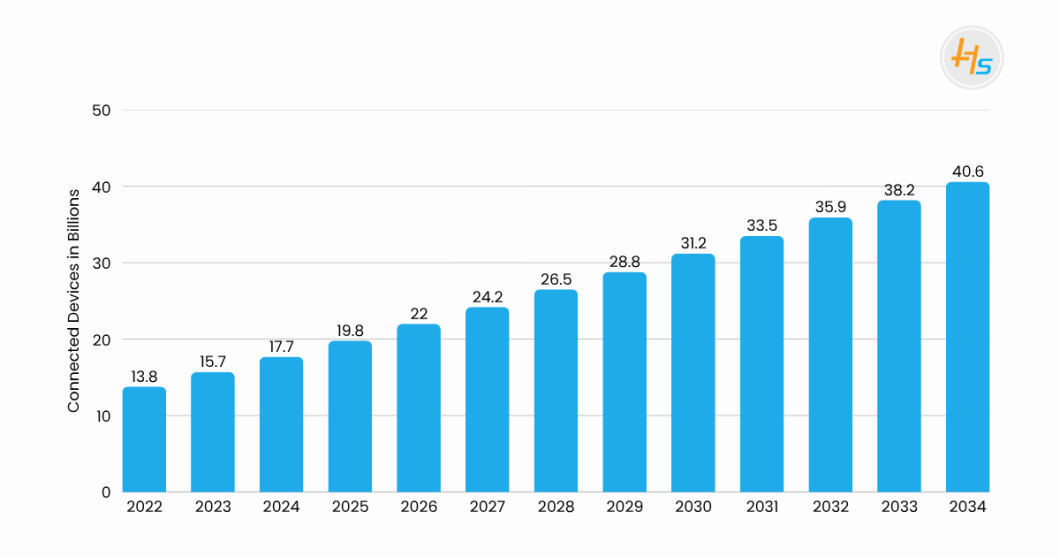
Yet despite this rapid adoption, many organizations still struggle to move beyond pilot deployments into stable, production-grade systems.
The difference usually comes down to one factor – how well the system is engineered to scale in real-world conditions.
This is where an experienced IoT Development Company plays a critical role, especially when businesses need systems that go beyond connectivity and actually support operational decision-making.
Table of Contents
When IoT Stops Being a Pilot and Starts Becoming a System Problem
Most IoT projects begin with a controlled environment. A few sensors, a dashboard, and a test environment that behaves predictably. Everything looks promising at that stage.
Then reality enters the system.
Data volume increases. Devices behave differently under field conditions. Network latency becomes unpredictable. And business users start expecting insights that were never part of the original design.
At that point, the project stops being about devices and starts becoming about system architecture.
This transition is where many companies realize they need structured expertise from an IoT Development Company that understands not just device connectivity, but end-to-end system behavior under real operational load.
The Real Problem: Data Without Context
One of the less discussed issues in IoT adoption is that connectivity does not automatically translate into business value.
A factory may have thousands of sensors reporting temperature, vibration, pressure, or energy consumption. But if that data does not align with operational decision cycles, it becomes background noise.
In practice, businesses need answers, not raw data streams.
For example:
- Which machine will fail in the next 72 hours?
- Which production line is underperforming compared to historical baselines?
- Where is energy waste increasing beyond acceptable thresholds?
These questions require more than dashboards. They require data engineering layers, filtering logic, contextual modeling, and system-level correlation between multiple devices.
This is where many IoT systems fail silently. They collect everything but interpret very little.
Why Scalability Fails in Most IoT Architectures
Scalability in IoT is often misunderstood as “handling more devices.” In reality, it includes multiple layers of complexity that interact with each other.
A typical breakdown happens in three areas:
- Device scaling: more sensors, more endpoints, more data streams
- Data scaling: increased velocity, storage pressure, and processing load
- System scaling: integration with ERP, analytics tools, and business workflows
The real issue appears when these layers grow at different speeds.
A logistics company, for example, might scale devices rapidly across fleets but fail to upgrade backend processing systems. The result is delayed tracking updates and inconsistent reporting between operational teams and management dashboards.
Scalability problems rarely appear as system failures. They appear as small inconsistencies that gradually reduce trust in the system.
What Happens When Architecture Decisions Are Delayed
A retail distribution company once deployed an IoT-based inventory tracking system across multiple warehouses. The initial rollout worked smoothly. Stock visibility improved, and manual audits were reduced significantly.
But as the system expanded to more locations, latency issues began to surface. Inventory updates were delayed by several minutes in peak hours. This led to mismatched stock data between warehouses and central systems.
The issue was not hardware. It was architectural.
The system had been designed for a limited number of concurrent data streams, not enterprise-scale synchronization.
At that stage, the company had to revisit core system design, rework data pipelines, and introduce edge-level processing to reduce central system load.
This is a common turning point in IoT maturity, where early design decisions start shaping long-term operational stability.
Real Enterprise Context: Manufacturing and Operational Intelligence
In heavy manufacturing environments, even small inefficiencies accumulate into a large financial impact over time.
A global manufacturing setup similar to Toyota operates with tightly synchronized production systems where timing, machine health, and supply coordination directly affect output quality.
While not every organization operates at that scale, mid-sized manufacturers face similar coordination challenges in smaller ecosystems. Production delays, equipment wear patterns, and unplanned downtime often go unnoticed until they reflect in monthly performance metrics.
IoT systems designed with proper architecture can shift this visibility from retrospective reporting to near real-time operational awareness.
However, achieving this requires more than device deployment. It requires structured system design, integration planning, and continuous optimization of data flows across multiple layers.
Engineering Perspective: What Makes IoT Systems Actually Scalable
Scalability in IoT does not come from adding infrastructure. It comes from designing systems that expect growth from the beginning.
A few engineering principles consistently appear in systems that scale well:
- Data ingestion must handle uneven load patterns, not just average traffic
- Edge processing should reduce unnecessary central system load
- APIs must remain stable even as device types expand
- Data models should support evolution without breaking historical consistency
- Integration layers must avoid tight coupling with business applications
These are not theoretical principles. They come from repeated failure patterns observed in production environments.
Teams that work on enterprise implementations through an experienced IoT Development Services approach tend to focus heavily on these foundational layers before scaling device deployments.
Why Integration Becomes the Real Bottleneck
Once IoT systems reach a certain maturity level, the challenge shifts from data collection to system integration.
IoT platforms rarely exist in isolation. They connect with:
- ERP systems
- warehouse management platforms
- analytics tools
- cloud storage systems
- business dashboards
The complexity arises when data formats, timing, and business logic differ across systems.
A manufacturing alert, for example, may need to trigger a maintenance workflow, update inventory forecasting, and notify procurement systems simultaneously. If integration logic is poorly designed, delays and inconsistencies start appearing across departments.
At scale, integration design becomes more critical than device design.
ROI Does Not Come From Devices – It Comes From Decisions
A common misconception in IoT investment is that ROI comes from hardware deployment.
In reality, return on investment appears when systems start influencing operational decisions.
Companies typically see measurable improvements in:
- Reduced unplanned downtime
- Improved asset utilization
- Lower maintenance costs through predictive alerts
- Better energy consumption tracking
- Fewer manual reporting cycles
In many enterprise deployments, even a 3–5% improvement in operational efficiency translates into significant annual savings.
However, these outcomes only appear when IoT data is structured to support decision-making, not just monitoring.
Why Businesses Engage Specialized IoT Partners
As systems scale, internal teams often face architectural complexity that goes beyond traditional software development.
At this stage, organizations typically engage an experienced IoT Development Partner to evaluate system design, improve scalability, and stabilize production environments.
The goal is not just implementation support; it is system-level engineering that ensures long-term reliability under operational load.
At Hashstudioz, this approach is often applied in enterprise IoT projects where scalability, integration, and real-time performance are critical success factors.
Final Thoughts
IoT adoption is no longer about proving whether connectivity works. That question has already been answered. The real challenge now lies in building systems that survive scale, complexity, and real-world unpredictability.
Engineering decisions made early in the architecture phase tend to define how well the system performs years later. Devices will continue to get cheaper and more capable. Connectivity will continue to improve. But system design will remain the factor that determines whether IoT delivers consistent business value or becomes another underutilized technology layer.
Organizations that approach IoT as an evolving system rather than a fixed deployment tend to build more stable, long-term operational advantages.
FAQs
1. What makes an IoT system scalable?
A scalable IoT system can handle increasing devices, data volume, and integrations without performance degradation. It relies on strong architecture, not just hardware capacity.
2. Why do most IoT projects fail at scale?
Most failures happen due to poor architecture planning, weak data pipelines, and a lack of integration strategy with enterprise systems.
3. How important is edge computing in IoT scalability?
Edge computing reduces load on central systems by processing data closer to the source, improving speed and reducing latency in large deployments.
4. Can IoT systems integrate with existing enterprise software?
Yes, but integration must be carefully designed. Poor integration leads to delays, data mismatches, and operational inefficiencies.
5. When should a business hire an IoT development company?
Businesses should involve experts early, ideally during architecture planning, especially when scaling beyond pilot IoT deployments or integrating with enterprise systems.