


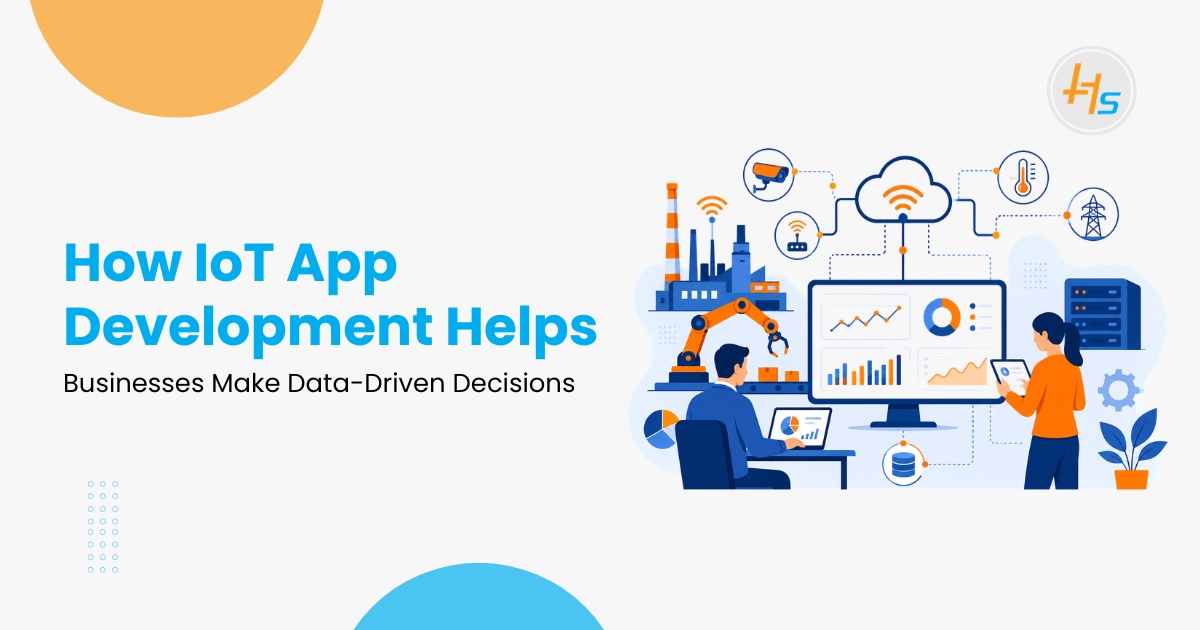
Businesses now depend on data for every decision. IoT plays a key role in this shift. It connects devices, collects data, and converts it into useful insights. Recent reports show strong growth in IoT adoption. Around 82% of enterprises already use or plan real-time IoT analytics. More than 75% of companies combine IoT with AI for better insights. Large enterprises now track over 166,000 assets daily using IoT systems.
These numbers show a clear trend. Businesses want faster and accurate decisions. An IoT Application Development Company builds systems that collect, process, and analyze real-time data. These systems help organizations move from guesswork to data-based decisions.
Table of Contents
What Is IoT App Development
IoT app development focuses on building software that connects devices, sensors, and cloud systems.
These applications perform three key tasks:
- Collect data from devices
- Process and analyze data
- Present insights through dashboards
Developers design these systems using:
- Embedded devices and sensors
- Communication protocols like MQTT and HTTP
- Cloud platforms for storage and analytics
- Mobile or web apps for visualization
The goal is simple. Provide accurate data at the right time.
Why Data-Driven Decisions Matter
Businesses generate large volumes of data daily. Without analysis, this data has no value.
Data-driven decisions offer clear benefits:
- Reduce human errors
- Improve operational speed
- Support better planning
- Increase profit margins
Traditional systems rely on reports created after events. IoT changes this approach. It delivers real-time insights.
Companies can react faster and avoid losses.
How IoT Enables Data Collection
IoT devices act as data sources. They collect information from the physical environment.
Types of Data Collected
- Temperature and humidity
- Machine performance
- Location and movement
- Energy usage
- User behavior
Sensors capture this data continuously.
Example
In manufacturing:
- Sensors monitor machine vibration
- Data shows wear and tear patterns
- Teams detect issues early
This approach reduces downtime and improves productivity.
Real-Time Data Processing
Data collection alone is not enough. Processing is critical.
IoT systems use:
- Edge computing for fast processing
- Cloud computing for large-scale analysis
Real-time processing allows:
- Instant alerts
- Faster response time
- Continuous monitoring
Research shows businesses focus on real-time analytics to improve decision speed.
Example
In logistics:
- GPS devices track shipments
- Systems analyze delays instantly
- Managers adjust routes in real time
This improves delivery performance.
Role of IoT Dashboards and Visualization
Raw data is complex. Visualization makes it easy to understand.
IoT applications provide dashboards that show:
- Graphs and charts
- Performance metrics
- Alerts and notifications
These dashboards help decision-makers:
- Identify trends
- Compare performance
- Take quick actions
Key Features
- Real-time updates
- Custom reports
- Predictive insights
This improves clarity and decision accuracy.
Predictive Analytics with IoT
IoT supports predictive decision-making.
Systems use historical and real-time data to predict future events.
How It Works
- Collect past data
- Apply machine learning models
- Predict outcomes
Studies show many enterprises now combine IoT with AI to shift from reactive to predictive decisions.
Example
In maintenance:
- Sensors detect unusual patterns
- System predicts machine failure
- Maintenance teams act early
This reduces repair costs and downtime.
Automation Through IoT Applications
IoT apps do not only provide data. They also trigger actions.
Automation Examples
- Adjust temperature in smart buildings
- Control machines in factories
- Send alerts during system failures
Automation improves:
- Speed
- Accuracy
- Efficiency
Businesses reduce manual effort and improve performance.
Industry Use Cases
1. Manufacturing
IoT monitors machines and production lines.
Benefits:
- Predictive maintenance
- Quality control
- Reduced downtime
2. Healthcare
IoT devices track patient health data.
Benefits:
- Remote monitoring
- Faster diagnosis
- Better patient care
3. Retail
IoT tracks customer behavior and inventory.
Benefits:
- Better stock management
- Personalized offers
- Improved sales
4. Logistics
IoT tracks vehicles and shipments.
Benefits:
- Route optimization
- Real-time tracking
- Reduced delays
Role of IoT Application Development Company
An experienced IoT Application Development services builds reliable systems.
Key Responsibilities
- Device integration
- Data pipeline design
- Cloud setup
- Security implementation
- App development
Technical Expertise Required
- Embedded systems
- Cloud platforms like AWS and Azure
- Data analytics tools
- API integration
Without proper development, IoT systems fail to deliver value.
Agriculture Farm Data Analytics Tools for Crop Yield Prediction and Supply Chain Insights
Key Features of IoT Application Development Services
Professional IoT Application Development Services include:
1. Device Connectivity
- Connect sensors and devices
- Ensure stable communication
2. Data Management
- Store and process large data sets
- Maintain data quality
3. Analytics and Reporting
- Provide real-time insights
- Support decision-making
4. Security
- Protect data from cyber threats
- Use encryption and authentication
5. Scalability
- Support business growth
- Handle increasing data volume
Challenges in IoT Data-Driven Systems
IoT data-driven systems help businesses collect, process, and act on real-time information. They improve visibility, automation, and decision-making. However, building and managing these systems comes with several technical and operational challenges.
1. Data Security Risks
IoT devices collect sensitive data such as user activity, location, machine performance, and operational metrics. Weak security can expose this data to cyber threats.
Common risks include:
- Unauthorized device access
- Data breaches
- Weak authentication methods
- Malware attacks on connected devices
Since many devices operate remotely, security becomes even more critical.
2. Integration with Legacy Systems
Many businesses still use older systems that were not designed for IoT connectivity. Integrating modern IoT platforms with these legacy systems can be complex.
Challenges include:
- Compatibility issues
- Data format differences
- Limited API support
- High integration cost
Without proper integration, data remains isolated and less useful.
3. High Data Volume
IoT systems generate large amounts of data every second. Sensors, devices, and machines continuously send information.
This creates problems such as:
- Data storage limitations
- Slow processing speed
- Increased infrastructure cost
- Difficulty in real-time analysis
Managing this data efficiently is a major challenge.
4. Network Reliability
IoT systems depend on stable network connections. Poor connectivity can disrupt data flow and affect system performance.
Common issues include:
- Data loss during transmission
- Delayed updates
- Device disconnection
- Reduced system accuracy
Reliable networks are essential for smooth IoT operations.
Solutions to Overcome Challenges
1. Use Strong Encryption
Encrypt data during transmission and storage. This protects sensitive information from unauthorized access.
2. Apply Secure APIs
Use secure APIs for device communication. This ensures safe data exchange between systems and applications.
3. Monitor System Performance
Regular monitoring helps detect issues early. Track device health, network performance, and data flow to maintain system stability.
4. Implement Access Control
Use role-based access to limit who can view or modify data. This reduces internal security risks.
5. Use Scalable Infrastructure
Cloud-based systems help manage large data volumes efficiently. They also support real-time processing and storage.
A well-designed IoT system with proper security, integration, and monitoring reduces risks and improves performance.
Future of IoT in Decision-Making
IoT technology is evolving beyond data collection. It is now becoming a key driver of intelligent and automated decision-making.
1. AI Integration
Artificial Intelligence is transforming IoT systems. AI analyzes large datasets and provides insights without manual effort.
Examples include:
- Predictive maintenance
- Demand forecasting
- Smart recommendations
- Automated alerts
AI helps businesses make faster and more accurate decisions.
2. Edge Computing Growth
Edge computing processes data closer to the source instead of sending it to central servers.
Benefits include:
- Faster response time
- Reduced latency
- Lower bandwidth usage
- Improved real-time decision-making
This is important for industries like manufacturing, healthcare, and logistics.
3. 5G Connectivity
5G networks provide faster speed and lower latency. This improves IoT performance significantly.
With 5G, businesses can:
- Connect more devices
- Get real-time data updates
- Improve system reliability
- Enable advanced automation
Shift Toward Intelligent Systems
IoT is moving from simple monitoring systems to intelligent platforms that can act on data automatically.
Modern IoT systems can:
- Detect issues instantly
- Trigger automated actions
- Predict future outcomes
- Optimize operations in real time
Transform Your Business Decisions with Smart IoT App Development Solutions
Choosing the right IoT Application Development Company is important for businesses that need real-time data insights, better process control, and improved operational visibility. From tracking devices and monitoring performance to analyzing large data sets, companies need a reliable solution built for long-term growth.
At HashStudioz, we provide advanced IoT Application Development Services that connect devices, collect real-time data, and deliver actionable insights. Our team builds secure and scalable IoT applications that help businesses reduce downtime, improve efficiency, and support accurate decision-making across operations.
Partner with our experienced team to develop smart IoT solutions that improve performance, enhance data visibility, and support business growth with confidence.
Conclusion
IoT app development plays a key role in modern business strategy. It connects devices, collects data, and delivers insights. With real-time analytics, predictive models, and automation, businesses can make faster and better decisions. An experienced IoT Application Development Company ensures proper system design and performance.
Reliable IoT Application Development Services help organizations convert raw data into actionable insights. Companies that adopt IoT gain a clear advantage. They improve efficiency, reduce costs, and make informed decisions based on real data.