


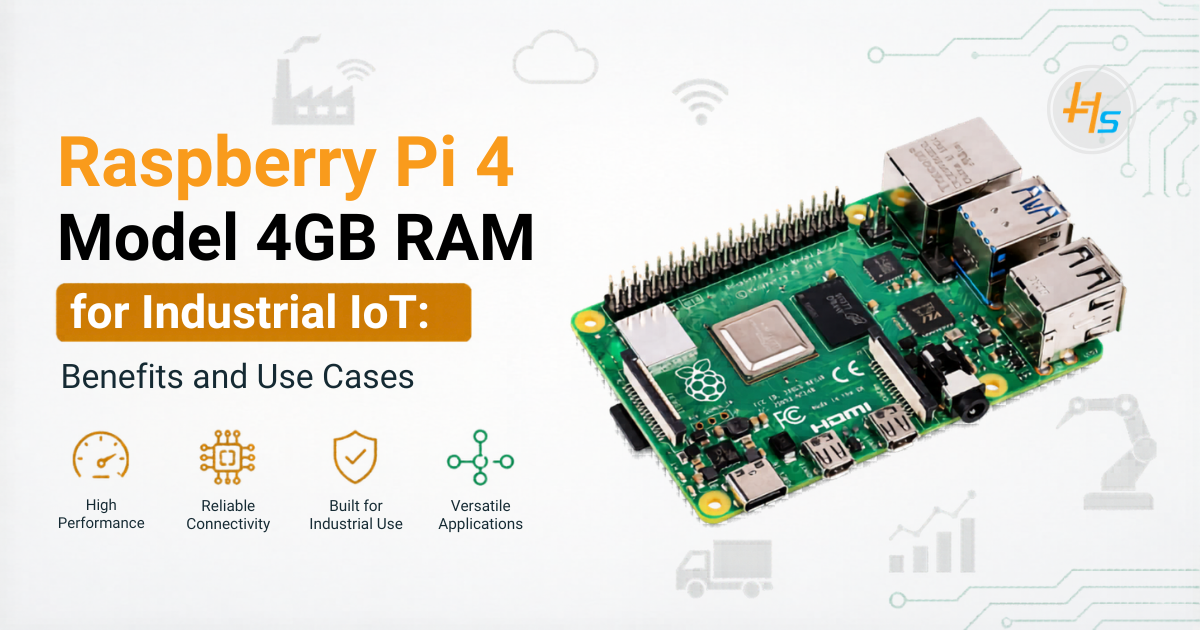
The Raspberry Pi 4 Model B 4GB RAM has become a powerful enabler in Industrial IoT (IIoT), helping businesses connect machines, process data at the edge, and build intelligent automation systems. Its balance of performance, affordability, and flexibility makes it a strong alternative to traditional industrial hardware for many use cases.
Table of Contents
Why Raspberry Pi 4 for Industrial IoT?
Industrial environments require systems that are reliable, scalable, and capable of handling real-time data. Traditionally, industries relied on PLCs (Programmable Logic Controllers) and industrial PCs, which are robust but often expensive and less flexible.
The Raspberry Pi 4 introduces a new approach:
- Modern Computing Power: With a quad-core processor and 4GB RAM, it can handle tasks like data processing, local analytics, and running lightweight applications.
- Software Flexibility: It supports Linux-based operating systems, allowing developers to use modern tools, frameworks, and programming languages.
- Rapid Deployment: Compared to industrial systems that take weeks to configure, Raspberry Pi solutions can be deployed in hours or days.
- Scalability: You can start small and scale across multiple machines or plants without major infrastructure changes.
This makes it especially valuable for companies adopting Industry 4.0 practices.
Key Benefits in Industrial IoT
1. Cost-Effective Deployment
Industrial-grade hardware can be costly, especially when deploying across large facilities. Raspberry Pi significantly reduces this barrier.
- A single unit costs a fraction of industrial PCs or PLC systems
- Enables low-risk experimentation before full-scale deployment
- Ideal for startups and SMEs entering the IoT space
This affordability allows businesses to deploy multiple nodes across different production lines or remote sites without heavy investment.
2. Edge Computing Capabilities
Edge computing is critical in IIoT, where real-time decisions matter.
With Raspberry Pi 4, you can:
- Process sensor data locally instead of sending everything to the cloud
- Run AI/ML models for predictive maintenance
- Trigger instant alerts or actions based on conditions
For example, in a factory, the Raspberry Pi can detect abnormal machine vibrations and immediately trigger a shutdown to prevent damage – without waiting for cloud processing.
3. Rich Connectivity Options
Industrial environments often involve a mix of modern and legacy systems.
The Raspberry Pi supports:
- Ethernet for stable wired communication
- Wi-Fi for flexible wireless setups
- Bluetooth for short-range device communication
- USB interfaces for connecting external modules
Additionally, with the help of converters, it can communicate with industrial protocols like RS485 and CAN, making it adaptable to existing infrastructure.
4. Protocol Support and Integration
Industrial IoT relies on standardized communication protocols.
Raspberry Pi supports:
- MQTT for lightweight, real-time messaging
- Modbus for industrial device communication
- HTTP/REST APIs for cloud integration
This allows seamless communication between:
- Sensors and machines
- Edge devices
- Cloud platforms (AWS, Azure, Google Cloud)
As a result, it becomes a central node in IIoT architecture.
5. Compact Size and Energy Efficiency
Industrial setups often have space and power constraints.
Raspberry Pi offers:
- Small form factor (fits inside control panels)
- Low power consumption (ideal for 24/7 operations)
- Reduced heat generation compared to traditional systems
This makes it suitable for remote installations such as wind turbines, solar plants, and agricultural fields.
6. Customization and Open Ecosystem
Unlike proprietary industrial systems, Raspberry Pi is highly customizable.
Developers can:
- Build tailored applications for specific use cases
- Integrate third-party libraries and APIs
- Use frameworks for AI, IoT, and automation
For example, you can create a custom dashboard to monitor machine data or integrate AI-based anomaly detection – something difficult with closed systems.
7. Strong Community and Ecosystem Support
The Raspberry Pi ecosystem is one of its biggest strengths.
- Thousands of tutorials and open-source projects
- Active forums and developer communities
- Continuous updates and improvements
This reduces development time and ensures that solutions are easier to maintain and scale.
Real-World Industrial IoT Use Cases
1. Smart Manufacturing (Industry 4.0)
In modern factories, Raspberry Pi is used to digitize production lines.
It helps in:
- Monitoring machine performance in real time
- Collecting operational data for analytics
- Predicting maintenance needs
For example, vibration sensors connected to Raspberry Pi can detect early signs of machine failure, reducing downtime and maintenance costs.
2. Remote Monitoring and Data Logging
Industries operating in remote locations (oil rigs, farms, pipelines) need reliable monitoring systems.
Raspberry Pi can:
- Continuously log sensor data
- Store it locally or send it to the cloud
- Provide real-time alerts
This ensures better decision-making and reduces the need for manual inspections.
3. Industrial Gateway
One of the most common uses is as an IoT gateway.
It acts as a bridge between:
- Legacy machines (using Modbus/RS485)
- Modern cloud platforms
For example, it can convert machine data into MQTT format and send it to a cloud dashboard for visualization and analysis.
4. Energy Management Systems
Energy efficiency is a major concern in industries.
Raspberry Pi helps by:
- Monitoring power consumption across machines
- Identifying energy wastage
- Automating power-saving measures
Factories can significantly reduce costs by optimizing energy usage.
5. Smart Agriculture
In agriculture, Raspberry Pi enables precision farming.
It can:
- Monitor soil moisture and weather conditions
- Automate irrigation systems
- Send alerts to farmers via mobile apps
This leads to better crop yield and efficient resource utilization.
6. Fleet and Asset Tracking
Logistics companies use Raspberry Pi for tracking vehicles and assets.
It integrates with:
- GPS modules
- Cellular networks
This allows:
- Real-time location tracking
- Route optimization
- Predictive maintenance alerts
7. Vision-Based Inspection Systems
With camera integration, Raspberry Pi can perform basic image processing tasks.
It is used for:
- Detecting product defects
- Monitoring production quality
- Automating inspection workflows
Although not as powerful as industrial vision systems, it is a cost-effective alternative for small-scale deployments.
Challenges and Considerations
While powerful, Raspberry Pi is not inherently industrial-grade.
Key challenges include:
- Environmental Limitations: Sensitive to dust, heat, and vibrations
- Thermal Management: Requires cooling solutions under heavy workloads
- Power Reliability: Needs stable power supply to avoid failures
- Storage Durability: Standard SD cards may wear out quickly in industrial use
These issues can be mitigated with proper system design.
Best Practices for Industrial Deployment
To ensure reliable operation in industrial environments:
- Use rugged enclosures to protect against dust and moisture
- Add heat sinks or cooling fans for temperature control
- Use industrial-grade SD cards or external SSDs
- Implement watchdog timers for automatic reboot in case of failure
- Secure communication using VPNs and encryption protocols
- Regularly update software to patch vulnerabilities
These practices significantly improve system reliability and lifespan.
Conclusion
The Raspberry Pi 4 Model B 4GB RAM is redefining how industries adopt IoT and edge computing. It offers a flexible, scalable, and cost-effective platform for building intelligent industrial systems.
From smart factories to agriculture and energy management, its applications are vast and growing. While it may require additional considerations for rugged environments, its advantages make it a compelling choice for modern Industrial IoT deployments.
For businesses looking to innovate without heavy investment, Raspberry Pi 4 (4GB) is not just an option – it’s a strategic advantage.
FAQ
1. Is Raspberry Pi 4 Model 4GB RAM suitable for industrial environments?
Yes, the Raspberry Pi 4 (4GB) can be used in industrial environments, but it is not industrial-grade by default. To ensure reliability, it should be deployed with protective enclosures, proper cooling systems, and stable power supplies. When configured correctly, it performs well in applications like monitoring, automation, and IoT gateways.
2. Can Raspberry Pi 4 be used as an IoT gateway in industrial setups?
Absolutely. Raspberry Pi 4 is widely used as an IoT gateway to connect field devices (sensors, PLCs, machines) with cloud platforms. It supports protocols like MQTT, Modbus, and HTTP, allowing it to collect, process, and transmit data efficiently between edge devices and centralized systems.
3. What are the limitations of using Raspberry Pi 4 in Industrial IoT?
Some limitations include:
- Lack of built-in ruggedization for harsh environments
- Limited performance for heavy industrial workloads
- Dependence on microSD storage (which may wear out over time)
- Need for external modules for certain industrial protocols
These challenges can be mitigated with proper hardware and system design.
4. How does Raspberry Pi 4 support edge computing in IIoT?
Raspberry Pi 4 can process data locally at the edge, reducing the need to send all data to the cloud. It can run analytics, filter sensor data, and trigger real-time actions. This reduces latency, improves response time, and lowers bandwidth usage—making it ideal for time-sensitive industrial applications.
5. What industries commonly use Raspberry Pi 4 for IoT applications?
Raspberry Pi 4 is used across multiple industries, including:
- Manufacturing (smart factories, predictive maintenance)
- Agriculture (smart irrigation, crop monitoring)
- Energy (power monitoring, renewable systems)
- Logistics (fleet tracking, asset monitoring)
- Utilities (remote monitoring and automation)
Its versatility and low cost make it suitable for both small-scale and large-scale IoT deployments.