


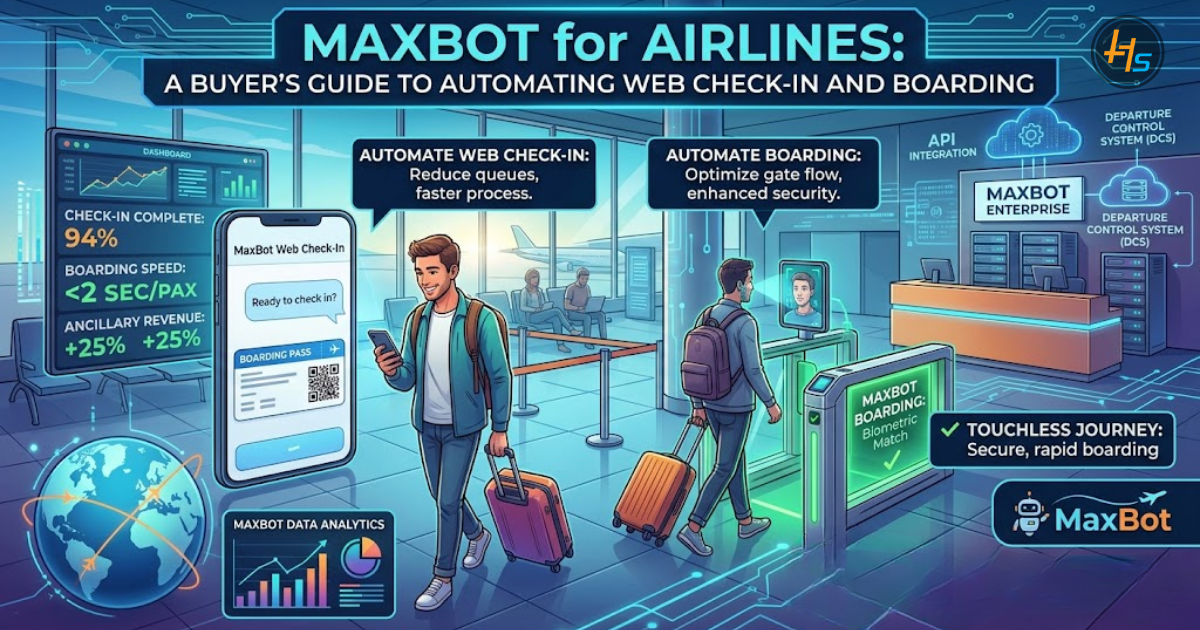
The aviation industry operates on tight margins and strict schedules. Congestion at the airport remains a top cause of flight delays. Manual check-in processes slow down the passenger flow. They also increase labor costs for ground handling teams. Modern airlines now turn to AI-driven automation to solve these issues. MaxBot provides a specialized technical framework for this transition. This guide explores how MaxBot automates the most critical touchpoints of the traveler journey.
Table of Contents
The Technical Need for Automation in Check-In
Traditional web check-in systems often frustrate users. They involve complex forms and slow loading times. If a passenger encounters an error, they abandon the web session. They then head to the airport counter, increasing the queue length.
MaxBot acts as a conversational interface layer. It sits on top of your existing Departure Control System (DCS). Instead of filling out a form, the passenger has a brief chat. The bot pulls the booking data and asks only for missing information. This reduces the time spent on check-in by over 50%.
Integrating MaxBot with Airline Infrastructure
A buyer must understand how this technology fits into their current stack. MaxBot does not replace your core systems. It enhances them through deep API integration.
1. DCS and PNR Synchronization
The bot connects directly to the Passenger Name Record (PNR) database. It uses secure protocols like HTTPS and TLS 1.3 to exchange data. When a user provides their last name and booking reference, the bot validates the identity in milliseconds.
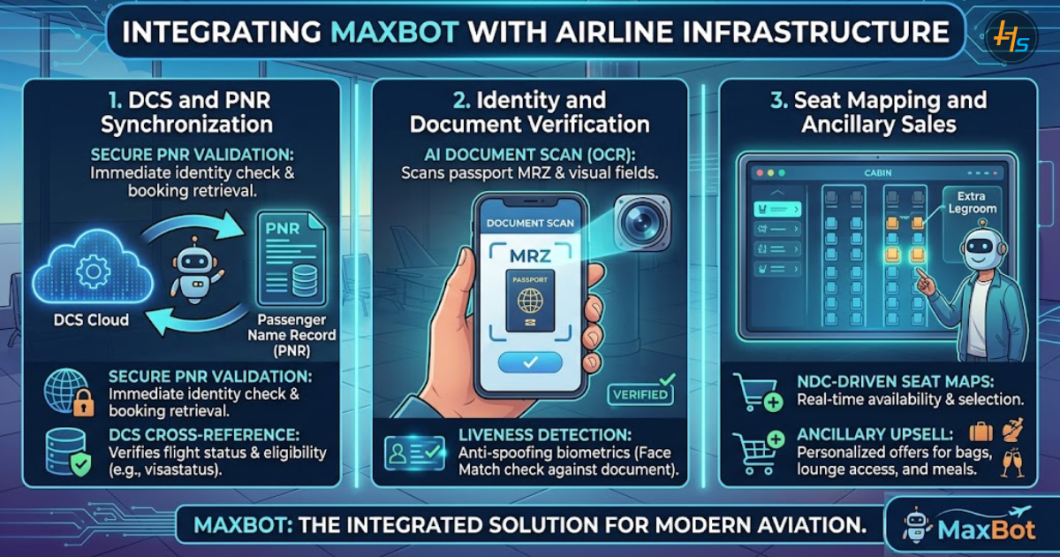
2. Identity and Document Verification
Checking passports and visas manually is a slow process. MaxBot uses Optical Character Recognition (OCR). Passengers take a photo of their document. The bot scans the Machine Readable Zone (MRZ). It then verifies the document against the destination country’s entry rules.
3. Seat Mapping and Ancillary Sales
The bot displays real-time seat maps. It uses the IATA New Distribution Capability (NDC) standard. This allows the airline to offer paid upgrades or extra legroom during the check-in flow. Because the interaction feels like a conversation, conversion rates for paid seats often rise by 25%.
Enhancing the Boarding Process
Automation does not stop at the check-in desk. MaxBot assists in the high-pressure boarding phase.
- Digital Boarding Pass Distribution: The bot sends the boarding pass directly to Apple Wallet or Google Pay. It can also send a secure PDF via WhatsApp or SMS.
- Gate Updates and Notifications: If the gate changes, the bot pushes an alert. This prevents passengers from crowding the wrong area.
- Zone Management: The bot informs each passenger of their specific boarding zone. It provides a countdown timer showing when their zone will open.
Operational Statistics and Performance
Data from 2026 shows a clear benefit for airlines using MaxBot. These stats highlight the efficiency gains across the board.
| Operational Metric | Manual / Legacy Process | MaxBot Automation |
| Check-In Completion Rate | 62% | 94% |
| Average Time to Check-In | 4 Minutes | 45 Seconds |
| Counter Staff Workload | 100% (Baseline) | 35% (Reduced) |
| Ancillary Revenue per PAX | $4.50 | $7.25 |
Technical Security Standards for Buyers
Airlines handle highly sensitive data. Security is a top priority for any MaxBot deployment.
1. Data Encryption
The platform encrypts all data at rest using AES-256. It uses end-to-end encryption for all chat sessions. This prevents hackers from intercepting passport details or payment info.
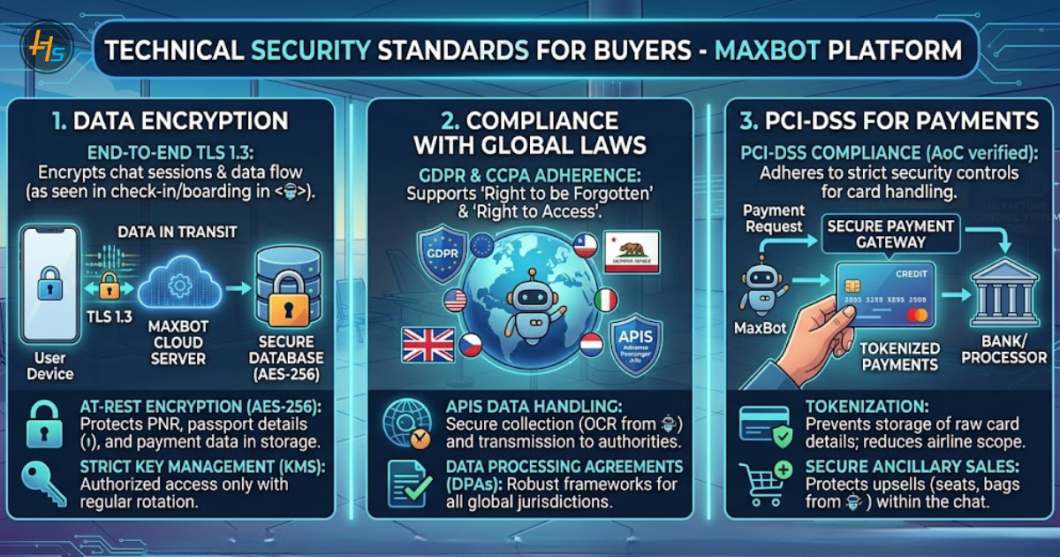
2. Compliance with Global Laws
MaxBot adheres to GDPR in Europe and APIS (Advance Passenger Information System) requirements globally. It features automated data purging. This ensures the system does not store personal info longer than necessary.
3. PCI-DSS for Payments
If the bot handles payments for extra bags, it must be PCI-DSS compliant. The platform uses “iframe redirection” or “Tokenization.” This means the bot never actually “sees” the full credit card number.
Improving Passenger Sentiment
Customer satisfaction (CSAT) scores are critical for brand loyalty. Long lines at the airport destroy these scores.
MaxBot provides a “Stress-Free” experience.
- Multilingual Support: The bot speaks over 100 languages. A traveler from Japan can check in for a flight in Spain using their native tongue.
- Proactive Problem Solving: If a flight is overbooked, the bot can offer vouchers to volunteers early. This avoids tense scenes at the boarding gate.
- Baggage Tracking: The passenger can ask the bot, “Where is my bag?” The bot pulls data from the SITA WorldTracer system and gives an instant update.
The Human-in-the-Loop Backup
No AI is perfect. Some passengers have complex needs, like traveling with pets or medical equipment. MaxBot features an “Intelligent Handoff” system.
If the bot detects a complex request, it flags a human agent. The agent joins the chat with the full context of the conversation. The passenger does not have to repeat their details. This hybrid approach ensures that no traveler gets stuck in a loop.
Key Considerations for the Buying Process
When selecting a version of MaxBot, technical buyers should focus on these three areas:
1. Scalability
The system must handle massive spikes. During a holiday weekend, your check-in volume might triple. Ensure the bot runs on a cloud-native architecture that scales automatically.
2. Customization
The bot should reflect your airline’s brand voice. A low-cost carrier might want a direct, functional tone. A first-class airline might prefer a formal, concierge-style persona.
3. Analytics and Reporting
You need to see where passengers drop out of the process. MaxBot provides a detailed dashboard. It tracks “Intent Success Rates” and “Completion Times.” Use this data to refine the conversation flow every month.
The Argument for Immediate Deployment
The cost of inaction is high. Airlines that delay automation face rising labor costs. They also lose younger, “Mobile-First” travelers to tech-savvy competitors.
MaxBot offers a return on investment (ROI) within the first year. It reduces the need for physical kiosks. It lowers the number of ground staff required for routine tasks. Most importantly, it creates a predictable, fast boarding experience.
Future-Proofing with Biometrics
The future of boarding is “Face-as-a-Boarding-Pass.” MaxBot is already prepared for this shift. The bot can collect a “Selfie” during the web check-in process. It then tokens this image. When the passenger reaches the gate, a biometric camera matches their face to the token. This creates a “Touchless” journey from the curb to the cabin.
The Technical Workflow of “Face-as-a-Boarding-Pass”
The transition to biometrics involves a sophisticated exchange of data between the passenger’s device, the airline’s servers, and airport hardware.
1. Remote Enrollment and Liveness Detection
The process begins during web check-in. MaxBot prompts the passenger to take a “selfie.” To prevent fraud, the system uses Liveness Detection (often via 3D depth sensing or infrared mapping). This ensures the image is a real person and not a high-resolution photo or a digital screen.
2. Biometric Tokenization
Once captured, the system does not store your raw photo. Instead, a Biometric Engine maps unique points on your face (distance between eyes, nose shape, jawline) and converts them into a mathematical string called a Token.
- Security Benefit: If a hacker steals the token, they cannot “reverse-engineer” it to recreate your face.
- Privacy Benefit: The raw image is typically deleted within 24 hours of the flight, leaving only the temporary digital pass.
3. The 1:1 Matching at the Gate
When you reach the boarding gate, high-speed cameras capture your live image. The system performs a 1:1 Match—comparing your live face against the specific token linked to your seat on that flight. Because the system only searches for one person rather than a database of millions, the match happens in under 2 seconds.
Why Choose HashStudioz Technologies for MaxBot Implementation
Implementing MaxBot in an airline environment requires deep technical knowledge and strong execution capabilities. Airlines operate with complex systems, strict timelines, and high data sensitivity. A small integration issue can affect thousands of passengers. This is where HashStudioz Technologies brings clear value.
The team at HashStudioz understands how airline systems work, including Departure Control Systems (DCS), Passenger Name Record (PNR) databases, and third-party APIs. They design solutions that fit into existing infrastructure without disrupting operations. This reduces risk during deployment and ensures faster adoption.
What HashStudioz Offers
- End-to-end MaxBot integration
- Custom API development for airline systems
- Secure cloud deployment
- Advanced analytics dashboards
Conclusion
The transition from manual check-in counters to automated AI solutions is no longer a luxury for the modern airline—it is a competitive necessity. MaxBot provides the technical bridge between legacy airline systems and the high-speed expectations of today’s travelers. By integrating seamlessly with Departure Control Systems and handling complex tasks like document verification and ancillary sales, the bot removes the most common friction points of air travel.
The results are measurable and impactful. Airlines using MaxBot experience higher check-in completion rates, reduced airport congestion, and significant increases in ancillary revenue. More importantly, they provide a multilingual, 24/7 support system that meets passengers on the platforms they already use.