

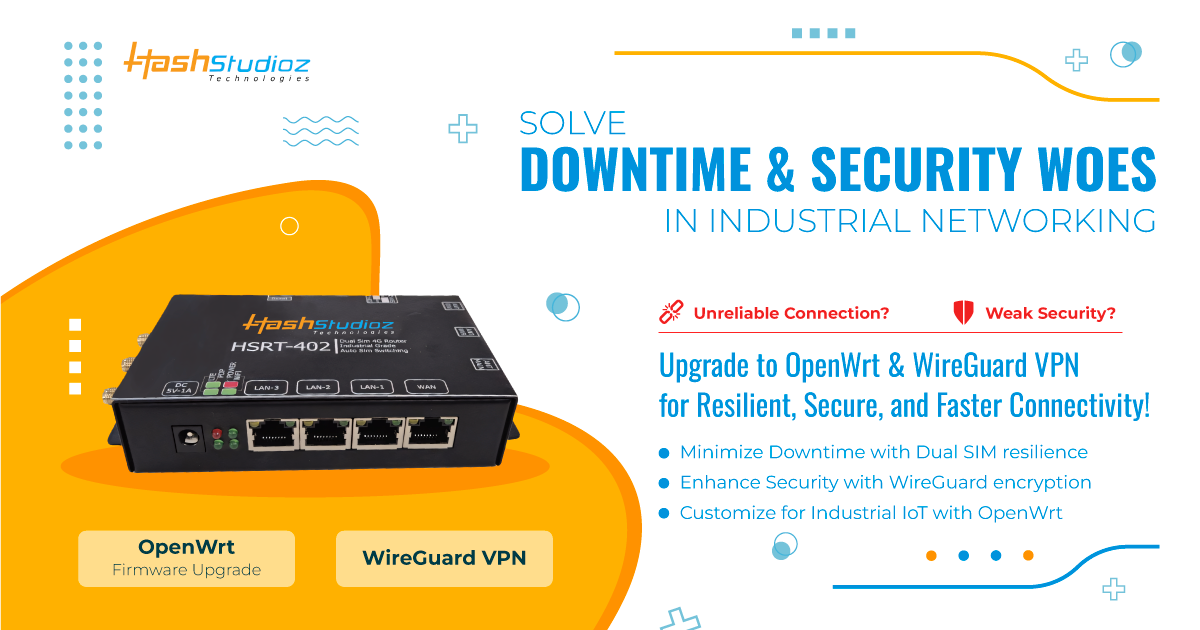
In the world of industrial networking, your router is more than just a box with blinking lights, it is the lifeline of your entire operation. Whether you are managing a fleet of remote sensors, a smart factory floor, or a decentralized energy grid, the stability of your connection determines your bottom line.
However, many businesses are still tethered to “black box” legacy systems. These routers come with restrictive vendor firmware that is often slow to update, difficult to customize, and vulnerable to modern cyber threats. For a CTO or IT Manager, this isn’t just an inconvenience; it’s a significant risk to industrial network security.
Transitioning to an OpenWrt industrial router equipped with WireGuard VPN. By combining open-source flexibility with the world’s fastest encryption protocol and dual SIM industrial router hardware, you can transform your network from a bottleneck into a competitive advantage.
Table of Contents
1. What Exactly is “Firmware” in Industrial Routers?
Think of firmware as the “brain” of your hardware. It is the specialized software embedded in your industrial router that tells it how to route data, manage security protocols, and communicate with connected devices.
The Limitations of Traditional Vendor Firmware
Most industrial routers ship with proprietary firmware developed by the manufacturer. While functional, these systems often come with “invisible” costs:
- The “Walled Garden”: You are restricted to the features the manufacturer chooses to provide. If you need a specific networking protocol or a custom script for remote monitoring, you are often out of luck.
- Security Lag: When a new vulnerability is discovered, you must wait for the vendor to release a patch. In the industrial world, a one-month delay in patching can lead to catastrophic data breaches.
- Feature Bloat: Many traditional systems are weighed down by unnecessary tools that consume CPU and RAM, slowing down your secure IoT connectivity.
2. Why Upgrade to OpenWrt?
OpenWrt is a Linux-based, open-source operating system designed for embedded devices. Instead of being stuck with a static set of features, an OpenWrt industrial router acts like a smartphone—you can install “packages” (apps) to give it exactly the functionality you need.
Key Benefits for Industrial Use:
- Unmatched Flexibility: Need to run a custom Python script or an MQTT broker directly on the router? With OpenWrt, you can.
- Longevity: OpenWrt breathes new life into hardware. By optimizing resource usage, it allows your routers to handle modern traffic loads without needing a hardware refresh.
- Enhanced Security: Because the code is open-source, it is constantly audited by thousands of developers worldwide. Vulnerabilities are often found and fixed long before they can be exploited.
- Scalability: You can create a “master configuration” and push it across hundreds of devices, ensuring consistency across your entire industrial network.
3. The Game Changer: WireGuard VPN for Industrial Networking
For years, IPsec and OpenVPN were the industry standards for creating secure tunnels. But for the modern industrial router with VPN capabilities, these older protocols are becoming a liability. They are complex to set up and often heavy on processor power.
Why WireGuard is Better
WireGuard is a modern VPN protocol that uses state-of-the-art cryptography. It was designed with a “less is more” philosophy:
- Speed: WireGuard is significantly faster than OpenVPN. In industrial settings where low latency is critical (like real-time robotics), this speed is vital.
- Lean Codebase: WireGuard has about 4,000 lines of code, compared to OpenVPN’s 100,000+. This makes the “attack surface” much smaller, drastically improving industrial network security.
- Instant Re-connection: In mobile or remote environments, connections often drop. WireGuard handles “roaming” better than any other protocol, re-establishing the secure tunnel instantly when the signal returns.
4. The Power Trio: OpenWrt + WireGuard + Dual SIM
The most robust networking solution for 2026 involves a “Power Trio” of technologies working in tandem. When you deploy a dual SIM industrial router running OpenWrt and WireGuard, you achieve a level of resilience that was previously impossible.
- Failover and Uptime: A dual SIM industrial router allows you to connect to two different cellular providers (e.g., AT&T and Verizon). If one tower goes down, OpenWrt can automatically switch to the second SIM in milliseconds.
- Seamless Performance: Because WireGuard is so lightweight, the router doesn’t struggle to encrypt data even when switching between SIM cards. This ensures that your remote monitoring router stays online and secure without manual intervention.
- Centralized Management: By using OpenWrt, you can manage your VPN keys and SIM failover rules from a single dashboard, giving IT managers total control over a global fleet of devices.
5. Real-World Use Cases
How does this look in practice? Here are four industries being transformed by these upgrades:
- Manufacturing & Industry 4.0: Factories use secure IoT connectivity to monitor machine health. By using OpenWrt, they can segment the network so that a breach in a sensor doesn’t provide access to the main office servers.
- Smart Cities & Infrastructure: Traffic lights, water sensors, and public Wi-Fi all require constant uptime. A dual SIM industrial router ensures that even if one carrier has a localized outage, the city’s critical infrastructure remains connected.
- Logistics & Fleet Management: Trucks and ships move through areas with varying signal strength. WireGuard’s ability to maintain a VPN tunnel while hopping between different cell towers makes it the perfect WireGuard VPN router for mobile assets.
- Renewable Energy: Solar and wind farms are often in the middle of nowhere. Remote monitoring routers with high-gain antennas and OpenWrt allow engineers to troubleshoot equipment from thousands of miles away without the cost of a site visit.
6. Before vs. After: The Impact of the Upgrade
| Feature | Legacy Vendor Firmware | OpenWrt + WireGuard Upgrade |
| Security Updates | Dependent on manufacturer schedule | Community-backed & instant patches |
| VPN Speed | Slow (OpenVPN/IPsec) | Ultra-fast & Lightweight |
| Customization | Locked/Restricted | Fully programmable (Linux-based) |
| Connection Stability | Single point of failure | Dual SIM Failover + Instant Reconnect |
| Hardware Life | 3–5 years (software bloat) | 7–10 years (optimized resources) |
7. Strategic Business Benefits
Choosing to upgrade your hardware to an OpenWrt industrial router isn’t just a technical decision, it’s a financial one.
- Reduced Downtime: Every minute of a network outage costs money. Dual SIM failover minimizes that risk.
- Lower OpEx: Because the system is more stable and allows for better remote access, you spend less on “truck rolls” (sending technicians to remote sites).
- Future-Proofing: As 5G and new security threats emerge, an open system like OpenWrt can be updated to handle them, whereas legacy systems often require total hardware replacement.
- Data Sovereignty: You have total control over where your data goes. No “backdoors” or hidden telemetry often found in cheaper, proprietary hardware.
Conclusion
The era of “set it and forget it” industrial networking is over. To stay competitive, your infrastructure must be as agile as your software. By moving from basic firmware to an OpenWrt industrial router with WireGuard VPN, you are ensuring that your business is protected by the best security protocols available today.
Don’t let outdated firmware be the weak link in your industrial chain. Upgrade to a solution that offers the flexibility of Linux, the speed of WireGuard, and the reliability of dual SIM hardware.
Ready to Secure Your Industrial Network?
Your infrastructure deserves more than “standard.” Our team of experts specializes in deploying high-performance WireGuard VPN routers tailored for the most demanding industrial environments.
- Explore Our Industrial Router Product Page
- Book a Demo to see our remote monitoring dashboard in action.
- Get a Custom Solution designed specifically for your IoT deployment.
FAQs
1. Is OpenWrt difficult to manage for a non-Linux expert?
While OpenWrt offers deep command-line access, most modern industrial versions come with a user-friendly web interface (LuCI) that allows IT managers to configure VPNs and SIM settings easily.
2. Can I install WireGuard on my existing industrial router?
It depends on the hardware. If your router supports OpenWrt or has a modular firmware system, WireGuard can often be added. However, for best performance, we recommend hardware optimized for high-speed encryption.
3. How does Dual SIM failover work with a VPN?
The router constantly monitors the “health” of the primary connection. If it detects a failure, it switches to the secondary SIM. WireGuard is unique because it doesn’t require a “handshake” to resume data flow, meaning your VPN tunnel stays active during the switch.
4. Does using a VPN slow down my IoT data transmission?
Traditional VPNs like OpenVPN can add significant overhead. However, WireGuard is designed to be extremely “thin.” Most users report no noticeable latency increase when switching to a WireGuard VPN router.
5. Why is an open-source router better for security?
“Security through obscurity” (the hallmark of proprietary firmware) rarely works. Open-source code allows for constant public scrutiny, ensuring that bugs are caught and patched by the global security community faster than any single company could manage.
 Nikhil Saini
  Yatin Sapra