


Every day, thousands of hotels appear across OTAs, wholesaler platforms, bed banks, metasearch engines, and direct booking channels. While this vast inventory gives travelers more choices, it also creates a major challenge for travel businesses: the same property often exists under multiple names, IDs, and supplier records.
According to a 2024 analysis of 12 major OTAs, platforms with more than 5% duplicate hotel listings experience significantly higher booking cancellations and negative reviews. The study found that mismatched room information causes 14% of reservation cancellations, while incorrect amenity listings account for 27% of negative reviews.
To solve this issue, travel companies rely on hotel mapping tools. These tools identify duplicate hotel records from different suppliers and combine them into a single, accurate listing. As a result, travel platforms can maintain consistent hotel data, improve search accuracy, and provide a better booking experience.
Hotel mapping has become an essential part of modern travel technology, especially for OTAs, hotel aggregators, and booking platforms that manage large inventories from multiple sources.
Table of Contents
What is Hotel Mapping?
Hotel mapping is the process of matching and consolidating hotel listings from multiple suppliers into a single, standardized property record. It helps OTAs, hotel aggregators, and travel booking platforms eliminate duplicate listings and maintain consistent property information across their inventory.
Since travel businesses often source hotel data from GDSs, wholesalers, bed banks, and direct hotel partners, the same property can appear multiple times with different names, IDs, or room descriptions. Hotel mapping resolves these inconsistencies by matching key details such as hotel name, address, geolocation, and supplier IDs, creating a single accurate listing for travelers.
Why do you need hotel mapping tools?
Hotel mapping tools compare hotel data from multiple suppliers and identify records that refer to the same property. They analyze key attributes such as hotel names, addresses, geolocation coordinates, contact details, room information, and supplier IDs to find potential matches.
Modern mapping solutions use AI, machine learning, and rule-based algorithms to detect duplicate listings and merge them into a single standardized property record. Once mapped, the system continuously updates hotel information as suppliers add new properties or modify existing data.
This process helps travel businesses maintain accurate inventories, reduce duplicate listings, and provide travelers with consistent hotel information across all booking channels.
How Hotel Mapping Works
| Step | Process |
|---|---|
| Step 1 | Collect hotel data from multiple suppliers, wholesalers, GDSs, and bed banks. |
| Step 2 | Compare hotel attributes such as name, address, geolocation, amenities, and supplier IDs. |
| Step 3 | Identify duplicate records and merge them into a single standardized listing. |
| Step 4 | Continuously update hotel information as suppliers add, modify, or remove properties. |
Result: A clean, accurate, and duplicate-free hotel inventory that improves search accuracy and the booking experience.
How do hotel mapping tools work?
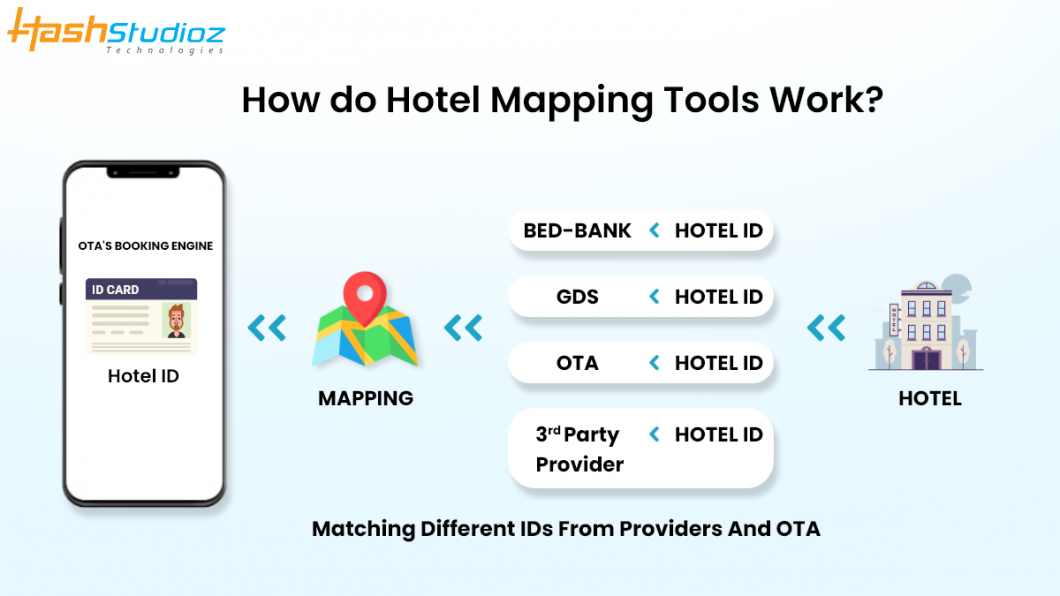
As we stated before, hotel mapping tools use technologies like machine learning and artificial intelligence to deliver prevailing results and datasets. There are several hotel mapping tools you can use to refine your data and filter out repeating property IDs. Every hotel mapping tool has a different way of operating and processing the data it contains. Some of these tools are mentioned below.
Gimmonix
Gimmonix is a travel technology company that provides automated hotel mapping and inventory optimization solutions for OTAs, bed banks, and travel platforms. Its cloud-based platform uses AI-driven matching algorithms to identify duplicate hotel records and improve data accuracy.
The solution helps travel businesses maintain a clean hotel inventory while reducing manual mapping efforts.
DataBindR
DataBindR specializes in hotel and accommodation mapping using machine learning technology. The platform helps travel companies standardize hotel content, eliminate duplicate records, and improve property matching across multiple suppliers.
Its automated approach enables businesses to manage large hotel inventories with greater accuracy and consistency.
HotelMappR
HotelMappR used its customized HotelBindR REST API to process and integrate the client’s hotel catalog. The client must provide the data in a CSV or Excel format for processing.
RoomMappR
Where HotelMappR processes properties via its API, RoomMappR processes the information of specific rooms of a property by giving them a unique BindID which can later be combined with the hotel portfolio.
GIATA
GIATA is arguably the largest hotel mapping provider in the business with a hotel catalogue containing more than 1,024,000 properties. Came into existence in 1996, the company provides services to online travel agencies and hotels by providing personal ID’d to properties and mapping them with its smartly engineered API.
Juniper Unique Hotel
Juniper Unique Hotel is a service provider that focuses on hotel and travel business solutions. It is a company based in Spain that offers its expertise to different OTAs and hotel booking websites.
Unlike other hotel mapper tools that work via customized APIs, Juniper features an advanced booking engine that integrates the features of hotel mapping.
What are the benefits of hotel mapping tools?
Hotel mapping tools help travel businesses manage large hotel inventories more efficiently while improving data quality and customer experience. Here are some of the key benefits:
1. Improves Inventory Accuracy
Hotel mapping eliminates duplicate listings and standardizes hotel information from multiple suppliers. This ensures travelers see accurate property details, room types, and amenities.
2. Enhances the Booking Experience
Consistent hotel content makes it easier for travelers to compare properties and make booking decisions. Accurate listings also reduce confusion and booking errors.
3. Reduces Manual Work
Automated mapping tools process large volumes of hotel data faster than manual methods. This saves time and allows teams to focus on higher-value tasks.
4. Supports Business Growth
As travel businesses add new suppliers and expand into new markets, hotel mapping tools help maintain a clean and scalable inventory without increasing operational complexity.
Conclusion
As travel businesses expand their hotel inventory through multiple suppliers, maintaining accurate and consistent property data becomes increasingly challenging. Duplicate listings, inconsistent hotel information, and manual data management can negatively impact both operational efficiency and customer experience.
Hotel mapping tools help solve these challenges by consolidating hotel records, improving inventory accuracy, and ensuring travelers receive reliable property information. Whether you operate an OTA, travel marketplace, hotel aggregator, or booking platform, hotel mapping plays a critical role in delivering a seamless booking experience and supporting long-term business growth.
By investing in the right hotel mapping solution, travel companies can maintain a clean, scalable, and high-quality hotel inventory while staying competitive in a rapidly evolving travel industry.
If you are also looking for hotel mapping solutions or want to know more about hotel content mapping and travel technology services, you can visit our Travel Technology Services Company page and know all about it. You can also shoot an email to info@hashstudioz.com.
FAQs
1. What is hotel mapping in the travel industry?
Hotel mapping is the process of matching and consolidating hotel listings from multiple suppliers into a single standardized property record. It helps travel businesses eliminate duplicate listings and maintain accurate hotel information.
2. Why is hotel mapping important for OTAs?
Online travel agencies often source hotel inventory from multiple providers. Hotel mapping ensures the same property does not appear multiple times with conflicting information, improving both data accuracy and user experience.
3. How do hotel mapping tools work?
Hotel mapping tools compare hotel attributes such as property names, addresses, geolocation data, amenities, and supplier IDs. They then identify matching records and merge them into a single listing.
4. What are the benefits of hotel mapping tools?
Hotel mapping tools improve inventory accuracy, reduce duplicate listings, minimize manual data management, enhance the booking experience, and support business scalability.
5. Can hotel mapping improve booking conversions?
Yes. Accurate hotel information helps travelers make informed decisions, reduces booking errors, and creates a smoother booking journey, which can positively impact conversion rates.
6. What technologies are used in modern hotel mapping solutions?
Modern hotel mapping platforms use artificial intelligence (AI), machine learning (ML), geolocation matching, and rule-based algorithms to identify duplicate properties and maintain accurate hotel inventories.
7. Who uses hotel mapping tools?
Hotel mapping tools are commonly used by OTAs, travel aggregators, hotel wholesalers, bed banks, metasearch platforms, destination management companies, and travel technology providers.
8. What is the difference between hotel mapping and room mapping?
Hotel mapping focuses on matching entire hotel properties across suppliers, while room mapping matches room types, rate plans, and accommodation details within a specific property.