

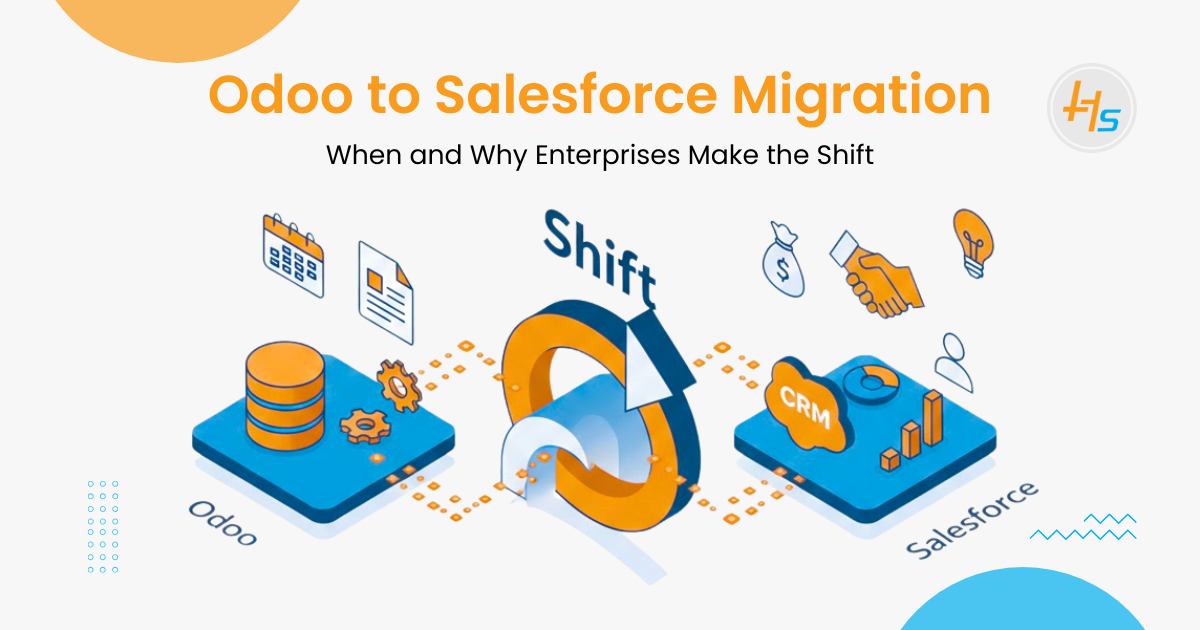
This pattern plays out consistently across the enterprises we work with. A company starts with Odoo, and it works perfectly for early growth. Everything feels manageable, licensing costs stay low, and implementation happens quickly. Then something shifts around the $30-50 million revenue mark—suddenly, the same platform that enabled rapid growth becomes a bottleneck.
According to Statista, the global CRM software market reached $64.4 billion in 2023 and continues expanding at 13.5% annually. Enterprise adoption of specialized CRM platforms over all-in-one solutions is accelerating as companies scale. When enterprises evaluate alternatives to Odoo, Salesforce consistently emerges as the preferred replacement due to superior CRM capabilities and enterprise-grade infrastructure.
At HashStudioz, we’ve guided numerous enterprises through this exact transition across manufacturing, SaaS, and professional services sectors. The outcomes remain remarkably consistent: faster sales cycles, better data visibility, reduced operational overhead.
The question isn’t whether Odoo is bad software—it’s not. It’s perfectly adequate for what it was built for. The question is whether it stays adequate as your company transforms.
Table of Contents
Why Odoo Works Initially (But Not Forever)
Odoo positions itself as the all-in-one solution. One platform handles invoicing, inventory, CRM, project management, HR, manufacturing, and accounting. This appeals to startups that are bootstrapped, need something functional fast, and can’t afford Salesforce at $200/user.
By year two, every team has customized Odoo substantially. You’ve built workflows around the system. Everything still works, but you’ve created a custom machine held together with code changes and workarounds.
Here’s the core problem: Odoo optimizes for breadth but masters nothing. Basic pipeline management happens in the CRM module. Transaction processing works in accounting. Stock levels track in inventory. None can compete with specialized platforms built for one specific job.
Salesforce takes the opposite approach—laser-focused on sales and customer management. When managing customer relationships, there’s no comparison.
When the Breaking Point Arrives
You don’t wake up one morning deciding to migrate. It’s gradual. Different problems surface over months or quarters. Eventually, they compound into a business case for change.
The Sales Complexity Explosion
Your first 50 customers? Everyone knew who they were. Sales were simple. Now you have 500 customers and a 100-person sales team. Each role needs different data, a different workflow, and different access levels.
Territory management becomes critical. Your VP Sales needs to assign accounts fairly, handle overlaps automatically, and route territory changes when reps leave. Odoo’s sales module forces workarounds. Salesforce Territory Management handles it natively in an afternoon.
Your Development Team Becomes the Bottleneck
Every time you need something new, you submit a ticket to your developer. New field? Ticket. New workflow? Ticket. New integration? Ticket. Your developer, who should be building strategic systems, spends 60% of their time maintaining Odoo customizations.
A manufacturing company we worked with hit this wall hard. They needed to modify the quote logic based on customer volume. Their developer spent three weeks building this feature in Odoo. In Salesforce, it would’ve been a configuration task completed in hours.
Your dev team isn’t happy. They’re problem-solvers, not maintenance workers. Your business isn’t happy. Feature requests queue up for months.
Reporting Becomes Impossible
Revenue visibility by region matters to CFOs. VP Sales need win-loss analysis. Marketing leaders want attribution reporting. Churn prediction helps customer success teams.
Odoo’s reporting tools are basic. You can run standard reports easily. Anything custom requires You guessed it, a development request. You’re back to your developer rebuilding queries while your CFO waits.
By now, your CFO probably already knows SQL. She’s writing custom queries directly against the database because that’s faster than waiting for reports through Odoo. Your data governance people hate this. Your security team is concerned. But it happens because the system doesn’t provide what people need.
Salesforce includes Einstein Analytics. Business analysts (not developers) build dashboards. CFOs get the visibility they need. Sales leaders see forecast accuracy metrics. Customer success managers track churn risk by account.
Integration Sprawl Gets Out of Control
Integration sprawl started small. Email systems connected first (Outlook, Gmail). Marketing platforms followed (HubSpot, Marketo). Accounting systems got linked. Slack notifications plugged in. Data warehouse synced last.
That’s five integrations. Each one is custom-built. Your dev team maintains each one.
Fast forward two years. You’ve added Stripe for payments, Zuora for subscriptions, Outreach for sales engagement, 6sense for account intelligence, and Gong for conversation intelligence. Now you’re maintaining fifteen integrations. Your developer spends half her time fixing integration breaks when APIs change.
Your budget for integration maintenance is shocking. You’re paying vendors for APIs that barely work together. Data syncs fail at midnight, creating emergencies. Critical business processes rely on integrations that frequently break down quarterly.
Salesforce has AppExchange—a marketplace of 5,000+ pre-built integrations. Most are maintained by vendors, not by you. You configure them in minutes. When they break, the vendor fixes it. You’re paying list price, not engineering time.
The Real Numbers: Cost Beyond Licensing
Here’s what most companies get wrong when comparing Odoo to Salesforce. They look at per-user licensing costs.
Odoo: $15-50/user/month Salesforce: $165-330/user/month
Salesforce looks expensive. Odoo looks like a bargain. Except this comparison ignores the rest of the cost structure.
Let’s model a real scenario. You have 200 users. You’re operating Odoo and have been for four years.
Your actual Odoo costs:
- Per-user licensing: 200 × $30 = $6,000/month ($72,000/year)
- One dedicated developer maintaining customizations: $120,000/year
- One systems administrator babysitting integrations: $80,000/year
- Custom integration development and maintenance: $60,000/year
- Annual customization projects (new requirements): $40,000/year
- Emergency fixes and patches: $30,000/year
Total Odoo annual cost: $402,000
Your Salesforce costs after migration:
- Per-user licensing (blended rate): 200 × $200 = $40,000/month ($480,000/year)
- One Salesforce administrator managing configuration: $90,000/year
- Salesforce Consulting Service support (ongoing): $50,000/year
- AppExchange integrations: $15,000/year
- Annual configuration projects: $20,000/year
Total Salesforce annual cost: $655,000
Salesforce looks more expensive. But look deeper. Development teams aren’t tied up maintaining platform customizations. Systems administrators focus on system health instead of fixing integration breaks. CFOs get reporting without custom queries.
The real comparison: $402,000 of pure platform cost versus $655,000 that includes strategic capability improvements. That’s not a cost increase—that’s redirecting spending toward value generation.
Real Example: Manufacturing Company Migration
I worked with a $40 million manufacturing company running Odoo. They sold complex products with many variants. Pricing depended on volume, customer segment, and seasonal demand.
Their Odoo system required manual quote calculations. Sales reps would email the pricing department. The pricing department would calculate costs and email quotes back. This loop took 3-5 days. Complex quotes (bundled products, custom configurations) took even longer.
Their problems:
- Slow quoting process costs them deals
- Sales reps couldn’t adjust pricing in the field
- No visibility into the quote-to-cash cycle
- Can’t track which quotes convert
They migrated to Salesforce and implemented CPQ (Configure-Price-Quote). Now:
- Sales reps generate accurate quotes in minutes
- Pricing rules are configured centrally (no more pricing department emails)
- Quotes route to approvers automatically based on the discount level
- Win-loss analysis shows exactly which quotes convert
Their average sales cycle dropped from 42 days to 35 days. For a company with a $500,000 average deal size, faster cycles mean more revenue per quarter.
Did the migration cost money? Yes, about $150,000 in consulting and implementation.
Did it pay back? The 7-day sales cycle improvement generates $1.4 million in additional quarterly revenue (calculated conservatively). Migration investment paid back in their first month.
What Actually Triggers the Migration Decision
Most companies don’t migrate because they read blog posts about Salesforce benefits. They migrate because something broke.
Your CEO hired a new VP Sales from Salesforce and she refuses to use Odoo. Perhaps you onboarded a massive customer requiring Salesforce integration. Or you lost three deals because your sales team couldn’t access information quickly enough.
Usually, it’s several small problems compounding. The bottleneck isn’t one thing—it’s the accumulation of limitations.
That’s when migration conversations start. And when they do, the timeline suddenly feels urgent. You need this fixed in 9 months, not “sometime next year.”
Planning the Migration Without Disaster
Migration success depends less on technology than on people. Your systems have to work, absolutely. But adoption determines actual value.
Phase 1: Assessment (4-6 weeks)
Don’t jump into migration planning. First, understand where you are.
What data lives in Odoo? What lives elsewhere? What’s the data quality? Your finance team probably knows your data is messy. This assessment forces everyone to acknowledge it.
Which Odoo customizations actually matter? Brilliant workarounds exist. Band-Aids also exist. Many can die in migration. Separate the three categories.
Which users will resist change most? These are your power users. They’ve built Odoo workflows that work for them. Salesforce will disrupt those workflows initially.
Phase 2: Design (6-8 weeks)
How will your enterprise actually use Salesforce? This matters more than most companies realize.
You probably don’t need Salesforce configured exactly like Odoo is configured. That’s false equivalence. Salesforce works differently. Your operating model should leverage how Salesforce works, not force Salesforce to work like Odoo.
Work with your Salesforce Consulting Service partner here. They bring patterns from hundreds of implementations. They know which configurations scale and which create technical debt.
Design decisions made here determine your flexibility post-migration. A poor data model limits future growth. A thoughtful data model scales with your business for years.
Phase 3: Data Migration (8-12 weeks)
This is the boring part that determines success. You’re moving customer records, opportunities, activities, and historical data from Odoo to Salesforce.
Two approaches exist:
Approach 1: Migrate as-is Move everything exactly as it sits in Odoo. Faster initially. But you inherit all data quality problems. Duplicates migrate. Invalid entries migrate. Incomplete records migrate.
Approach 2: Clean first. Spend time deduplicating customers, validating data, and standardizing fields. Slower upfront. But Salesforce starts with clean data.
Almost universally, the companies that cleaned first report better outcomes. Bad data is like dirt in gears—it slows down every system that uses it.
Phase 4: Testing and Cutover (4-6 weeks)
Your team tests actual workflows in Salesforce. Sales rep onboards an opportunity. Customer success tracks expansion revenue. Finance prepares invoices. Marketing views attribution.
This isn’t testing a feature. This is testing your actual job. Does it work? Is it faster? Is it intuitive?
Cutover typically happens over a weekend. Friday night, you stop entering data into Odoo. Saturday, you run final migrations and validations. Monday morning, your team uses Salesforce.
Plan for problems. Something will break. Someone will need help. The first week is chaos. Expect it. Prepare for it.
Phase 5: Adoption and Stabilization (3-6 months)
Your system works. Your people need to change. This is the hard part.
Train aggressively before go-live. Train the first week. Support people when they’re frustrated. Celebrate quick wins. Acknowledge frustrations.
Your power users become advocates or obstacles. Invest in them. Show them how Salesforce makes their jobs easier, not harder. Because if you migrate right, it actually does.
Why HashStudioz for Your Migration
HashStudioz specializes in enterprise CRM implementations with hands-on experience across Odoo to Salesforce transitions. Our team brings Salesforce expertise and practical migration knowledge from dozens of implementations.
We don’t just move your data. We transform your business processes:
- Data Assessment: Identify data quality issues before migration happens
- Architecture Design: Design your Salesforce operating model for future growth
- Custom Integration: Build APIs that reduce ongoing maintenance costs
- Team Training: Train your team to use Salesforce strategically
- Post-Migration Support: Provide 90-day stabilization for team success
Our implementations consistently deliver measurable results: improved sales cycle efficiency, better data visibility, and reduced operational overhead within 12 months post-migration.
Ready to evaluate migration? Contact HashStudioz for a free assessment. We’ll analyze your Odoo implementation, identify optimization opportunities, and outline your migration path.
Conclusion:
Odoo works well until it doesn’t. Most enterprises hit this inflection point between $30-100 million in revenue. At that stage, maintaining Odoo customizations consumes resources better spent on growth. Your sales cycles lag competitors. Your executive team lacks critical visibility.
Migration makes sense when your business needs CRM capabilities that Odoo wasn’t designed to provide. The companies that succeed treat migration as business transformation, not just system replacement. They plan carefully, involve their team, and change how they work.
FAQs
Q1: How long does the Odoo to Salesforce migration take?
Most companies complete the migration in 6-12 months. Expect 9 months for medium-sized enterprises, depending on data volume and customization complexity.
Q2: Will we lose data?
No, when planned properly. However, migration is ideal for cleaning data. Dirty data simply migrates with you if you don’t address it.
Q3: Can we run both systems simultaneously?
Yes, for 2-4 weeks. Parallel operation maintains a fallback while you transition. It costs more but prevents disaster if migration breaks.
Q4: What’s the biggest challenge?
User adoption. Technical migration is straightforward. The hard part is changing how hundreds of people work daily. Invest in change management and training.
Q5: Should we customize Salesforce?
No. Use standard features first. Salesforce’s strength is configuration, not customization. Only customize when the configuration cannot meet your needs.