

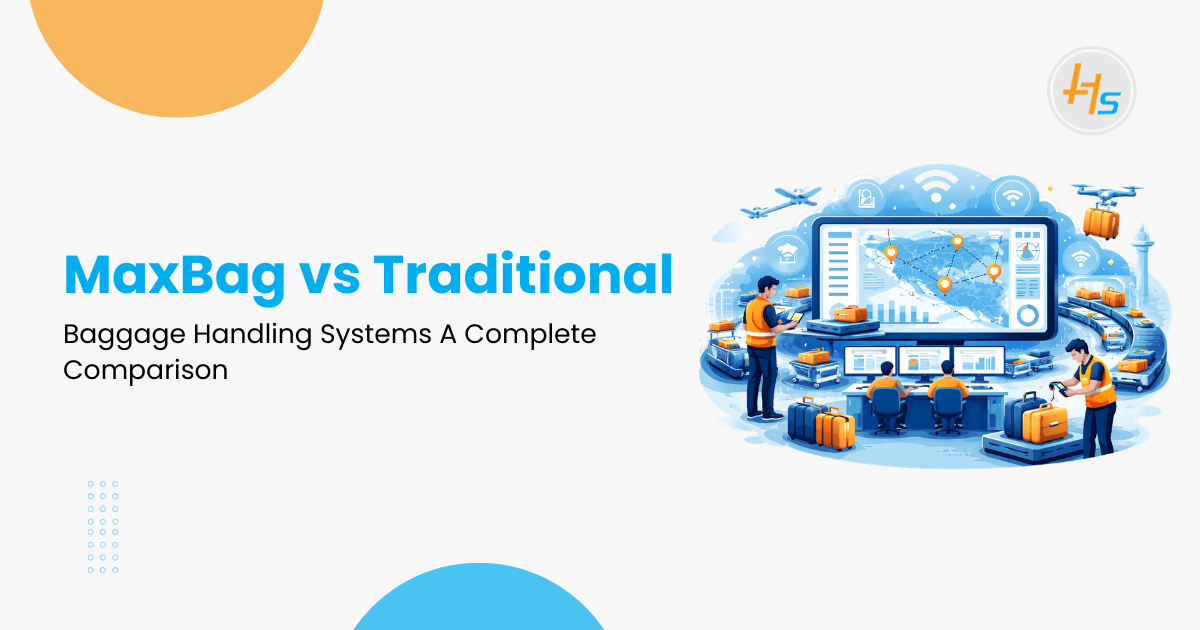
Airports lose bags daily. Mishandled bags hit 6.3 per 1000 passengers worldwide. The total reaches 33.4 million bags yearly. Costs total $5 billion in 2024. Delayed bags make up 74% of cases. Transfer errors cause 41%. Traditional systems use conveyor belts. They scan tags at stations. Bags route by destination. MaxBag changes this approach. It builds Salesforce Baggage Management Solution. AI-Powered Baggage Tracking System tracks every bag live. Stats show gaps clear. Europe drops to 12.3 per 1000.
Global average falls from 6.9. Airlines resolve 66% in 48 hours. MaxBag aims for lower numbers. It uses cloud data. Real-time tags locate bags. Airports gain total control. This article compares systems technical. It shows architectural differences. It gives deployment facts real.
Table of Contents
Traditional Baggage Systems Work
Traditional systems use belt conveyors. Bags enter at check-in. Tags print barcodes. Scanners read at merge points. Sorters are diverted by flight code.
Components include:
- Check-in conveyors feed main line
- Explosives detection scans hold bags
- Transfer sorters route connecting flights
- Early bag storage holds overflow
- Makeup carousels load ULD containers
PLC controls motors. Photo eyes detect jams. Diverter gates push bags left right. HMI screens show status local.
Bags hold RFID or barcode tags. Resolution 753 requires four tag reads. Acceptance, load, transfer, delivery.
Systems handle 5000 bags/hour typical. Peak reaches 10,000. Denver airport runs 1500km belts.
MaxBag Uses Salesforce Platform
MaxBag builds on Salesforce core. It uses custom objects and track bags. Lightning components show live maps. Einstein AI predicts paths.
Key objects include:
- Bag Master holds tag data
- Journey Record logs locations
- Flight Assignment links bags planes
- Handler Task assigns staff
- Resolution Case tracks delays
Platform Events push updates real-time. External Services call scanner APIs. Flow Builder routes logic no code.
Salesforce Solutions for Manufacturing reads patterns. It flags bags at risk. Salesforce Baggage Management Solution scales global.
Hardware Differences Show Clear
Traditional systems need conveyor steel. Motors drive belts constantly. Sorters tilt bags divert. Totes protect fragile items.
MaxBag cuts hardware heavy. RFID readers sit gates. Mobile scanners work handlers. Tablets show assignments.
Comparison table:
| Feature | Traditional | MaxBag |
| Conveyor Length | Kilometers | None required |
| Power Consumption | Megawatts | Minimal scanners |
| Maintenance Cost | High belts | Low RFID readers |
| Bag Capacity | Fixed lines | Unlimited cloud scale |
| Peak Handling | Limited | Scales with servers |
MaxBag uses tote carriers as optional. Bags ride individual carts. Destination prints screens.
Software Architecture Compares Deep
Traditional PLC programs ladder logic. SCADA shows HMI screens. Databases store tag scans SQL.
MaxBag runs as a Salesforce multi-tenant. Apex processes events server-side. LWC renders maps client. Einstein models predict delays.
Data flow differs sharp:
Traditional: Tag scan → PLC → SCADA → Operator screen
MaxBag: RFID read → Platform Event → Flow → Einstein → Mobile alert
Salesforce Baggage Management Solution queries fast. SOQL finds bags by flight. SOSL searches tags fuzzy.
Tag Technology Evolves Smart
Traditional systems use barcode stickers. Scanners need line of sight. Damage stops reading. The first pass rate is around 95%.
MaxBag uses UHF RFID tags. Passive chips read up to 10 meters away. Metal bags use on-metal tags. The read rate reaches 99.8%.
Tag Data Structure
Tag data stores key details:
- Bag ID (10 digits)
- Flight number
- Passenger PNR
- Weight class
- Fragile flag
RFID portals scan in bulk. No line of sight is needed. Tunnels can read up to 100 bags per second.
Real-Time Tracking Beats Static
Traditional systems log scan data in databases. Operators check reports to find bag locations. They only see the last scan point.
An AI-Powered Baggage Tracking System uses geofencing. Beacons track carts. GPS tracks trucks. Bags send location updates every minute.
Tracking Journey Map
The system shows the full path:
- Check-in counter
- Explosives scanner
- Transfer sorter
- ULD makeup
- Aircraft loader
- Baggage claim belt
Alerts trigger when issues occur. If a bag stops moving, the system assigns a task instantly.
AI Prediction Prevents Problems
Einstein AI studies patterns. Transfer bags carry higher risk. International flights face more delays. Weather affects movement.
Model Input Data
The model uses:
- Origin and destination airports
- Connection time in minutes
- Bag weight class
- Passenger class
- Historical delay rates
The system assigns a risk score from 1 to 100. Scores above 70 trigger alerts. Staff review such cases manually.
Salesforce Baggage Management Solution runs daily retraining. It achieves about 92% accuracy.
Handler Assignment Works Different
Traditional dispatch relies on radio calls. Supervisors assign tasks manually. Whiteboards track progress.
MaxBag uses Field Service Lightning. It matches skills with tasks. It also optimizes routes based on location.
Dispatch Console Insights
The console displays:
- Handler availability
- Current bag location
- Required skills like RFID handling
- Travel time estimate
- Priority score
A mobile app guides handlers. The scanner confirms pickup. Photos verify bag condition.
Resolution Process Speeds Recovery
Lost bags enter case systems. Traditional methods use email. Passengers call support centers.
MaxBag creates Resolution Cases automatically. It integrates with WorldTracer. Einstein AI suggests possible matches.
Case Workflow Stages
Each case follows steps:
- Bag located and scanned
- Owner contact attempted
- Delivery scheduled
- Bag delivered and signed
- Case closed with survey
The industry resolves 66% of cases in 48 hours. MaxBag aims to resolve within 24 hours.
Integration With Airport Systems
MaxBag connects AODB systems. Flight schedules sync live. Gate changes and update routes.
API integrations include:
- SITA BagManager status exchange
- Airport Operations Database delays
- Carrier systems passenger manifests
- Ground handler dispatch systems
Salesforce External Objects read external data. No sync needed.
Mobile App Guides Ground Staff
Handlers use iOS Android apps. Camera scans tags. GPS shows the next bag. AR overlays point locations.
App features:
- Bag details passenger name
- Flight gate changes
- ULD container assignments
- Handler checklist signatures
- Photo documentation damage
Offline mode caches data. Sync resumes connection.
Dashboard Shows Airport Truth
The operations center sees all bags. Heat maps show congestion. Flight delays predict bag issues.
KPIs track:
- Bags per hour processed
- Transfer success rate
- Resolution time hours
- On-time delivery percentage
- Handler productivity bags/hour
Red alerts flash problems. Drill down shows bag details.
Cost Comparison Favors MaxBag
Traditional systems cost $200 million at large airports. Maintenance adds $10 million yearly.
MaxBag deploys Salesforce licenses. $150 per user monthly. Custom dev one-time $2 million.
Savings include:
- Less steel conveyors
- Fewer maintenance staff
- Lower energy bills
- Faster bag recovery
- Higher passenger satisfaction
ROI hits 24 months typical.
Scalability Handles Peak Traffic
Traditional belts have fixed capacity. Peak hours jam lines. Overflow bags manual.
MaxBag cloud scales servers. The 10,000 bags/hour process is easy. Multi-tenant serves multiple airports.
Peak handling auto-scales. Black Friday air travel doubles load. The system holds steady.
How Growing Businesses Replace 10+ Tools With a Single Odoo ERP
Security Protects Bag Data
Passenger PII stays safe. GDPR CCPA compliance built-in. Encryption protects transit data.
Features include:
- Role based access controls
- Audit trails every scan
- Data masking non-essential views
- MFA for admin access
- Annual penetration tests
Bag tags anonymize public views.
Case Example Airport Wins
Dubai airport handles 90 million passengers. Traditional system jams peaks. Bags pile makeup areas.
MaxBag deploys phase one. RFID tags all bags. Salesforce Baggage Management Solution goes live at Terminal 3.
Results after year one:
- Mishandled rate drops 62%
- Resolution time halves
- Handler productivity rises 45%
- Transfer accuracy hits 99.2%
- Annual savings $8 million
Ground ops director notes, “We locate every bag minute by minute. Passengers trust us completely.”
Traditional System Limits Exposed
Traditional baggage handling systems face multiple operational challenges that impact efficiency and scalability. Conveyor belts often suffer from mechanical wear and tear, leading to frequent breakdowns. Motors tend to overheat under continuous load, increasing the risk of failure. Sorting systems struggle with irregular or oversized baggage, causing jams and delays.
Operational Challenges
Maintenance activities further disrupt operations, as even short maintenance windows can shut down entire conveyor lines. Expanding capacity is another major limitation, as it requires installing new physical infrastructure such as conveyors and sorting units. These upgrades take years to plan and implement, with costs often reaching tens of millions of dollars.
MaxBag: A Modern, Scalable Approach
MaxBag transforms baggage management by shifting from hardware dependency to software-driven scalability. Instead of adding physical infrastructure, capacity can be increased through code and cloud-based systems. Servers can scale dynamically using cloud technology, enabling airports to handle higher volumes without major physical changes.
Benefits of Software-Driven Systems
New features can be deployed rapidly, often on a weekly basis, ensuring continuous improvement and adaptability to changing demands. This approach reduces downtime, lowers costs, and improves overall system efficiency.
MaxBag Deployment Roadmap
The implementation of MaxBag follows a structured and phased approach:
1. Implementation Phases
- Phase 1: RFID tagging of baggage to enable real-time tracking
- Phase 2: Development of Salesforce-based data models and objects
- Phase 3: Training baggage handlers using mobile-enabled solutions
2. Deployment Timeline
- Month 1: Hardware installation and setup
- Month 2: Data model configuration and system setup
- Month 3: Integration testing with existing airport systems
- Month 4: Go-live at Terminal 1
- Month 6: Full airport-wide rollout
A skilled Salesforce Development Company plays a key role in this process by leading implementation, customizing workflows, and providing hands-on training to airport staff for smooth adoption.
Future Features That Push Limits
MaxBag is designed with future-ready capabilities that go beyond traditional systems:
1. Advanced Innovations
- Digital baggage tags with real-time status indicators
- Blockchain integration to ensure secure chain of custody
- Drone-based baggage delivery to hotels and nearby locations
2. Upcoming Roadmap Enhancements
- Passenger mobile app for live baggage tracking
- Automated self-service baggage drop kiosks
- Robotic systems for baggage loading and sorting
- Carbon tracking for environmentally conscious flight operations
Transform Your Baggage Handling Operations with MaxBag Solutions
Choosing the right baggage management solution is essential for airports aiming to reduce delays and replace outdated systems with a smart, unified platform. From real-time baggage tracking and transfer management to delay prediction and automated workflows, modern airports need a reliable and scalable system that supports efficient operations and better passenger experience.
At HashStudioz, we help airports implement and customize MaxBag solutions that centralize baggage operations, improve real-time visibility, and simplify complex handling processes across terminals.
Partner with our experienced team to build a powerful baggage management system that reduces delays, increases efficiency, and supports smooth airport operations with a single integrated platform.
Conclusion
Traditional baggage systems use belt steel. They scan tags fixed points. Jams stop lines. Bags pile makeup. Mishandled rates stay high. MaxBag builds differently. Salesforce Sales Cloud tracks live. AI-Powered Baggage Tracking System predicts risks. Handlers get tasks mobile. Airports see the truth totally.
RFID reads bulk fast. Maps show locations exactly. Alerts fire delays early. Resolution cases close quickly. Costs drop sharp. Capacity grows cloud. Passengers trust bags arrive. Airlines save millions. Airports choose MaxBag future. Technical foundation proves solid. Deployment roadmap works proven. Production uptime climbs high.
FAQs
1. What makes MaxBag different from traditional systems?
MaxBag uses AI, cloud computing, and RFID. Traditional systems rely on conveyors and barcodes.
2. How does an AI-Powered Baggage Tracking System help?
It predicts issues, tracks bags in real time, and reduces errors.
3. Is MaxBag expensive to implement?
Initial costs are higher. Long-term savings are significant.
4. Can MaxBag integrate with existing systems?
Yes. It supports API-based integration, including Salesforce Baggage Management Solution.
5. Does MaxBag improve passenger satisfaction?
Yes. Real-time updates and faster resolution improve the passenger experience.