

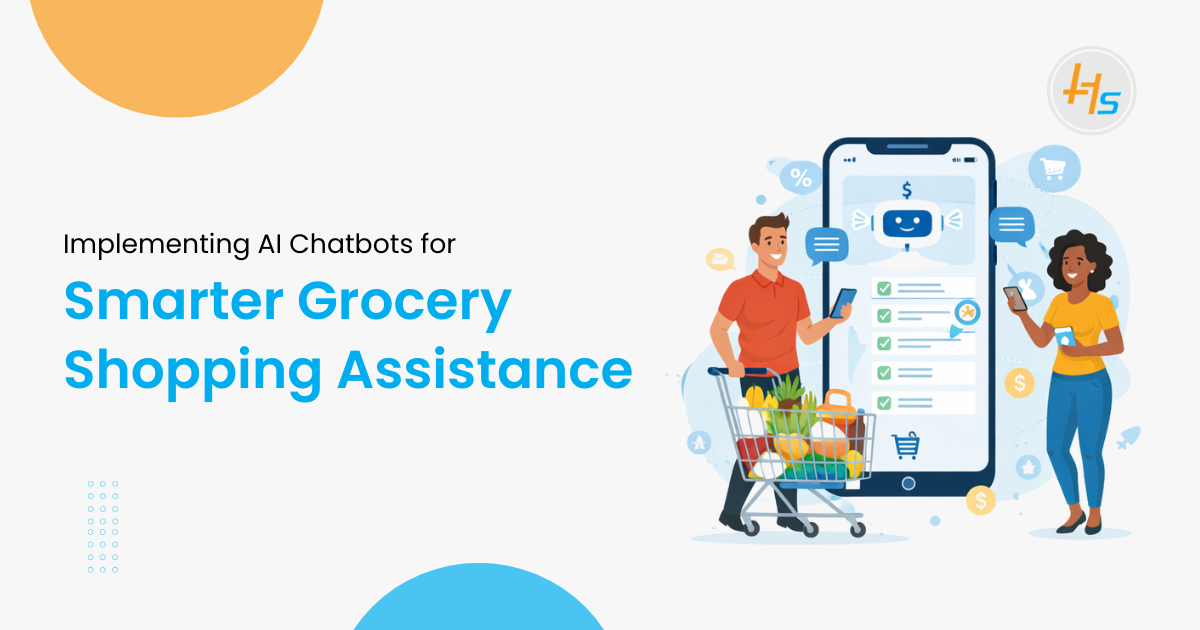
The global online grocery market is growing fast. According to Statista, the global online grocery market crossed USD 800 billion in 2024 and continues to grow at over 25% CAGR. In India alone, online grocery users exceeded 180 million, driven by mobile-first behavior and quick commerce demand.
Customers now expect fast responses, accurate product suggestions, and smooth order support. Traditional customer support teams struggle to handle high request volumes. AI chatbots solve this problem by providing instant, data-driven assistance. Many businesses now rely on chatbot systems built by a Grocery Delivery App Development Company to improve user experience and reduce operational costs.
Table of Contents
What Is an AI Chatbot in a Grocery App?
An AI chatbot is a software agent that interacts with users through text or voice. It uses artificial intelligence to understand queries and provide relevant responses.
In grocery apps, chatbots help users with:
- Product search
- Order tracking
- Price comparison
- Personalized suggestions
- Issue resolution
Unlike rule-based bots, AI chatbots learn from user data. They improve responses over time through machine learning models.
Why Grocery Apps Need Smarter Assistance
1. High Product Volume
A grocery app may list over 10,000 SKUs. Manual search becomes difficult for users. Chatbots help users find items quickly.
2. Frequent Repeat Orders
Over 65% of grocery orders are repeat purchases. Chatbots recognize buying patterns and suggest items instantly.
3. Peak-Time Load
During festivals or sales, customer queries spike by 3x to 5x. Chatbots handle these spikes without delays.
4. Low Patience Levels
Research shows that 53% of users leave apps if responses take more than 5 seconds. Chatbots respond instantly.
Core Functions of AI Chatbots in Grocery Apps
1. Product Discovery Support
Chatbots understand natural language queries like:
- “Show organic vegetables under ₹200”
- “Milk brands with low fat”
They convert text into structured search filters. This reduces user effort.
2. Smart Cart Assistance
Chatbots track cart activity and notify users about:
- Missing daily essentials
- Better pack sizes
- Discounted alternatives
This increases cart value without aggressive prompts.
3. Order Tracking and Status Updates
Chatbots integrate with order management systems. They provide live updates on:
- Order confirmation
- Delivery time
- Rider location
This reduces customer support tickets.
4. Customer Issue Resolution
Chatbots handle common issues like:
- Refund status
- Damaged item reporting
- Replacement requests
They route complex cases to human agents only when required.
Technical Architecture of Grocery Chatbots
1. Frontend Integration
The chatbot appears inside the mobile app or website. It uses:
- React Native or Flutter for mobile apps
- WebSocket for real-time messaging
The UI stays minimal to avoid distraction.
2. Backend Processing Layer
The backend handles:
- Message routing
- User session tracking
- API calls
Most Grocery Delivery App Development Services use Node.js or Python for this layer.
3. Natural Language Processing Engine
The NLP engine processes user messages. It performs:
- Intent detection
- Entity extraction
- Context handling
Popular tools include Dialogflow, Rasa, and Microsoft Bot Framework.
4. Machine Learning Models
ML models analyze user behavior. They learn from:
- Search history
- Order frequency
- Product ratings
These models improve suggestions over time.
5. Data Storage Layer
Chatbots rely on databases like:
- PostgreSQL for structured data
- Redis for session caching
- MongoDB for chat logs
This setup ensures fast response times.
How Chatbots Improve Personalization
1. User Profile Analysis
Chatbots build user profiles using:
- Past orders
- Preferred brands
- Price sensitivity
This data enables accurate suggestions.
2. Seasonal and Local Context
Chatbots consider:
- Local availability
- Seasonal produce
- Weather-based demand
For example, they suggest soups during cold weather.
3. Dynamic Recommendation Logic
Instead of static rules, chatbots apply scoring models. These models rank products based on relevance.
This approach increases conversion rates by 15–25%, according to McKinsey.
Voice-Based Chatbots for Grocery Apps
1. Growing Voice Usage
Over 40% of smartphone users use voice assistants weekly. Grocery apps now support voice-based ordering.
2. Voice Recognition Pipeline
The system includes:
- Speech-to-text engine
- NLP processing
- Response generation
- Text-to-speech output
Google Speech API and Amazon Polly are common tools.
3. Use Cases
Voice chatbots help users:
- Add items while cooking
- Check order status hands-free
- Create shopping lists
This improves accessibility for elderly users.
AI Chatbots and Inventory Awareness
1. Real-Time Stock Checks
Chatbots connect with inventory systems. They show only available products.
2. Alternative Suggestions
If an item is out of stock, the chatbot suggests similar options.
This reduces cart abandonment.
3. Expiry and Freshness Alerts
Some chatbots notify users about:
- Near-expiry products
- Fresh arrival stock
This supports better inventory movement.
Security and Data Privacy Considerations
1. User Data Protection
Chatbots handle sensitive data. Developers must follow:
- Data encryption standards
- Secure API communication
- Role-based access
2. Compliance Requirements
In India, apps must follow IT Act guidelines. Global apps follow GDPR rules.
3. Secure Authentication
Chatbots verify users through:
- OTP validation
- Token-based authentication
This prevents misuse.
Why Enterprises Are Choosing PWAs Over Traditional Web and Mobile Apps
Role of a Grocery Delivery App Development Company
A professional Grocery Delivery App Development Company plays a key role in chatbot success.
They handle:
- Requirement analysis
- NLP model selection
- System integration
- Performance testing
They also ensure chatbot scalability for future growth.
Chatbot Testing and Performance Metrics
Chatbot testing and performance metrics help businesses measure how well a chatbot works. These metrics show whether the chatbot understands users, responds quickly, and improves customer experience. Regular testing ensures the chatbot delivers accurate, fast, and useful responses.
1. Accuracy Rate
Accuracy rate measures how correctly a chatbot understands user queries and provides relevant responses.
An intent recognition accuracy above 90% means the chatbot can correctly identify what users want in most cases. High accuracy reduces user frustration, minimizes errors, and increases trust in the chatbot. Poor accuracy often leads to wrong answers and higher escalation to human agents.
2. Response Time
Response time is the speed at which a chatbot replies to user messages.
For best performance, chatbots should respond within 2 seconds. Fast responses keep users engaged and prevent drop-offs. Slow response times can frustrate users, reduce satisfaction, and make the chatbot feel unreliable, especially in grocery and eCommerce apps where users expect quick service.
3. User Engagement Rate
User engagement rate shows how actively users interact with the chatbot. Developers usually track:
- Chat sessions per user: Indicates how often users return to the chatbot
- Conversation length: Shows how long users continue interacting
Higher engagement means the chatbot is helpful, easy to use, and relevant. Strong engagement reflects better usability and customer acceptance.
4. Escalation Rate
Escalation rate measures how often conversations are handed over to human agents.
A low escalation rate indicates that the chatbot successfully resolves most user queries on its own. This reduces workload for support teams and lowers operational costs. High escalation suggests the chatbot needs better training or improved intent handling.
Real-World Example: AI Chatbot in Action
A mid-size grocery app in India implemented an AI chatbot for product search and customer support.
After six months, the results were impressive:
- Support tickets reduced by 38%, lowering customer service workload
- Average cart value increased by 22%, due to better product suggestions
- Repeat orders rose by 18%, showing improved customer loyalty
The chatbot handled over 1 million queries per month without downtime, proving its scalability and reliability.
Challenges in Chatbot Implementation
1. Language Diversity
India has multiple regional languages. Chatbots must support local languages to serve a wider audience effectively.
2. Complex Queries
Users often ask unclear or incomplete questions. Continuous chatbot training and data updates help improve understanding over time.
3. Initial Training Cost
Machine learning models need large datasets. Early-stage apps must invest in data collection and training to achieve good performance.
Despite these challenges, the long-term benefits of chatbots outweigh the initial effort.
Future Trends in Grocery Chatbots
1. Predictive Shopping Lists
Chatbots will automatically create shopping lists based on user habits and past orders.
2. Visual Chatbots
Users will upload images to search for products instead of typing.
3. Emotion Detection
Chatbots may detect user frustration and adjust tone or responses accordingly.
These advancements will shape the future of Grocery Delivery App Development Services.
Business Benefits of AI Chatbots
AI chatbots offer strong business value, including:
- Lower customer support costs
- Higher order frequency
- Better user satisfaction
- Improved customer retention
According to IBM, chatbots can reduce customer service costs by up to 30%, making them a smart investment for growing digital businesses.
Transform Grocery Experiences with AI Chatbots from HashStudioz
Want to make grocery shopping faster, smarter, and more convenient for your customers? From product discovery to order support, AI chatbots are changing how users interact with grocery apps. At HashStudioz, we build intelligent chatbot solutions that help grocery businesses deliver quick assistance and personalized experiences.
Our AI Chatbot Development Services cover everything from smart search and order tracking to customer support automation—designed to match the needs of modern grocery platforms.
Partner with HashStudioz to enhance customer engagement and simplify grocery shopping with reliable, future-ready AI chatbot solutions.
Conclusion
AI chatbots have become essential for modern grocery apps. They improve product discovery, reduce support load, and enhance personalization. From a technical perspective, chatbots rely on NLP, ML models, and real-time system integration.
Businesses that invest in chatbot solutions gain a competitive edge. Partnering with an experienced Grocery Delivery App Development Company ensures reliable implementation. As technology evolves, chatbots will continue to shape smarter grocery shopping experiences.
 Prithvi Singh