

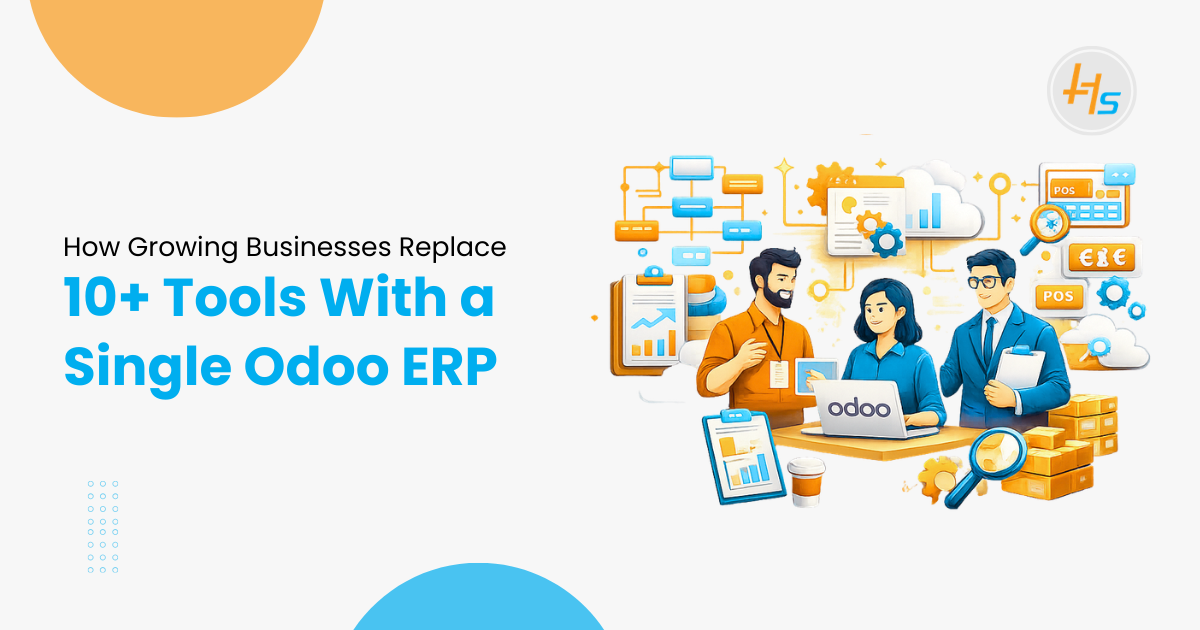
Growing businesses use many tools. They manage CRM, accounting, inventory, HR, and sales. This creates chaos. Odoo ERP combines all into one system. Businesses cut tool count from 10+ to single platform. Stats show clear benefits. Odoo serves 13 million users worldwide. Companies save 45% on operations costs. Firms reduce ERP expenses by 35-55%. Odoo adds 13,000 clients monthly. It reaches €20 million in new revenue in January 2026. Cross-department collaboration improves greatly. Growing teams need this unity. An Odoo Consulting Company helps make it work. Odoo Consulting Services guide the switch.
Table of Contents
The Problem: Too Many Tools for Business Operations
Many companies rely on separate applications for every department. For example:
- CRM software manages leads and customer relationships
- Accounting platforms handle invoices and financial records
- Inventory systems track product stock
- HR software manages employee information and payroll
- Sales platforms generate quotes and process orders
- Marketing tools handle email campaigns
- Project management systems track tasks
- POS systems process retail payments
Teams often switch between 10 or more tools every day. As a result, business data becomes fragmented across different platforms. Reporting takes longer because information must be collected manually from multiple sources.
The costs also increase. Each tool requires licenses, maintenance, and training.
Odoo ERP eliminates this complexity by connecting all business functions within a single database. Every module communicates with the others, ensuring smooth information flow across departments.
For example, when a sales order is created in Odoo, it automatically updates inventory levels, generates invoices, and records the transaction in accounting.
Odoo Modules Replace Multiple Business Tools
Odoo provides more than 80 integrated modules that cover nearly every business function. Companies can activate only the modules they need and expand later as the business grows.
Common Odoo modules include:
- CRM for managing leads and customer relationships
- Sales for quotations and order processing
- Accounting for financial tracking and invoicing
- Inventory for warehouse and stock management
- HR for employee management and payroll
- Project Management for task tracking
- Website Builder for online presence
- Point of Sale (POS) for retail operations
- Marketing Automation for email campaigns
- Reporting Dashboards for business insights
All modules share the same database, allowing information to move automatically between departments. For example, once a sales order is confirmed, inventory adjusts automatically, and accounting records the revenue instantly.
An experienced Odoo Consulting Services team analyzes existing tools and maps them to the correct modules to ensure complete coverage of business needs.
Technical Architecture Behind Odoo ERP
Odoo ERP uses a modern and scalable architecture designed to support growing businesses.
The platform runs on a PostgreSQL database, which acts as a centralized data source. All modules access the same database, eliminating duplicate data storage.
The backend uses the Python programming language, which processes business logic and system operations. The frontend runs through the Odoo Web Interface, offering a consistent user experience across modules.
Odoo also supports REST APIs, allowing integration with external applications such as payment gateways, shipping systems, and third-party services.
Deployment options include:
- Cloud Hosting via Odoo.sh
- On-premise installations using Docker containers
Both options provide scalability and flexibility for growing organizations. An Odoo Consulting Company typically manages deployment and system optimization to ensure strong performance.
Step-by-Step Process to Replace Multiple Tools
Successful ERP adoption requires a structured implementation process.
1. Analyze Existing Tools
The first step is identifying all tools currently used by the organization. Businesses often discover they rely on more than ten systems.
During this stage, consultants evaluate data volume, user roles, and workflow dependencies.
2. Implement Core Modules
Companies usually start with key modules such as CRM, Sales, and Accounting. Customer data is imported, and order workflows are tested.
Sales representatives create quotes, customers approve orders, and invoices are generated automatically.
3. Add Operational Modules
Next, businesses deploy modules like Inventory, Purchasing, and Manufacturing. These modules automate supply chain processes and improve stock management.
Warehouse teams can use barcode scanning and mobile tools to track inventory movements.
4. Launch Customer-Facing Modules
Modules such as Website, POS, and Marketing Automation are then introduced to improve customer interaction and online operations.
5. Activate Back-Office Modules
Finally, companies implement HR, project management, and reporting dashboards to complete the ERP ecosystem.
An experienced Odoo Consulting Company typically manages each phase while training employees simultaneously.
Data Migration Strategy
Migrating business data is one of the most critical steps during ERP implementation.
The process generally includes:
- Exporting existing data from legacy systems
- Cleaning duplicates and formatting fields
- Importing data into Odoo using built-in tools
- Testing small batches first
- Completing the full migration after validation
Complex data migrations may require custom scripts developed by Odoo Consulting Services to ensure accurate transformation and verification.
Agriculture IoT Application Development Company Delivers Precision Farming Apps With Real Sensors
Customization for Business Requirements
Although Odoo modules cover most requirements, businesses sometimes need additional customization.
Odoo allows developers to extend functionality using its modular architecture. Instead of modifying core code, developers create extensions that maintain upgrade compatibility.
Common customizations include:
- Additional fields on customer forms
- Approval workflows for orders
- Automated notifications and alerts
- Custom business reports
- Integration with third-party platforms
Tools such as Odoo Studio enable basic modifications without coding, while advanced customizations require Python development.
Training and User Adoption
Technology adoption depends heavily on user training. Employees must feel comfortable using the new system.
Successful training programs usually include:
- Live instructor sessions
- Video tutorials and documentation
- Role-based training programs
- Test environments for practice
Most organizations achieve over 90% user adoption within two months when training is properly structured.
Performance and Scalability
Odoo ERP supports growing businesses with strong scalability features.
Typical performance benchmarks include:
- Support for 1,000 concurrent users
- Processing 10,000 daily orders
- Managing databases larger than 50GB
- Delivering 99.9% system uptime
Cloud deployments automatically scale infrastructure during traffic spikes, ensuring consistent performance.
Cost Benefits of Odoo ERP
Maintaining multiple software systems significantly increases operational costs.
By consolidating tools into a single platform, businesses typically achieve:
- Up to 70% reduction in software license costs
- Lower IT maintenance expenses
- Reduced training requirements
- Elimination of integration tools
Many organizations recover their ERP investment within 12 months of implementation.
Real Business Example
A retail company based in Delhi previously relied on 14 separate software tools to manage operations. The business had more than 200 employees and annual revenue exceeding ₹50 crore.
After implementing Odoo ERP with the help of an Odoo Consulting Company, the organization achieved the following results:
- Tool count reduced from 14 to 1
- Order processing speed doubled
- Inventory accuracy improved to 99%
- Financial reporting time reduced from 10 days to 2 days
The company’s leadership gained real-time insights through centralized dashboards. This article shows technical steps. It gives real examples.
Future Growth Stays Easy
Odoo scales with business. Add modules any time. New apps activate instant. User seats grow linearly.
Version upgrades add features. v18 brings AI forecasting. v19 adds voice mode.
Cloud handles traffic spikes. Black Friday doubles orders no problem.
International expansion is simple. Multi-currency tracks global sales. Multi-language serves teams.
An Odoo Consulting Company plans for a three-year roadmap. They keep the system current.
Transform Your Business Operations with Odoo ERP Solutions
Choosing the right Odoo ERP implementation partner is essential for businesses aiming to simplify operations and replace multiple disconnected tools with one unified platform. From managing sales, accounting, inventory, and HR to automating workflows and generating real-time business insights, modern companies need a reliable and scalable ERP system that supports efficient decision-making and long-term growth.
At HashStudioz, we help businesses implement and customize Odoo ERP solutions that centralize operations, improve data visibility, and streamline everyday processes across departments.
Partner with our experienced team to build a powerful ERP ecosystem that reduces operational complexity, increases productivity, and supports sustainable business growth with a single integrated platform.
Conclusion
Growing businesses often struggle with fragmented tools and disconnected systems. Managing multiple platforms creates data silos, slows reporting, and increases operational costs.
Odoo ERP solves this problem by bringing every department onto a single platform. CRM, sales, accounting, inventory, and HR modules work together seamlessly, providing real-time visibility across the organization.
With its powerful architecture, scalable infrastructure, and flexible customization options, Odoo enables businesses to simplify operations and focus on growth.
By working with an experienced Odoo Consulting Company, organizations can successfully migrate from complex software environments to a unified ERP system that drives efficiency, productivity, and long-term success.