

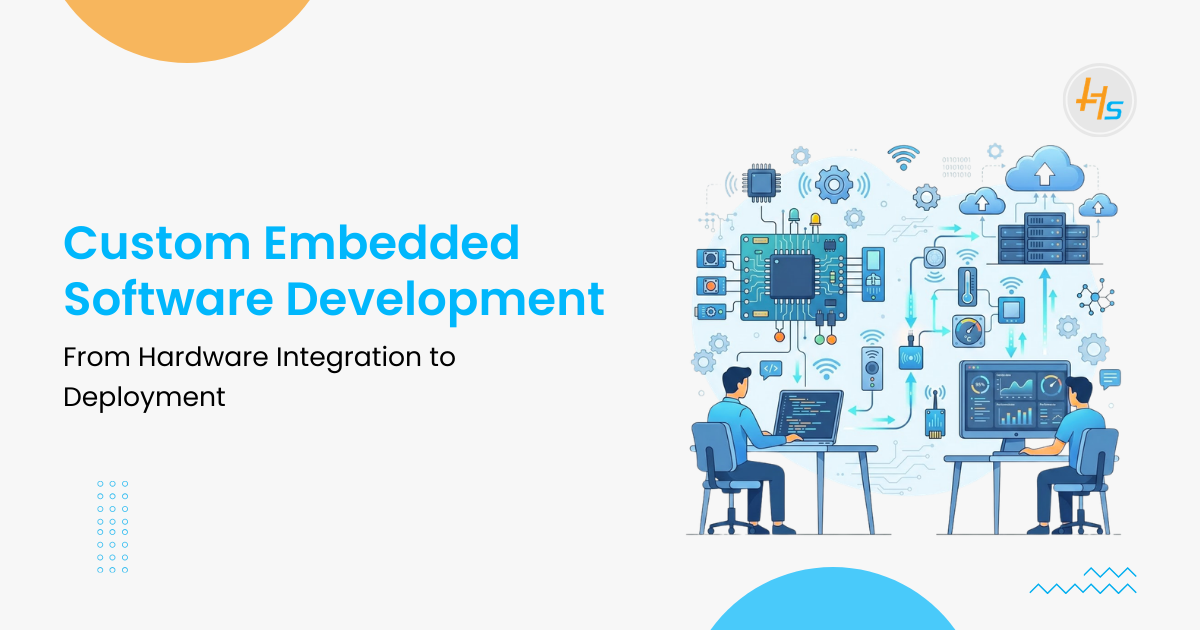
Custom embedded software is what brings smart devices to life, whether it’s a machine on a factory floor, a medical device, or an IoT-enabled product you use every day. In this blog, we take you through the entire journey of building embedded solutions, from connecting software with hardware to designing firmware, testing performance, optimizing efficiency, and deploying systems in real-world environments.
In 2025, the global embedded software market reached $28.2 billion, growing at 9.2% CAGR through 2032. Embedded systems now operate in billions of devices, from smartwatches to industrial robots. More than 70% of all connected devices use customized embedded software to meet specific performance requirements. This trend highlights how critical embedded software development has become across industries. Today’s embedded systems demand precision, efficiency, and specialized expertise.
Table of Contents
What Is Embedded Software Development?
Embedded software is specialized code designed to run on dedicated hardware to perform specific functions. It operates within devices where performance, reliability, and real-time responsiveness are critical. This software typically runs on microcontrollers or digital signal processors (DSPs) and interacts directly with sensors, actuators, and communication interfaces.
Why Custom Development Matters
General-purpose software often struggles in real-time or resource-constrained environments. Custom embedded software is tailored to the exact hardware and application requirements, delivering higher performance, lower power consumption, and greater stability than off-the-shelf solutions.
Core Components of Embedded Systems
To build effective embedded software, developers must understand key hardware components:
Microcontrollers and CPUs
- Central processing units (CPUs) manage code execution.
- Microcontrollers combine CPU, memory, and I/O on a single chip.
- They must support required instruction sets and peripherals.
Memory Types
- Flash memory for program storage
- SRAM/DRAM for runtime data
- Memory selection affects speed and power.
Sensors and Actuators
- Sensors collect physical data (temperature, motion, pressure).
- Actuators respond to commands (motors, relays).
- Software must interpret inputs accurately and respond reliably.
Communication Interfaces
- Common protocols: SPI, I2C, UART, CAN, Ethernet, USB
- Correct configuration avoids data loss or timing faults.
Development Stages Explained
Embedded software development happens in several structured stages. Each stage requires close attention and technical skill.
1. Requirements Gathering
At this stage, developers collect sensor specs, timing needs, and hardware limits. They define real-time constraints, input/output behavior, power consumption limits, and security requirements. Clear requirements reduce design errors later.
2. Hardware Selection and Evaluation
Software and hardware depend on each other. Engineers choose microcontrollers and peripherals that meet performance needs. They benchmark possible hardware to ensure appropriate support for real-time tasks.
3. Architecture Design
Architects plan software modules and task scheduling. They allocate memory and define how processes communicate. This design must support future updates and diagnostics.
4. Low-level Driver Development
Drivers connect software to hardware. They manage register configuration, interrupt handling, timing, and delays. Drivers must be efficient and stable.
5. Application Layer Development
This layer includes core logic such as control algorithms, user interfaces, and communication protocols. Developers write functions that shape user experience and system behavior.
6. Debugging and Testing
Testing includes unit testing, integration testing, system testing, and hardware-in-the-loop (HIL). Tools such as oscilloscopes and logic analyzers help trace faults.
7. Optimization
Developers refine code to reduce latency and memory use. They use profilers to find bottlenecks. Optimization ensures the system meets real-time deadlines.
8. Deployment
Deployment moves the software from development to production. It includes flashing firmware, configuring bootloaders, and testing final hardware units. Often, manufacturers deploy software in assembly lines.
9. Maintenance and Updates
Even after release, bugs may appear. Developers provide patches and improvements. Over-the-air (OTA) updates are common in connected devices.
Hardware Integration Techniques
Hardware integration is a key part of embedded software development services. It involves close coordination between physical devices and software modules.
1. Direct Register Access
Software writes directly to hardware registers. It provides maximum control and speed and requires detailed hardware knowledge.
2. Use of Hardware Abstraction Layers (HAL)
HALs hide low-level details. They help make code reusable, support multiple hardware models, and simplify maintenance. However, HALs may reduce performance compared to direct register access.
3. Interrupt-driven Design
Interrupts handle external events immediately. This technique is essential for real-time signal capture, sensor events, and communication timeouts. Efficient interrupt design reduces CPU idle time.
4. DMA (Direct Memory Access)
DMA moves data without CPU intervention. It improves performance, especially for high-speed I/O, data logging, and media streaming. Effective DMA use reduces CPU load.
Tools and Environments
Various tools support embedded development. Their correct use increases productivity and accuracy.
- Compilers: GCC (GNU Compiler Collection), IAR Embedded Workbench, and Keil MDK are commonly used. Compilers must generate optimized machine code with minimal overhead.
- Debuggers: GDB with hardware probes, JTAG/SWD interfaces, and in-circuit emulators are widely used. Debuggers trace execution and inspect variables on real hardware.
- Real-Time Operating Systems (RTOS): RTOS manages tasks and timing constraints. Examples include FreeRTOS, Zephyr, and VxWorks. RTOS improves scheduling and separation of tasks.
- Continuous Integration Tools: Automated testing and integration ensure quality. Tools run tests on each code change and catch issues early.
Key Challenges in Embedded Software Development
Embedded systems present unique technical hurdles not seen in standard software.
1. Real-time Constraints: Devices must respond within strict time limits. A delay of microseconds can cause failures in automotive safety systems, industrial controllers, and medical devices. Real-time performance requires careful scheduling and priority management.
2. Limited Resources: Memory and processing power often stay minimal. Developers must balance features with resource limits.
3. Hardware Variability: Different hardware revisions or component tolerances can affect software behavior. Developers must design for adaptability.
4. Power Efficiency: Battery-powered systems demand low energy use. Code and hardware must minimize power drain using sleep modes, low-power peripherals, and efficient loops.
5. Safety and Compliance: Embedded systems in regulated industries must meet standards such as ISO 26262 for automotive, FDA regulations for medical, and IEC 62304 for the software lifecycle. Verification and documentation are mandatory.
Embedded Software Use Cases
Real-world examples show how software shapes device behavior.
- Automotive Control Units: Modern vehicles use embedded software in engine control, brake systems, and airbag deployment. These systems require microsecond-level timing and high reliability.
- Industrial Automation: Programmable logic controllers (PLCs) rely on embedded code to control production lines. The software monitors sensors and actuates motors in real time.
- Medical Devices: Pacemakers and insulin pumps use embedded systems with strict safety standards. Software must operate with zero tolerance for error.
- Consumer Electronics: Smartwatches, cameras, and smart speakers all depend on embedded software for battery management, connectivity, and sensor fusion. Each application balances performance with cost.
Testing and Validation Methods
Testing ensures embedded systems meet functional and safety requirements.
- Unit Testing: Individual modules are tested in isolation. It catches logic errors early.
- Integration Testing: Software components are tested together. This ensures that modules interact correctly.
- System Testing: The complete system runs with hardware. It validates real operation scenarios.
- Hardware-in-the-Loop (HIL) Testing: HIL simulates real hardware signals to test software without full deployment. It helps catch errors before physical hardware is ready.
- Performance and Stress Tests: These ensure the system meets timing and load conditions. They reveal memory leaks, latency issues, and throughput limits.
Role of an Embedded Software Development Company
A specialized embedded software development company brings expertise, tools, and processes that individual teams may lack.
1. Expertise Across Hardware Platforms: Companies have engineers skilled in various microcontrollers, DSPs, and FPGAs. They select the best hardware for each use case.
2. Best Practices in Software Engineering: They use structured methods for requirements, testing, and documentation. These practices improve quality and reduce defects.
3. Cost and Time Efficiency: Experienced teams reduce development cycles. They avoid costly redesigns by identifying issues early.
4. Support and Maintenance: They provide long-term support, including updates, patches, and performance improvements.
Case Study: Smart Industrial Energy Monitoring
A mid-sized manufacturing company wanted better visibility into energy consumption across its production lines, but struggled with fragmented data and delayed reporting. Through custom embedded software development, a tailored firmware solution was created to connect industrial sensors, process data at the edge, and securely transmit insights to the central monitoring system. The implementation improved operational awareness, reduced waste, and enabled faster decision-making without requiring major hardware changes.
Key Highlights:
- Integrated real-time sensor data with existing PLC infrastructure
- Developed lightweight firmware optimized for low-power microcontrollers
- Enabled edge processing to reduce latency and network load
- Implemented secure OTA updates for easier maintenance
- Achieved 18% reduction in energy waste within six months
- Improved machine uptime by 22% through faster diagnostics
Future Trends in Embedded Software
The field continues evolving due to new technologies.
1. Edge AI and Machine Learning: AI at the edge brings smart analytics without cloud dependence. This requires optimized ML models for constrained hardware.
2. Connectivity Enhancements: 5G, WiFi 6, and BLE improvements expand device communication options. Software must support complex stacks.
3. Model-Based Design: Design tools like MATLAB/Simulink allow early validation of control logic before coding. This reduces errors.
4. Containerization in Embedded Systems: Container technologies help isolate applications, improving modularity and updates.
Why Choose HashStudioz?
HashStudioz delivers reliable custom embedded solutions designed for real-world performance. The team supports the full lifecycle, from hardware integration to deployment and maintenance.
Key Advantages:
- Strong expertise in microcontrollers, DSPs, and industrial protocols
- End-to-end development, including firmware, testing, and OTA updates
- Optimized code for real-time performance and low power consumption
- Secure architectures with encrypted communication and safe boot features
- Proven experience across IoT, automation, and smart monitoring projects
HashStudioz focuses on building stable, scalable embedded systems that continue to perform long after deployment.
Conclusion
Custom embedded software development plays a critical role in modern devices. From requirements and hardware integration to testing and deployment, each phase needs skilled engineers and solid tools. A strong embedded software development company maximizes performance, reliability, and long-term viability.
This field continues to grow, requiring both deep technical knowledge and practical experience. Organizations that invest in expert embedded software development services will deliver better products and support future innovations.
Businesses planning connected products or industrial automation initiatives should consider custom embedded software as a strategic investment rather than a technical add-on.
Frequently Asked Questions (FAQs)
1. What is embedded software?
Software designed to run on dedicated hardware to perform specific tasks.
2. Why choose custom embedded software development?
It ensures better performance, reliability, and optimization for the exact device.
3. Which industries use embedded systems?
Automotive, healthcare, industrial automation, IoT, and consumer electronics.
4. How long does development take?
It varies by complexity – typically from a few months to a year.
5. What are the main challenges?
Limited resources, real-time requirements, hardware compatibility, and strict testing standards.
 Manvendra Kunwar