

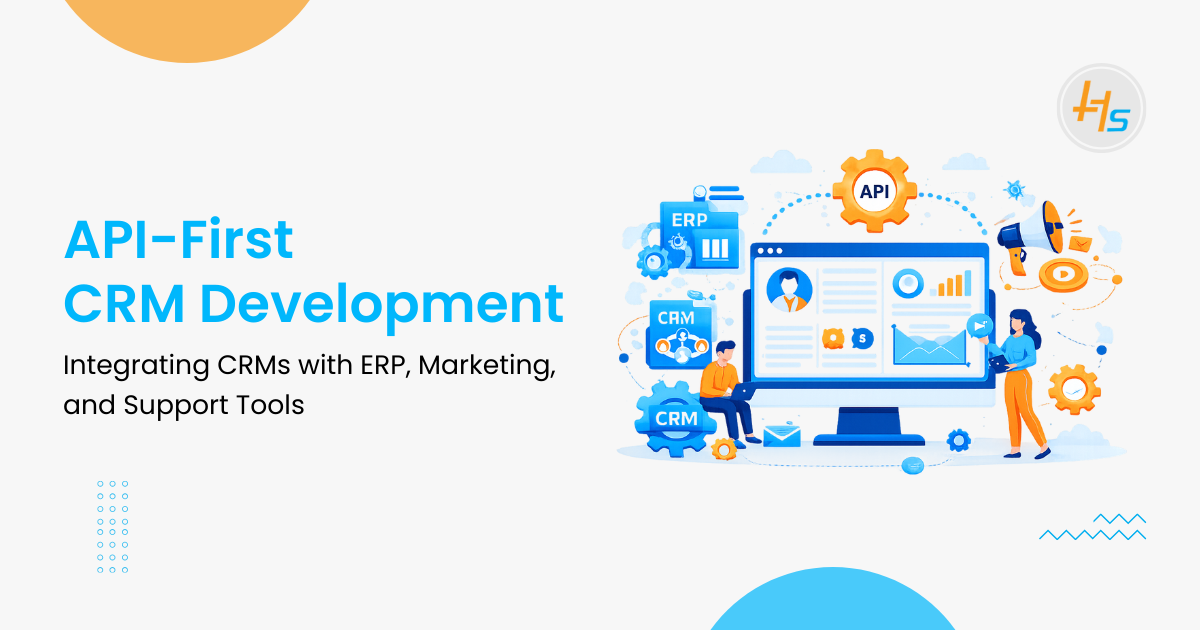
Customer Relationship Management systems play a central role in modern enterprises. Organizations now expect CRMs to connect with many business platforms. According to Salesforce research, over 91% of companies with more than 10 employees use a CRM system. According to MuleSoft’s Connectivity Benchmark research, less than one-third of enterprises report achieving organization-wide system integration across their business platforms. Gartner research shows that poor data quality costs organizations around $13 million each year on average. The same research indicates that a significant portion of business initiatives fail to achieve full value due to data quality and integration issues.
These numbers highlight a growing challenge. Traditional CRM designs struggle to support complex integration needs. This problem becomes larger as businesses add ERP, marketing, and support platforms.
API-first CRM development addresses this challenge. It places integration at the core of system design. Many organizations now collaborate with a CRM Software Development Company to build scalable, connected systems. API-first methods also support long-term growth through Custom CRM Solutions.
Table of Contents
What Is API-First CRM Development
API-first development designs APIs before building user interfaces or business logic. Developers treat APIs as the main product.
Key concept of API-first design
In API-first CRM development, every function exposes a stable API. These APIs define how systems exchange data.
Why APIs matter in CRM systems
CRMs store customer data, sales records, and service history. Other systems depend on this data. APIs allow controlled and secure data access.
This approach avoids rigid system coupling.
Limitations of Traditional CRM Integration
Many legacy CRMs use point-to-point integrations.
Problems with traditional methods
Traditional CRM integration approaches create technical and operational challenges as systems scale and business requirements change.
- Hardcoded integrations: Developers build direct links between systems, which makes changes difficult and risky.
- High maintenance effort: Each system update requires manual fixes across multiple integrations.
- Poor scalability: Adding new tools increases complexity and reduces system stability.
- Slow change adoption: Integration updates take longer, which delays feature releases and system upgrades.
Each new system adds complexity.
Impact on enterprise operations
Integration failures delay reporting. Data mismatches affect decisions. Support teams face incomplete customer views.
These issues increase operational risk.
Why Enterprises Choose API-First CRM Architecture
API-first architecture solves traditional integration headaches by placing connectivity at the heart of CRM design. By defining clear data contracts, this approach eliminates communication silos between departments. Instead of rebuilding connections for every new platform, teams can reuse integration logic, significantly accelerating deployment. Because the API layer remains stable even when internal backend logic is updated, enterprises benefit from reduced maintenance and lower long-term costs. In short: you build once and scale everywhere—from ERPs to marketing and support tools.
How a CRM Development Partner Helps
A specialized CRM Software development Company acts as a bridge between your vision and a functional ecosystem. They don’t just write code; they help define the technical roadmap, ensuring the CRM integrates seamlessly with your legacy systems while minimizing technical debt. By handling the complexities of API security and data mapping, a partner reduces manual workloads and ensures the system remains stable and adaptable as your business evolves.
Core Principles of API-First CRM Development
API-first CRM development follows strict technical principles.
1. Contract-driven development: Teams define API specifications before coding. OpenAPI standards often support this process.
2. Version control strategy: APIs support versioning. New features do not break existing integrations.
3. Security by design: APIs enforce authentication and authorization at every request.
Integrating CRM with ERP Systems
ERP systems manage finance, inventory, and operations.
Why CRM-ERP integration matters
Sales teams need pricing data. Finance teams need customer billing data. ERP systems hold this information.
API-first CRM design enables controlled data sharing.
Common CRM-ERP integration use cases
- Customer account synchronization
- Order and invoice data exchange
- Credit limit validation
- Product catalog updates
APIs handle these exchanges in real time.
Technical Flow of CRM-ERP Integration
API-first CRM systems expose endpoints for ERP access. In a typical data flow, the ERP requests customer data through the API, the CRM validates the request, returns structured data, and the ERP processes the response. This flow avoids database-level access. APIs support idempotent operations, which prevent duplicate records during retries and support data consistency handling.
Integrating CRM with Marketing Platforms
Marketing tools handle campaigns and lead nurturing.
Why CRM-marketing integration is critical
Marketing teams generate leads. Sales teams convert leads. CRM systems connect these processes.
API-first CRMs ensure smooth data flow.
Common marketing integrations
- Email marketing platforms
- Campaign analytics tools
- Lead scoring engines
- Advertising platforms
APIs automatically transfer lead data, eliminating manual steps.
Event-Driven CRM Integration for Marketing
Modern CRM systems support event-based APIs. The CRM emits events when data changes. Marketing platforms subscribe to these events.
Benefits of event-based integration
- Near real-time updates
- Reduced polling load
- Better campaign timing
This improves customer engagement accuracy.
Integrating CRM with Customer Support Tools
Support platforms manage tickets and service history. Support teams need customer context, and sales teams need service feedback, which explains the importance of CRM-support integration. API-first CRMs connect both views.
Typical support integrations include ticket creation and updates, customer profile access, SLA status sharing, and case history retrieval, and APIs ensure data consistency across teams.
Unified Customer View Through APIs
API-first CRM design supports a unified customer profile. Each system updates the CRM through APIs. The CRM becomes the source of truth.
Technical advantages
- Reduced data duplication
- Faster reporting
- Consistent customer records
This supports accurate analytics.
Role of Custom CRM Solutions in API-First Design
Off-the-shelf CRMs may not fit complex workflows. Enterprises choose Custom CRM Solutions to support unique business logic, industry-specific processes, and advanced integration needs, and these solutions support flexible API design. Developers tailor APIs to business needs, which improves integration clarity and performance.
Ensuring Security in API-First CRM Systems
Security remains a core concern in API-first CRM systems. Most implementations use OAuth 2.0 authentication. They apply role-based access control. API rate limiting is also used. Audit logging remains enabled. API-first CRMs enforce these controls at a central layer. APIs expose only required data fields. This reduces the risk of unauthorized access and data misuse.
Performance and Scalability Factors
Enterprise CRMs handle high data volumes. Performance optimization techniques include caching frequently accessed data, pagination for large responses, and asynchronous processing, and API-first design supports these techniques. Scalability advantages come from the fact that APIs scale independently from user interfaces. This improves system resilience.
Monitoring and Observability in API-First CRM
Integration reliability depends on visibility. Key monitoring metrics include API response time, error rates, throughput, and authentication failures, and monitoring tools track these metrics. Teams detect issues early and resolve problems before users notice failures, which benefits operations teams.
Real-World Example of API-First CRM Integration
A B2B manufacturing firm decided to update its CRM. The firm used ERP, marketing automation, and support platforms. Data sync issues were common, and reports were often delayed. To fix this, the company worked with a CRM Software Development Company and built API-first Custom CRM Solutions. After the change, the data synced in real time. Reporting became 35% faster. Manual data fixes reduced. This helped teams make better decisions.
API Governance and Documentation
API governance ensures long-term success. Clear API documentation supports faster integration, and developers understand request and response formats. API governance includes usage policies, version lifecycle management, and security compliance checks, and these practices reduce integration risk. Standardized governance also improves cross-team collaboration. It helps organizations maintain API consistency as systems evolve.
Future Trends in API-First CRM Development
API-first CRM adoption continues to grow.
1. Market trends: According to Postman’s 2024 API report, 89% of enterprises consider APIs critical to business strategy.
2. Growth of composable systems: Enterprises build modular systems using APIs. CRMs act as connected components.
3. Role of AI and automation: APIs enable CRM data access for analytics tools. This supports predictive insights.
Choosing the Right CRM Software Development Company
Selecting the right partner matters.
Key technical evaluation factors
- API design expertise
- Integration experience
- Security knowledge
- Scalability planning
A skilled CRM Software Development Company reduces project risk.
Long-term partnership value
Strong API design supports future system changes without rework.
Conclusion
Modern enterprises rely on connected systems. CRMs no longer operate in isolation. ERP, marketing, and support platforms require reliable data access.
API-first CRM development solves integration challenges through structured and secure APIs. It improves scalability, performance, and data consistency. Organizations often rely on a CRM Software Development Company to implement this approach. Custom CRM Solutions further support complex workflows and integration needs.
As enterprises adopt more digital tools, API-first CRM design becomes a technical necessity. It ensures stable integration and supports long-term system growth.
 Abhinav Rastogi