


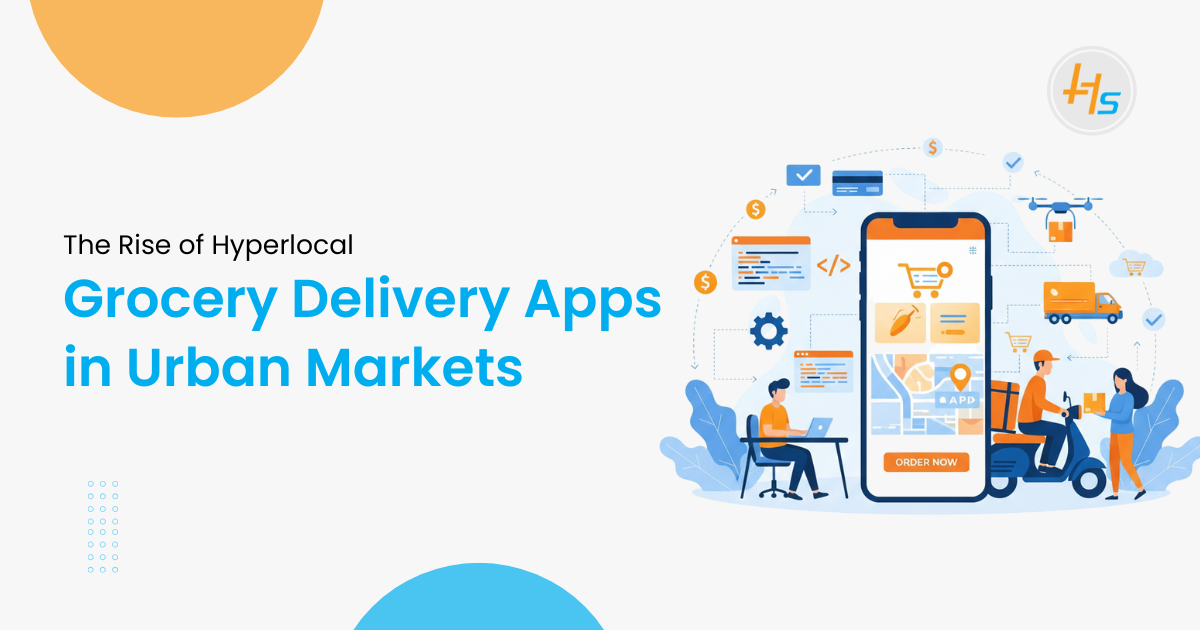
Urban markets are changing fast due to rising demand for instant services. People no longer plan grocery shopping days ahead. They expect fresh items delivered within minutes. Hyperlocal grocery delivery apps meet this demand by sourcing products from nearby stores and delivering them quickly. The growth numbers confirm this shift. Hyperlocal grocery delivery market reached $7.2 billion in 2025, growing at a 45% annual rate. Projections show it crossing $40 billion by 2030. At the global level, over 1.5 billion users now use hyperlocal delivery platforms. In 2025 alone, grocery orders increased by 30% worldwide.
Table of Contents
What Defines Hyperlocal Grocery Delivery
Hyperlocal grocery delivery focuses on short delivery zones ranging from 2 to 5 kilometers. Instead of large central warehouses, these apps source products from local kirana stores or nearby dark stores. This approach reduces travel time and improves order accuracy.
Technology ensures precision at every stage. Real-time APIs keep inventory data updated across stores. Matching algorithms assign riders based on distance, traffic, and order priority. Platforms like Blinkit, operating in 20 cities, and Zepto, active in 10 cities, achieve 99% on-time delivery rates using this model.
Core Technologies That Drive Hyperlocal Apps
Modern hyperlocal apps rely on scalable and reliable technology stacks. Cloud platforms manage high traffic during lunch and dinner peaks without downtime.
1. GPS and Location Services
Apps use Google Maps SDK for navigation and route planning. Devices send location updates every 5 seconds, ensuring accurate rider tracking. Location accuracy reaches up to 5 meters, which helps reduce delivery delays.
2. Real-Time Data Handling
Backend systems built with Node.js and Socket.io push live updates to users. Customers can track rider movement and estimated arrival time in real time.
Order data is stored in MongoDB, with sharding used to distribute data across multiple servers for faster access.
3. Payment Integration
Payment gateways like Stripe handle UPI and card payments. Webhooks confirm transactions instantly. Retry logic manages failures, resulting in a 98% payment success rate.
Detailed Backend Architecture
Hyperlocal grocery apps use microservices-based architecture for flexibility and scale. Each service runs inside Docker containers, allowing independent updates.
Key services include:
- Order Service: Validates orders and queues requests
- Inventory Service: Updates stock in real time
- Rider Service: Assigns riders using geohashing
Kubernetes manages container orchestration and auto-scales services during high demand. Databases use PostgreSQL for transactional consistency and Redis for session management. Average query response time stays under 20 milliseconds. NGINX load balancers distribute traffic evenly, helping maintain 99.99% uptime.
Frontend Frameworks and User Features
Apps use Flutter or React Native to support Android and iOS with a single codebase. This reduces development time and cost.
Key frontend features include:
- Predictive search powered by Elasticsearch
- Cart persistence using localStorage
- Push notifications via Firebase
Performance targets keep bundle size under 10MB and page load time under 2 seconds. A/B testing improves UI elements and increases conversion rates by 15%.
AI and Machine Learning Capabilities
AI plays a major role in demand forecasting and personalization. Python-based models run on AWS SageMaker to predict hourly demand.
Examples include:
- Random Forest models to identify low-stock items
- Recommendation engines that increase cart value by 18%
- NLP chatbots using Dialogflow, resolving 70% of customer queries without human support
Model accuracy reaches 92%, helping reduce waste and stockouts.
Why Choose a Grocery Delivery App Development Company
A professional Grocery Delivery App Development Company understands urban traffic patterns, local vendor needs, and regulatory rules. Teams often use Laravel for PHP backends and Django for Python-based scaling.
Many companies integrate ONDC APIs to connect with local sellers. Regular audits ensure PCI DSS compliance, protecting payment and user data.
Grocery Delivery App Development Services Explained
Grocery Delivery App Development Services cover the full lifecycle:
- Discovery: User flow mapping
- Design: UI/UX prototypes in Figma
- Development: CI/CD pipelines using GitHub Actions
- QA: Automated testing with Selenium
- Deployment: AWS or Azure hosting
Agile sprints last two weeks. MVP development costs average $80,000. Post-launch monitoring uses Prometheus, enabling quick issue resolution
Challenges and Technical Solutions
- User churn reaches 20% monthly. Loyalty programs help retention.
- Festival traffic spikes cause server stress. Auto-scaling fixes this.
- Battery drain from GPS is reduced by increasing polling intervals to 10 seconds.
Traffic Optimization and Route Planning
Apps use graph algorithms like Dijkstra’s, running in O(E log V) time. Traffic APIs improve route accuracy and cut delays by 20%.
EV fleets with IoT trackers extend battery life by 30%.
Security Protocols
- OAuth 2.0 secures APIs
- JWT tokens expire every 15 minutes
- Prepared statements block SQL injection
- Weekly OWASP scans detect risks
ML-based fraud detection keeps false positives under 2%.
Implementing AI Chatbots for Smarter Grocery Shopping Assistance
Analytics and Business Insights
Apache Kafka streams event data, while Spark processes billions of records.
Dashboards built in Tableau track KPIs such as dwell time, averaging 45 seconds per session. These insights improve pricing and increase margins by 10%.
Future Technologies Shaping Hyperlocal Grocery Delivery Apps
Future technologies will play a key role in making hyperlocal grocery delivery apps faster, smarter, and more reliable. These innovations focus on speed, personalization, security, and operational efficiency.
1. Edge AI for Offline Order Processing
Edge AI allows apps to process data directly on devices or nearby servers instead of relying only on cloud systems. This helps apps continue working even during poor internet connectivity. Order validation, price checks, and inventory updates can happen locally. This reduces latency and improves delivery speed in crowded urban areas. Edge AI also lowers cloud costs and improves system reliability during peak hours.
2. 5G for AR-Based Product Previews
5G networks provide high-speed and low-latency connectivity. This enables augmented reality features inside grocery apps. Users can preview products, check packaging details, and view portion sizes through AR. Real-time video support also improves customer assistance. Faster data transfer improves app responsiveness and creates a smoother user experience.
3. Web3 Wallets and NFT-Based Loyalty Programs
Web3 wallets introduce decentralized and secure payment options. Users can store digital assets and make instant payments without intermediaries. NFT-based loyalty programs replace traditional reward points. Customers earn NFTs for repeat orders, referrals, or special events. These NFTs offer discounts, priority delivery, or exclusive offers. Blockchain ensures transparency and prevents reward fraud.
4. Quantum Computing for Route Optimization
Quantum computing will help solve complex routing problems. Traditional systems struggle with thousands of real-time variables like traffic, weather, and rider availability. Quantum algorithms can evaluate millions of route combinations at once. Early trials for delivery route optimization are expected to begin in 2027. This technology can reduce delivery time, fuel costs, and carbon emissions.
Cost Breakdown and ROI
- MVP cost: $60,000–$150,000
- Frontend: 25%
- Backend: 40%
- Testing: 15%
- Other costs: 20%
Urban Impact and Economic Growth
Delhi residents lose 100 hours yearly to traffic. Hyperlocal apps save time. 70% of millennials use these apps daily, with women forming 55% of users.
Sustainable delivery grows, with 40% of orders using cycles.
Transform Urban Grocery Delivery with HashStudioz
Want to make grocery shopping faster, smarter, and more convenient for your customers? Hyperlocal grocery delivery apps connect users to nearby stores, enable real-time tracking, and ensure deliveries in minutes. At HashStudioz, we develop intelligent app solutions that help grocery businesses serve customers efficiently and reliably.
Our Hyperlocal Grocery App Development Services cover everything from micro-warehouse integration and rider tracking to real-time inventory updates—built to meet the demands of fast-paced urban markets.
Partner with HashStudioz to boost customer satisfaction, increase order volume, and deliver a seamless grocery experience with future-ready hyperlocal app solutions.
Conclusion
Hyperlocal grocery delivery apps now define urban shopping behavior. Market growth, strong demand, and technical advances drive this rise. These platforms rely on real-time data, scalable systems, and local partnerships.
Businesses that invest in solid technology gain long-term value. With expert Grocery Delivery App Development Services, brands can build fast, secure, and reliable platforms for urban users.
The future belongs to apps that deliver fresh groceries quickly and consistently. Urban markets will continue to lead this transformation.