


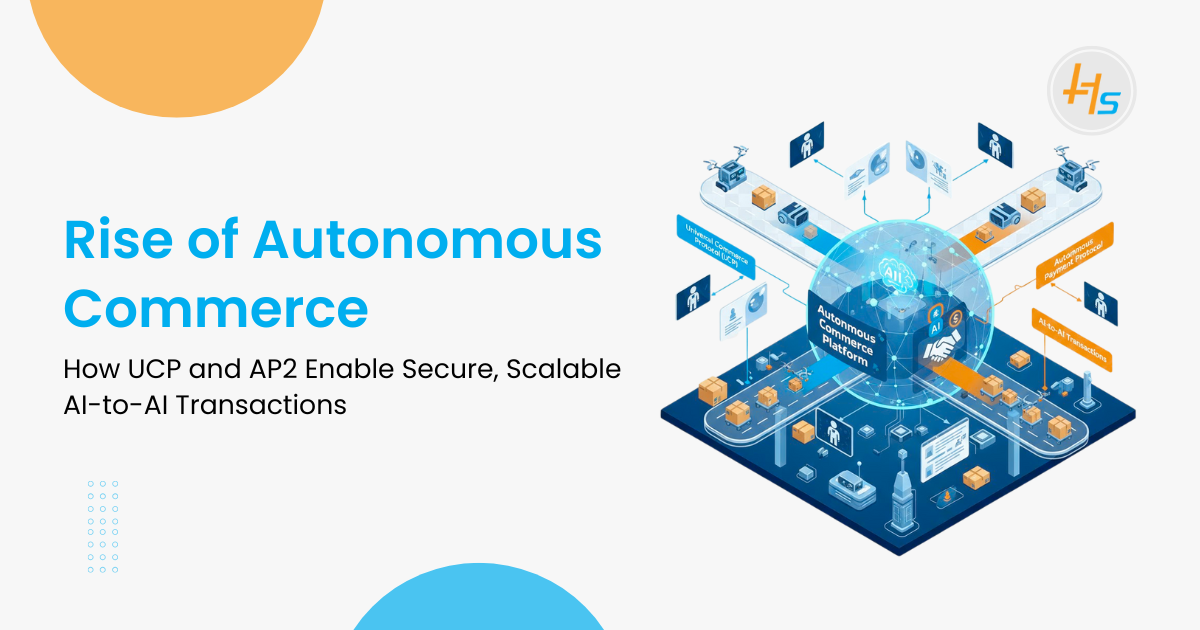
Autonomous commerce is emerging as a major shift in digital business models. According to Forrester, autonomous transactions are expected to contribute to a global market value exceeding $7 trillion by 2030. This growth is driven by advancements in artificial intelligence (AI), the Internet of Things (IoT), and machine learning, which enable systems to make decisions and execute transactions without human involvement.
At HashStudioz, we closely work with enterprises adopting AI and IoT-driven automation to support scalable, data-driven commerce systems. Technologies such as Unified Commerce Platforms (UCP) and Autonomous Process Protocols (AP2) are central to this evolution, enabling secure and efficient AI-to-AI transactions across digital ecosystems.
Table of Contents
What Is Autonomous Commerce?
Autonomous commerce refers to digital transactions where AI systems handle the entire transaction lifecycle. This includes initiation, decision-making, negotiation, execution, and settlement without manual intervention. These systems rely on AI models that analyze large datasets, identify patterns, and respond in real time.
Unlike traditional commerce workflows that depend on approvals and human actions, autonomous commerce operates continuously. AI-driven supply chains, automated procurement systems, and intelligent retail platforms can respond instantly to demand changes and operational signals.
The result is improved accuracy, faster execution, and reduced operational overhead for enterprises operating at scale.
The Role of UCP in Enabling Autonomous Commerce
Unified Commerce Platforms (UCP) act as the foundation of autonomous commerce by connecting multiple systems, channels, and data sources into a unified environment. This integration allows AI systems to access consistent, real-time data across business operations.
In retail and logistics environments, UCP enables seamless communication between online platforms, payment systems, warehouses, and fulfillment services. Once a transaction is triggered, inventory updates, payment processing, and delivery scheduling occur automatically.
Key Benefits of UCP
- Centralized Data Access: Data from ERP systems, CRM platforms, and operational tools becomes accessible through a single platform.
- Real-time Intelligence: AI systems can respond immediately to inventory changes, customer activity, or supply constraints.
- Operational Consistency: Automated workflows reduce errors caused by disconnected systems and manual processes.
UCP provides the structural backbone needed for AI systems to operate autonomously and at scale.
AP2: Autonomous Process Protocols and Their Impact
Autonomous Process Protocols (AP2) define how AI systems interact, negotiate, and execute actions within autonomous environments. These protocols establish clear rules that guide system-to-system decision-making.
AP2 is especially valuable in sectors such as finance, supply chain management, and manufacturing. AI agents can reorder materials, negotiate pricing, or adjust logistics routes based on real-time data and predefined rules.
How AP2 Supports AI-to-AI Transactions
- Interoperability: AI systems can communicate even when they operate on different platforms or infrastructures.
- Autonomous Decision Logic: AI agents evaluate conditions, negotiate terms, and finalize transactions without manual input.
- Security and Transparency: Protocol-based execution helps ensure compliance, traceability, and reduced operational risk.
When combined with UCP, AP2 enables reliable and scalable autonomous commerce workflows.
How AI-to-AI Transactions Work in Autonomous Commerce
AI-to-AI transactions refer to interactions where one AI system initiates and completes a transaction with another AI system without human involvement. These systems act as autonomous agents that evaluate data, make decisions, and execute actions based on predefined rules and real-time inputs.
A typical AI-to-AI transaction in an autonomous commerce environment follows a structured flow:
1. Data Signal Initiation
The process begins when data signals are generated from internal systems or connected IoT devices. For example, inventory sensors detect low stock levels or a demand forecasting model predicts an upcoming shortage.
2. Decision Trigger by the Buyer AI
The buyer-side AI system evaluates the data using machine learning models. It assesses factors such as pricing thresholds, supplier reliability, delivery timelines, and historical performance before deciding whether to initiate a purchase.
3. System Coordination Through UCP
Once the decision is made, the Unified Commerce Platform acts as the integration layer. UCP ensures the buyer AI can access supplier catalogs, pricing data, and availability information across multiple systems in real time.
4. Autonomous Negotiation Using AP2
Autonomous Process Protocols guide how both AI systems interact. The buyer AI and supplier AI negotiate pricing, quantities, delivery terms, and service-level agreements based on predefined rules and constraints.
5. Transaction Execution and Settlement
After agreement, the transaction is executed automatically. Payments are processed, inventory records are updated, and fulfillment workflows are triggered without human intervention.
6. Continuous Learning and Optimization
Post-transaction data is fed back into AI models. This allows systems to learn from outcomes, refine negotiation strategies, and improve future decision-making.
This structured AI-to-AI workflow enables faster transactions, reduced operational overhead, and consistent execution across enterprise commerce systems.
The Role of IoT in Autonomous Commerce
IoT enables autonomous commerce by acting as the primary source of real-time data. Sensors, connected devices, and smart equipment continuously feed operational data into AI systems.
In supply chains, IoT devices track inventory movement, location, and condition. AI systems use this data to trigger replenishment, adjust pricing, or reschedule deliveries automatically.
Key IoT Use Cases
- Inventory Monitoring: Sensors detect stock levels and trigger automated procurement processes.
- Customer Interaction Insights: Connected devices provide behavioral data that supports personalization.
- Predictive Maintenance: Industrial sensors detect equipment anomalies and initiate maintenance actions before failures occur.
Well-integrated IoT architectures ensure AI systems have accurate and timely data to operate autonomously.
How AI Development Solutions Enable Autonomous Commerce
AI is the core engine behind autonomous commerce. Advanced AI models allow systems to learn from data, predict outcomes, and make decisions without human supervision.
AI development solutions typically support:
- Custom Machine Learning Models: Used for demand forecasting, pricing optimization, and risk detection.
- Intelligent Automation: AI-driven workflows automate order processing, customer support, and inventory management.
- Predictive Analytics: Real-time insights help enterprises anticipate changes and optimize decisions.
Together, these capabilities allow organizations to move from reactive operations to proactive, autonomous systems.
The Future of Autonomous Commerce
Autonomous commerce will expand as AI systems become more intelligent and interconnected.
Key trends include:
- AI-driven negotiations: Autonomous agents managing pricing and contract terms.
- Advanced decision engines: AI systems evaluating complex variables in real time.
- End-to-end automation: Fully autonomous workflows from procurement to customer service.
Enterprises that invest early in these technologies will be better positioned to compete in fast-evolving markets.
Why Enterprises Partner with HashStudioz
Enterprises partner with HashStudioz for building autonomous commerce solutions because of our combined expertise in AI engineering, IoT consulting, and enterprise system integration.
- End-to-end AI and IoT solution development
- Scalable, cloud-native architectures
- Secure and enterprise-grade system design
- Experience across retail, logistics, manufacturing, and fintech
Our focus is on building reliable systems that support long-term automation and growth.
Conclusion
Autonomous commerce is transitioning from concept to reality. Powered by UCP, AP2, AI, and IoT, enterprises can now enable systems that transact, communicate, and operate independently with speed and accuracy.
By integrating AI development solutions, businesses can automate daily operations and create algorithms that match their specific workflows. At the same time, IoT consulting helps set up and manage connected systems so that real-time data is used correctly for better decisions.
As commerce moves toward more automated systems, adopting these technologies helps businesses respond faster, reduce manual effort, and stay competitive in an increasingly digital market.
FAQs
1. What is autonomous commerce?
Autonomous commerce involves AI systems managing transactions and business processes without human intervention.
2. How do UCP and AP2 enable AI-to-AI transactions?
UCP integrates systems and data, while AP2 defines protocols that allow AI systems to make autonomous decisions.
3. What role does IoT play in autonomous commerce?
IoT provides real-time operational data that AI systems use for automation and predictive analytics.
4. How do AI development solutions support autonomous commerce?
They enable intelligent automation, predictive insights, and autonomous decision-making.
5. Why choose HashStudioz for autonomous commerce solutions?
HashStudioz combines AI, IoT, and enterprise engineering expertise to build scalable autonomous systems.