


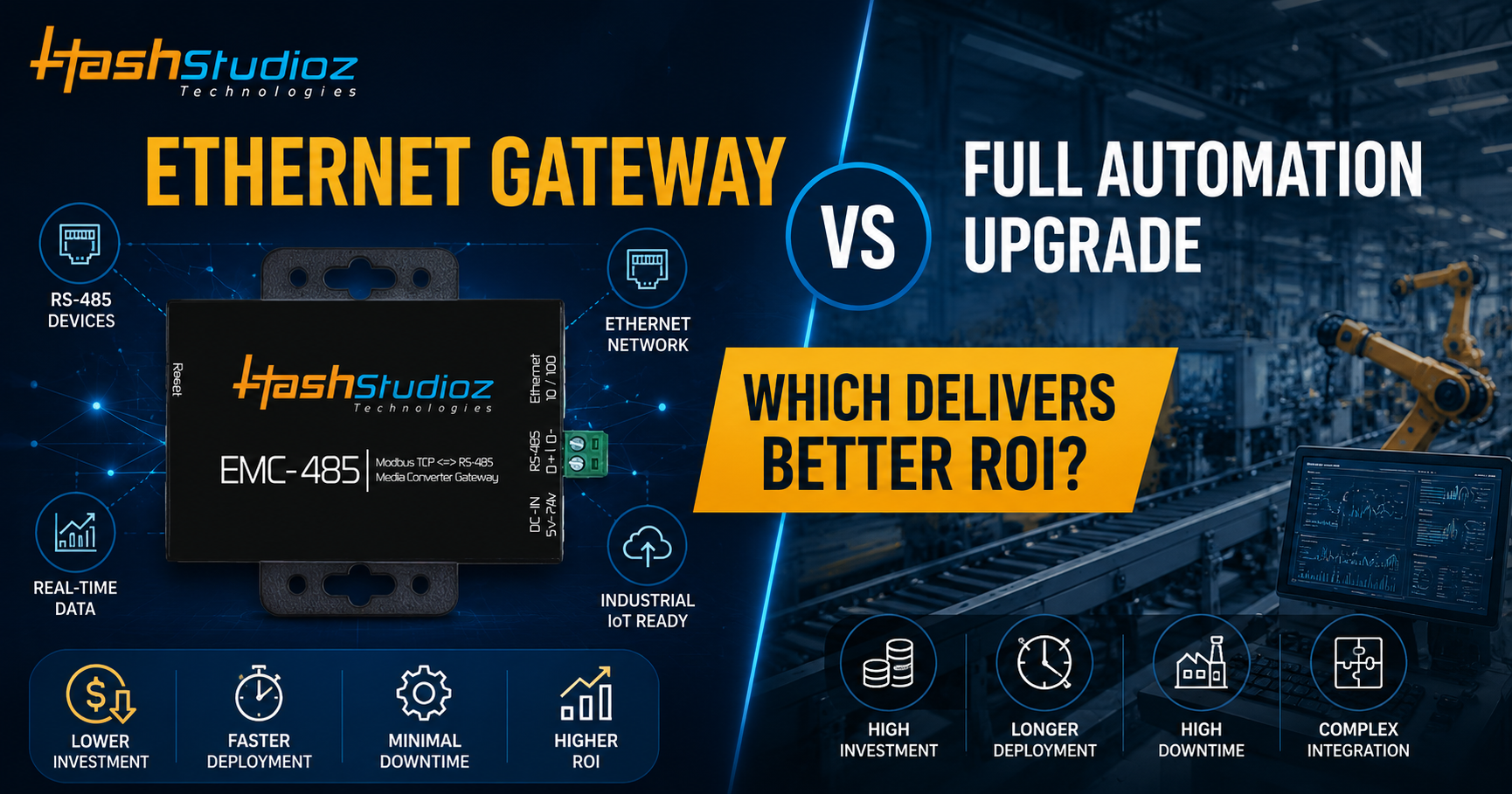
In the era of Industry 4.0, industrial organizations are continuously looking for ways to improve productivity, reduce operational costs, and gain better visibility into their manufacturing processes. However, many factories and industrial facilities still rely on legacy equipment that communicates through serial protocols such as RS-485. While these systems may be old, they often continue to perform their intended functions reliably.
Should you invest in a complete automation upgrade, or should you modernize your existing infrastructure using an Ethernet gateway such as an RS-485 to Ethernet Converter?
The answer depends on several factors, including budget, operational goals, equipment lifespan, scalability requirements, and expected return on investment (ROI). While a full automation upgrade can provide advanced capabilities and future-ready infrastructure, it often comes with significant costs and implementation challenges. In contrast, an Ethernet gateway offers a practical and affordable way to connect legacy devices to modern networks without replacing existing equipment.
Table of Contents
Understanding an Ethernet Gateway
An Ethernet gateway is a networking device that enables communication between legacy serial devices and modern Ethernet-based systems. One of the most common examples is an RS-485 to Ethernet Converter, which converts serial data into Ethernet packets, allowing older equipment to communicate over TCP/IP networks.
Many industrial devices still use RS-485 communication because it is reliable, cost-effective, and suitable for long-distance communication. Examples include:
- Programmable Logic Controllers (PLCs)
- Energy meters
- Industrial sensors
- Variable Frequency Drives (VFDs)
- Human Machine Interfaces (HMIs)
- Building automation systems
- Environmental monitoring devices
- Data acquisition systems
Without an Ethernet gateway, these devices remain isolated from modern monitoring and control systems. By installing an RS-485 to Ethernet Converter, organizations can integrate legacy equipment into SCADA systems, cloud platforms, Industrial IoT applications, and centralized monitoring solutions.
Key Features of Modern Ethernet Gateways
Modern industrial Ethernet gateways offer several advanced capabilities:
- RS-485 to Ethernet communication
- Modbus RTU to Modbus TCP conversion
- Transparent TCP/IP data transmission
- Remote device monitoring
- Web-based configuration interface
- Industrial-grade reliability
- Wide operating temperature range
- Multi-device connectivity
- Easy integration with SCADA and IoT platforms
These features make Ethernet gateways an attractive option for organizations seeking digital transformation without replacing functioning equipment.
What Is a Full Automation Upgrade?
A full automation upgrade involves replacing existing industrial infrastructure with modern automation technologies. Rather than connecting legacy devices to a network, this approach focuses on redesigning and modernizing the entire control architecture.
A complete automation modernization project may include:
- New PLC systems
- Industrial PCs
- Smart sensors and actuators
- Advanced HMIs
- Modern SCADA software
- Industrial Ethernet networks
- Edge computing devices
- Cloud-based analytics platforms
- AI-powered monitoring systems
- Cybersecurity enhancements
The primary goal is to create a highly connected, intelligent, and scalable automation environment capable of supporting future operational requirements.
While this approach offers significant benefits, it also requires substantial investment, extensive planning, and considerable implementation effort.
Cost Comparison
Cost is often the most important factor when evaluating modernization strategies.
1. Ethernet Gateway Approach
One of the biggest advantages of deploying an Ethernet gateway is affordability.
Instead of replacing expensive machinery and control systems, organizations can continue using their existing assets while adding modern networking capabilities. This significantly reduces capital expenditure and accelerates ROI.
2. Typical Costs Include:
- Ethernet gateway hardware
- Basic installation
- Network configuration
- Minimal engineering support
3. Benefits of Lower Costs
- Existing equipment remains operational
- No need for major infrastructure changes
- Reduced engineering expenses
- Faster implementation
- Lower project risk
For small and medium-sized manufacturing facilities, this approach often provides the most economical path toward digital transformation.
4. Full Automation Upgrade
A complete automation upgrade requires significantly higher investment.
5. Typical Costs Include:
- New PLCs and controllers
- Industrial networking equipment
- SCADA software licenses
- Engineering design services
- System integration
- Testing and commissioning
- Employee training
- Production downtime costs
In many cases, the total project cost can reach hundreds of thousands or even millions of dollars depending on facility size.
6. Challenges Associated with Higher Costs
- Large upfront investment
- Longer payback period
- Increased project complexity
- Greater implementation risk
7. ROI Winner: Ethernet Gateway
For organizations seeking immediate financial returns, Ethernet gateways typically provide a much faster ROI due to their lower implementation costs.
Deployment Time Comparison
Time-to-value is another critical factor when evaluating modernization options.
1. Ethernet Gateway Deployment
Installing an RS-485 to Ethernet Converter is generally straightforward.
Most deployments can be completed within a few hours or days depending on the number of connected devices.
Advantages Include:
- Quick installation
- Minimal configuration requirements
- No major system redesign
- Existing equipment remains operational
- Immediate network connectivity
Organizations can begin collecting and analyzing data almost immediately after deployment.
2. Full Automation Upgrade Deployment
A complete automation project requires extensive planning and execution.
Typical project phases include:
- System assessment
- Engineering design
- Hardware procurement
- Software development
- Installation
- Testing
- Commissioning
- Operator training
Depending on project complexity, implementation may take several weeks or months.
3. ROI Winner: Ethernet Gateway
The faster deployment timeline allows organizations to realize benefits much sooner.
Downtime Impact
Downtime directly affects productivity and profitability.
1. Ethernet Gateway
Because existing equipment remains in place, downtime is usually minimal.
In many cases:
- Installation can occur during scheduled maintenance windows.
- Production interruptions are limited.
- Existing workflows remain unchanged.
This minimizes operational disruption and protects revenue.
2. Full Automation Upgrade
Replacing automation infrastructure often requires:
- Equipment shutdowns
- System migration
- Extensive testing
- Production interruptions
For high-volume manufacturing facilities, downtime costs can quickly become substantial.
3. ROI Winner: Ethernet Gateway
Lower downtime translates directly into faster ROI and reduced operational risk.
Scalability Considerations
Scalability is essential for organizations planning future growth.
1. Ethernet Gateway
An Ethernet gateway provides a gradual path toward modernization.
Organizations can:
- Connect one machine at a time
- Expand monitoring capabilities incrementally
- Add IoT functionality as needed
- Avoid large upfront investments
This phased approach allows businesses to modernize at their own pace.
2. Full Automation Upgrade
A complete automation overhaul offers maximum scalability.
Benefits include:
- Unified architecture
- Advanced analytics capabilities
- Greater processing power
- Enhanced cybersecurity
- Future-ready infrastructure
However, these advantages come at a significantly higher cost.
3. ROI Winner: Depends on Business Goals
Short-Term ROI: Ethernet Gateway
Long-Term Strategic Growth: Full Automation Upgrade
Industrial IoT Readiness
Industrial IoT (IIoT) has become a major driver of digital transformation across manufacturing industries.
Organizations increasingly require:
- Real-time machine monitoring
- Predictive maintenance
- Remote diagnostics
- Energy management
- Production analytics
- Cloud connectivity
1. How Ethernet Gateways Enable IIoT
An RS-485 to Ethernet Converter acts as a bridge between legacy equipment and modern IoT platforms.
By converting serial communication into Ethernet-based protocols, organizations can:
2. Enable Remote Monitoring
Operators can monitor equipment performance from centralized dashboards or remote locations.
3. Improve Predictive Maintenance
Continuous data collection helps identify equipment issues before failures occur.
4. Increase Operational Visibility
Managers gain access to real-time production data and performance metrics.
5. Reduce Maintenance Costs
Early fault detection minimizes unexpected breakdowns and repair expenses.
6. Support Cloud Integration
Machine data can be transmitted to cloud platforms for advanced analytics and reporting.
7. Enhance Decision-Making
Access to accurate operational data enables better business decisions.
For many organizations, Ethernet gateways provide the quickest and most affordable route to Industrial IoT adoption.
Security Considerations
Modern industrial environments require secure communication between devices and networks.
1. Ethernet Gateway Security Benefits
Many industrial-grade gateways support:
- Password-protected access
- Secure configuration interfaces
- Network segmentation
- Controlled remote access
These features help protect legacy devices while enabling connectivity.
2. Full Automation Upgrade Security Benefits
A complete modernization project often includes:
- Advanced cybersecurity frameworks
- Secure industrial protocols
- Network monitoring systems
- Threat detection capabilities
While full upgrades generally offer stronger security architectures, Ethernet gateways can still provide adequate protection for many industrial applications.
Maintenance and Support Requirements
1. Ethernet Gateway
Maintenance requirements are relatively low.
Benefits include:
- Fewer components to manage
- Minimal software updates
- Reduced training requirements
- Lower support costs
2. Full Automation Upgrade
Modern automation systems require:
- Software maintenance
- Firmware updates
- Cybersecurity monitoring
- Specialized technical expertise
These ongoing costs should be considered when calculating ROI.
3. ROI Winner: Ethernet Gateway
Lower maintenance expenses contribute to faster returns.
When Should You Choose an Ethernet Gateway?
An Ethernet gateway is often the best choice when:
- Existing equipment is still reliable.
- Budget constraints exist.
- Downtime must be minimized.
- Quick deployment is required.
- Industrial IoT connectivity is needed.
- Devices communicate using RS-485 or Modbus RTU.
- Real-time monitoring is a priority.
- Management wants immediate ROI.
For many facilities, this approach delivers substantial benefits without major disruption.
When Should You Choose a Full Automation Upgrade?
A complete automation upgrade may be the better option when:
- Equipment is approaching end-of-life.
- Existing systems cannot meet production demands.
- Maintenance costs are increasing significantly.
- Advanced automation capabilities are required.
- Long-term digital transformation is a strategic objective.
- Regulatory requirements demand modernization.
- Future scalability is a top priority.
Although more expensive, a full upgrade can provide significant long-term advantages.
ROI Comparison Table
| Factor | Ethernet Gateway | Full Automation Upgrade |
| Initial Investment | Low | High |
| Deployment Time | Fast | Slow |
| Downtime | Minimal | Significant |
| Integration Complexity | Low | High |
| Risk Level | Low | Medium to High |
| Immediate ROI | High | Moderate |
| Long-Term Scalability | Good | Excellent |
| Industry 4.0 Readiness | Good | Excellent |
| Maintenance Costs | Low | Higher |
| Training Requirements | Minimal | Extensive |
| Implementation Risk | Low | High |
Why HashStudioz RS-485 to Ethernet Converter Is a Smart Choice
For organizations seeking a practical and cost-effective modernization solution, the HashStudioz RS-485 to Ethernet Converter offers an excellent balance of performance, reliability, and affordability.
It enables industrial facilities to connect legacy RS-485 devices to Ethernet networks without replacing existing equipment.
Key Benefits
- Cost-effective modernization
- Reliable industrial-grade performance
- Modbus RTU to Modbus TCP conversion
- Easy deployment and configuration
- Seamless integration with SCADA systems
- Industrial IoT compatibility
- Remote monitoring capabilities
- Wide industrial application support
- Made-in-India design and manufacturing
Suitable Applications
- Manufacturing plants
- Energy monitoring systems
- Building automation
- Water treatment facilities
- Smart factories
- Industrial control systems
- Environmental monitoring networks
Whether you’re connecting PLCs, sensors, energy meters, or industrial controllers, the HashStudioz converter helps bridge the gap between legacy infrastructure and modern digital networks.
Conclusion
When evaluating modernization strategies, the best choice depends on your operational goals, budget, and long-term vision.
For most industrial facilities, an Ethernet gateway provides the fastest and most cost-effective ROI. By deploying an RS-485 to Ethernet Converter, organizations can unlock real-time monitoring, Industrial IoT connectivity, predictive maintenance capabilities, and improved operational visibility without replacing functioning equipment.
A full automation upgrade remains an excellent option for organizations pursuing comprehensive digital transformation and long-term scalability. However, it requires significantly greater investment, longer deployment timelines, and higher implementation risk.
If your goal is to modernize quickly, minimize downtime, and maximize return on investment, an RS-485 to Ethernet Converter from HashStudioz is often the smartest first step toward Industry 4.0 readiness.
By leveraging existing assets while embracing modern connectivity, businesses can achieve meaningful digital transformation today while preparing for future automation initiatives tomorrow.