


The Internet of Things has moved beyond isolated connected devices. Enterprises now use IoT systems to monitor equipment, track assets, optimize energy consumption, automate workflows, manage facilities, and generate real-time operational data.
The scale of these deployments continues to grow. IoT Analytics estimates that the number of connected IoT devices reached 21.1 billion in 2025, up 14% year over year, and forecasts approximately 39 billion connected devices by 2030. Its 2026 enterprise IoT research also estimates that the enterprise IoT market reached $324 billion in 2025, with 13% year-over-year growth. Ericsson’s latest IoT outlook estimates 22.3 billion total IoT connections in 2025, including 4.5 billion cellular IoT connections, with total IoT connections projected to reach 47.1 billion by 2031.
For enterprises, however, connecting more devices does not automatically create business value. A production-grade IoT system must connect physical devices with networks, edge infrastructure, cloud services, data pipelines, applications, security controls, and business systems. That makes the IoT application development lifecycle different from conventional software development. Teams must consider hardware, connectivity, device provisioning, telemetry, data processing, application logic, security, deployment, and ongoing device operations as one system.
This guide explains how enterprises can move from an IoT idea to a production-ready application while controlling technical risk and preparing the platform for scale.
Table of Contents
What Is IoT Application Development?
IoT application development is the process of designing, building, integrating, testing, deploying, and maintaining software that communicates with connected devices and processes the data they generate.
An enterprise IoT application may include:
- Sensors and connected devices
- Embedded software and firmware
- Connectivity protocols and networks
- Edge gateways or edge computing
- Cloud IoT infrastructure
- Data ingestion and processing pipelines
- APIs and backend services
- Web or mobile applications
- Analytics and visualization
- Device management
- Authentication and access control
- Monitoring and security systems
Microsoft’s current IoT architecture guidance illustrates this layered model through sensing, networking, data ingestion, data processing, and application/presentation layers. It also highlights cloud and edge patterns for industrial and enterprise deployments.
This architecture matters because an application can fail even when its individual components work correctly. A sensor may produce accurate readings while the network drops packets. The cloud platform may process telemetry correctly while the application displays stale information. A device may connect successfully but lack secure provisioning or a reliable software update mechanism.
The development lifecycle must therefore validate the complete system rather than only the application interface.
IoT Application Development Lifecycle
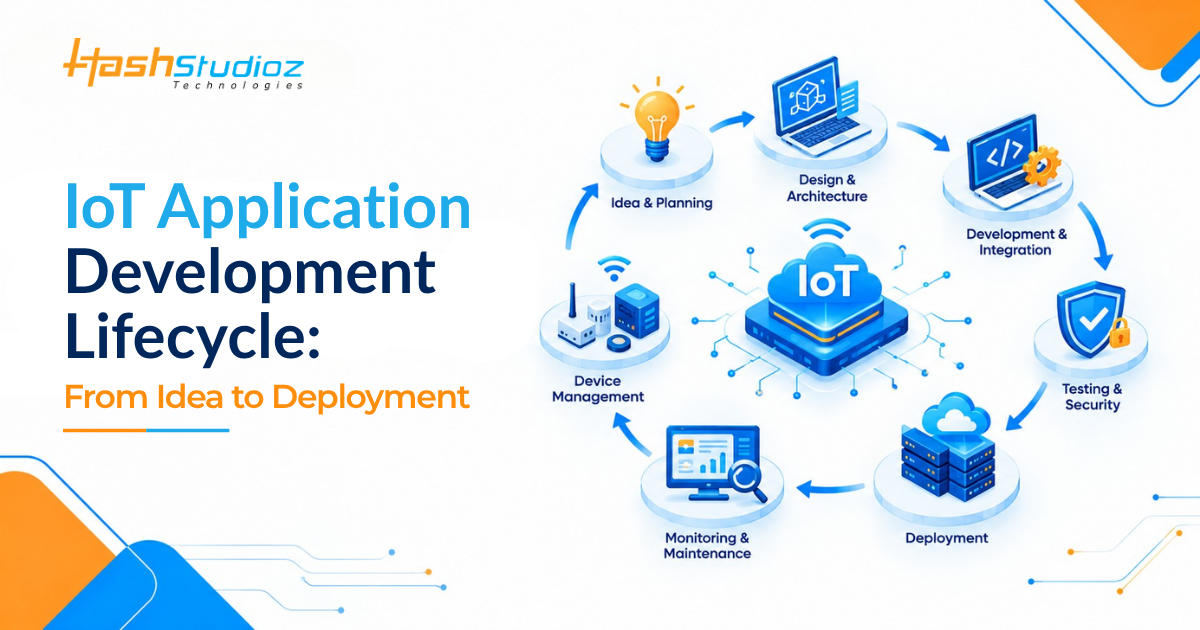
A practical enterprise lifecycle typically includes eight connected stages:
- Idea and business-case definition
- Requirements and feasibility analysis
- IoT architecture and technology selection
- Prototyping and proof of concept
- Application development and system integration
- Testing and security validation
- Production deployment and device provisioning
- Monitoring, maintenance, and continuous improvement
These stages should not operate as isolated handoffs. Teams should create feedback loops between architecture, development, testing, deployment, and operations.
1. Define the IoT Idea and Business Case
The lifecycle starts with a business problem rather than a technology choice.
An enterprise might want to:
- Predict equipment failures
- Monitor cold-chain conditions
- Track high-value assets
- Reduce energy consumption
- Monitor production lines
- Improve fleet visibility
- Automate facility management
- Monitor environmental conditions
- Build a connected product
- Improve field-service operations
The first question should be:
What operational decision will the IoT system improve?
For example, a manufacturing company may initially describe its requirement as “connect production machines.” That is too broad to guide development.
A better requirement could be:
Detect abnormal vibration patterns in critical equipment and alert maintenance teams early enough to investigate before an unplanned production stoppage.
That statement gives the development team a measurable business objective.
Define measurable KPIs
The business case should identify KPIs before technical implementation begins.
Depending on the use case, these could include:
- Reduction in unplanned downtime
- Mean time to detect an equipment anomaly
- Mean time to respond
- Energy consumption per production unit
- Asset utilization
- Device uptime
- Data delivery rate
- Alert accuracy
- Cost per connected device
- Number of devices managed per operator
This prevents the project from becoming a dashboard-building exercise without a clear business outcome.
2. Analyze Requirements and Feasibility
Once the business objective is defined, technical and operational requirements can be established.
IoT requirements extend beyond conventional application requirements because the physical environment affects system behavior.
Teams should evaluate:
Device requirements
Determine:
- What devices or sensors are required?
- What measurements must they capture?
- How frequently should they transmit data?
- What is the expected device lifespan?
- What are the power constraints?
- Will devices operate indoors, outdoors, or in industrial environments?
- Can firmware be updated remotely?
Connectivity requirements
The connectivity layer may use:
- Wi-Fi
- Bluetooth Low Energy
- Ethernet
- 4G/5G
- NB-IoT
- LTE-M
- LoRaWAN
- Zigbee
- Other industrial or proprietary protocols
The correct choice depends on range, bandwidth, power consumption, latency, mobility, network availability, and deployment environment.
Ericsson’s current data also shows why connectivity decisions matter at scale. Cellular IoT connections reached approximately 4.5 billion at the end of 2025, while Ericsson forecasts 7.8 billion cellular IoT connections by 2031.
Data requirements
Define:
- Data types
- Message frequency
- Data volume
- Retention period
- Real-time processing requirements
- Historical analytics requirements
- Data ownership
- Data residency requirements
For an enterprise operating thousands of machines, the architecture must handle continuous telemetry rather than occasional API requests.
Integration requirements
Enterprise IoT applications often need integration with existing:
- ERP systems
- CRM platforms
- MES platforms
- SCADA systems
- WMS platforms
- Enterprise data warehouses
- Business intelligence platforms
- Mobile applications
- Customer portals
These requirements should enter the architecture before development begins.
3. Design the IoT Architecture
Architecture is one of the most important stages in the lifecycle because changes become significantly more expensive after devices enter production.
A typical enterprise IoT architecture contains several layers:
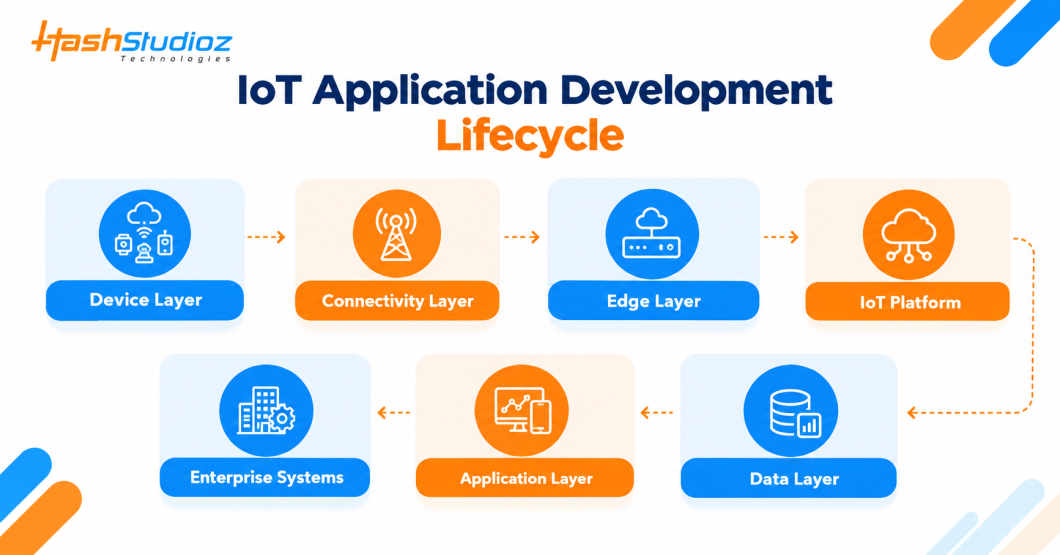
Device layer
This layer contains sensors, actuators, cameras, meters, machines, vehicles, and other connected endpoints.
Each device should have a defined identity and lifecycle.
Connectivity layer
The connectivity layer transports telemetry and commands between devices, gateways, edge systems, and cloud infrastructure.
Protocols such as MQTT, HTTP, CoAP, OPC UA, and other industrial protocols may be appropriate depending on the environment.
Edge layer
Edge computing becomes useful when applications need local processing, lower latency, bandwidth optimization, or continued operation during intermittent connectivity.
For example, a factory may process machine telemetry locally and send selected events to the cloud instead of transmitting every raw measurement.
IoT platform layer
The IoT platform manages device connections, messaging, provisioning, authentication, telemetry routing, and device management.
Cloud providers such as Microsoft Azure and AWS provide services and reference architectures for these capabilities. Microsoft’s current architecture guidance, for example, includes IoT Hub, device provisioning, edge infrastructure, event ingestion, data processing, and application layers.
Data layer
The data architecture determines where telemetry goes and how it becomes useful.
Depending on the use case, an enterprise may use:
- Time-series databases
- Relational databases
- Data lakes
- Data warehouses
- Stream-processing systems
- Object storage
- Analytics platforms
The architecture should distinguish between high-frequency operational data and information that needs long-term retention.
Application layer
This is where users interact with the system.
Applications may include:
- Web dashboards
- Mobile applications
- Operations consoles
- Alerting systems
- Asset-management interfaces
- Customer portals
- Analytics applications
The application should expose decisions and actions, not simply display raw sensor readings.
4. Build a Prototype or Proof of Concept
Before building the complete production system, teams should validate the riskiest assumptions.
A useful IoT proof of concept may connect:
- A small number of physical devices
- One communication protocol
- A gateway or edge component
- A cloud ingestion service
- A basic database
- A backend API
- A simple dashboard
The objective is not to build the final product.
The objective is to answer questions such as:
- Can the device produce reliable data?
- Does the chosen protocol work in the environment?
- Is the data accurate enough?
- Can the platform process the expected message rate?
- What happens when connectivity is interrupted?
- Can devices reconnect automatically?
- Can the system authenticate devices securely?
- Does the proposed user workflow make sense?
Academic research on IoT development also emphasizes the multidisciplinary nature of these systems and the value of structured development methodologies covering business, requirements, and implementation.
A prototype should therefore reduce technical uncertainty before the organization commits to full-scale development.
5. Develop the Application and Integrate IoT Components
Once the architecture has been validated, development can move toward production capabilities.
This stage usually involves parallel work across multiple components.
Device and firmware development
Firmware must support:
- Sensor interaction
- Data collection
- Local processing
- Device identity
- Secure communication
- Error handling
- Diagnostics
- Software updates
Backend development
Backend services manage:
- Device communication
- Telemetry processing
- Business rules
- User authentication
- APIs
- Alerts
- Data storage
- Integration with enterprise applications
Frontend development
Web and mobile applications can provide:
- Device status
- Asset locations
- Real-time telemetry
- Historical trends
- Alerts
- Reports
- Configuration controls
- User and role management
API integration
APIs connect IoT applications with other enterprise systems.
For example:
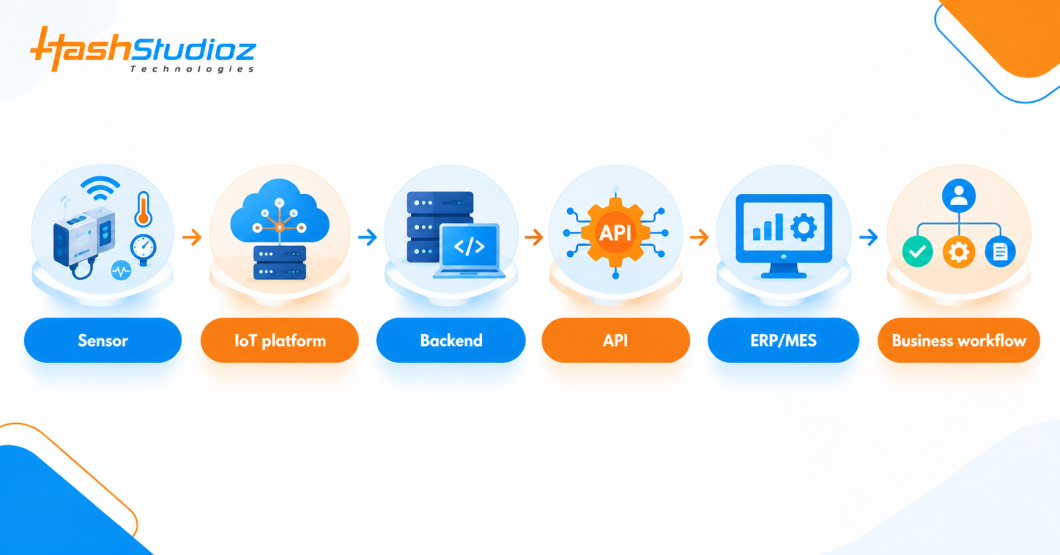
A temperature anomaly could trigger a backend event that updates an inventory workflow, creates a service ticket, or alerts an operations team.
This is where IoT becomes part of an organization’s operating model rather than an isolated technology project.
6. Test Performance, Reliability, and Security
IoT testing needs to cover both software behavior and physical-world conditions.
Traditional functional testing is necessary, but it is not sufficient.
Functional testing
Verify that:
- Devices register correctly
- Telemetry reaches the backend
- Commands reach devices
- APIs return expected responses
- Dashboards display correct values
- Alerts trigger correctly
Integration testing
Test the complete path:
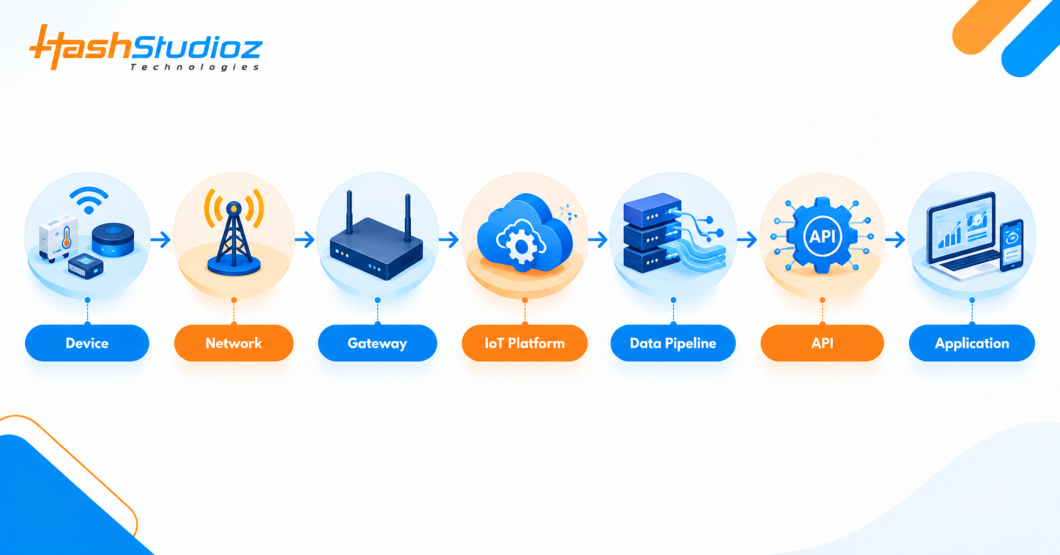
Integration testing should include external enterprise systems when they form part of the production workflow.
Connectivity testing
Simulate:
- Network interruptions
- Weak signals
- High latency
- Packet loss
- Device reconnection
- Gateway failure
- Cloud service interruption
Load and scalability testing
Test the expected production scale rather than only a small pilot.
If the final deployment may contain 50,000 devices, testing only 100 devices provides limited evidence about production behavior.
Measure:
- Messages per second
- API latency
- Processing latency
- Database performance
- Queue depth
- CPU and memory usage
- Cloud infrastructure costs
- Concurrent users
Security testing
Security must cover the entire IoT stack.
NIST’s IoT cybersecurity catalog identifies capabilities including device identification, device configuration, data protection, logical access control, software updates, cybersecurity state awareness, and device security.
Security testing should therefore address:
- Device authentication
- Certificate management
- Encryption in transit
- Encryption at rest
- API authentication
- Role-based access control
- Secrets management
- Firmware integrity
- Vulnerability management
- Network segmentation
- Logging and monitoring
NIST’s 2025 SP 1800-36 specifically emphasizes trusted IoT network-layer onboarding and lifecycle management so organizations can verify device and network trust before provisioning credentials and maintain device security throughout the lifecycle.
7. Deploy the IoT Application
Deployment involves much more than publishing a web application.
The team must prepare both the software platform and the connected device fleet.
Device provisioning
Production devices need secure mechanisms for:
- Identity assignment
- Credential provisioning
- Configuration
- Network onboarding
- Registration with the IoT platform
Manual provisioning becomes difficult as device counts increase.
NIST recommends scalable and automated approaches for trusted device onboarding and lifecycle management.
Phased deployment
For enterprise systems, a phased rollout can reduce operational risk.
A practical sequence may look like:
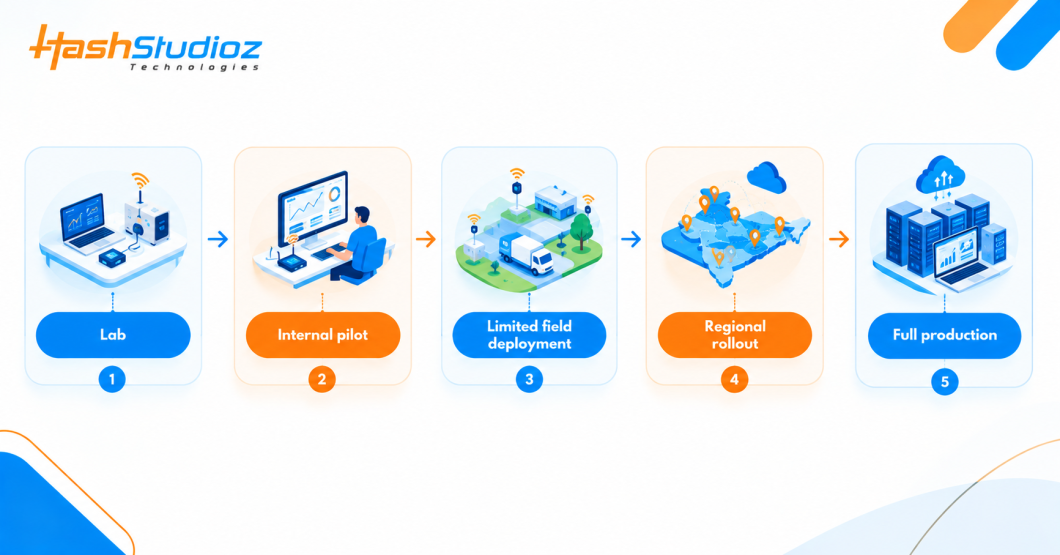
Each stage should have explicit acceptance criteria.
For example:
- Device connectivity above a defined threshold
- Telemetry delivery within the required latency
- No critical security findings
- Acceptable false-alert rate
- Stable application performance
- Defined support procedures
Infrastructure deployment
Production deployment may include:
- Cloud infrastructure
- Edge infrastructure
- IoT platform
- Databases
- APIs
- Monitoring
- Logging
- Alerting
- CI/CD pipelines
- Backup and recovery systems
Infrastructure-as-code and automated deployment pipelines can make repeatable environments easier to maintain.
8. Monitor, Maintain, and Scale
Deployment is not the end of the IoT app development lifecycle.
An IoT application must operate for months or years while devices, networks, software, business requirements, and security threats change.
Operational monitoring should cover three areas.
Device health
Monitor:
- Device connectivity
- Battery level
- Firmware version
- Sensor status
- Error codes
- Last-seen timestamp
Application health
Monitor:
- API latency
- Application errors
- Queue depth
- Data-processing failures
- Database performance
- Cloud resource consumption
Business health
Track:
- Downtime reduction
- Asset utilization
- Energy savings
- Maintenance outcomes
- Alert resolution time
- Operational cost changes
Device lifecycle management should also support secure OTA updates, configuration changes, certificate rotation, replacement, and decommissioning.
AWS IoT security guidance similarly recommends device identity lifecycle management, secure update mechanisms, encryption, monitoring, network segmentation, and incident-response planning for IoT environments.
Key Challenges in IoT Application Development
Enterprise IoT projects often encounter challenges that conventional software projects do not.
1. Hardware and software dependency
Applications depend on physical devices that may have different firmware versions, capabilities, power constraints, and communication behavior.
2. Connectivity variability
Devices may operate with unstable networks or intermittent connectivity. Applications need buffering, retry mechanisms, offline behavior, and recovery logic.
3. Data volume
Thousands of devices can generate continuous telemetry. The architecture must control ingestion, processing, storage, and retention costs.
4. Security across the lifecycle
Security cannot stop at authentication during initial deployment. Organizations must maintain device identity, software updates, access control, monitoring, and vulnerability management throughout the device lifecycle.
5. Scaling beyond the pilot
A system that works with 50 devices may behave differently with 50,000.
Teams should design for fleet management, automated provisioning, observability, data partitioning, and scalable infrastructure before large-scale deployment.
6. Integration with legacy systems
Enterprise IoT rarely operates independently. Integration with existing OT and IT systems can become one of the largest sources of implementation complexity.
Best Practices for Successful IoT Application Development
Several practices can reduce technical and operational risk.
1. Start with a measurable business outcome
Do not define the project only around connectivity or dashboards. Identify the operational decision or business process the IoT system will improve.
2. Design security from the architecture stage
Define device identity, authentication, authorization, encryption, update mechanisms, and monitoring before production deployment.
3. Use a pilot to test risky assumptions
A proof of concept should answer difficult technical questions before the full system is built.
4. Design for device lifecycle management
Plan provisioning, configuration, monitoring, firmware updates, replacement, and decommissioning from the beginning.
5. Separate real-time and historical workloads
Real-time operational data may require stream processing, while long-term analytics may belong in a data lake or warehouse.
6. Build observability into the platform
Track device, network, application, infrastructure, and business metrics from the first production release.
7. Design for failure
IoT systems operate in physical environments where networks fail, sensors malfunction, batteries drain, and devices become unavailable.
Resilience should be an architectural requirement, not a post-launch fix.
Real-World Enterprise Example: Industrial Condition Monitoring
Consider a manufacturing company with hundreds of critical machines across multiple facilities.
The business wants to reduce unexpected equipment failures.
A practical IoT implementation could follow this architecture:
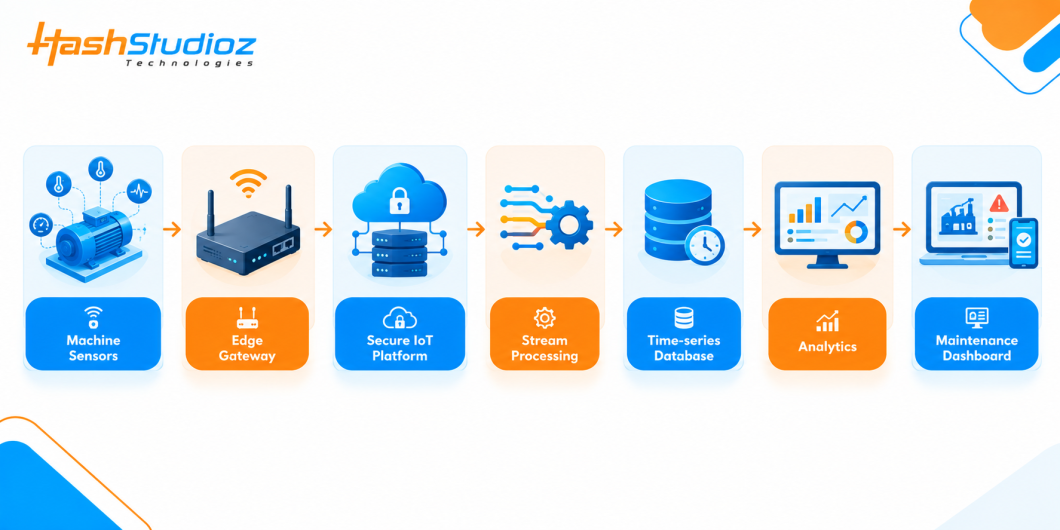
Sensors capture vibration, temperature, pressure, or other machine conditions.
The edge layer can filter data and detect anomalies. Relevant telemetry then moves to the cloud platform for centralized processing and historical analysis.
The application can provide maintenance teams with:
- Equipment health scores
- Anomaly alerts
- Historical trends
- Maintenance history
- Machine-level dashboards
- Work-order integration
The measurable business outcomes could include lower unplanned downtime, faster anomaly detection, improved maintenance scheduling, and better asset utilization.
The important point is that the value comes from the complete workflow, not simply from collecting sensor data.
How to Measure IoT Project ROI
IoT ROI should connect technical metrics with business outcomes.
A basic calculation is:
IoT ROI = (Annual Financial Benefit − Annual IoT Cost) ÷ Annual IoT Cost × 100
For example, assume an industrial deployment costs $500,000 annually and produces:
- $350,000 in avoided downtime
- $180,000 in reduced maintenance costs
- $120,000 in energy savings
Total annual benefit = $650,000
Using the formula:
ROI = ($650,000 − $500,000) ÷ $500,000 × 100 = 30%
This is only an illustrative calculation. Actual ROI depends on implementation cost, device count, operational baseline, savings methodology, and the period used for measurement.
Organizations should also track non-financial KPIs such as device availability, data quality, alert accuracy, response time, and system uptime.
When to Work With an IoT Application Development Partner
Internal teams can manage many IoT projects, particularly when they already have expertise across embedded systems, cloud infrastructure, application development, data engineering, cybersecurity, and DevOps.
External expertise becomes useful when the project requires several disciplines simultaneously or when the organization needs to move from prototype to production.
An experienced IoT development partner can support areas such as:
- IoT architecture design
- Connected device integration
- IoT application development
- Cloud and edge integration
- Backend and API development
- IoT dashboards and mobile applications
- Device management
- Data pipelines
- IoT security
- Testing and quality assurance
- Production deployment
- Post-launch maintenance
For organizations evaluating an external development team, the evaluation should focus on architecture capability, integration experience, security practices, scalability, DevOps maturity, and post-deployment support rather than only development speed.
IoT Application Development With HashStudioz
HashStudioz Technologies provides IoT Application Development services for organizations building connected products and enterprise IoT platforms. The development approach can cover the application and technology layers required to move an IoT concept toward production, including IoT architecture, device connectivity, cloud integration, backend development, APIs, dashboards, data processing, testing, deployment, and ongoing application support.
For enterprises in the USA and India, the appropriate development model depends on the use case, device ecosystem, deployment environment, integration requirements, security requirements, and expected scale. Organizations planning a new IoT application can evaluate the requirements, architecture, prototype, and deployment roadmap before committing to full-scale development.
Conclusion
The IoT app development lifecycle extends far beyond building an application interface. A production-ready IoT system connects physical devices with reliable connectivity, edge or cloud infrastructure, data processing, APIs, business applications, security controls, and device lifecycle management.
The strongest projects begin with a measurable business problem, validate technical assumptions through prototypes, establish a scalable architecture, build security into every layer, test under realistic conditions, and continue monitoring the system after deployment.
As connected-device volumes increase, enterprises need to treat IoT as an operational technology platform rather than a standalone software project. Current industry data already shows the scale involved: IoT Analytics estimates 21.1 billion connected IoT devices at the end of 2025, while Ericsson forecasts 47.1 billion total IoT connections by 2031.
That scale makes lifecycle planning a core part of IoT application development – not an activity reserved for the final deployment stage.
FAQ
1. What are the stages of IoT application development?
The main stages include business-case definition, requirements analysis, architecture, prototyping, development and integration, testing, deployment, and post-launch monitoring and maintenance.
2. How long does IoT application development take?
The timeline varies significantly based on device complexity, integrations, connectivity requirements, application scope, security requirements, and deployment scale. A small proof of concept can take weeks, while an enterprise production platform can require several months or longer.
3. What technologies are used for IoT application development?
Common technologies include MQTT, HTTP, CoAP, OPC UA, cloud IoT platforms, edge computing, APIs, databases, stream-processing systems, mobile/web frameworks, and analytics platforms. The appropriate stack depends on the use case and operating environment.
4. How can enterprises scale an IoT application?
Enterprises should plan for automated device provisioning, scalable messaging and data infrastructure, edge processing where appropriate, centralized device management, observability, automated deployments, and secure OTA updates.
5. Why is device lifecycle management important in IoT?
IoT devices remain part of the production environment for extended periods. Organizations need mechanisms to provision, authenticate, monitor, update, troubleshoot, replace, and securely decommission devices. NIST’s current IoT guidance specifically addresses trusted onboarding and lifecycle management at scale.

A tech mind, who loves to craft content that may popup on the SERPs. RPA, engineering, travel industry, and the various management system topic comes under my belt.
In spare time like to read & make friends. A believer in thought power. Ted talks lightens me up. Wish to share the stage someday!