


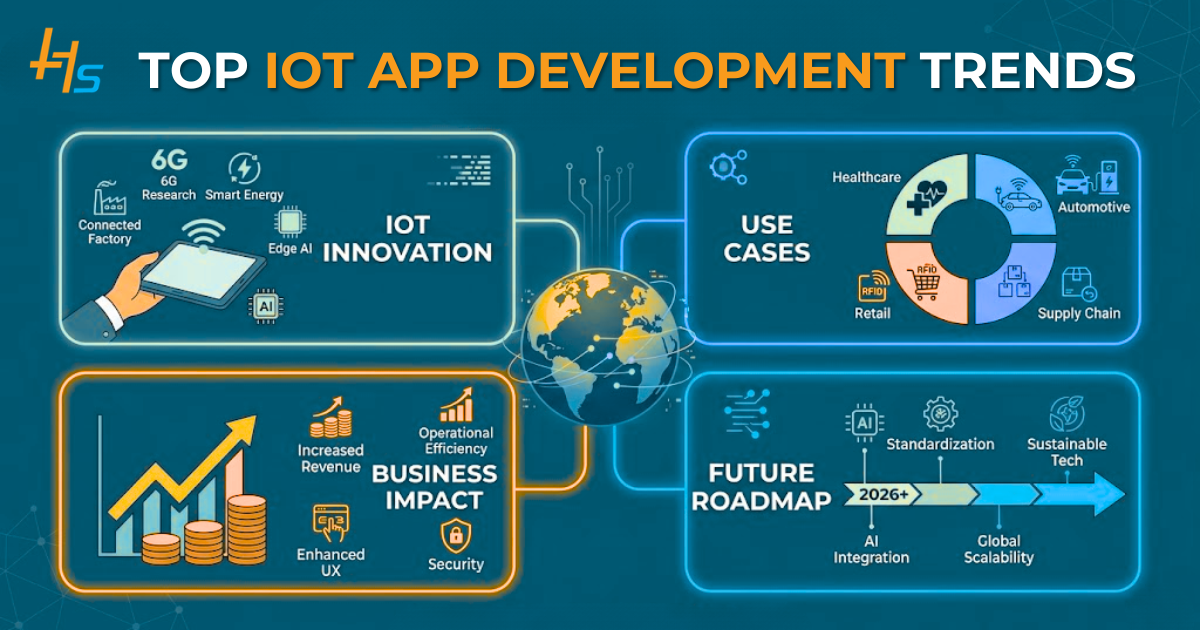
The Internet of Things (IoT) is no longer just about connecting devices. It has become a core driver of digital transformation across industries. Businesses today rely on IoT applications to collect real-time data, automate operations, and improve decision-making.
From manufacturing plants to healthcare systems, IoT is enabling organizations to operate with greater efficiency and visibility. According to industry estimates, the number of connected IoT devices is expected to exceed 29 billion by 2030. This rapid growth is pushing companies to invest in scalable, secure, and intelligent IoT applications.
At the same time, emerging technologies such as artificial intelligence, edge computing, and digital twins are redefining how IoT applications function. These technologies are not only improving performance but also enabling systems to act autonomously.
In this blog, we explore the most important IoT app development trends for 2026 and beyond. We also explain how these trends impact businesses and why they matter for long-term growth.
Table of Contents
IoT App Development Trends 2026 (Quick Overview)
Businesses looking to invest in IoT must understand the key trends shaping the industry. Here is a quick overview of the most important IoT app development trends in 2026:
- AIoT (Artificial Intelligence integrated with IoT systems)
- Edge computing for faster data processing
- Digital twins for simulation and optimization
- Advanced IoT cybersecurity frameworks
- Smart home and connected ecosystems
- Wearable IoT advancements
- IoT adoption in healthcare
- TinyML for on-device intelligence
- Sustainable IoT solutions
Each of these trends represents a shift from basic connectivity to intelligent, data-driven systems. Understanding them helps businesses make better technology decisions.
What is IoT App Development?
IoT app development refers to the process of building applications that connect physical devices, collect and process data, and provide users with control and insights through digital interfaces.
An IoT ecosystem includes devices such as sensors and gateways, communication protocols, cloud platforms, and user-facing applications. The application layer plays a critical role by connecting all these components into a unified system.
A well-designed IoT application enables real-time monitoring, remote device control, and advanced analytics. For example, in manufacturing, IoT apps can track machine performance and predict failures before they occur. In healthcare, they allow doctors to monitor patients remotely using connected devices.
Modern IoT applications must also focus on scalability and security. As the number of connected devices increases, the application must handle large volumes of data without performance issues. At the same time, it must ensure that sensitive data remains protected.
Why IoT Apps Matter in 2026
IoT applications have become essential for businesses that want to stay competitive in a data-driven world. They are no longer considered optional or experimental technologies.
One of the biggest advantages of IoT apps is their ability to improve operational efficiency. By collecting real-time data from devices, businesses can monitor processes, identify inefficiencies, and take corrective actions immediately. This reduces downtime and improves productivity.
IoT applications also play a key role in automation. Tasks that once required manual intervention can now be handled automatically through connected systems. For example, smart inventory systems can update stock levels in real time without human input.
Another important benefit is enhanced customer experience. IoT apps allow businesses to offer personalized and responsive services. For instance, connected devices can provide real-time updates and alerts to users.
In 2026, businesses that leverage IoT effectively will have a clear advantage in terms of efficiency, cost savings, and innovation.
Key IoT App Development Trends in 2026
1. AIoT (Artificial Intelligence + IoT)
What is AIoT?
AIoT is the integration of artificial intelligence with IoT systems, enabling devices to analyze data and make decisions in real time.
Detailed Insight
Traditional IoT systems focus on data collection and transmission. However, AIoT takes this a step further by adding intelligence to the system. It allows IoT applications to process large volumes of data and identify patterns that would be difficult for humans to detect.
For example, in industrial environments, AIoT can analyze sensor data to predict equipment failures before they happen. This reduces maintenance costs and prevents unexpected downtime.
AIoT also plays a crucial role in improving decision-making. Instead of relying on manual analysis, businesses can use AI-powered insights to optimize operations automatically.
As AI technologies continue to evolve, AIoT will become a standard feature in advanced IoT applications.
2. Edge Computing for Real-Time Processing
What is Edge Computing?
Edge computing processes data closer to the point of generation rather than sending it to a centralized cloud.
Detailed Insight
In traditional cloud-based IoT systems, data is transmitted to remote servers for processing. This can lead to delays, especially in applications that require real-time responses.
Edge computing solves this problem by enabling local data processing. Devices or nearby edge servers handle data analysis, reducing latency and improving performance.
This approach is particularly useful in industries such as manufacturing, where even a small delay can impact production. It also reduces bandwidth usage, as only relevant data is sent to the cloud.
Edge computing enhances both speed and reliability, making it a key component of modern IoT architectures.
Edge vs Cloud in IoT
| Feature | Edge Computing | Cloud Computing |
|---|---|---|
| Latency | Very Low | Moderate |
| Processing | Local | Centralized |
| Speed | Faster | Slower |
| Data Transfer | Reduced | High |
3. Digital Twins Technology
What are Digital Twins?
Digital twins are virtual models of physical systems that use real-time IoT data to replicate their behavior.
Detailed Insight
Digital twins allow businesses to simulate real-world conditions without affecting actual operations. This makes them extremely valuable for testing, monitoring, and optimization.
For example, a manufacturing company can use a digital twin to analyze machine performance under different conditions. If a potential issue is detected, it can be resolved before it impacts production.
Digital twins also support predictive maintenance. By continuously analyzing data, they can identify patterns that indicate potential failures.
This technology is becoming increasingly important as businesses look for ways to improve efficiency and reduce risks.
4. IoT Security and Cybersecurity Focus
Security is one of the most critical aspects of IoT app development.
As IoT devices collect and transmit sensitive data, they become potential targets for cyberattacks. A single security breach can lead to data loss, financial damage, and loss of customer trust.
Modern IoT applications must implement strong security measures, including encryption, secure APIs, and device authentication. Many organizations are also adopting zero-trust architectures, where every device and user must be verified before access is granted.
In addition, regular updates and monitoring are essential to address new threats. Security should not be treated as an afterthought. It must be integrated into the development process from the beginning.
5. Smart Home and Connected Ecosystems
Smart home technology continues to grow rapidly, driven by increasing consumer demand for convenience and automation.
Modern IoT applications are designed to connect multiple devices into a unified ecosystem. Users can control lighting, security systems, appliances, and more from a single interface.
The focus is now on interoperability and user experience. Devices from different manufacturers must work together seamlessly. At the same time, applications must provide intuitive controls and real-time updates.
Energy efficiency is another important factor. Smart systems can optimize energy usage, helping users reduce costs and environmental impact.
6. Wearable IoT Advancements
Wearable devices are becoming more sophisticated and capable.
Earlier, wearables were limited to basic functions such as step tracking. Today, they offer advanced features like health monitoring, sleep analysis, and real-time alerts.
IoT applications for wearables must handle continuous data streams and ensure accurate analysis. They must also prioritize data security, as wearable devices often collect sensitive health information.
In healthcare, wearable IoT devices are used for remote patient monitoring. They provide real-time data to doctors, enabling early detection of potential issues.
This trend is expected to grow as technology continues to evolve.
7. IoT in Healthcare Transformation
The healthcare industry is undergoing a major transformation with the adoption of IoT.
Connected devices and applications enable continuous monitoring of patient health. This reduces the need for frequent hospital visits and improves patient outcomes.
IoT applications also help healthcare providers manage resources more efficiently. For example, connected systems can track medical equipment and ensure its availability when needed.
During recent global health challenges, IoT played a key role in monitoring patients and managing healthcare systems. This trend will continue as technology advances.
8. TinyML (Machine Learning on Devices)
TinyML is an emerging trend that enables machine learning models to run directly on IoT devices.
This reduces reliance on cloud infrastructure and allows faster decision-making. It also improves privacy, as data does not need to be transmitted to external servers.
TinyML is widely used in applications such as smart home devices, wearables, and industrial sensors. As hardware capabilities improve, more devices will support on-device intelligence.
9. Sustainable IoT (Green IoT)
Sustainability is becoming a key consideration in IoT development.
Businesses are focusing on energy-efficient devices and optimized data processing to reduce environmental impact. This includes the use of low-power networks and efficient communication protocols.
Sustainable IoT solutions not only benefit the environment but also help businesses reduce operational costs. As regulations become stricter, this trend will gain even more importance.
Business Impact of IoT Trends
IoT trends are not just technological advancements. They directly influence how businesses operate, compete, and grow in a data-driven environment.
One of the most significant impacts is operational efficiency. IoT applications collect real-time data from devices and systems, allowing businesses to identify inefficiencies and take immediate action. This reduces downtime and improves productivity across operations.
Another major impact is predictive decision-making. Technologies like AIoT and digital twins enable businesses to forecast potential failures and optimize processes before issues occur. This shift from reactive to proactive operations helps reduce maintenance costs and improve system reliability.
IoT also enhances customer experience. For example, in retail, IoT-enabled systems track customer behavior and preferences, allowing businesses to offer personalized services. In logistics, real-time tracking improves delivery transparency and customer satisfaction.
In addition, IoT supports cost optimization. By automating processes and improving resource utilization, businesses can reduce unnecessary expenses.
Overall, IoT trends are helping organizations move toward smarter, faster, and more efficient operations, making them essential for long-term competitiveness.
Build Your IoT Solution with Confidence
From idea to deployment, get the right approach to create scalable and reliable IoT applications that work in real environments.
Industry Use Cases of IoT Apps
IoT app development is transforming industries by enabling real-time monitoring, automation, and data-driven decision-making.
In the manufacturing sector, IoT applications are widely used for predictive maintenance and machine monitoring. Sensors collect performance data from equipment, allowing businesses to detect anomalies and prevent unexpected failures. This reduces downtime and improves production efficiency.
In healthcare, IoT applications enable remote patient monitoring through connected devices such as wearables and smart medical equipment. Doctors can access real-time patient data, improving diagnosis and reducing hospital visits.
The logistics and transportation industry benefits from IoT through fleet tracking and shipment visibility. Businesses can monitor vehicle location, fuel consumption, and delivery status in real time, improving operational efficiency and customer satisfaction.
In retail, IoT applications help manage inventory and analyze customer behavior. Smart shelves and connected systems provide real-time stock updates, reducing overstocking and stockouts.
For smart cities, IoT plays a key role in traffic management, energy optimization, and public safety. Connected systems enable better urban planning and resource management.
These use cases highlight how IoT applications deliver practical value across different sectors.
Technology Stack Behind IoT Apps
A robust IoT application relies on a well-structured technology stack that ensures performance, scalability, and security.
At the device level, IoT systems use sensors and gateways to collect and transmit data. These devices act as the foundation of the entire ecosystem, capturing real-time information from the physical environment.
For communication, protocols such as MQTT, HTTP, and CoAP are commonly used. These protocols ensure efficient and reliable data transfer between devices and cloud platforms.
The cloud layer plays a critical role in data storage and processing. Platforms like AWS IoT and Microsoft Azure IoT provide scalable infrastructure to handle large volumes of data and support advanced analytics.
On the application side, mobile apps and web dashboards allow users to monitor and control IoT systems. These interfaces must be intuitive and capable of displaying real-time insights.
Finally, the analytics layer uses AI and big data tools to process information and generate actionable insights. This enables businesses to make informed decisions and optimize operations.
Choosing the right combination of these components is essential for building a reliable IoT application.
Challenges in IoT App Development
While IoT offers significant benefits, developing and deploying IoT applications comes with several challenges that businesses must address.
One of the primary concerns is data security. IoT devices continuously collect and transmit sensitive information, making them potential targets for cyberattacks. Ensuring secure communication and data protection is critical.
Another challenge is device compatibility. IoT ecosystems often include devices from different manufacturers, each with its own standards and protocols. Ensuring seamless integration across these devices can be complex.
Network reliability is also a major factor. IoT applications depend on stable connectivity for real-time data transmission. Any disruption in the network can impact performance and user experience.
Additionally, managing large volumes of data can be challenging. IoT systems generate massive amounts of information, which must be stored, processed, and analyzed efficiently.
Finally, development and implementation costs can be high, especially for large-scale IoT projects. Businesses need to plan carefully to ensure a good return on investment.
Addressing these challenges early helps ensure successful IoT deployment and long-term scalability.
Why Businesses Choose HashStudioz for IoT App Development
Choosing the right IoT development partner plays a critical role in the success of any IoT initiative. Businesses today look for partners who can deliver end-to-end solutions, from device integration to application development and analytics.
HashStudioz is known for delivering practical and scalable IoT solutions tailored to real business requirements. The focus is not just on building applications, but on creating systems that work reliably in real-world environments.
The team has experience working across industries such as manufacturing, healthcare, and logistics. This industry exposure helps in understanding specific challenges and designing solutions that address them effectively.
Key capabilities include:
- IoT hardware and software integration
- Custom mobile and web application development
- Real-time monitoring dashboards
- AI-powered analytics for data-driven insights
Another important aspect is the focus on scalability and security. Solutions are designed to handle growing data volumes while ensuring data protection and system reliability.
With a strong technical foundation and industry experience, HashStudioz helps businesses implement IoT solutions that deliver measurable results.
Future of IoT App Development
IoT app development is moving beyond simple connectivity toward intelligent and self-operating systems. Future IoT applications will not just collect data but will analyze it in real time and take actions with minimal human input.
Technologies like AIoT and edge computing are accelerating this shift by enabling faster processing and smarter decision-making at the device level.
What will shape the future?
- AI-driven automation: IoT systems will automatically respond to real-world conditions without manual intervention.
- Edge-first architecture: More data will be processed locally, reducing latency and improving performance.
- Connected ecosystems: Multiple devices, apps, and platforms will work together seamlessly instead of operating in silos.
- Stronger security frameworks: Security will become a built-in layer, not an add-on.
- Scalable IoT infrastructure: Systems will be designed to handle billions of connected devices efficiently.
What it means for businesses
Businesses will shift from monitoring systems to fully automated operations. This will improve efficiency, reduce costs, and enable faster decision-making.
Organizations that invest early in these technologies will be better positioned to innovate and stay competitive in a rapidly evolving digital landscape.
Key Takeaways
- IoT is evolving from connectivity to intelligence
- AI and edge computing are driving innovation
- Security is essential for trust and reliability
- Businesses use IoT for efficiency and automation
Looking to build a scalable IoT solution?
HashStudioz helps businesses design, develop, and deploy IoT applications tailored to real-world needs.
Conclusion
IoT app development is evolving from simple device connectivity to intelligent, data-driven systems. Technologies like AIoT, edge computing, and digital twins are enabling real-time insights, automation, and faster decision-making.
At the same time, factors such as security, scalability, and seamless integration remain critical for successful implementation.
The future of IoT lies in building connected systems that can act intelligently with minimal human intervention. Businesses that adopt these technologies early will gain a strong competitive edge.
Investing in the right IoT strategy today can drive long-term efficiency, innovation, and growth.
FAQs
1. What is IoT app development?
IoT app development is the process of creating applications that connect devices, collect data, and enable monitoring and control through mobile or web interfaces. These apps act as a bridge between physical devices and users.
2. Which industries benefit the most from IoT applications?
Industries such as manufacturing, healthcare, logistics, retail, and smart cities benefit the most. IoT helps these sectors improve efficiency, automate processes, and gain real-time insights.
3. How much does IoT app development cost?
IoT app development typically costs between $20,000 and $150,000. The cost depends on factors such as the number of devices, features, integrations, and system complexity.
4. What are the biggest challenges in IoT app development?
The main challenges include data security, device compatibility, network reliability, and managing large volumes of data. Addressing these challenges is essential for successful deployment.
5. Is IoT secure for business applications?
Yes, IoT can be secure when proper measures such as encryption, secure APIs, and device authentication are implemented. Security should be integrated into the development process from the beginning.