


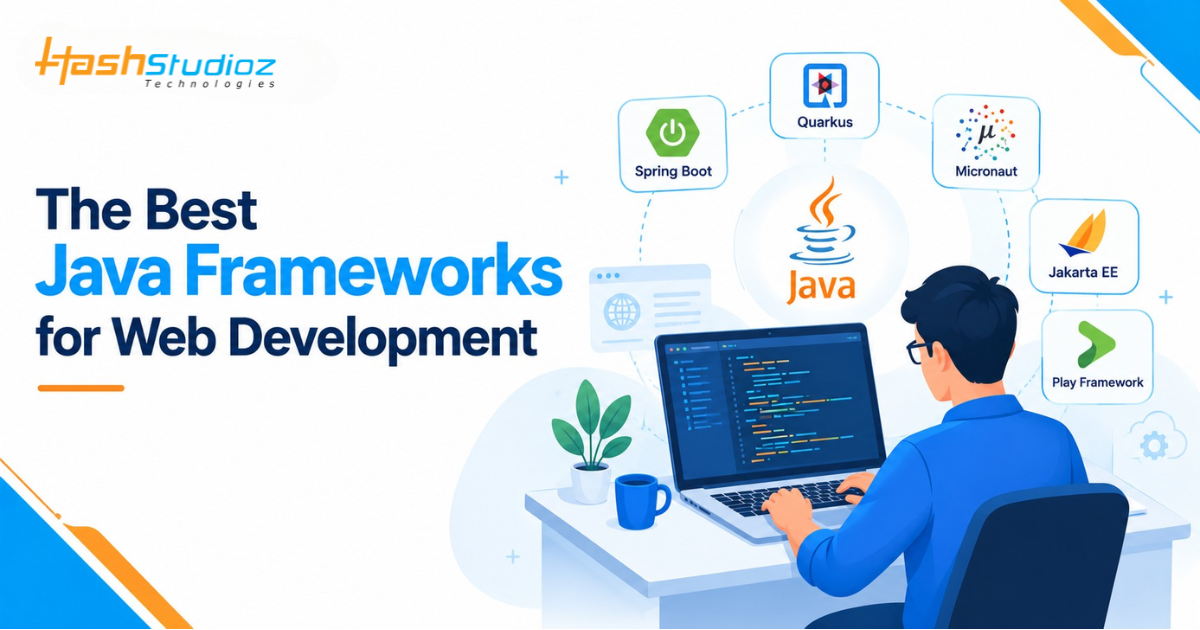
Java continues to play a major role in enterprise web development, backend services, APIs, and distributed systems. The 2025 JetBrains State of Java report, based on more than 5,000 developers worldwide, found that 78% of respondents work on backend development and 57% use Java to provide APIs and services. The same report shows that Spring remains the leading Java framework ecosystem, used by 65% of respondents.
At the same time, enterprise application architectures are changing. Kubernetes, microservices, serverless workloads, native compilation, event-driven systems, and API-first development have created new requirements for Java applications. Frameworks such as Quarkus and Micronaut address these requirements with compile-time processing, cloud-native capabilities, and support for lightweight deployments. Jakarta EE continues to provide a standards-based approach for enterprise Java, while Play Framework remains an option for teams building reactive web applications with Java or Scala.
For CTOs, CIOs, and engineering leaders, choosing a Java framework is therefore not simply a matter of developer preference. The decision affects application architecture, cloud infrastructure, developer availability, security, testing, scalability, maintenance, and long-term technology costs.
This guide compares the leading Java frameworks for web development and explains where each framework fits in modern enterprise applications.
Table of Contents
What Makes a Java Framework Suitable for Enterprise Web Development?
A framework should do more than create an HTTP endpoint. Enterprise applications often need authentication, authorization, database access, API integration, observability, testing, messaging, caching, deployment automation, and security controls.
When evaluating a Java web framework, engineering teams should consider:
- Application architecture: Monolith, modular monolith, microservices, event-driven services, or serverless.
- Cloud compatibility: Support for containers, Kubernetes, public clouds, and cloud-native deployment patterns.
- Performance requirements: Throughput, latency, startup time, memory consumption, and concurrency.
- Ecosystem: Available libraries, integrations, documentation, tooling, and community support.
- Developer availability: How easily the organization can recruit or onboard engineers with the required framework skills.
- Security: Authentication, authorization, encryption, security updates, and integration with enterprise identity platforms.
- Maintainability: Upgrade paths, testing capabilities, observability, and long-term support.
- Total cost of ownership: Infrastructure requirements, engineering effort, operational complexity, and migration costs.
No framework performs best for every workload. The correct choice depends on the application’s technical and business requirements.
1. Spring Boot
Best suited for: Enterprise applications, REST APIs, SaaS platforms, microservices, transactional systems, and large business applications.
Spring Boot is one of the most widely adopted choices for modern Java web development. The Spring ecosystem provides libraries and integrations for web development, security, data access, messaging, cloud applications, testing, and observability.
Spring Boot can run applications with embedded Tomcat, Jetty, or Netty and supports both traditional Spring MVC applications and reactive applications through Spring WebFlux.
Its production capabilities also include health checks, metrics, externalized configuration, security integrations, and deployment options for containers and other environments.
Why enterprises choose Spring Boot
Spring Boot has a broad ecosystem that reduces the amount of infrastructure teams need to build themselves. Developers can combine Spring MVC, Spring Security, Spring Data, Spring Cloud, messaging libraries, and other Spring projects depending on the application’s requirements.
Its ecosystem also matters from a hiring and maintenance perspective. JetBrains’ 2025 Java survey reports that Spring was used by 65% of respondents, while Maven was used by 67% as a build system.
For an enterprise with several Java applications, this familiarity can reduce onboarding and technology-transition costs.
Where Spring Boot fits
Spring Boot is particularly suitable for:
- Enterprise REST APIs
- SaaS platforms
- E-commerce applications
- Banking and financial systems
- CRM and ERP integrations
- Microservice architectures
- Internal business applications
- Data-driven applications
- Applications integrating with multiple enterprise systems
Spring Boot also supports modern deployment models. Teams can package applications as executable JARs, container images, or native applications depending on their architecture and deployment requirements.
Potential trade-offs
Spring Boot’s extensive ecosystem can also increase architectural complexity. Enterprises need clear dependency management, service boundaries, observability standards, and upgrade policies to prevent large applications from becoming difficult to maintain.
The framework should therefore be selected as part of an application architecture rather than treated as an isolated technology decision.
2. Quarkus
Best suited for: Kubernetes-based applications, cloud-native microservices, serverless workloads, container-heavy environments, and applications where startup time and memory usage matter.
Quarkus was designed around cloud-native Java workloads. Its architecture emphasizes build-time processing and Kubernetes-oriented deployment.
The official Quarkus documentation describes the framework as designed to run in containers and provides Kubernetes extensions that can automate parts of application deployment.
Why enterprises consider Quarkus
Traditional Java applications can work well in containers, but some workloads require faster startup and a smaller runtime footprint. This becomes particularly relevant when applications scale dynamically or run large numbers of containerized services.
Quarkus addresses this use case with build-time optimization and support for native compilation.
It also supports technologies commonly found in enterprise cloud architectures, including REST APIs, persistence, messaging, security, and Kubernetes integrations.
Where Quarkus fits
Quarkus is worth evaluating for:
- Kubernetes microservices
- Serverless applications
- High-density container environments
- Event-driven services
- Cloud-native APIs
- Applications requiring fast startup
- Services deployed across large container fleets
However, enterprises should benchmark the complete application rather than compare framework claims in isolation. Database drivers, dependencies, JVM configuration, network latency, container limits, and workload patterns can significantly affect real-world performance.
3. Micronaut
Best suited for: Lightweight microservices, serverless applications, cloud-native APIs, and resource-constrained deployments.
Micronaut takes a different approach to dependency injection and application metadata. The framework performs much of its dependency injection work at compile time instead of relying heavily on runtime reflection.
The official documentation describes Micronaut as a JVM-based framework for Java, Kotlin, and Groovy applications, with support for dependency injection, HTTP servers, message-driven applications, and microservices.
Micronaut also emphasizes fast startup, low memory overhead, and native-image support for cloud applications.
Where Micronaut fits
Micronaut can be considered for:
- Serverless functions
- Lightweight REST APIs
- Microservices
- Cloud-native applications
- IoT backend services
- Resource-constrained containers
- Applications requiring native deployment
The compile-time approach can reduce runtime reflection and support smaller application footprints. However, organizations should consider ecosystem size, developer familiarity, available integrations, and internal skills before standardizing on Micronaut.
4. Jakarta EE
Best suited for: Standards-driven enterprise applications, organizations that value portability, long-lived systems, and established enterprise Java specifications.
Jakarta EE is different from Spring Boot, Quarkus, and Micronaut because it is primarily an open, vendor-neutral standards platform rather than a single application framework.
The Eclipse Foundation describes Jakarta EE as a standard for building reliable, cloud-native enterprise Java applications, with specifications designed to provide consistent behavior across compatible runtimes.
This distinction matters for enterprises that prioritize portability and standards.
Why organizations use Jakarta EE
Jakarta EE provides specifications for capabilities used in enterprise applications, including web services, dependency injection, persistence, security, transactions, messaging, and other application infrastructure.
Organizations can use compatible Jakarta EE runtimes rather than tying an application to a single proprietary application server.
Where Jakarta EE fits
Jakarta EE can be appropriate for:
- Large enterprise applications
- Standards-based architectures
- Long-lived business systems
- Government and regulated environments
- Applications requiring runtime portability
- Organizations with existing Jakarta EE expertise
For teams already operating substantial Jakarta EE estates, modernization does not necessarily require replacing the platform. Incremental modernization, containerization, API separation, and selective migration can often provide a more controlled path.
5. Play Framework
Best suited for: Reactive web applications, high-concurrency services, and teams working with Java or Scala.
Play Framework provides a full-stack web framework for Java and Scala. Its current 3.0 documentation describes an MVC architecture, integrated HTTP server, routing, form handling, CSRF protection, internationalization, testing support, and REST-service capabilities.
Play uses an asynchronous model based on Pekko in Play 3 and provides a lightweight, stateless architecture intended for scalable web applications.
Where Play fits
Play can be useful for:
- Reactive web applications
- High-concurrency applications
- REST APIs
- Java and Scala development teams
- Applications requiring asynchronous processing
Its suitability depends heavily on team experience and the existing technology ecosystem. Organizations already invested in Play may find continued modernization practical, while new projects should evaluate the framework against available enterprise integrations and developer availability.
Java Framework Comparison
The following comparison provides a practical starting point for enterprise architecture discussions:
| Framework | Primary Strength | Best Fit | Cloud-Native Support | Enterprise Ecosystem |
| Spring Boot | Broad ecosystem and enterprise integrations | APIs, SaaS, enterprise applications, microservices | Strong | Very broad |
| Quarkus | Kubernetes and build-time optimization | Cloud-native microservices, serverless | Strong | Broad and growing |
| Micronaut | Compile-time DI and lightweight runtime | Microservices, serverless, APIs | Strong | Growing |
| Jakarta EE | Standards and portability | Enterprise and standards-driven systems | Strong | Mature |
| Play Framework | Reactive web development | Java/Scala web applications and APIs | Strong | More specialized |
This table should not be interpreted as a performance ranking. Actual performance depends on the application architecture, dependencies, infrastructure, workload, and deployment model.
How to Choose the Right Java Framework
The framework decision should start with business and technical constraints rather than framework popularity.
1. Choose Spring Boot when ecosystem depth matters
Spring Boot is a practical option when the organization needs extensive integrations, a large talent pool, mature tooling, and support for different enterprise application patterns.
It is particularly useful when multiple teams need to follow a common Java platform standard.
2. Consider Quarkus for Kubernetes-heavy environments
If the organization runs a large Kubernetes estate and cares about container startup, resource utilization, and native deployment, Quarkus deserves a technical evaluation.
Run representative workloads before committing. A small proof of concept should measure startup time, memory consumption, request latency, throughput, image size, and operational complexity.
3. Consider Micronaut for lean services
Micronaut is worth evaluating when low runtime overhead and compile-time dependency injection are important.
It can be particularly relevant for serverless and microservice workloads where resource consumption affects infrastructure economics.
4. Choose Jakarta EE when standards and portability are priorities
Organizations with existing Jakarta EE expertise or strict portability requirements may benefit from continuing with a standards-based architecture.
This approach can also reduce dependency on framework-specific APIs.
5. Consider Play when reactive architecture is central
Play can be appropriate for teams building Java or Scala applications around asynchronous and reactive programming models.
Existing team expertise should be a major consideration because framework familiarity affects delivery speed and long-term maintenance.
Java vs. JavaScript: An Important Distinction
Enterprise technology teams sometimes use the terms Java and JavaScript interchangeably because both appear frequently in web development. They are different technologies.
Java is commonly used for backend systems, APIs, enterprise applications, distributed services, and business logic.
JavaScript primarily runs in web browsers and can also run on servers through environments such as Node.js.
A modern web platform may use both.
For example:
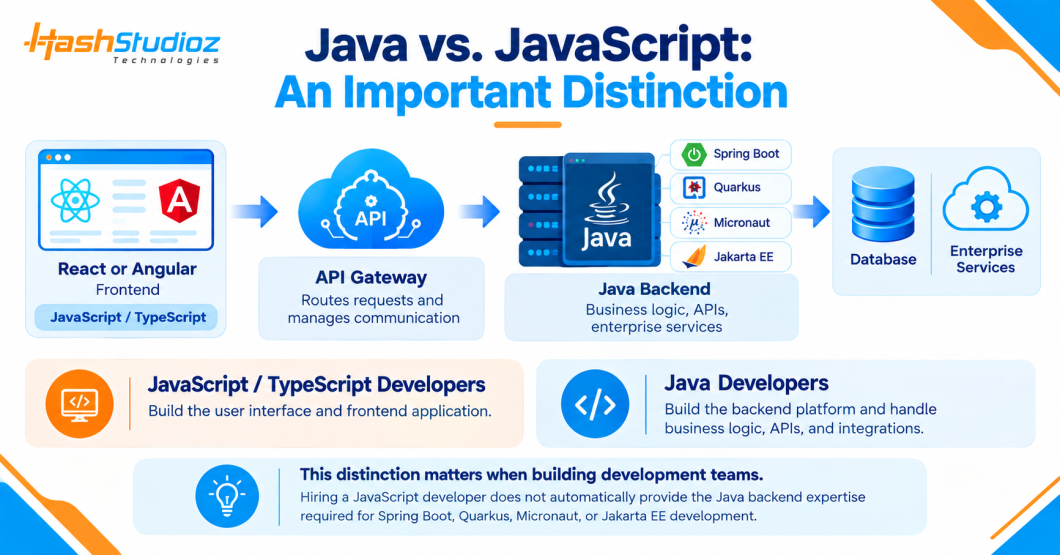
In this architecture, Java developers build the backend platform while JavaScript or TypeScript developers build the user interface and frontend application.
This distinction becomes important when organizations build development teams. Hiring a JavaScript developer does not automatically provide the Java backend expertise required for Spring Boot, Quarkus, Micronaut, or Jakarta EE development.
How the Right Development Team Affects Framework Selection
The framework is only one part of the technology decision. Engineering capability can have a greater impact on delivery than the framework itself.
A Java web application may require expertise across:
- Java and JVM architecture
- REST and API design
- Spring Boot or another Java framework
- Database design
- Cloud infrastructure
- Docker and Kubernetes
- CI/CD
- Authentication and authorization
- Automated testing
- Application monitoring
- Frontend JavaScript or TypeScript
- Performance optimization
For organizations building a complete web platform, frontend and backend skills often need to work together.
If an enterprise needs additional frontend capability, it can hire dedicated JavaScript developers to work alongside its Java backend team. This approach can help create a clear separation between frontend and backend responsibilities while maintaining API contracts between the two layers.
For organizations evaluating external development capacity, HashStudioz provides JavaScript development resources for frontend and full-stack requirements. Teams can review the available engagement model and developer capabilities through the Hire JavaScript Developers service.
A Practical Framework Selection Process
A structured evaluation can reduce the risk of choosing a framework based only on popularity.
Step 1: Define the workload
Document the application’s expected:
- Request volume
- Concurrent users
- API traffic
- Data volume
- Latency requirements
- Availability requirements
- Deployment frequency
Step 2: Define the deployment environment
Identify whether the application will run on:
- Virtual machines
- Docker containers
- Kubernetes
- Serverless infrastructure
- Hybrid cloud
- Public cloud
- On-premises infrastructure
The deployment model can significantly influence the framework decision.
Step 3: Assess existing skills
Review the team’s current knowledge of Java, Spring, Jakarta EE, Kubernetes, cloud platforms, databases, frontend frameworks, and DevOps.
A technically capable team can often adopt a framework faster than a team starting from scratch.
Step 4: Build a proof of concept
Do not benchmark frameworks using only a basic “Hello World” endpoint.
Use a representative service that includes:
- Authentication
- Database queries
- External API calls
- Logging
- Metrics
- Error handling
- Serialization
- Container deployment
Then measure performance under realistic load.
Step 5: Calculate total cost
Framework selection should account for more than compute costs.
A useful model is:
Total Cost of Ownership = Infrastructure + Development + Maintenance + Training + Migration + Operations
A framework that saves infrastructure costs but requires significantly more engineering effort may not reduce total cost.
ROI Considerations for Enterprise Java Development
Framework ROI is difficult to calculate from framework benchmarks alone. Organizations should connect technical metrics to business outcomes.
Useful measurements include:
- Development hours per feature
- Deployment frequency
- Mean time to recovery
- Infrastructure cost per service
- Memory consumption per container
- API response time
- Defect rate
- Developer onboarding time
- Cloud cost per transaction
- Cost of maintaining legacy services
For example, if a service processes 10 million requests per month and a framework migration reduces infrastructure spending by 20%, the organization can calculate the annual infrastructure savings directly.
However, the migration should also include engineering and testing costs.
Net ROI = Financial Benefit − Implementation Cost
This prevents organizations from treating lower memory usage or faster startup as business value without calculating their actual financial effect.
What Should Enterprise Teams Choose in 2026?
The current Java ecosystem supports several credible approaches rather than one universal framework.
Spring remains deeply established. JetBrains’ 2025 Java survey places Spring at 65% usage among respondents and shows that Java continues to be heavily focused on backend systems and APIs.
Quarkus and Micronaut address a different set of requirements, particularly cloud-native and resource-sensitive workloads. Jakarta EE remains relevant for standards-driven enterprise architectures, while Play continues to support Java and Scala web applications using an asynchronous model.
The practical decision is therefore less about finding the single “best” Java framework and more about matching the framework to the workload, deployment environment, team skills, integration requirements, and long-term operating model.

Final Takeaway
Java remains a strong platform for enterprise web development, but the framework ecosystem has become more diverse.
Spring Boot provides a broad enterprise ecosystem. Quarkus targets cloud-native and Kubernetes-oriented workloads. Micronaut focuses on lightweight JVM applications and compile-time processing. Jakarta EE provides standards-based enterprise development, while Play offers an asynchronous approach for Java and Scala web applications.
The best framework decision starts with architecture, not popularity. Define the workload, deployment environment, security requirements, team capabilities, integration needs, and cost model before selecting the framework.
For organizations building the frontend layer alongside Java-based backend systems, JavaScript and TypeScript expertise can complement the Java engineering team. Where additional frontend or full-stack capability is required, businesses can evaluate development resources through HashStudioz’s Hire JavaScript Developers offering.
Frequently Asked Questions
1. Which Java framework is best for web development?
The right choice depends on the application. Spring Boot is widely used for enterprise applications and APIs, Quarkus and Micronaut are designed for modern cloud-native workloads, Jakarta EE provides standards-based enterprise development, and Play supports reactive Java and Scala web applications.
2. Is Spring Boot still relevant for enterprise applications?
Yes. JetBrains’ 2025 State of Java report found Spring at 65% usage among surveyed Java developers, indicating its continued importance in the Java ecosystem.
3. Is Quarkus better than Spring Boot?
Neither framework is universally better. Quarkus emphasizes cloud-native deployment and build-time optimization, while Spring Boot provides a very broad ecosystem and extensive enterprise integrations. Teams should evaluate both against their actual workload and operational requirements.
4. Is Micronaut suitable for microservices?
Yes. Micronaut is designed for JVM applications and provides features for microservices, HTTP services, dependency injection, cloud applications, and native-image deployments.
5. Is Jakarta EE still used for enterprise development?
Yes. Jakarta EE continues to provide vendor-neutral specifications for cloud-native enterprise Java applications and focuses on portability and standardized application behavior.
6. What is the difference between Java and JavaScript developers?
Java developers commonly focus on backend systems, APIs, enterprise applications, and JVM-based services. JavaScript developers generally work on web interfaces and can also build server-side applications using JavaScript runtimes such as Node.js. Large web platforms may require both skill sets.
7. Should companies hire Java or JavaScript developers for a web project?
That depends on the architecture. A Java-based backend may require Java expertise, while the browser-facing application may require JavaScript or TypeScript expertise. Many enterprise web platforms use both teams.