


Three numbers explain why amusement park operators are replacing spreadsheets and standalone point-of-sale terminals this year. Strategic Market Research (2024) projects the global amusement park management software market to reach USD 9.7 billion by 2030, up from USD 4.8 billion in 2024, growing at 11% annually. More than 68% of the world’s 4,000-plus amusement parks have already deployed at least one centralized platform for ticketing, operations, or visitor analytics, according to Market Growth Reports (2024). Cloud-based deployments now account for 58.5% of category spend, signaling that operators have moved beyond maintaining servers on-site.
Those figures describe an industry moving in one direction. Parks that still run ticketing, POS, CRM, and maintenance logs as separate systems are becoming the exception, not the norm. For a CTO or CIO weighing this shift, the real question is not whether to invest in a management platform. It is whether an off-the-shelf tool or a custom-built Amusement Park Management System will actually solve the problems specific to how your park operates.
Table of Contents
The Hidden Costs of Fragmented Park Operations
Most parks did not choose fragmented systems intentionally. The technology stack usually grew over time. A park may have added a ticketing vendor in 2015. It may have added a POS system in 2018. Later, the team may have introduced a CRM platform for email campaigns. Someone may have then created a spreadsheet to reconcile everything at month-end. Each addition solved a specific problem. At the same time, each system created another connection point.
These gaps create costs that rarely appear as a single line item. Guest services staff may not see a ticket purchase and a previous complaint on the same screen. As a result, response times can stretch from hours to days. Finance teams may spend the first week of each month reconciling POS totals with ticketing revenue. They often perform this work manually because the systems cannot communicate effectively.
Maintenance crews may also discover ride faults through guest complaints instead of sensor alerts. The relevant sensor data may sit in a dashboard that staff rarely check during shift changes. None of these issues represents one catastrophic failure. Instead, they create small losses across departments throughout the season. Over time, those small losses can affect margins.
What an Amusement Park Management System Actually Does
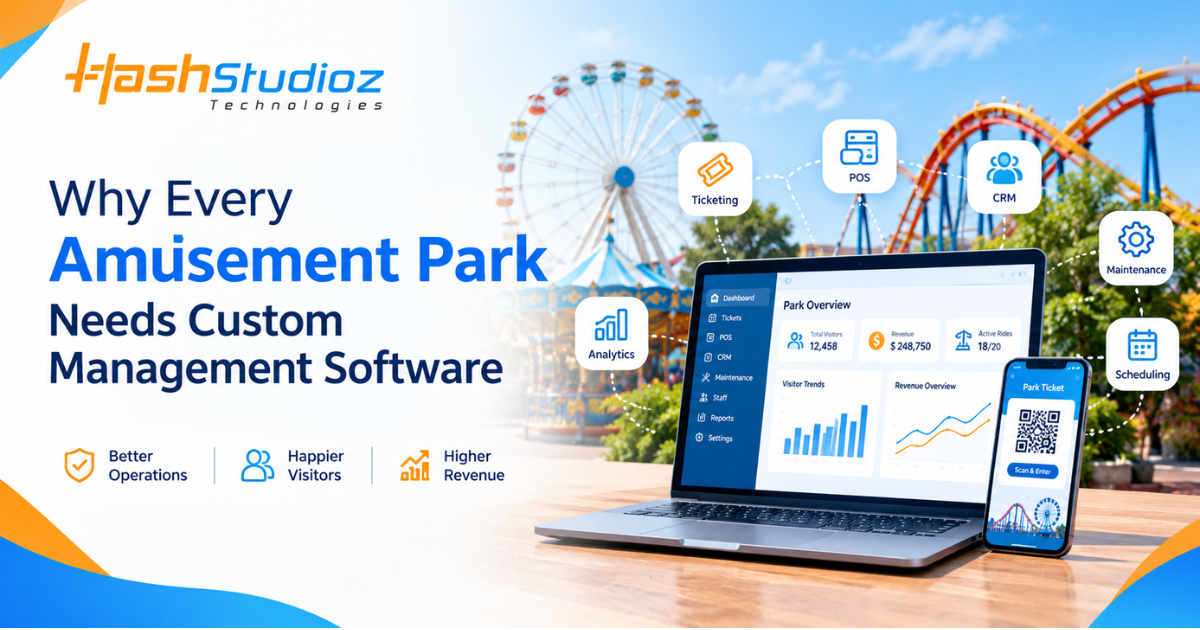
An Amusement Park Management System replaces this patchwork with a connected platform. Instead of running a webstore, gate scanner, CRM, and finance spreadsheet separately, the system connects them. It can connect ticketing, POS, access control, guest CRM, staff scheduling, and financial reporting. This approach allows a guest transaction to flow across relevant departments automatically. The result is one guest record, one revenue ledger, and one operational view. Teams no longer need to rely on multiple dashboards that show different versions of the same information.
Consider a family that buys a season pass online. The same family may also book a birthday party and add concession credit at the gate. A connected system can treat these activities as one guest relationship. Separate systems may treat them as three unrelated transactions. This baseline functionality has become standard across credible vendors. The bigger decision for CTOs concerns the software model. Should the park purchase a pre-built product? Or should it build the platform around its specific operating model?
Six modules typically form the core of an amusement park management platform:
- Ticketing and access control, covering online sales, timed entry, and RFID or QR-based gate scanning.
- Point of sale for food, retail, and add-on experiences, with inventory tied to the same guest transaction.
- Guest CRM, holding one profile per visitor across every channel they use to interact with the park.
- Ride and attraction monitoring, feeding IoT sensor data into maintenance and safety compliance workflows.
- Staff scheduling, built around forecasted crowd flow rather than a fixed weekly roster.
- Financial reporting, consolidating revenue across ticketing, POS, and memberships into one ledger.
Where Off-the-Shelf Software Stops Being Enough
Vendors such as CenterEdge, Gatemaster, Tixera, and Centaman sell capable products. For a single-site seasonal park, an off-the-shelf platform may work well. This is especially true when ticketing and POS requirements remain fairly standard. These platforms can also deploy faster. They generally require less upfront investment. The calculation changes when a park has more complex requirements. Consider a park with multiple properties and different pricing rules. An existing CRM or ERP investment can create another challenge. Salesforce is a common example.
The new platform may need to work inside that environment rather than replace it. IoT sensors can create another limitation. A park may need ride data to feed directly into a maintenance workflow. A packaged vendor may not support that requirement out of the box. Generic scheduling logic can also create problems. Some parks operate with labor models that require more flexibility. Vendors build off-the-shelf platforms for hundreds of parks. These products typically support broadly similar requirements.
Development teams build custom systems around the needs of one specific park. Multi-property operators can eventually reach the limits of packaged software. This can happen within two to three years. The result may be another migration project with additional costs.
Where Custom Software Delivers Business Value
The ROI case for custom development rests on a few specific mechanisms rather than a general claim about efficiency.
- Dynamic pricing tied to real demand data. A system built around actual booking patterns can adjust pricing by day, weather, and capacity in ways a generic pricing module cannot.
- Predictive maintenance from IoT sensor integration. Feeding ride telemetry directly into a maintenance workflow catches faults before they cause a shutdown, not after a guest reports one.
- Labor cost control through demand-based scheduling. Staffing tied to predicted crowd flow, rather than a fixed roster, cuts overtime and trims idle headcount on slow days.
- Fewer integration workarounds. Every manual export-import between systems is a point of failure and a recurring labor cost; removing it tends to save more than the line item suggests.
Whether packaged or custom-built, the underlying mechanism is the same: connecting systems that used to run in isolation. Accesso’s published case study on Lakeridge Resort makes the point well. After replacing a patchwork of manual processes, a standalone POS, and phone reservations with one connected platform, the resort grew lift ticket revenue by 15%, cut labor in lesson registration by 60%, and protected $50,000 to $60,000 in revenue through resort credit alternatives.
How Morey’s Piers Addressed Its Data Challenge
Morey’s Piers, a group of seaside amusement and water parks in New Jersey, ran into a version of this problem familiar to any RevOps leader. Guest data sat across separate marketing, service, and sales systems that never connected, so guest services staff had no quick way to see who had bought tickets or which emails a guest had already received.
Working with a Salesforce consulting partner, Morey’s unified its data inside one CRM environment. Response times to guest inquiries dropped from a range of 24 to 48 hours down to two to three hours, according to IAAPA’s account of the project. The park then built a knowledge base on that same data foundation, which handled 15,000 guest questions through automated chat in its first summer alone.
The lesson here is not that Salesforce is mandatory for every park. It is that guest data trapped in disconnected systems carries a direct, measurable cost in staff time and guest satisfaction, and that cost is fixable with the right integration work, regardless of which platform sits underneath it.
What CTOs Should Look for in System Architecture
For a technical buyer, a platform’s feature list matters less than how its architecture integrates with everything else in the stack.
- API depth and documentation. Clean, well-documented APIs let you connect the system to your existing CRM, ERP, and IoT stack instead of forcing a rip-and-replace.
- A single source of truth for guest identity. Ticketing, POS, memberships, and marketing all need to resolve to the same guest record rather than separate IDs reconciled later.
- Edge and IoT compatibility. Ride sensors, access gates, and RFID wristbands generate high-frequency data; the architecture needs to handle that volume without the reporting dashboard lagging by hours.
- Data residency and compliance controls. Parks collect payment data, ID information, and in some cases behavioral data on minors, so GDPR, CCPA, or India’s DPDP Act requirements need to be designed in rather than bolted on after an audit.
- Cloud-native deployment. With 58.5% of category spend now cloud-based, a system still tied to on-premises servers is already behind on scalability and disaster recovery.
These are architecture decisions, not feature checkboxes, and they are exactly where a custom build earns its cost premium over a packaged product.
Why Revenue and Salesforce Leaders Need to Pay Attention
Ticketing and ride monitoring get most of the attention in vendor marketing, but for a RevOps leader, the more interesting layer is what happens to guest data after the transaction closes.
A park that treats its management system as a Salesforce-adjacent data source, rather than an isolated ticketing tool, can build the same revenue attribution and lifecycle marketing it would expect from any other consumer business: which channel drove a season pass renewal, which guest segment responds to a dynamic pricing offer, and which gate upsell correlates with a longer average visit. None of that is possible when ticketing data lives in one system and CRM data lives in another with a nightly batch sync in between.
This is where the case for a custom build strengthens further. Off-the-shelf platforms usually treat CRM integration as an add-on connector with limited field mapping. A system architected from the start to sit inside Salesforce, or to push clean, real-time data into it, gives revenue leaders the same visibility into guest lifecycle value they already expect from every other revenue channel.
Why the Timing Matters for Amusement Park Operators
The urgency extends beyond the US market. Industry data cited in recent IPO filings from Indian park operators indicates strong growth ahead. India’s amusement park sector could grow from roughly ₹61.6 billion in CY24 to ₹125 billion by CY29.
That represents a 15.2% CAGR. The same filings note another important market gap. India has only two to three amusement parks per 1 crore of population.
The global average stands at around six. This difference points to continued park development in tier-2 and tier-3 cities. This expansion pattern can change the software decision for Indian operators. A system purchased for one metro-area park may not scale cleanly to a five-park, multi-city portfolio.
Operators expanding into new geographies can therefore plan their management platform as group-wide infrastructure. They can establish that foundation from the first property.
This approach can reduce the need to retrofit a shared system after opening the second or third park.
Choosing Between Buying, Customizing, and Building
Rather than a binary build-versus-buy choice, most parks land on one of three paths.
- Buy. Single-site parks with standard ticketing, POS, and season pass needs, and no significant existing CRM or ERP investment to integrate around.
- Customize a platform. Parks that need most of a packaged system’s functionality but require deeper integration with an existing CRM, ERP, or IoT stack than the vendor’s standard connectors support.
- Build custom. Multi-property operators, parks with unusual pricing or membership models, or organizations where guest data needs to live inside a broader Salesforce or enterprise data strategy rather than a standalone ticketing tool.
The decision usually comes down to a five-year view rather than a first-year budget. Packaged software is nearly always cheaper to deploy. Custom systems are nearly always cheaper to operate once a park has outgrown the assumptions the packaged product was built around.
Common Implementation Challenges to Avoid
Even a well-chosen platform can underdeliver when implementation is treated as a software rollout instead of an operational change. Underestimating integration work with legacy ticketing or finance systems is the most common failure point; data migration and reconciliation routinely take longer than the software configuration itself.
Staff training often gets compressed into a single pre-launch session, which leaves frontline teams reverting to old workarounds within weeks. Teams also frequently treat data privacy planning as a compliance checkbox late in the project, when encrypted payment handling, consent management, and access controls need to form part of the architecture from day one rather than a retrofit after an audit flags a gap.
A fourth pitfall shows up specifically in multi-property rollouts: treating each park as a separate implementation instead of one system deployed across locations. That approach duplicates configuration work at every site and produces group-wide reporting that has to be stitched together manually, which defeats much of the original point of consolidating systems.
How HashStudioz Builds Custom Amusement Park Management Systems
Amusement parks rarely need another standalone application. They need technology that connects the systems already responsible for ticketing, guest management, payments, maintenance, workforce planning, and reporting. HashStudioz develops custom amusement park management systems around these operational requirements, allowing businesses to create a connected technology environment instead of adding another isolated tool.
The development approach starts with understanding how the park currently operates, where systems exchange data, and which manual processes create delays or additional costs. This helps define the right architecture, integrations, and functionality before development begins.
Connecting Core Park Operations
A custom platform can bring multiple operational functions into a unified environment, including:
- Ticketing and access control: Manage online bookings, season passes, QR-based entry, memberships, and visitor access.
- Point of sale: Connect food, beverage, retail, and other purchases with centralized transaction and customer data.
- CRM and Salesforce integration: Connect guest interactions and purchase information with existing CRM systems for a more complete customer view.
- IoT and maintenance integration: Connect ride and equipment data with maintenance workflows to support proactive monitoring and maintenance planning.
- Staff scheduling: Align workforce requirements with expected visitor volumes, operating schedules, and park activities.
- Analytics and reporting: Consolidate operational, financial, visitor, and performance data into dashboards for management teams.
This connected architecture gives different departments access to relevant information without requiring teams to repeatedly export, reconcile, or transfer data between disconnected systems.
Designed for Integration and Future Growth
Custom development also gives amusement park operators greater control over how the platform interacts with their existing technology stack. APIs can connect CRM, ERP, payment, access-control, IoT, and analytics systems without requiring operators to replace every existing application.
For operators managing multiple properties, the architecture can support shared data and reporting across locations while allowing individual parks to maintain their own pricing, visitor flows, attractions, and operational processes.
HashStudioz focuses on building the platform around these specific business and technical requirements. The result is a custom amusement park management system designed to support current operations while providing a foundation for future integrations, new locations, and evolving visitor experiences.
For parks evaluating a move from disconnected systems to a unified technology environment, the HashStudioz Amusement Park Management System provides a starting point for exploring the capabilities and architecture involved in a custom implementation.
Final Thoughts
The amusement park management software market grows at 11% a year because fragmented operational data creates costly problems that become more visible as parks scale. For a CTO or CIO, the key decision involves more than modernization. Leaders must determine whether a packaged product fits their park’s operations or whether multi-property complexity, IoT ride data, and existing CRM investments justify a custom build.
Parks that make the right technology decision can treat their management system as core infrastructure for the next five years of growth rather than simply another ticketing upgrade. Parks that choose a platform that cannot support their evolving needs may face another migration within two to three years when the software reaches its limits.
FAQs
1. What is the difference between an off-the-shelf and a custom Amusement Park Management System?
An off-the-shelf platform is pre-built software configured to fit a park’s operations. A custom system is built around the park’s specific pricing models, integrations, and scale, which matters most for multi-property operators or parks with existing CRM and IoT investments.
2. How long does it take to implement a custom amusement park management system?
Timelines vary by scope, but most custom builds run six to twelve months from integration audit to full rollout, with ticketing and POS modules typically going live before deeper IoT and CRM integrations.
3. Does a management system replace ride maintenance software?
No. Ticketing and guest management platforms handle guest-facing operations. Ride inspections and safety compliance typically run on a separate computerized maintenance management system, though the two should exchange data through APIs.
4. Can a custom system integrate with Salesforce?
Yes, and for parks with an existing Salesforce investment, this is usually one of the strongest arguments for a custom build over a packaged product with limited CRM connectors.
5. Is custom software worth it for a single, small park?
Usually not on its own. Single-site parks with standard needs are typically better served by a packaged platform. Custom development earns its cost premium once a park has multiple properties, IoT ride data, or complex CRM integration needs.