


Digital transformation has moved well beyond simply adopting new software or migrating business applications to the cloud. In 2026, it is increasingly about creating connected, intelligent, and adaptable organizations where technology supports everyday decisions and operations. Artificial intelligence, IoT, cloud computing, automation, data analytics, and edge technologies are becoming interconnected parts of this transformation.
The shift is particularly visible in the way organizations approach AI. Generative AI is moving into practical business workflows, while agentic AI is opening new possibilities for automating multi-step tasks. At the same time, connected devices are generating more real-time data, creating demand for stronger data platforms, edge processing, and secure digital infrastructure.
For businesses, the challenge is no longer simply keeping pace with technology. It is determining which technologies can solve meaningful business problems and integrating them into an ecosystem that can scale over time. This is where digital transformation services can provide strategic and technical support.
Table of Contents
Digital Transformation in 2026: What Has Changed?
The earlier phase of digital transformation was largely centered on digitizing existing processes. Businesses launched mobile applications, moved infrastructure to the cloud, automated repetitive tasks, and replaced manual systems with digital alternatives.
Today, the focus is shifting from digitizing processes to redesigning how those processes work.
Consider a connected manufacturing environment. Sensors can capture equipment data, edge systems can process information locally, cloud platforms can aggregate operational data, and AI models can identify patterns that may indicate a potential equipment issue. Instead of each technology operating independently, they contribute to a single operational workflow.
This convergence is defining digital transformation in 2026. Successful initiatives increasingly bring together technology modernization, data strategy, AI adoption, cybersecurity, and employee adoption rather than treating them as separate projects.
Technologies Driving Digital Transformation in 2026
Increasingly interconnected technologies are shaping the digital transformation landscape in 2026. From AI and IoT to cloud, edge computing, and intelligent automation, these technologies are helping organizations modernize operations and build more responsive digital ecosystems.
Generative AI and Agentic AI
Generative AI has rapidly expanded from content generation into areas such as software development, customer service, knowledge management, document processing, and business analysis.
Agentic AI represents another step in this evolution. AI agents can be designed to interpret objectives, retrieve information, interact with software systems, and complete multiple steps within a defined workflow. This creates opportunities to automate processes that previously required employees to move manually between applications.
However, greater AI autonomy also increases the importance of access controls, monitoring, governance, and human oversight. The technology therefore needs to be introduced as part of a broader digital architecture rather than as an isolated AI feature.
Internet of Things and Industrial IoT
IoT is transforming physical operations by turning equipment, vehicles, devices, and environments into sources of continuous data. In manufacturing, for instance, connected machines can provide visibility into production conditions, equipment performance, and maintenance requirements.
The value of IoT increasingly comes from what happens after data is collected. When sensor information is combined with analytics, AI, cloud platforms, and automation, organizations can move from simply monitoring assets to responding to operational conditions more intelligently.
This is making IoT an important building block for smart factories, connected healthcare, fleet management, smart buildings, and other digitally connected environments.
Cloud and Cloud-Native Technologies
Cloud computing remains a core component of enterprise modernization, but its role has become broader than infrastructure migration. Organizations are increasingly adopting cloud-native architectures, APIs, containers, managed services, and scalable application environments to support evolving digital products.
Hybrid and multi-cloud approaches can also help organizations balance performance, security, compliance, and operational requirements. The emphasis is shifting toward building flexible technology foundations that can support AI, analytics, applications, and connected devices without creating unnecessary complexity.
Edge Computing
As connected devices generate increasing amounts of data, sending everything to a centralized cloud environment is not always practical. Edge computing addresses this by processing selected workloads closer to the source of the data.
This can be particularly valuable where low latency matters, such as industrial automation, connected vehicles, video analytics, healthcare monitoring, and smart infrastructure. Edge and cloud are therefore becoming complementary technologies: edge environments can handle time-sensitive processing, while cloud platforms provide centralized analytics, storage, management, and scalability.
Data Analytics and Modern Data Platforms
Data is at the center of digital transformation, but collecting more data does not automatically create better decisions. Organizations need reliable systems for integrating, managing, analyzing, and governing information across applications and operational environments.
Modern data platforms can support real-time analytics, business intelligence, predictive models, operational dashboards, and AI applications. Strong data foundations are also essential for organizations looking to scale AI, since fragmented or unreliable information can limit the usefulness of even sophisticated models.
Digital Twins
Digital twins provide virtual representations of physical assets, environments, or processes. They can help organizations understand how systems behave and explore potential changes before making them in the physical world.
Manufacturing facilities, energy infrastructure, buildings, vehicles, and supply chains can all benefit from digital-twin approaches. When connected with IoT data and analytics, digital twins can provide a continuously updated view of operational conditions and support simulation, monitoring, and optimization.
Intelligent Automation
Automation is evolving from fixed rule-based workflows toward systems that can interpret information and make context-aware decisions within defined boundaries.
Combining AI, machine learning, robotic process automation, and workflow orchestration can help automate activities such as document processing, customer onboarding, invoice management, claims handling, and internal IT operations.
The objective is not to automate every task. It is to identify processes where automation can remove unnecessary manual effort while allowing employees to focus on work that requires judgment, creativity, and domain expertise.
Cybersecurity and AI Governance
Every new digital connection introduces another consideration for security. Cloud platforms, APIs, IoT devices, AI applications, third-party services, and digital supply chains all need to be protected as part of the transformation strategy.
In 2026, this includes a growing focus on AI-specific risks. Organizations need to understand how AI systems access data, what permissions they have, how their outputs are monitored, and where human intervention is required.
Security, privacy, identity management, encryption, monitoring, and governance should therefore be incorporated into the architecture from the beginning rather than treated as final-stage requirements.
How Digital Transformation Is Reshaping Industries
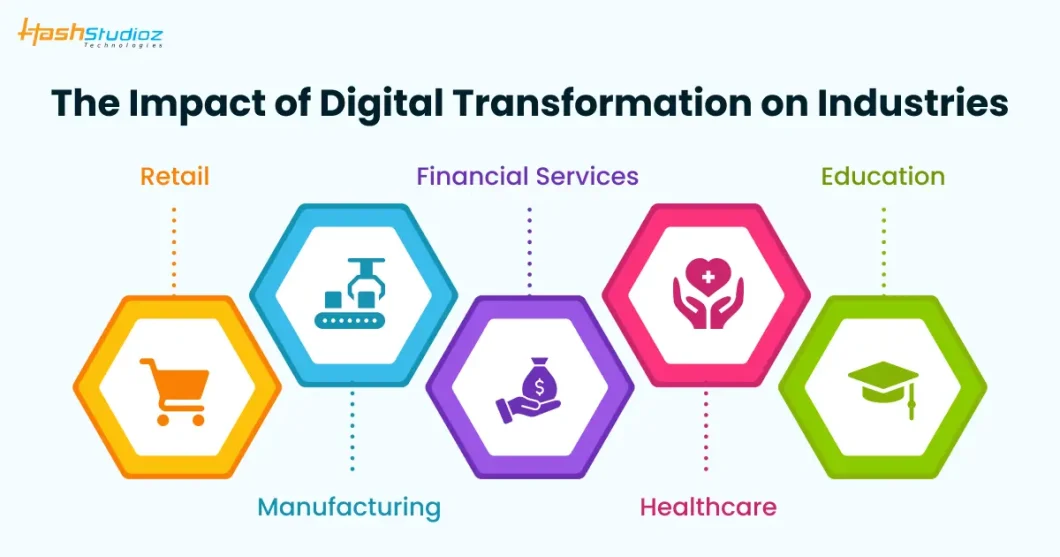
Digital transformation is affecting industries differently, depending on their operational challenges, customer expectations, and regulatory environments. While the technologies may overlap, their applications range from smart manufacturing and connected healthcare to intelligent retail, financial services, and digitally enabled supply chains.
Manufacturing
Manufacturing is moving toward increasingly connected and intelligent production environments. IoT sensors, robotics, computer vision, AI, edge computing, and analytics can work together to provide greater visibility across production operations.
Predictive maintenance is one example. Rather than relying only on scheduled maintenance, organizations can analyze equipment conditions and identify patterns associated with potential failures. Digital twins can further support production planning and simulation, while real-time dashboards provide operational teams with a clearer view of factory performance.
The broader movement toward Industry 5.0 also introduces a greater focus on collaboration between people and intelligent technologies.
Healthcare
Healthcare transformation is increasingly extending beyond digitized records and administrative systems. Connected medical devices, remote monitoring platforms, analytics, AI, and telehealth technologies are creating more connected models of care.
For example, remote monitoring can allow healthcare teams to receive patient data outside traditional clinical environments. AI and analytics can then help identify relevant patterns within large datasets, supporting healthcare professionals in their decision-making.
Because healthcare involves sensitive information and highly regulated environments, interoperability, privacy, security, and responsible use of AI remain essential considerations.
Retail and E-commerce
Retailers are using digital technologies to connect customer experiences with inventory, marketing, logistics, and operational systems.
AI-powered recommendations, demand forecasting, intelligent inventory management, digital payments, customer analytics, and automated support are becoming part of increasingly integrated retail ecosystems. Generative AI can also assist customers and employees with product discovery, information retrieval, and service interactions.
The objective is to create experiences that are more responsive while giving retailers better visibility into what customers need and how operations are performing.
Financial Services
Digital transformation continues to reshape banking, payments, insurance, and financial operations. AI and analytics can support fraud detection, risk analysis, customer service, document processing, and compliance workflows.
Modern digital platforms also allow financial institutions to deliver more personalized services through mobile and web applications. At the same time, the sensitivity of financial data makes cybersecurity, identity management, regulatory compliance, and responsible AI deployment particularly important.
Automotive
The automotive industry is increasingly becoming software-driven. Connected vehicles can generate operational and usage data, while AI, edge computing, and cloud platforms support applications ranging from vehicle diagnostics to driver-assistance technologies.
The same transformation is occurring within manufacturing, where connected production systems, robotics, computer vision, and analytics can improve factory operations. As vehicles and manufacturing environments become more software-intensive, the ability to manage data and digital services becomes an increasingly important capability.
Logistics and Supply Chain
Supply chains depend on visibility, timing, and coordination. IoT devices can provide real-time information about vehicles, shipments, and assets, while AI and analytics can help organizations identify patterns in demand, inventory, and transportation.
Warehouse automation, predictive logistics, route optimization, and connected fleet management are examples of how digital technologies can reduce information gaps across complex supply networks.
Energy and Utilities
Energy organizations are using digital technologies to manage increasingly complex infrastructure. IoT sensors, smart-grid technologies, analytics, AI, and remote monitoring can provide greater visibility into assets and energy operations.
Digital twins can also help model infrastructure and evaluate operational scenarios. As energy systems incorporate more distributed and renewable sources, digital capabilities can become increasingly important for monitoring and optimization.
Business Benefits of Digital Transformation
The impact of digital transformation extends beyond technology departments. When implemented around clear business objectives, it can influence operational efficiency, customer experience, innovation, and organizational agility.
Some of the most significant benefits include:
- Greater operational efficiency: Automation and connected systems can reduce manual work and improve process visibility.
- Faster decision-making: Real-time data and analytics provide decision-makers with more timely information.
- Improved customer experiences: Digital platforms and AI can support more personalized and responsive interactions.
- Scalable operations: Cloud and modern application architectures make it easier to adapt technology to changing requirements.
- Better resource utilization: Connected systems can help organizations identify inefficiencies across assets and processes.
- New digital opportunities: Technology modernization can enable new products, services, and business models.
The actual benefits, however, depend on how well technology initiatives are connected to measurable business outcomes.
Challenges Businesses Need to Address
Digital transformation can be complex, particularly for organizations operating on legacy technology. Older applications may not easily integrate with modern cloud, AI, or IoT environments, while fragmented data can make analytics and AI initiatives difficult to scale.
There is also a human dimension. Employees may need new skills and workflows, and organizations must manage the transition carefully to achieve meaningful adoption.
Security and governance add another layer of complexity. As systems become more interconnected and AI becomes more deeply integrated into business processes, organizations need clear policies around data access, privacy, identity, monitoring, and responsible technology use.
Perhaps the most common strategic challenge is losing sight of the business objective. Technology should address a defined problem or opportunity; otherwise, transformation can become an expensive collection of disconnected tools.
Building a Practical Digital Transformation Strategy
A successful transformation does not need to begin with a complete overhaul. In many cases, a phased approach is more practical.
The first step is to identify the business challenges that need attention. This could involve inefficient workflows, outdated applications, limited operational visibility, poor customer experiences, or disconnected data.
The next stage is to evaluate the existing technology landscape and determine where modernization will create the greatest impact. High-value use cases can then be prioritized, followed by architecture planning, implementation, security controls, and adoption initiatives.
Most importantly, transformation should be measurable. Defining relevant KPIs before implementation makes it easier to evaluate whether a project is improving efficiency, reducing costs, increasing engagement, accelerating operations, or achieving another intended business outcome.
How HashStudioz Helps Businesses Accelerate Digital Transformation
Digital transformation requires more than implementing individual technologies. It requires the ability to connect applications, data, devices, infrastructure, and user experiences into a technology ecosystem that supports the organization’s broader goals.
HashStudioz works with businesses to design and develop digital solutions across areas such as AI/ML, IoT, cloud, mobile and web applications, software development, and connected digital platforms. Our approach focuses on understanding the business requirement first and then selecting the technologies and architecture needed to address it.
From modernizing existing applications to building IoT-enabled solutions, AI-powered products, and cloud-based platforms, our development teams can support organizations across different stages of their digital transformation journey.
The goal is straightforward: help businesses turn technology investments into practical digital capabilities that can evolve with changing operational and customer requirements.

What Comes Next for Digital Transformation?
The next stage of transformation will likely be defined less by individual technologies and more by how those technologies work together.
AI agents may increasingly interact with enterprise applications. IoT and edge systems will continue generating real-time operational data. Digital twins can connect physical environments with digital models, while cloud platforms provide the infrastructure needed to manage these increasingly complex ecosystems.
At the same time, organizations will need to maintain a balance between automation and human oversight. Security, governance, transparency, and responsible technology adoption will become increasingly important as intelligent systems take on more meaningful roles within business processes.
For companies, the ability to adapt may ultimately matter more than adopting any single technology. Digital transformation is becoming an ongoing capability rather than a one-time project.
Conclusion
Digital transformation in 2026 is being shaped by the convergence of AI, IoT, cloud computing, data analytics, automation, edge computing, digital twins, and cybersecurity. Together, these technologies are changing how organizations build products, manage operations, interact with customers, and make decisions.
The most effective transformation strategies are not necessarily those that adopt the greatest number of technologies. They are the ones that connect technology investments to clear business objectives and create an architecture that can evolve over time.
As industries continue moving toward intelligent and connected operations, digital transformation services can provide the technical expertise and strategic support needed to navigate this transition—from modernizing legacy environments to building entirely new digital products and ecosystems.
Frequently Asked Questions
1. What is digital transformation in 2026?
Digital transformation in 2026 involves using technologies such as AI, IoT, cloud computing, automation, analytics, and connected platforms to redesign business processes, improve customer experiences, and create more intelligent and adaptable operations.
2. What are the major digital transformation trends in 2026?
Key trends include generative AI, agentic AI, intelligent automation, IoT, edge AI, digital twins, cloud-native technologies, data modernization, cybersecurity, and AI governance.
3. How does AI support digital transformation?
AI can analyze large volumes of information, automate repetitive work, assist employees, personalize customer experiences, and support decision-making. Agentic AI also enables more complex, multi-step workflows within defined business processes.
4. Why is IoT important for digital transformation?
IoT provides real-time information from connected devices, machines, vehicles, and environments. When combined with cloud platforms, analytics, and AI, this data can support monitoring, prediction, optimization, and automation.
5. What are the main challenges of digital transformation?
Common challenges include legacy infrastructure, data fragmentation, integration complexity, cybersecurity, skills gaps, employee adoption, AI governance, and difficulty connecting technology investments to measurable business outcomes.