


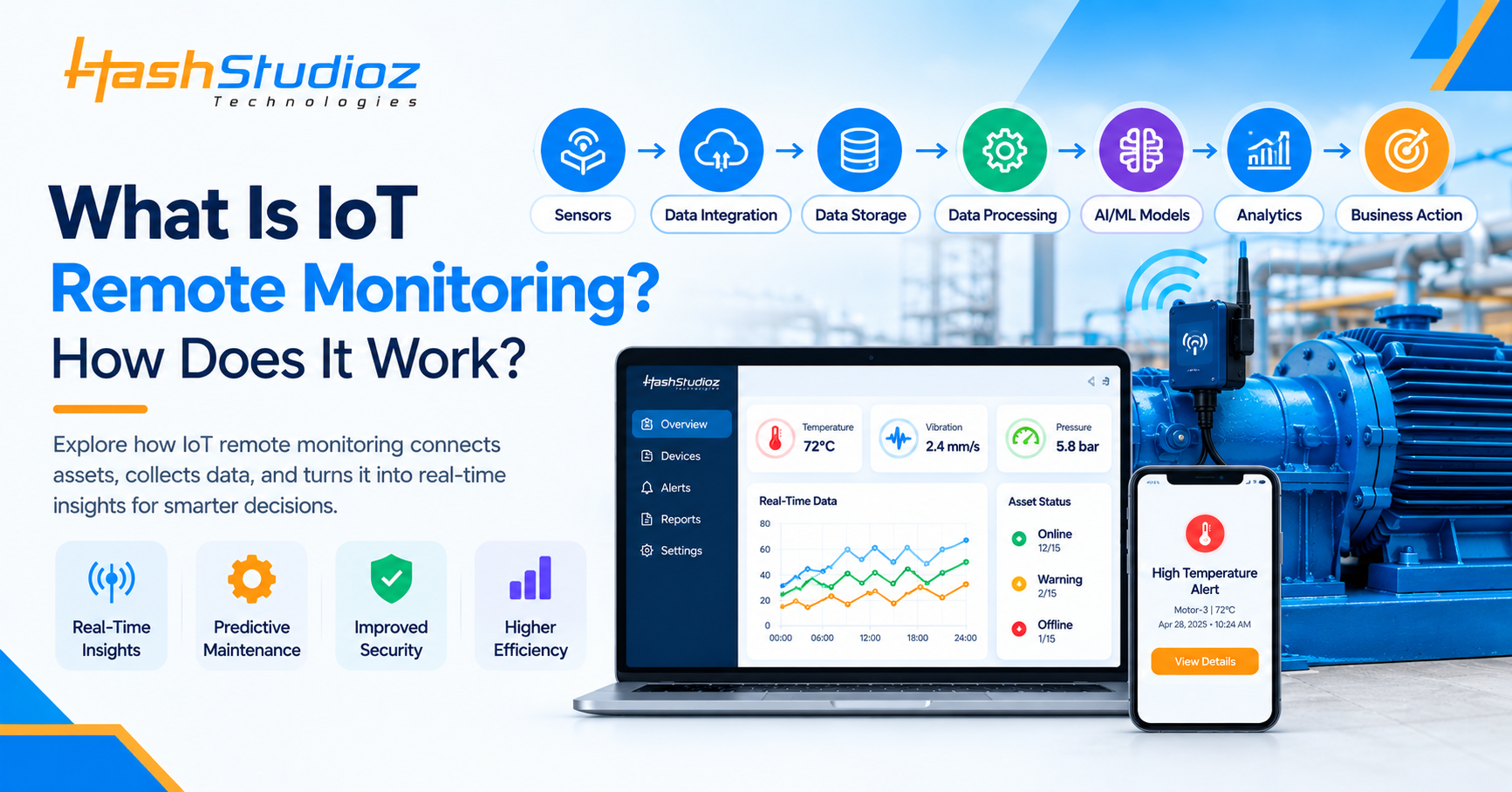
IoT remote monitoring enables businesses to track equipment, assets, environmental conditions, and operational processes from a centralized platform without requiring staff to remain physically present at every location. It combines connected sensors, communication networks, edge devices, cloud platforms, and analytics to turn real-world measurements into timely operational information.
The technology is becoming increasingly relevant as connected infrastructure expands. According to Ericsson, total IoT connections reached approximately 22.3 billion in 2025 and could reach 47.1 billion by 2031. This forecast highlights the growing scale of connected systems that organizations may need to monitor and manage.
For businesses operating factories, warehouses, energy systems, healthcare facilities, or distributed assets, remote monitoring provides visibility into conditions that would otherwise require manual inspections or separate monitoring tools. However, its value depends on more than collecting data. Businesses must also ensure that measurements are reliable, alerts reach the right people, and monitoring insights lead to appropriate action.
This guide explains how IoT remote monitoring works, its architecture, applications, benefits, limitations, implementation process, and the factors businesses should evaluate before deploying a solution.
Table of Contents
What Is IoT Remote Monitoring?
IoT remote monitoring is the use of connected devices and software to collect, transmit, analyze, and display data from assets or environments located away from the people monitoring them.
A remote monitoring system may measure machine vibration, equipment temperature, energy consumption, soil moisture, vehicle location, air quality, or patient vital signs. Users access this information through a web dashboard, mobile application, or integration with existing business software.
For example, a manufacturing company can install vibration and temperature sensors on a motor. When the readings exceed configured limits, the system can notify the maintenance team so they can investigate before the problem causes a production interruption.
IoT remote monitoring generally supports four functions:
- Observation: Collect data from equipment, devices, and environments.
- Analysis: Compare incoming readings with thresholds, historical patterns, or predictive models.
- Notification: Alert designated users when an abnormal condition occurs.
- Response: Help operators investigate the issue or trigger an authorized automated action.
Remote monitoring and remote control are related but different. Monitoring provides visibility into a system’s condition, while remote control allows authorized users or automation rules to change its operation. A monitoring-only solution does not automatically have permission to operate machinery.
How Does IoT Remote Monitoring Work?
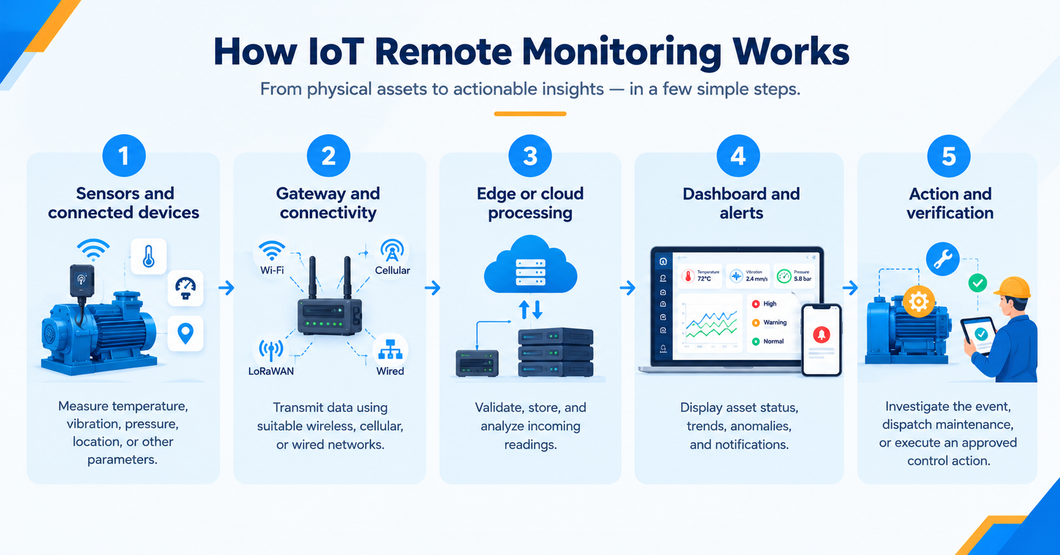
An IoT remote monitoring system moves information from a physical asset to a software platform, analyzes the data, and presents relevant findings to users. Depending on the application, some processing happens on the device or gateway, while other tasks take place in the cloud.
1. Sensors and connected devices: Measure temperature, vibration, pressure, location, or other parameters.
2. Gateway and connectivity: Transmit data using suitable wireless, cellular, or wired networks.
3. Edge or cloud processing: Validate, store, and analyze incoming readings.
4. Dashboard and alerts: Display asset status, trends, anomalies, and notifications.
5. Action and verification: Investigate the event, dispatch maintenance, or execute an approved control action.
Step 1: Sensors collect operational data
Sensors measure specific conditions in the physical environment. The selection depends on the asset and the business objective.
Examples include temperature sensors for cold storage, vibration sensors for rotating machinery, current sensors for electrical equipment, and GPS modules for fleet tracking.
The system must also account for sensor accuracy, calibration, sampling frequency, and installation conditions. A poorly positioned sensor can produce misleading readings even when the software works correctly.
Step 2: Connectivity transfers the data
Devices transmit their readings through a communication network. Nearby devices may use Wi-Fi, Bluetooth Low Energy, or Zigbee, while remote assets may rely on cellular connectivity, LoRaWAN, or satellite communication. Industrial environments can also use Ethernet and fieldbus connections.
A gateway is often needed when sensors use different protocols, require local aggregation, or cannot connect directly to the cloud. Protocols such as MQTT and HTTPS help transfer data between devices, gateways, and software platforms.
For a deeper technical comparison, read HashStudioz’s guide to MQTT vs. HTTP vs. CoAP for enterprise IoT systems.
Step 3: The system processes and analyzes the data
Once data reaches the processing layer, the platform validates readings, adds asset information, stores historical records, and evaluates operational conditions.
A basic implementation might trigger an alert when a temperature exceeds a predefined limit. A more advanced implementation could compare vibration, temperature, operating speed, and historical maintenance records to identify a developing equipment problem.
Edge computing is useful when the system needs to respond locally, reduce network traffic, or continue operating during a temporary internet outage. Cloud processing is valuable for centralized dashboards, long-term analysis, and comparing performance across multiple sites.
Step 4: Dashboards display conditions and alerts
The monitoring platform presents relevant information through dashboards, reports, and notifications. Users may see current readings, historical trends, device connectivity, battery status, and active alarms.
Alerts can be delivered through email, SMS, mobile push notifications, or integrations with enterprise ticketing systems. Good alert design prioritizes severity and context instead of sending a notification for every minor variation.
Explore IoT monitoring dashboards for real-time operations for more information about visualizing operational data.
Step 5: Teams respond and verify the outcome
An alert only creates business value when it leads to an appropriate response. A maintenance team might inspect a motor, replace a worn component, or adjust an operating schedule. In other situations, an authorized controller may reduce a machine’s load or activate a backup system.
The monitoring platform should record the alert, response, corrective action, and resulting equipment condition. This creates a feedback loop that helps organizations improve maintenance procedures and assess whether the intervention worked.
What Are the Main Components of an IoT Remote Monitoring System?
A production-ready system usually includes more than sensors and a dashboard. Its components must work together to deliver reliable measurements, secure communication, useful analytics, and manageable operations.
| Component | Primary function |
| Sensors and connected devices | Measure physical conditions or equipment performance. |
| Embedded firmware | Reads sensor values, manages device behavior, and handles communication. |
| IoT gateway | Aggregates data, translates protocols, and may process information locally. |
| Connectivity layer | Transfers data through wireless, cellular, satellite, or wired networks. |
| IoT platform and backend | Registers devices, receives messages, applies rules, and manages data flows. |
| Data storage and analytics | Retains historical readings and identifies trends or abnormal conditions. |
| Dashboard and notification service | Presents information and routes alerts to relevant users. |
| Security and device management | Controls access, authenticates devices, and supports firmware updates and diagnostics. |
| Enterprise integrations | Connects monitoring data with maintenance, ERP, SCADA, or other operational systems. |
The architecture varies by deployment. A small building monitoring system may send data directly from sensors to a cloud platform, while a factory with legacy equipment may need industrial gateways, protocol conversion, local processing, and integration with existing control systems.
For more on these design considerations, see HashStudioz IoT development services.
What Are the Different Types of IoT Remote Monitoring?
Businesses can select a monitoring model based on how quickly they need information, where data should be processed, and whether the system must operate during network interruptions.
Real-time monitoring
Real-time monitoring provides readings and alerts with minimal delay. It is useful for applications such as critical temperature monitoring, production-line supervision, and equipment fault detection.
The required response time should determine the architecture. A dashboard that updates every few seconds may be sufficient for energy reporting but unsuitable for a safety-critical control loop.
Periodic monitoring
Periodic monitoring collects readings at defined intervals, such as every five minutes or once per hour. It suits applications where long-term trends matter more than immediate intervention, including energy consumption analysis and environmental monitoring.
Lower sampling and transmission frequencies can reduce network usage and battery consumption, although excessive intervals may hide short-lived events.
Condition-based monitoring
Condition-based monitoring evaluates equipment measurements against operating limits or known healthy patterns. It helps maintenance teams service assets when their condition indicates a need rather than relying exclusively on fixed schedules.
Predictive monitoring
Predictive monitoring uses historical data, statistical methods, or machine learning to estimate the likelihood of a future problem. It requires sufficient data quality and a validated model; predictions are not guaranteed to identify every failure.
Remote device and fleet monitoring
This model tracks the health and availability of connected devices themselves, including battery levels, firmware versions, signal strength, connectivity, and last communication time. It is especially important for organizations managing large fleets of deployed devices.
What Are the Applications of IoT Remote Monitoring?
IoT remote monitoring supports industries that need visibility into distributed equipment, changing environmental conditions, or assets that are expensive or difficult to inspect manually.
1. Manufacturing and industrial automation
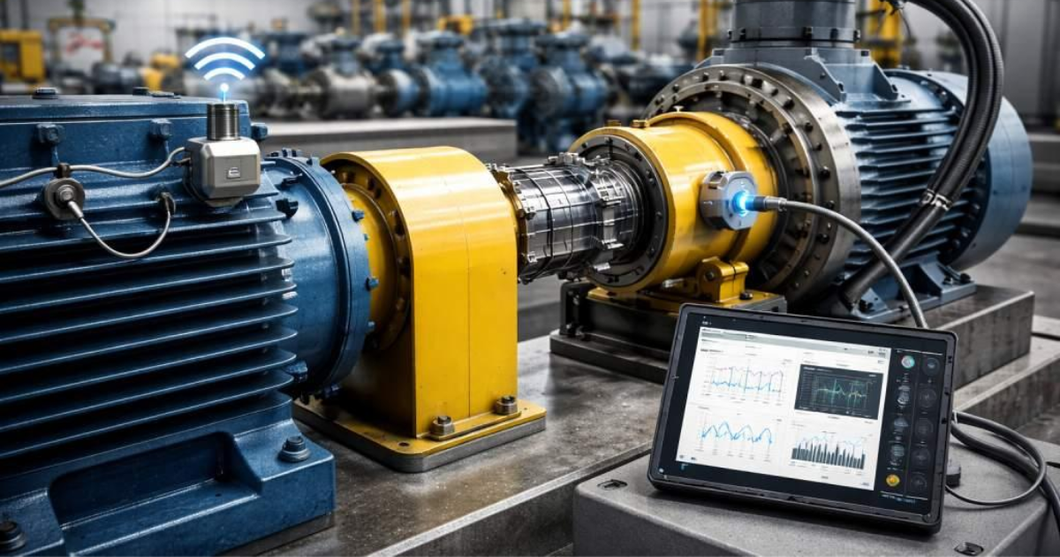
Sensors monitor machine temperature, vibration, pressure, production status, and operating hours. Maintenance teams can investigate abnormal patterns before they cause extended downtime, while managers can compare asset performance across production lines.
2. Healthcare and remote patient monitoring

Connected medical devices can transmit readings such as blood pressure, heart rate, or oxygen saturation to authorized healthcare professionals. Deployments must address patient consent, data privacy, device reliability, clinical workflows, and applicable medical regulations.
3. Energy and utility management
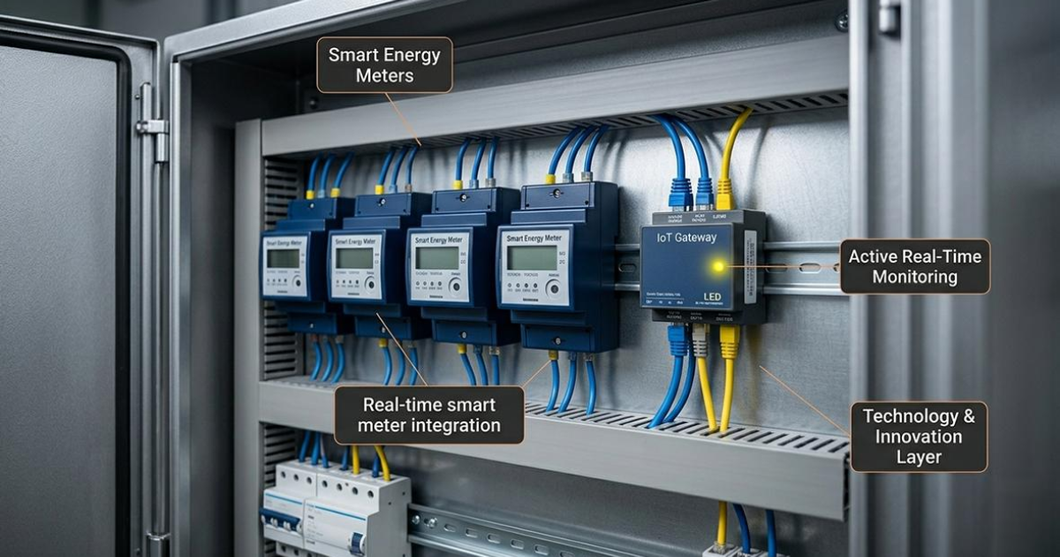
Smart meters and electrical sensors help organizations monitor consumption, identify unusual loads, compare facilities, and detect potential equipment issues. Historical data can also support energy budgeting and demand planning.
Also Read: Remote monitoring of energy meters with HashStudioz IoT gateways.
4. Agriculture and irrigation
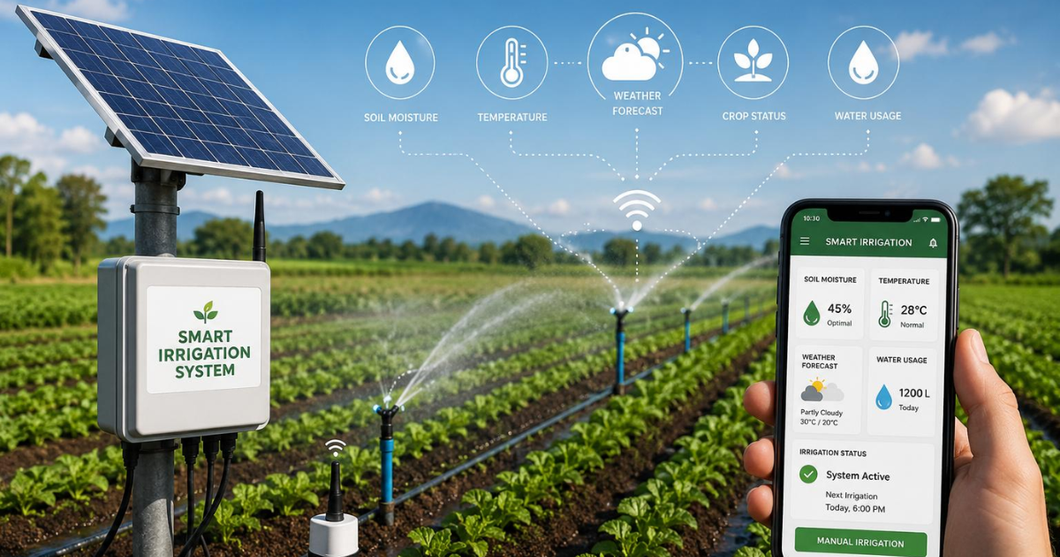
Soil moisture, weather, water flow, and temperature sensors help farmers determine when and where irrigation is needed. Remote monitoring is especially useful for farms with widely distributed plots or limited access to reliable communications.
5. Logistics and cold-chain management
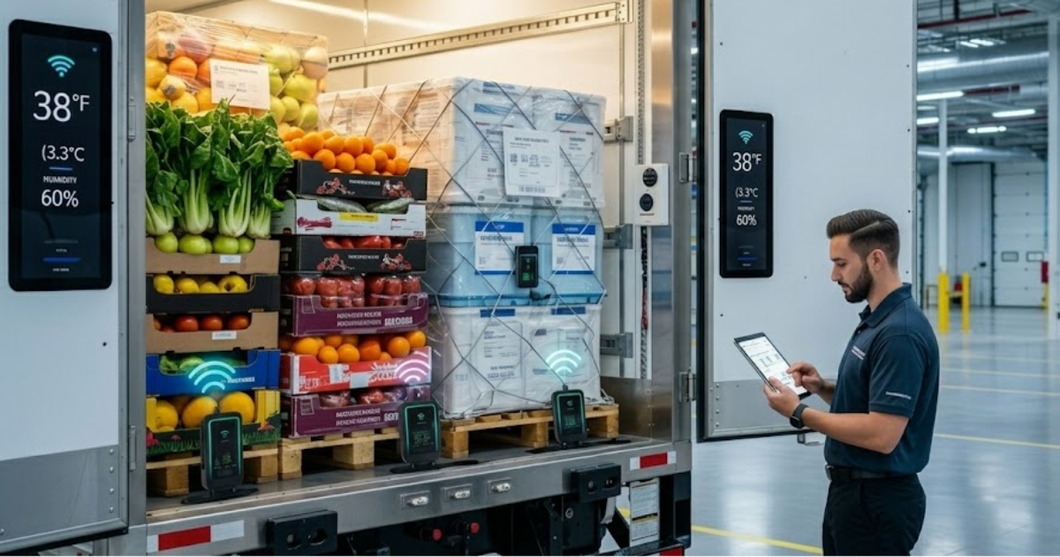
GPS, temperature, humidity, and door sensors provide visibility into vehicle location and cargo conditions. Alerts can help logistics teams investigate route delays or temperature excursions before goods are compromised.
6. Smart buildings and facilities
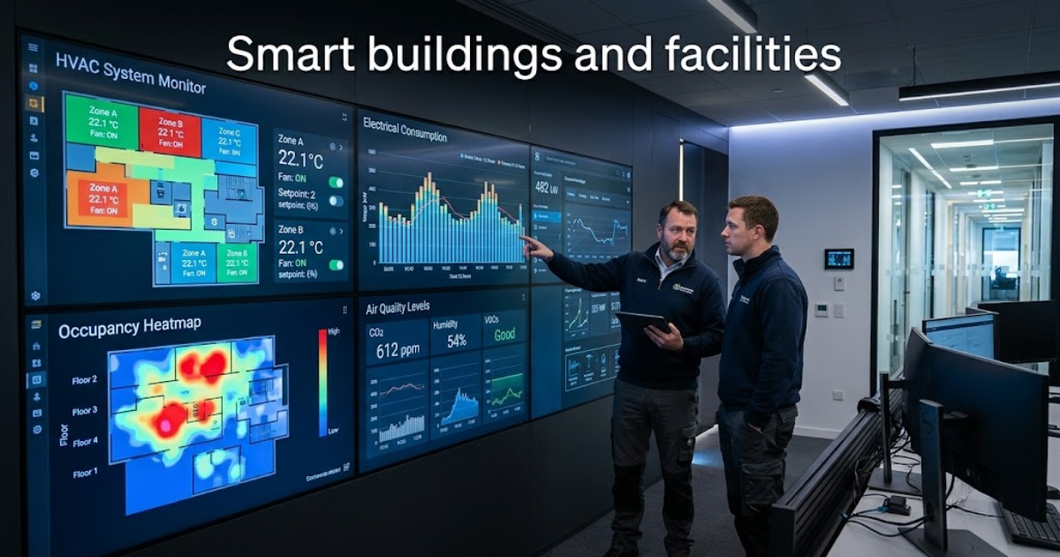
Monitoring HVAC systems, occupancy, air quality, water leakage, and electrical consumption helps facility managers identify faults and investigate energy waste across multiple buildings.
7. Solar and renewable energy installations
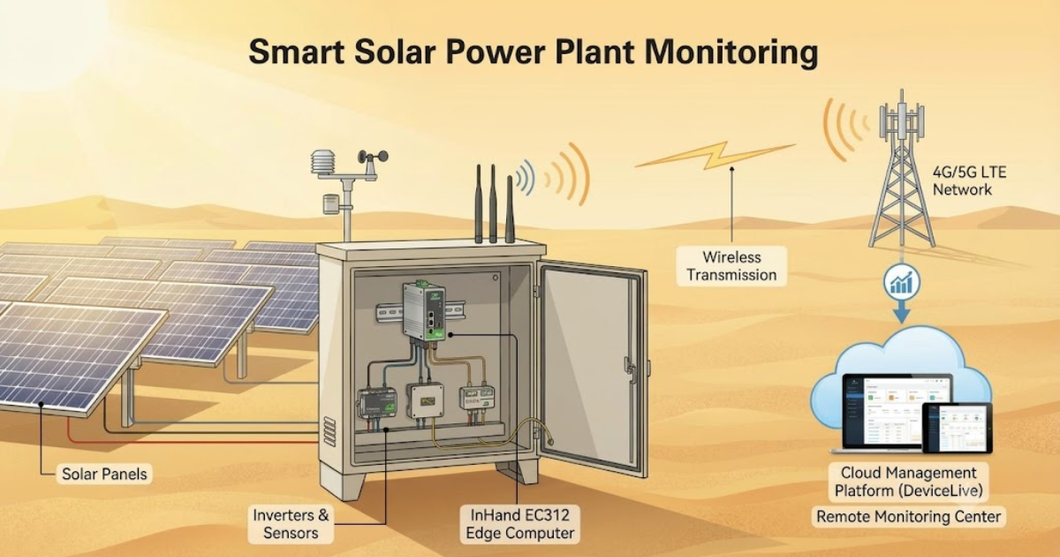
Inverters, environmental sensors, and power meters help operators track output, identify underperforming equipment, and compare generation against expected conditions. Remote access reduces the need for routine on-site checks.
What Are the Benefits of IoT Remote Monitoring?
The business value of IoT remote monitoring depends on the assets being monitored and the actions the organization can take using the resulting data.
- Improved operational visibility: Teams can view asset status across sites without relying solely on manual inspections or disconnected reporting tools.
- Earlier fault detection: Configured alerts and trend analysis help identify problems before they develop into more serious operational issues.
- Better maintenance planning: Condition data supports maintenance prioritization and can reduce unnecessary servicing when implemented appropriately.
- Reduced site visits: Remote diagnostics help teams determine which assets need physical inspection and what tools or replacement parts to bring.
- More informed decisions: Historical readings reveal recurring problems, abnormal consumption, and differences in asset performance.
- Improved resource utilization: Monitoring can help teams manage energy, water, equipment availability, and technician time more effectively.
- Greater accountability: Event histories and response records make it easier to review operational issues and measure service performance.
These benefits are potential outcomes, not guaranteed savings. Actual results depend on sensor quality, system availability, alert accuracy, maintenance practices, and whether staff can respond to the information.
What Challenges Should Businesses Consider?
A successful IoT remote monitoring deployment must account for technical limitations and operational responsibilities from the beginning.
Connectivity gaps and unreliable networks
Remote sites may have weak cellular coverage, unstable Wi-Fi, or no dependable broadband connection. Choose connectivity according to the deployment location and required data rate, and consider local buffering, retry mechanisms, and redundant links where necessary.
Data quality and excessive alerts
Incorrect sensor placement, calibration drift, missing readings, and noisy signals can undermine trust in the system. Validate incoming data and establish thresholds using actual operating conditions. Group related alerts and prioritize those that require action.
Cybersecurity and access control
Every connected device and communication path can introduce security risks. Use unique device identities, encrypted communication, secure credential storage, least-privilege access, network segmentation, and controlled firmware updates. Establish a process for vulnerability management and device decommissioning.
Integration with existing systems
Legacy equipment may use proprietary interfaces or industrial protocols that are not directly compatible with modern IoT platforms. Gateways, adapters, APIs, and carefully tested integrations can bridge these systems without requiring every asset to be replaced.
Scalability and lifecycle costs
More devices generate additional telemetry, storage requirements, connectivity charges, and support work. Design for device provisioning, monitoring, software updates, retention policies, and component replacement from the beginning.
Safety and operational control
A monitoring alert should not automatically trigger a potentially dangerous action. Systems that can control physical equipment require appropriate interlocks, authorization, testing, fail-safe behavior, and human oversight where necessary.

How to Implement an IoT Remote Monitoring System
Businesses should start with a measurable operational problem rather than selecting sensors or cloud platforms first. A phased implementation helps validate the design before extending it across multiple locations.
- Define the monitoring objective: Identify the asset, condition, business problem, and expected response. For example, a manufacturer might aim to detect overheating in critical motors early enough for maintenance staff to intervene.
- Select sensors and connectivity: Choose measurement devices, sampling intervals, network technology, and gateways based on accuracy, range, power availability, environmental conditions, and required response time.
- Design the data and application architecture: Decide which tasks belong on the device, edge gateway, or cloud. Define data formats, storage requirements, user roles, alert rules, and integration requirements.
- Build a proof of concept: Test the system with a limited number of representative assets. Verify sensor accuracy, communication reliability, dashboard usability, alert delivery, and recovery after network outages.
- Integrate security and business workflows: Connect relevant enterprise systems and define how alerts become maintenance tickets, escalation events, or approved operational actions. Test permissions and failure scenarios.
- Deploy in stages and measure performance: Expand to additional assets after validating the pilot. Track system reliability, alert accuracy, response time, maintenance outcomes, and total operating costs.
Organizations that need guidance on moving from a concept to a production-ready solution can also review the IoT application development lifecycle.
How Much Does an IoT Remote Monitoring System Cost?
There is no universal price for an IoT remote monitoring system. A basic installation that monitors a few sensors has different requirements from an industrial platform that manages thousands of devices across multiple sites.
The total cost of ownership generally includes:
| Cost category | What affects the cost |
| Hardware and sensors | Sensor type, accuracy, ruggedness, certifications, and quantity |
| Gateways and connectivity | Network coverage, cellular plans, satellite links, and protocol conversion |
| Software development | Dashboards, APIs, alert rules, user roles, and custom workflows |
| Cloud infrastructure | Message volume, processing, storage, analytics, and data retention |
| Integration and deployment | Legacy equipment, site installation, testing, and commissioning |
| Security and maintenance | Device management, firmware updates, monitoring, support, and compliance |
A reliable budget should distinguish initial implementation costs from recurring operating expenses. Businesses should also account for replacement parts, calibration, network outages, and future expansion.
How to Measure the ROI of IoT Remote Monitoring
ROI should be measured against the specific problem the monitoring system is intended to solve. A project designed to reduce equipment downtime needs different success metrics from one designed to reduce energy consumption or improve cold-chain compliance.
Useful indicators include:
- Unplanned downtime: Hours lost before and after deployment.
- Mean time to detect (MTTD): Average time taken to identify an operational issue.
- Mean time to repair (MTTR): Average time required to restore operation after a fault.
- Maintenance cost per asset: Labor, parts, travel, and servicing costs.
- Alert precision: The proportion of alerts that identify a genuine condition requiring attention.
- Energy consumption: Usage per unit of production, facility, or operating hour.
- System availability: The proportion of time the monitoring service remains usable.
- Remote resolution rate: The proportion of issues diagnosed or resolved without an on-site visit.
A simple calculation is:
ROI (%) = Annual Benefits – Annual Costs / Annual Costs * 100
For a complete investment assessment, calculate benefits and costs over the same period and include initial implementation costs, recurring expenses, and measurable savings. Avoid attributing every operational improvement to the monitoring system without evidence.
What Is the Future of IoT Remote Monitoring?
IoT remote monitoring is moving from basic visibility toward systems that can interpret operating conditions and help teams make faster decisions.
AI-powered anomaly detection
Machine learning can analyze combinations of sensor readings and identify patterns that simple threshold rules may miss. Models need representative data, validation, and ongoing monitoring to avoid unreliable predictions.
Edge computing and local intelligence
Processing data closer to the device can reduce latency and bandwidth usage. It also allows selected functions to continue during temporary cloud or network interruptions.
Digital twins and asset context
Digital twins can combine live sensor readings with asset specifications, maintenance histories, and operational models. This helps teams understand why a measurement matters rather than viewing it in isolation.
Remote device lifecycle management
As connected fleets expand, centralized provisioning, firmware updates, health checks, and device retirement become increasingly important. These capabilities help teams manage deployed devices throughout their operational life.
More resilient and interoperable architectures
Hybrid connectivity, standardized protocols, secure device identities, and edge-to-cloud integration can make monitoring systems more adaptable across sites and equipment types.
These developments will not eliminate the need for sound engineering. Data quality, security, system reliability, and clear operational ownership will remain central to successful deployments.
How HashStudioz Supports IoT Remote Monitoring Development
Building a reliable remote monitoring solution requires coordination across sensors, embedded firmware, connectivity, cloud infrastructure, analytics, and user-facing applications. HashStudioz provides IoT development services for businesses that need to develop or extend connected monitoring systems.
Depending on project requirements, these services can include IoT hardware and gateway integration, embedded software, cloud-connected applications, real-time monitoring dashboards, device management, and analytics. The goal is to build a solution around the assets being monitored, the required response times, and the organization’s operational workflows.
Businesses planning a new monitoring platform or upgrading an existing deployment can contact HashStudioz to discuss their requirements, technical constraints, and implementation goals.

Conclusion
IoT remote monitoring gives businesses a practical way to observe distributed assets, identify abnormal conditions, and make operational decisions using current and historical data. Its effectiveness depends on selecting suitable sensors and connectivity, designing reliable data flows, securing connected devices, and integrating alerts into real-world workflows.
For organizations evaluating a deployment, the best starting point is a clearly defined business problem and a small pilot with measurable success criteria. Once the system demonstrates reliable performance and operational value, it can be extended to additional assets and locations.
Frequently Asked Questions
1. What is IoT remote monitoring, and how does it work?
IoT remote monitoring uses connected sensors and devices to collect data from assets or environments and transmit it to a monitoring platform. The platform processes the readings, displays operational information, and sends alerts when configured conditions require attention.
2. What are the main components of an IoT remote monitoring system?
The main components are sensors and connected devices, embedded firmware, connectivity, gateways where needed, a data processing platform, storage, dashboards, and alerting services. Security and integration capabilities are also important for production deployments.
3. Which connectivity technologies are used for IoT remote monitoring?
Common options include Wi-Fi, Bluetooth Low Energy, cellular networks, LoRaWAN, satellite, Ethernet, and industrial fieldbus protocols. The right choice depends on coverage, power consumption, data volume, latency, deployment environment, and operating cost.
4. Can IoT remote monitoring work without an internet connection?
Yes, some functions can continue locally if devices or gateways support edge processing and local data storage. The system can buffer readings and synchronize them when connectivity returns. However, centralized dashboards and remote notifications may remain unavailable during the outage.
5. How does IoT remote monitoring support predictive maintenance?
It collects equipment data such as temperature, vibration, pressure, and operating hours. Analytics can identify abnormal patterns and, when supported by suitable historical data and validated models, estimate potential failures so maintenance teams can investigate earlier.
6. Is IoT remote monitoring secure?
It can be designed with strong security controls, including device authentication, encryption, role-based access, network segmentation, secure firmware updates, and continuous vulnerability management. Security also depends on proper configuration, maintenance, and operational practices throughout the device lifecycle.
7. How much does IoT remote monitoring cost?
Costs vary according to the number and type of devices, sensor requirements, connectivity, software development, cloud usage, integrations, security, and ongoing maintenance. A proof of concept can help establish technical feasibility and develop a more reliable budget before large-scale deployment.
8. How can a business measure the success of an IoT remote monitoring project?
Businesses can track downtime, fault detection time, repair time, maintenance expenditure, energy consumption, alert accuracy, system availability, and the number of issues resolved remotely. These metrics should be compared with a documented baseline to establish measurable business impact.

A tech mind, who loves to craft content that may popup on the SERPs. RPA, engineering, travel industry, and the various management system topic comes under my belt.
In spare time like to read & make friends. A believer in thought power. Ted talks lightens me up. Wish to share the stage someday!