


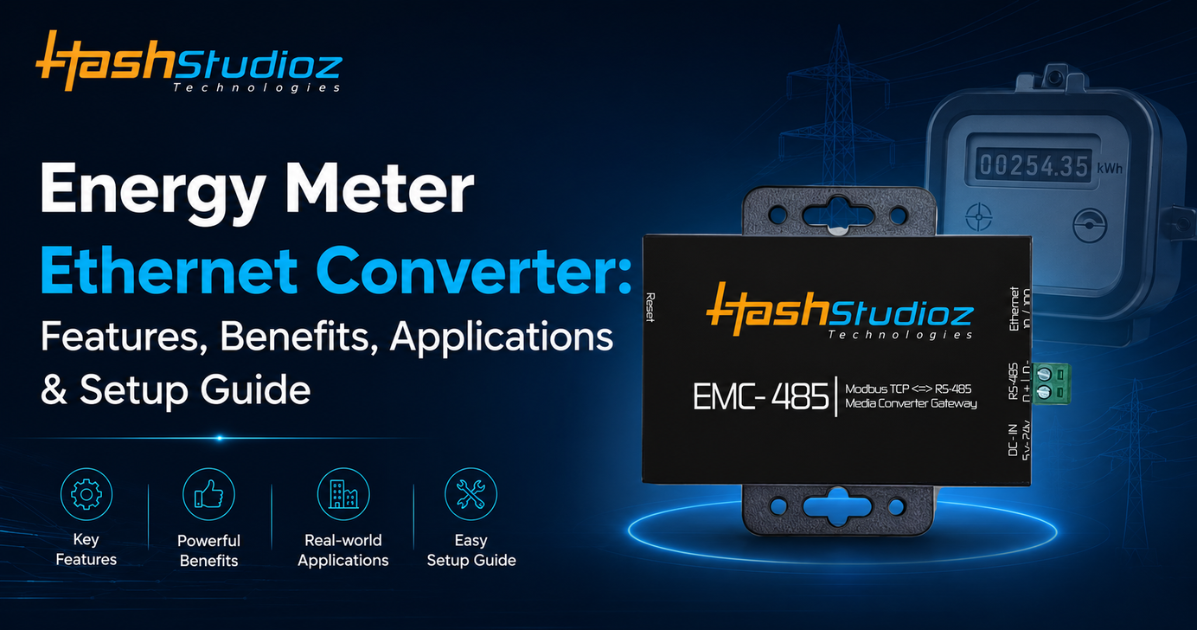
As operational costs rise and sustainability requirements become stricter, industrial facilities and commercial enterprises can no longer rely only on monthly energy reports. Real-time energy monitoring has evolved from a progressive operational choice into a core business necessity. Driven by the swift adoption of Industry 4.0, smart buildings, and advanced industrial automation, organizations require immediate, granular insight into their power distribution systems.
Traditional energy infrastructure relies heavily on legacy serial communication protocols. While highly reliable, these isolated systems struggle to meet the demands of modern, decentralized operations. This data silo is precisely where an energy meter ethernet converter becomes essential. By seamlessly adapting older, localized hardware to high-speed corporate networks, this link allows organizations to transition from reactive maintenance to proactive, data-driven utility management.
Table of Contents
What Is an Energy Meter Ethernet Converter?
An energy meter ethernet converter is a specialized hardware gateway designed to bridge the communication gap between legacy power meters and local area networks (LANs) or cloud platforms. Most installed electricity meters communicate using serial interfaces like RS-485 or RS-232, running protocols such as Modbus RTU. While functional, these serial networks cannot natively communicate with modern IT infrastructures, SCADA systems, or Enterprise Resource Planning (ERP) software that run on standard Ethernet.
The primary purpose of the converter is to translate serial meter data into Ethernet-compatible communication. It ingests legacy serial data, packetizes it into standard TCP/IP format, and transmits it safely across standard network cables or fiber optics. This allows industries to modernize their utility monitoring without replacing functional legacy meters.
Basic Communication Flow
The physical and digital communication loop moves sequentially from the electrical panel straight to your supervisory dashboard:
Energy Meter (RS-485 / Modbus RTU)⟶Ethernet Converter⟶Ethernet Network (TCP/IP)⟶SCADA / Cloud Platform
By acting as the intermediary, the converter ensures that raw electrical metrics—such as voltage, current, power factor, and total kilowatt-hours—are instantly accessible to any authorized device on the corporate network.
Why Convert an Energy Meter to Ethernet?
Traditional serial communication methods like RS-485 were designed for local device communication, but they often struggle to meet the demands of modern industrial environments. These networks are limited by distance, offer restricted accessibility, and make centralized monitoring difficult.
Converting an energy meter to ethernet overcomes these limitations by enabling real-time data transmission across local networks, cloud platforms, and SCADA systems. Multiple users and applications can access the same meter data simultaneously, improving visibility and operational efficiency.
For example, a manufacturing company with facilities across multiple locations can monitor energy consumption from a single dashboard instead of manually collecting readings from each site. This simplifies energy management, supports sustainability initiatives, and enables faster decision-making.
Now, let’s explore the key features that make an energy meter ethernet converter an essential component of modern energy monitoring systems.
Key Features of an Energy Meter Ethernet Converter
Selecting the right hardware requires a clear understanding of its internal capabilities. High-quality industrial converters are packed with specialized features designed to make integration as seamless and reliable as possible.
1. Modbus RTU to Modbus TCP Conversion
An energy meter ethernet converter converts Modbus RTU data from serial energy meters into Modbus TCP data that can be transmitted over Ethernet networks.
Benefit: This allows legacy meters to integrate seamlessly with SCADA systems, energy management software, and Industrial IoT platforms without replacing existing hardware.
2. Remote Data Access
By exposing serial data to the IP network, these devices allow technicians and operators to access meter data remotely through web-based interfaces or network tools.
Benefit: Eliminates the need for hazardous, time-consuming manual panel inspections, keeping personnel safe and reducing localized maintenance hours.
3. Real-Time Monitoring
The converters are designed for low-latency data transfer, helping update dashboards quickly.
Benefit: Allows automated systems to instantly detect power anomalies, voltage sags, or phase imbalances before they damage sensitive downstream production machinery.
4. Multi-Device Connectivity
A single Ethernet converter with an RS-485 port can often support multiple serial energy meters on one bus, depending on the device and network design.
Benefit: Significantly reduces hardware acquisition and installation costs by leveraging a single IP address to monitor an entire substation panel.
5. Protocol Transparency
Advanced converters offer a “transparent mode,” meaning they simply wrap the original serial payload into a TCP packet without altering the underlying data structure.
Benefit: Guarantees total compatibility with proprietary software tools provided by older energy meter manufacturers.
6. Secure Communication
Industrial-grade converters may include security features such as password protection, IP filtering, HTTPS, and encrypted communication, depending on the model.
Benefit: Safeguards critical infrastructure against unauthorized access, data tampering, and potential cyber threats targeting industrial networks.
7. Industrial-Grade Reliability
Engineered for harsh operating environments, these units feature rugged metal enclosures, wide operating temperature tolerances (often -40°C to 75°C), and built-in isolation protection against voltage surges.
Benefit: Ensures uninterrupted data flow in high-EMI environments like manufacturing floors and power distribution substations.
8. Easy Configuration
Modern converters feature intuitive web-based interfaces, discovery utilities, and Windows-based setup tools that simplify initial network provisioning.
Benefit: Minimizes commissioning times, allowing internal IT and maintenance teams to deploy units rapidly without specialized systems integration training.
Benefits of Using an Ethernet Converter for Energy Meter Systems
Integrating an ethernet converter for energy meter systems delivers benefits that go far beyond basic connectivity. It enables organizations to improve visibility, reduce operational costs, and make faster, data-driven decisions.
1. Reduced Manual Data Collection
Manual meter reading is time-consuming, error-prone, and often requires personnel to access electrical panels. An ethernet-enabled system automates data collection and delivers accurate readings directly to monitoring software.
2. Improved Energy Efficiency
Real-time energy data helps facilities identify abnormal consumption patterns, equipment inefficiencies, and unnecessary energy usage before they impact operating costs.
3. Faster Decision-Making
With instant access to power quality and consumption metrics, teams can respond quickly to fluctuations, demand spikes, or equipment issues, reducing operational risks.
4. Lower Operational Costs
Organizations can leverage existing Ethernet infrastructure instead of investing in dedicated communication networks. This reduces installation expenses while simplifying system expansion.
5. Scalable Monitoring Infrastructure
As facilities grow, additional energy meters can be integrated into the network with minimal disruption, making the monitoring system easier to scale over time.
6. Better Maintenance Planning
Continuous monitoring helps identify unusual power consumption patterns that may indicate equipment wear, allowing maintenance teams to address issues before they lead to costly downtime.
7. Enhanced Data Visibility
By converting energy data into a network-accessible format, organizations can integrate information with SCADA platforms, Building Management Systems (BMS), analytics tools, and sustainability reporting software.
For example, a manufacturing company can monitor energy consumption across multiple facilities from a single dashboard, enabling better load management, reporting, and operational efficiency.
Common Applications of Energy Meter to Ethernet Solutions
The flexibility of an energy meter to ethernet architecture makes it highly effective across a wide array of demanding sectors.
1. Manufacturing Plants
- Problem: Large factories contain hundreds of high-power machines. Without localized tracking, pinpointing which production line is inflating the facility’s peak demand charge is impossible.
- Solution: Serial meters on individual machine panels are linked to localized ethernet converters, streaming precise operational power profiles to a central SCADA platform.
- Benefit: Plant managers can shift energy-intensive processes to off-peak hours, slashing thousands of dollars from monthly utility bills.
2. Smart Buildings
- Problem: Commercial high-rises house dozens of corporate tenants, making fair, accurate utility billing based purely on square footage highly contentious.
- Solution: Sub-meters on every floor feed consumption data over Ethernet directly to the building management system (BMS).
- Benefit: Automated, granular tenant invoicing reduces disputes, promotes conscious energy usage, and satisfies green building certifications like LEED.
3. Data Centers
- Problem: Data centers consume vast amounts of power for computing and cooling. Unnoticed power quality variances can cause catastrophic server damage and expensive downtime.
- Solution: Integrating high-speed converters on server racks and power distribution units (PDUs) to deliver continuous Power Usage Effectiveness (PUE) metrics.
- Benefit: IT infrastructure teams optimize cooling delivery in real time, preventing hotspots and ensuring 99.999% uptime.
4. Commercial Facilities
- Problem: Sprawling logistics hubs and retail complexes suffer from high operational overhead due to lighting and HVAC systems running inefficiently in unoccupied zones.
- Solution: Networking sub-meters via Ethernet enables automated coordination between actual energy usage patterns and climate control systems.
- Benefit: Reduces unnecessary baseline power consumption without compromising occupant comfort.
5. Renewable Energy Systems
- Problem: Solar arrays and wind installations are frequently located in remote areas, making manual collection of generation metrics impossible.
- Solution: Connecting generation meters to rugged, outdoor-rated industrial ethernet gateways that transmit production metrics over cellular routers or fiber backbones.
- Benefit: Grid operators gain immediate visibility into real-time renewable yields, ensuring stable grid balancing and accurate renewable energy credit tracking.
6. Utilities and Power Distribution
- Problem: Electrical substations must continuously monitor load configurations across diverse sub-grids to prevent catastrophic transformer overloads.
- Solution: Converting legacy RTU meters to Modbus TCP allows telemetry data to feed into regional distribution management systems instantly.
- Benefit: Drastically reduces the frequency of localized blackouts through rapid, automated load shedding and distribution adjustments.
7. Water Treatment Plants
- Problem: Water treatment involves heavy pumping infrastructure that experiences varying loads based on daily civic demand cycles.
- Solution: Linking flow and pump motor energy meters to the main control room network via industrial DIN-rail ethernet converters.
- Benefit: Operators optimize pump run-times against variable electricity tariffs, lowering the overall cost per gallon of treated water.
How Does an Energy Meter Ethernet Converter Work?
Understanding the precise internal mechanics of how data moves through the converter helps teams optimize their network layouts and troubleshoot communication paths.
- Data Collection: The energy meter continuously measures physical voltage and current lines through current transformers (CTs). It updates internal memory registers with real-time metrics like active power, reactive power, and total accumulation.
- Serial Communication: The master system (or the converter itself acting as a polling agent) sends an electrical command request over the RS-485 twisted-pair wire using the Modbus RTU protocol format.
- Protocol Conversion: The converter receives data from the energy meter, converts it into Ethernet-compatible packets, and forwards it to SCADA software, cloud platforms, or monitoring dashboards.
- Ethernet Transmission: The converter assigns standard network headers to the packet and transmits it over standard Cat5e/Cat6 wiring using standard IP routing rules.
- Monitoring Software Integration: The central SCADA, BMS, or cloud platform receives the standard IP packet, extracts the energy metrics, and displays them on live user dashboards or stores them within databases for historical analysis.
Energy Meter Ethernet Converter Setup Guide
Deploying a converter requires a methodical approach that balances physical wiring precision with proper network configuration. Follow these standard steps to get your system online safely.
Step 1: Hardware Requirements
Before beginning, gather all necessary components:
- Your energy meter with active RS-485 ports.
- An industrial-grade energy meter ethernet converter.
- A standard Cat5e or Cat6 network patch cable.
- A shielded, twisted-pair communication wire (24 AWG minimum).
- A 120-ohm termination resistor (if deploying a long serial run).
- A dedicated DC power supply for the converter.
Step 2: Physical Connections
Ensure all main power lines to the electrical panel are completely locked out and tagged out before handling data wiring.
- Wire the positive serial terminal (D+ or A) on the energy meter to the corresponding positive terminal on the converter.
- Connect the negative serial terminal (D− or B) to the negative terminal on the converter.
- Secure the signal ground wire (GND) between both devices to prevent communication errors from ground loops.
- Connect one end of your Ethernet cable to the RJ45 port of the converter and the other to an active network switch.
- Apply power to the converter using the designated DC power source.
Step 3: Network Configuration
To communicate with the converter, your configuration computer must sit on the same subnet.
- Check the converter’s housing label for its default static IP address (commonly 192.168.1.254).
- Temporarily adjust your laptop’s network adapter settings to a matching static IP, such as 192.168.1.50.
- Open a web browser, type the converter’s default IP into the address bar, and enter the factory administrator login credentials.
Step 4: IP Address Assignment
For reliable enterprise operations, never leave a converter on a default static IP.
- Navigate to the Network Settings tab within the web interface.
- Assign a dedicated, permanent static IP address provided by your facility’s IT department.
- Input the correct Subnet Mask and Default Gateway to allow cross-network routing if data needs to hit a cloud server.
- Save the settings and reboot the device.
Step 5: Software Configuration
The converter needs to know how to talk to both the serial meter and the network clients.
- Navigate to the Serial Port Settings menu.
- Match the Baud Rate, Data Bits, Parity, and Stop Bits exactly to the configuration of your connected energy meter (e.g., 9600 bps, 8 data bits, None parity, 1 stop bit).
- Navigate to the Operating Mode menu and select Modbus Gateway or TCP Server.
- Define the local TCP listening port (the industry standard for Modbus TCP is port 502).
Step 6: Testing and Verification
- Revert your laptop’s network card settings back to its standard corporate IP range.
- Open a command prompt and ping the newly assigned static IP of the converter to verify network visibility.
- Launch a Modbus polling utility (such as Modscan or QModMaster) on your PC.
- Target the converter’s IP on Port 502, specify the Device ID of your energy meter, and attempt to read a known holding register (like total kWh).
- Once values appear without timeout errors, secure the hardware onto the DIN rail.
Troubleshooting Tips
- No Communication Link: Verify that the D+ and D− lines are not reversed. Swapping these lines accidentally is the single most common installation error.
- Garbled Data Received: Double-check that the baud rate and parity settings on the converter’s serial configuration match the energy meter configuration exactly.
- Frequent Timeouts: If running a long daisy chain of multiple meters over RS-485, ensure you have placed a 120-ohm termination resistor across the data lines of the last meter on the loop to suppress signal reflections.
Key Factors to Consider Before Choosing an Energy Meter Ethernet Converter
Investing in conversion hardware requires looking beyond unit pricing. To ensure reliable data streams for years to come, assess potential models against these industrial criteria.
1. Protocol Compatibility
Does the unit support specialized variations of industrial protocols? While standard Modbus RTU to Modbus TCP is standard, some installations may require conversion to BACnet/IP for smart buildings, Profinet for automation loops, or MQTT/HTTP for direct integration into cloud-native IoT software stacks.
2. Number of Devices
Evaluate the physical port layout and internal processor memory. If you intend to hook up dozens of meters across an expansive substation, select a multi-port converter (such as a dual RS-485/422 model) that can handle high polling loads without dropping packets.
3. Network Requirements
Determine if your network infrastructure requires advanced features. If your facility relies on high-availability automation loops, look for converters that offer dual Ethernet ports to support daisy-chaining topology or RSTP (Rapid Spanning Tree Protocol) network redundancy.
4. Security Features
Industrial networks are primary targets for cyber incursions. Avoid low-cost consumer grade equipment. Prioritize units that offer robust security controls, including IP address whitelisting, strict user authentication models, and encrypted firmware upload paths.
5. Environmental Conditions
Where will the hardware physically live? If the unit is going inside an unconditioned outdoor solar enclosure or a vibrating factory floor next to high-voltage motor drives, it must feature an IP30 or higher ruggedized metal housing, heavy industrial surge protection, and a wide operating temperature certification.
6. Scalability
Ensure the device configuration can be managed at scale. Look for manufacturers that provide free centralized management utilities, allowing your IT team to push configuration profiles or firmware updates to dozens of distributed converters simultaneously across the network.
7. Vendor Support
A cheap converter can quickly become expensive if it stops working or has unpatched vulnerabilities. Choose established industrial automation brands that offer extensive documentation, downloadable device drivers, and responsive technical support lines.
Energy Meter Ethernet Converter vs. Traditional Monitoring Methods
To understand why upgrading your communication architecture makes fiscal and operational sense, let us look at how ethernet-enabled conversions stack up against legacy monitoring methodologies:
| Comparison Metric | Traditional Serial Architecture (RS-485) | Manual Clipboard Audits | Ethernet Converter Integration |
| Accessibility | Restricted to localized master loops. | Completely isolated inside physical panels. | Globally accessible via secure IP routing. |
| Scalability | Limited to 31 devices per physical run. | Extremely difficult to scale up. | Uncapped expansion across enterprise LANs. |
| Data Collection | Continuous but heavily siloed. | Periodic (monthly or weekly snapshots). | Continuous, real-time, automated streams. |
| Monitoring Speed | Moderate (limited by serial baud rates). | Slow, delayed, lagging behind operations. | Ultra-fast (leveraging megabit/gigabit speeds). |
| Maintenance Effort | High troubleshooting time for wiring faults. | High ongoing labor costs and human error risks. | Low; built-in remote diagnostics tools. |
| Reporting Capabilities | Basic localized charting options. | Prone to human calculation errors. | Rich, automated analytics and ERP links. |
Conclusion
Transitioning your power monitoring infrastructure from isolated legacy serial loops to an integrated network environment is no longer a luxury – it is a foundational requirement for sustainable operations. Deploying a rugged, high-performance energy meter ethernet converter protects your existing capital investments while giving you the granular data accessibility needed to cut overhead costs. The immediate visibility into power consumption patterns drives better maintenance planning, eliminates manual logging errors, and lowers utility bills across your entire enterprise.
As industrial environments dive deeper into automated operations, real-time energy data will serve as a primary pillar for machine learning optimizations and strict carbon accounting. Embracing an automated, ethernet-driven monitoring matrix gives your company the foundation to lower operational costs, meet sustainability targets, and thrive in the era of Industry 4.0.
Frequently Asked Questions
1. What is an energy meter ethernet converter?
An energy meter ethernet converter is a device that bridges the gap between serial energy meters and Ethernet networks. It allows energy data to be transmitted to SCADA systems, cloud platforms, and monitoring software.
2. Can I connect multiple energy meters to one converter?
Yes. If your converter features an RS-485 serial port, you can daisy-chain multiple meters (typically up to 31 devices) onto a single serial loop. The converter handles data routing from all connected meters using their individual Modbus Slave IDs over a single IP address.
3. What protocols do energy meter ethernet converters support?
Most standard converters focus on translating Modbus RTU to Modbus TCP. However, advanced industrial models can also support protocols like BACnet/IP, EtherNet/IP, SNMP, MQTT, and HTTPS for integration into various automation and cloud frameworks.
4. How does Modbus RTU differ from Modbus TCP?
Modbus RTU is a serial protocol designed for simple master-slave communications over point-to-point wiring like RS-485, relying on CRC checksums for errors. Modbus TCP wraps standard Modbus data frames inside standard TCP/IP network packets, allowing high-speed routing over standard IT infrastructures.
5. Is an ethernet converter required for remote energy monitoring?
If your existing energy meters only feature legacy serial outputs (like RS-485), a converter is required to get that data onto a local area network or internet-facing router for remote monitoring. It eliminates the physical distance limitations inherent to serial wiring.