


Modern web applications depend on backend systems for business logic, APIs, authentication, data processing, integrations, and security. The framework behind these systems can influence development speed, scalability, maintainability, and deployment architecture.
The backend landscape has changed significantly in recent years. TypeScript has become a major force in modern application development, while Python continues to play a central role in AI, machine learning, and data-intensive applications. Java and C# remain important choices for enterprise software, while PHP and other ecosystems continue to support large numbers of production applications. GitHub’s 2025 Octoverse report found that TypeScript became the most-used language on GitHub by monthly contributors in August 2025, while Python remained dominant in AI-focused projects.
For backend development, frameworks such as Node.js, Express.js, ASP.NET Core, FastAPI, Spring Boot, Django, Laravel, and NestJS continue to serve different application requirements. Recent Stack Overflow data also shows strong usage across these technologies, with FastAPI recording notable growth.
However, popularity should not be the only factor in a framework decision. Enterprise teams also need to consider application workload, scalability, security, cloud infrastructure, integrations, developer availability, and long-term maintenance.
This guide compares the most widely used backend frameworks and explains where each one fits in modern web development.
Table of Contents
Which Backend Frameworks Are Popular in 2026?
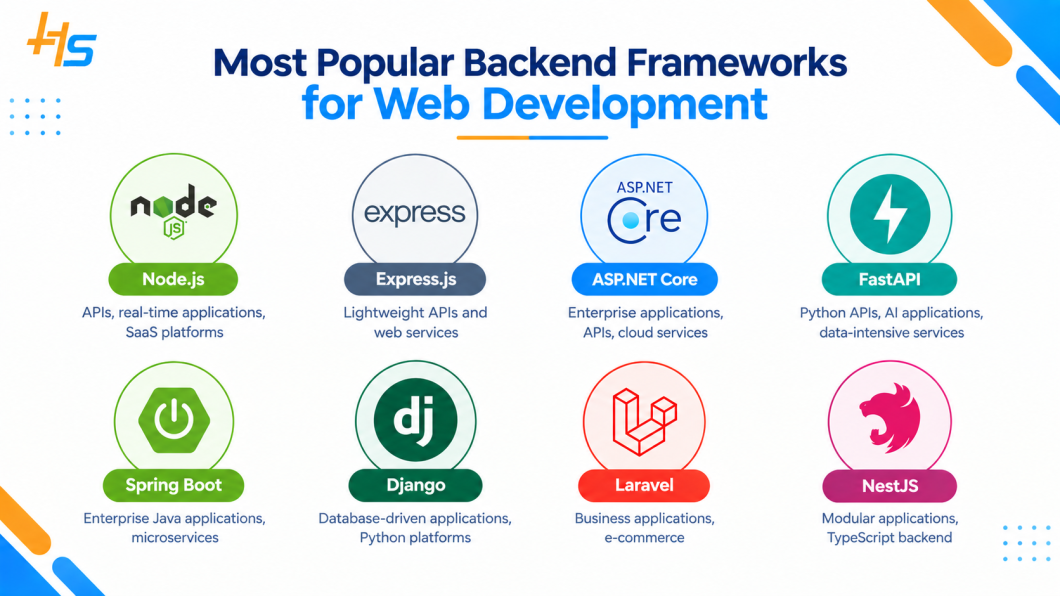
Several backend frameworks and platforms remain widely used in modern web development:
- Node.js: APIs, real-time applications, SaaS platforms, and JavaScript/TypeScript backends
- Express.js: Lightweight APIs and Node.js web services
- ASP.NET Core: Enterprise applications, APIs, cloud services, and Microsoft-based environments
- FastAPI: Python APIs, AI applications, machine learning services, and data-intensive systems
- Spring Boot: Enterprise Java applications, APIs, and microservices
- Django: Database-driven applications and Python-based platforms
- Laravel: PHP applications, SaaS products, and business platforms
- NestJS: Structured TypeScript applications, APIs, and modular backend systems
There is no single framework that can be called the universal “most popular” choice. Different sources measure popularity differently. Stack Overflow measures developer-reported usage, while GitHub measures activity within its own developer ecosystem. For enterprise technology decisions, production requirements and existing engineering capabilities matter more than a single popularity ranking.
What Is a Backend Framework?
A backend framework provides a structured foundation for developing the server-side part of an application.
It typically provides tools for:
- Request and response handling
- API development
- Routing
- Authentication and authorization
- Database access
- Input validation
- Error handling
- Session management
- Testing
- Application configuration
- Integration with external services
Without a framework, development teams would need to implement many of these capabilities themselves.
Frameworks also establish architectural patterns. This can make large codebases easier to maintain when developers follow consistent practices.
For enterprise applications, framework selection should therefore consider both technical capabilities and the team’s ability to maintain the resulting system.
1. Node.js
Node.js is a JavaScript runtime rather than a traditional web framework. It has become a major backend technology because it allows developers to use JavaScript or TypeScript on the server.
Its event-driven architecture works well for applications that handle many concurrent I/O operations. Common examples include APIs, real-time applications, collaboration platforms, streaming services, and transactional web applications.
Node.js also benefits from the large npm ecosystem. Teams can use established packages for authentication, database access, testing, API development, and other backend functions.
Where Node.js fits
Node.js is a practical option for:
- REST and GraphQL APIs
- Real-time applications
- SaaS platforms
- Microservices
- Server-side applications
- Full-stack JavaScript or TypeScript teams
- Applications with high numbers of concurrent connections
It is especially useful when an organization wants a common language across frontend and backend development.
Enterprise considerations
Large Node.js projects need disciplined architecture. Teams should define module boundaries, dependency policies, error handling, logging, testing, and security practices early.
For complex systems, organizations may also use TypeScript to introduce stronger type checking and improve maintainability. GitHub’s 2025 Octoverse reporting showed TypeScript overtaking Python and JavaScript as the most-used language on GitHub in 2025, highlighting its growing role in modern development.
2. Express.js
Express.js is a lightweight web framework for Node.js. It provides routing, middleware support, request handling, and other core capabilities needed for building web services.
Its relatively minimal approach gives developers considerable architectural freedom.
That flexibility can be useful for small services and APIs. It can also create challenges for large teams if developers follow inconsistent patterns.
Where Express.js fits
Express works well for:
- REST APIs
- Lightweight web applications
- Microservices
- Internal services
- Backend prototypes
- Custom API layers
Organizations with existing Node.js expertise can use Express to build services without adopting a highly opinionated architecture.
What to consider
Express does not impose a complete application architecture. Teams must make decisions about validation, dependency injection, project structure, authentication, testing, and other concerns.
For enterprise projects, development standards become important as the codebase grows.
3. ASP.NET Core
ASP.NET Core is Microsoft’s cross-platform framework for building modern web applications and APIs with .NET.
Microsoft describes ASP.NET Core as a high-performance, open-source framework designed for modern web applications and large-scale workloads. It includes features such as dependency injection, configuration, logging, metrics, authentication, authorization, SignalR, and gRPC support.
Where ASP.NET Core fits
ASP.NET Core is commonly suited to:
- Enterprise web applications
- REST APIs
- Cloud-native services
- Microservices
- Financial applications
- Business management systems
- Real-time applications
- gRPC services
Its integration with the wider .NET ecosystem can also make it attractive to organizations already using Microsoft technologies.
Enterprise advantages
ASP.NET Core supports multiple deployment environments and integrates with modern cloud infrastructure. Its tooling also supports unit and integration testing.
Microsoft’s documentation highlights its security capabilities, cloud-readiness, and performance characteristics for demanding workloads.
For enterprises with existing C# and .NET teams, this ecosystem can reduce the complexity of introducing backend development into larger technology environments.
4. FastAPI
FastAPI is a Python framework designed primarily for building APIs. It uses Python type hints and provides automatic interactive API documentation.
Its adoption has increased significantly in recent years. The 2025 Stack Overflow Developer Survey specifically identified a five-point increase for FastAPI and connected that growth with Python’s role in high-performance API development.
Where FastAPI fits
FastAPI is particularly relevant for:
- REST APIs
- AI applications
- Machine learning services
- Data platforms
- Model-serving APIs
- Microservices
- API-first architectures
This makes FastAPI relevant to enterprises building applications that need to connect traditional web systems with AI or data services.
Why enterprises consider FastAPI
Python has a mature ecosystem for AI, machine learning, analytics, and scientific computing. FastAPI can provide an API layer around those services.
This can help teams expose models and data-processing workloads to web applications without introducing a separate backend language.
FastAPI’s official documentation highlights performance, Python type hints, automatic documentation, and production-oriented API development.
5. Spring Boot
Spring Boot is a Java framework designed to simplify the development of production-grade Spring applications.
It remains highly relevant to enterprise development because Java has a long history in large business systems, financial applications, telecommunications, and other complex environments.
Spring Boot provides embedded server support, dependency management, configuration capabilities, health checks, metrics, and other production-oriented features.
Where Spring Boot fits
Spring Boot is well suited to:
- Enterprise applications
- Banking and financial platforms
- Microservices
- Large REST APIs
- Transaction-heavy applications
- Distributed systems
- Business process applications
Enterprise considerations
Spring’s ecosystem is broad. Teams can build applications around security, data access, messaging, cloud services, testing, and distributed architectures.
This makes Spring Boot a strong candidate when the backend forms part of a larger enterprise architecture.
However, its broader ecosystem can also require experienced developers. Organizations should consider development standards, dependency management, observability, and service architecture before scaling a Spring-based platform.
6. Django
Django is a Python web framework known for its batteries-included approach.
It provides many features needed for conventional web application development. These include URL routing, database integration through its ORM, authentication support, administration capabilities, security features, and templating.
Where Django fits
Django can work well for:
- Content-heavy platforms
- Business applications
- Data-driven web applications
- Customer portals
- Internal enterprise systems
- Rapidly developed applications
- Python-based platforms
Its integrated components can reduce the amount of infrastructure developers need to assemble themselves.
Django for enterprise applications
Django is particularly useful when an application has substantial database-driven business logic.
Python also gives Django projects access to the broader data and AI ecosystem. That can be useful when a business platform needs analytics, automation, or machine learning capabilities alongside conventional application functionality.
The key consideration is architecture. Large Django applications still need clear module boundaries, database optimization, testing strategies, caching, observability, and security controls.
7. Laravel
Laravel is a PHP framework designed for web application development.
It provides structured solutions for routing, database interaction, authentication, queues, caching, validation, and other common web development requirements.
Where Laravel fits
Laravel can be a practical choice for:
- Business web applications
- SaaS platforms
- E-commerce systems
- Customer portals
- Content management platforms
- PHP-based enterprise applications
Its developer-friendly conventions can help teams build applications efficiently.
When Laravel makes sense
Laravel can be particularly suitable when an organization already has PHP infrastructure or developers.
The framework also has a mature ecosystem. That can simplify integration with databases, payment systems, queues, caching layers, and other application services.
For enterprises, the decision should include hosting requirements, application scale, existing PHP expertise, security practices, and long-term maintenance needs.
8. NestJS
NestJS is a TypeScript framework built for Node.js applications.
Unlike lightweight Node.js frameworks, NestJS provides a more structured architecture. It uses concepts such as modules, controllers, providers, and dependency injection.
That structure can make it useful for larger TypeScript codebases.
Where NestJS fits
NestJS is often considered for:
- Enterprise APIs
- SaaS platforms
- Microservices
- Modular backend applications
- Event-driven systems
- TypeScript-based products
Its architecture can help teams establish consistent development patterns across larger projects.
For organizations already investing in TypeScript, NestJS can provide more structure than a minimal Node.js framework while keeping the team within the JavaScript ecosystem.
Backend Framework Comparison
| Framework | Language | Strong Fit | Enterprise Consideration |
| Node.js | JavaScript/TypeScript | APIs, real-time systems, SaaS | Requires strong architecture at scale |
| Express.js | JavaScript | APIs, lightweight services | Flexible but less opinionated |
| ASP.NET Core | C# | Enterprise apps, APIs, cloud services | Strong .NET ecosystem |
| FastAPI | Python | APIs, AI, ML and data services | Excellent fit for Python-based systems |
| Spring Boot | Java | Enterprise systems, microservices | Broad ecosystem and enterprise maturity |
| Django | Python | Data-driven applications | Strong integrated web features |
| Laravel | PHP | Business apps, SaaS, e-commerce | Good fit for PHP environments |
| NestJS | TypeScript | Modular APIs and services | Structured approach for large TypeScript teams |
There is no universal framework that fits every enterprise application. Technology selection should follow application requirements rather than popularity alone.
How to Choose the Right Backend Framework
Framework selection should start with the application rather than the developer’s preferred language.
Consider these factors.
1. Application workload
Identify whether the application handles:
- High API traffic
- Real-time connections
- Background processing
- Large transactions
- AI inference
- Data processing
- Content delivery
Different workloads can lead to different technology decisions.
2. Scalability requirements
Determine how the system will scale.
Ask whether the application needs:
- Horizontal scaling
- Container deployment
- Kubernetes support
- Microservices
- Event-driven processing
- Distributed caching
- Asynchronous workloads
The framework should support the intended architecture without creating unnecessary complexity.
3. Security requirements
Security should influence framework selection from the beginning.
Evaluate:
- Authentication
- Authorization
- Input validation
- Session management
- Encryption
- Dependency security
- Logging
- Audit requirements
Enterprise applications may also require compliance with industry-specific standards.
4. Existing technology stack
A new framework does not operate in isolation.
Consider the organization’s:
- Programming languages
- Databases
- Cloud platform
- CI/CD pipeline
- Identity provider
- ERP or CRM systems
- Monitoring tools
- API gateway
- Data platform
A technically capable framework may still create unnecessary complexity if it conflicts with the existing environment.
5. Developer availability
The availability of experienced developers matters.
A framework with a large ecosystem may offer more hiring options. A specialized framework may require a smaller pool of experienced engineers.
This is one reason businesses should evaluate both the framework and the development team before starting a major project.
Why Hiring the Right Backend Developers Matters
A framework alone does not determine the quality of a backend.
Experienced developers must understand architecture, databases, APIs, security, cloud infrastructure, testing, and performance optimization.
For example, two teams can use the same Node.js framework and produce very different systems. One may build a modular and observable architecture. Another may create tightly coupled services that become difficult to maintain.
The same applies to Java, Python, .NET, PHP, and TypeScript projects.
When organizations Hire Back-end Developers, they should evaluate more than framework familiarity.
Look for experience with:
- Backend architecture
- REST and GraphQL APIs
- Database design
- Authentication and authorization
- Cloud deployment
- Microservices
- API integrations
- Automated testing
- CI/CD
- Monitoring and logging
- Performance optimization
- Secure coding practices
For enterprise projects, developers should also understand how the backend connects with existing business systems.
When Should You Hire Back-end Developers?
Businesses may need additional backend expertise when internal teams face one or more of these situations:
1. New application development
A company may need a dedicated backend team to build APIs, business logic, database architecture, and integrations.
2. Legacy modernization
Older applications may require migration to Node.js, .NET, Java, Python, or another modern architecture.
3. Cloud migration
Moving backend workloads to AWS, Azure, or Google Cloud often requires changes to application architecture and deployment practices.
4. AI integration
Organizations adding AI features may need Python and API expertise to connect models with existing enterprise applications.
5. Scaling an existing product
Growing applications may require backend specialists who can address database bottlenecks, API performance, caching, concurrency, and infrastructure concerns.
6. Short-term engineering capacity
Companies may also need experienced developers for a specific product phase without expanding permanent headcount.
How HashStudioz Supports Backend Development Teams
HashStudioz provides backend development expertise for businesses that need additional engineering capacity or specialized skills.
Through its Hire Backend Developers service, organizations can work with developers experienced in technologies such as Node.js, Python, Java, PHP, and .NET, depending on project requirements.
The engagement can focus on specific development needs rather than forcing a business into one technology stack.
Typical areas include:
- Backend application development
- REST and API development
- Database integration
- Microservices
- Cloud-ready backend architecture
- Third-party API integration
- Enterprise application development
- Application modernization
- Performance optimization
- Ongoing backend maintenance
The technology choice should follow the application’s requirements. HashStudioz can help assess those requirements and align backend development skills with the project architecture.
Final Thoughts
The backend framework landscape continues to evolve. Node.js and its surrounding TypeScript ecosystem remain important for modern web applications. Python frameworks such as FastAPI and Django continue to benefit from Python’s expanding role in AI and data development. Spring Boot and ASP.NET Core remain relevant for enterprise systems. Laravel and other established frameworks continue to serve specific development environments.
The right choice depends on the application. Before selecting a framework, evaluate workload, scalability, security, integrations, infrastructure, developer availability, and long-term maintenance. For organizations building or modernizing enterprise applications, the development team matters as much as the framework. Experienced backend developers can translate business requirements into an architecture that remains maintainable as the product grows.
FAQs
1. Which backend framework is most popular for web development?
Node.js is among the most widely used web technologies in the 2025 Stack Overflow Developer Survey. Express.js, ASP.NET Core, FastAPI, Spring Boot, and Django also show substantial usage. Popularity varies by language, region, application type, and developer community.
2. Which backend framework is best for enterprise applications?
There is no single framework that fits every enterprise application. Spring Boot and ASP.NET Core are common choices for large business systems, while Node.js, Django, FastAPI, and NestJS can fit specific enterprise architectures.
3. Is FastAPI suitable for enterprise applications?
Yes. FastAPI can support enterprise APIs, especially when applications use Python for AI, machine learning, analytics, or data processing. Its automatic API documentation and type-hint-based development can also support API-focused teams.
4. Should businesses hire developers who know multiple backend frameworks?
It can be useful when a project involves multiple technologies or legacy modernization. However, framework breadth should not replace deeper skills in architecture, security, databases, APIs, testing, and cloud infrastructure.
5. How do I choose between Node.js, Python, Java, and .NET?
Start with the application’s requirements. Consider workload, existing infrastructure, team expertise, integrations, security requirements, scalability, and long-term maintenance. The framework should support the architecture rather than determine it.
6. Can backend developers work with cloud and AI applications?
Yes. Modern backend development often involves cloud infrastructure, APIs, distributed systems, and AI integrations. Python can be useful for AI services, while Node.js, Java, and .NET can support the surrounding application and enterprise service layers.