


Modern businesses need e-commerce platforms that can adapt to changing customer expectations, new digital channels, and increasingly complex integrations. Traditional commerce architectures can make it difficult to introduce new experiences quickly, especially when the front end and backend are tightly connected.
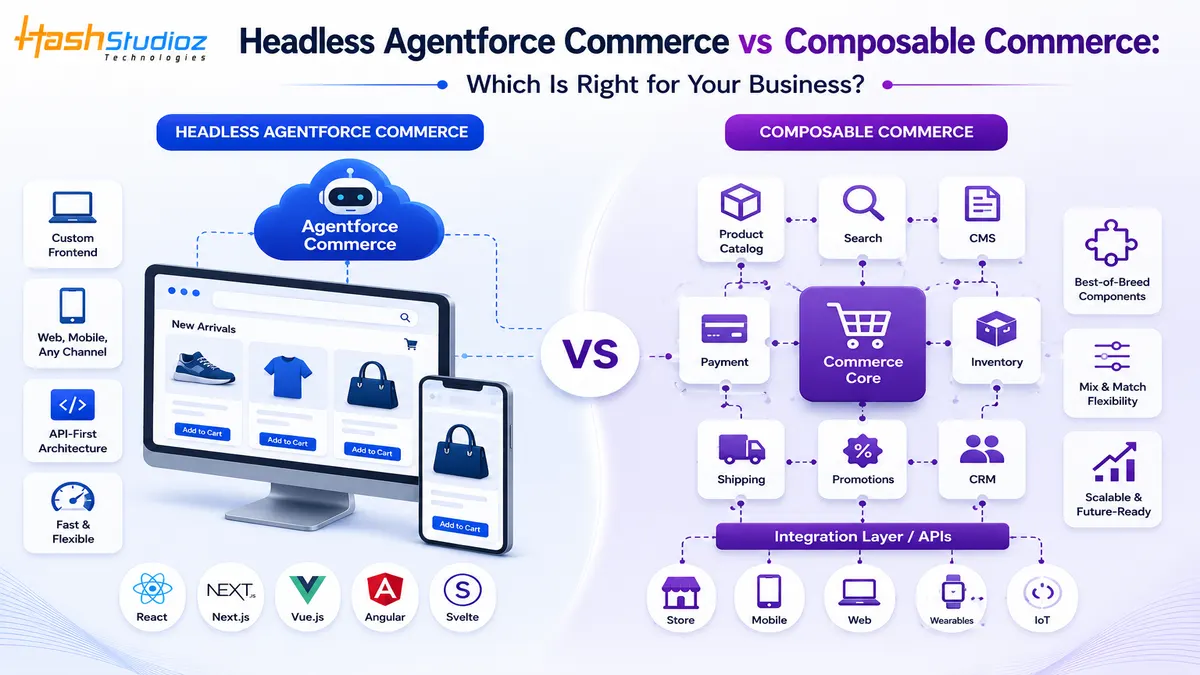
Two approaches that address these challenges are Headless Agentforce Commerce and Composable Commerce. Both offer flexibility, API-driven connectivity, and opportunities for creating customized digital commerce experiences. However, they differ in their architecture, level of modularity, implementation requirements, and the amount of control businesses have over individual commerce components.
Understanding the difference between Headless Agentforce Commerce vs Composable Commerce can help businesses select an architecture that fits their technology environment, development capabilities, scalability requirements, and long-term e-commerce strategy.
Table of Contents
What Is Headless Agentforce Commerce?
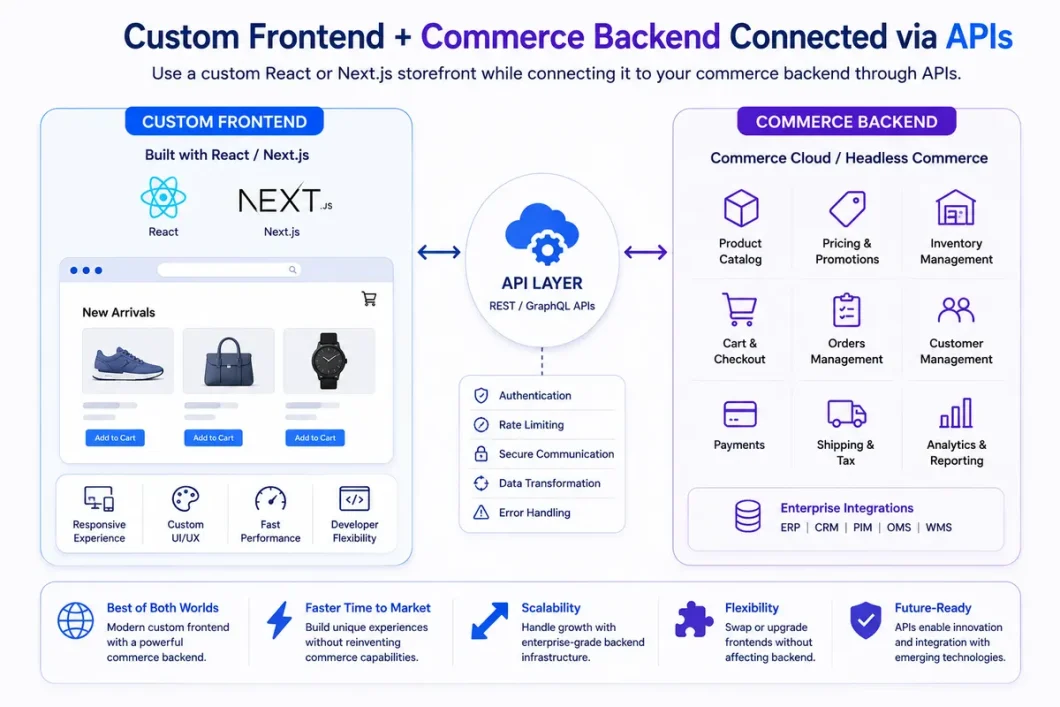
Headless Agentforce Commerce separates the customer-facing storefront from the underlying commerce backend. Instead of relying on a single front-end experience, businesses can use APIs to connect commerce capabilities with custom websites, mobile applications, kiosks, portals, or other digital touchpoints.
The headless approach gives development teams greater freedom over the customer-facing experience while allowing businesses to maintain commerce capabilities in the backend.
Salesforce describes headless commerce as an approach that allows businesses to use APIs to connect commerce functionality with different front-end experiences.
Key Characteristics of Headless Agentforce Commerce
- API-driven commerce
- Decoupled front-end and backend
- Flexible storefront development
- Custom digital experiences
- Omnichannel commerce
- B2B and B2C commerce support
- Salesforce ecosystem connectivity
- Integration with third-party applications
For example, a business could use a custom React or Next.js storefront while connecting it to its commerce backend through APIs.
What Is Composable Commerce?
Composable Commerce takes modularity a step further. Instead of primarily separating the front end from the commerce backend, businesses can assemble their commerce architecture from multiple independent components.
These components can perform specific functions such as:
- Commerce
- Search
- Content management
- Personalization
- Payments
- Checkout
- Order management
- Product information management
The business can select technologies based on its specific requirements and integrate them through APIs.
Salesforce describes composable commerce as a modular and headless approach where packaged business capabilities can be integrated or replaced independently.
This provides significant architectural flexibility, but it can also introduce additional complexity because businesses need to manage more independent components.
Headless Agentforce Commerce vs Composable Commerce: Key Differences
Although both approaches provide flexibility, they are not identical.
| Factor | Headless Agentforce Commerce | Composable Commerce |
| Architecture | Decoupled front end and backend | Modular and decoupled architecture |
| Front-End Flexibility | High | High |
| Backend Approach | Centralized commerce capabilities | Multiple modular capabilities |
| API Usage | Core to the architecture | Core to the architecture |
| Customization | High | Very high |
| Third-Party Components | Can be integrated | Strong emphasis on modular components |
| Implementation Complexity | Moderate to high | Generally higher |
| Technology Management | More centralized | Multiple components to manage |
| Best Fit | Flexible storefront with connected commerce backend | Businesses seeking maximum modularity |
The important distinction is that headless commerce focuses primarily on separating the presentation layer from the commerce backend, while composable commerce focuses on creating a more modular technology ecosystem.
In other words, composable commerce can include headless architecture, but a headless implementation does not necessarily need to be fully composable.
Benefits of Headless Agentforce Commerce
Flexible Storefront Development
Businesses can create custom storefronts without being restricted by the backend’s default presentation layer.
Faster Front-End Changes
Development teams can modify the customer-facing experience without making significant changes to the underlying commerce system.
Omnichannel Experiences
The same commerce capabilities can support websites, mobile applications, customer portals, kiosks, and other digital touchpoints.
Salesforce Connectivity
Businesses already using Salesforce can connect commerce with CRM and other Salesforce capabilities to create a more connected customer ecosystem.
Custom Customer Experiences
Organizations can create experiences designed specifically around their customers, industry, products, and business processes.
Benefits of Composable Commerce
Greater Modularity
Businesses can select individual technologies for different commerce functions.
Technology Flexibility
Organizations can choose specialized solutions for search, content, payments, personalization, and other functions.
Independent Component Management
Individual components can potentially be upgraded or replaced without rebuilding the entire commerce architecture.
Greater Architectural Control
Businesses have more control over how different technologies work together.
Long-Term Flexibility
Composable architecture can provide flexibility for enterprises with complex and evolving technology requirements.
When Should You Choose Headless Agentforce Commerce?
Headless Agentforce Commerce may be a better option when your business wants front-end flexibility while maintaining a strong commerce backend.
It can be particularly suitable when:
- You want a highly customized storefront.
- You already have Salesforce investments.
- You want to support multiple digital channels.
- Your development team prefers modern front-end frameworks.
- You need B2B or B2C commerce capabilities.
- You want API-driven integrations.
- You want to modernize the customer experience without replacing the entire commerce backend.
For example, a retailer could keep its existing commerce capabilities while developing a custom mobile-first storefront that connects through APIs.
When Should You Choose Composable Commerce?
Composable Commerce may be more appropriate when your organization needs maximum modularity across the entire commerce technology stack.
It can make sense when:
- Your business has complex enterprise requirements.
- You want specialized technologies for different commerce functions.
- You need to frequently replace or upgrade individual components.
- You have strong internal development resources.
- You are comfortable managing multiple technology vendors.
- Your long-term strategy requires a highly modular commerce architecture.
However, the additional flexibility comes with additional responsibility. Businesses must manage integrations, APIs, data flows, monitoring, security, upgrades, and dependencies across multiple components.
Case Study: Retail Brand Modernizing Its E-Commerce Experience
Consider a global fashion retailer that operates an e-commerce website, mobile application, physical stores, and multiple regional storefronts.
The company has:
- Salesforce CRM
- A large product catalog
- Multiple payment providers
- Third-party search technology
- Several fulfillment locations
- Web and mobile customers
- Plans for international expansion
Its existing storefront is difficult to customize, and even minor front-end changes require significant development effort.
Option 1: Headless Agentforce Commerce
The retailer could retain its commerce backend while creating a custom front end.
The architecture could look like:
Agentforce Commerce Backend → APIs → Custom Storefront → Web + Mobile + Other Channels
The retailer gets more control over its customer experience without having to replace the entire commerce backend.
For example, the business could create a custom product discovery experience, mobile shopping interface, personalized landing pages, and specialized checkout experience.
Option 2: Composable Commerce
The retailer could instead create a more modular architecture:
Commerce + Search + CMS + Personalization + Payments + Checkout + Order Management
Each capability could be provided by a specialized technology and connected through APIs.
This gives the retailer greater control over its technology stack but also requires more integration and ongoing management.
Which Approach Should the Retailer Choose?
If the retailer’s primary objective is custom storefront development while maintaining a connected commerce backend, Headless Agentforce Commerce could be the more practical approach.
If the company wants to completely rethink its commerce architecture and independently select technologies for multiple capabilities, Composable Commerce may be a better fit.
The decision should ultimately depend on the organization’s technical capabilities, existing investments, budget, integration requirements, and long-term strategy.
Headless Agentforce Commerce vs Composable Commerce: Decision Framework
| Business Requirement | Recommended Approach |
| Need a highly customized storefront | Headless Agentforce Commerce |
| Already invested in Salesforce | Headless Agentforce Commerce |
| Need multiple digital touchpoints | Headless Agentforce Commerce |
| Want to modernize the front end | Headless Agentforce Commerce |
| Need maximum architectural modularity | Composable Commerce |
| Want independent technology components | Composable Commerce |
| Have strong technical resources | Composable Commerce |
| Want to replace individual commerce capabilities | Composable Commerce |
Build Headless Agentforce Commerce With HashStudioz
Choosing the right architecture is only the first step. Successful implementation also requires the right development, integration, migration, testing, and optimization strategy.
HashStudioz helps businesses build customized commerce experiences using Salesforce Commerce capabilities, including headless commerce, integrations, customization, data migration, testing, deployment, and ongoing optimization. HashStudioz Salesforce Commerce Cloud Services
Businesses can work with HashStudioz for Agentforce Commerce implementation, headless commerce development, and Salesforce Commerce Cloud services based on their specific commerce requirements.
The implementation can involve:
- Custom storefront development
- API integration
- Salesforce CRM integration
- ERP integration
- Payment integration
- Third-party application integration
- Product and customer data migration
- Commerce customization
- Testing and deployment
- Performance optimization
- Ongoing support
How HashStudioz Services Relate to Headless Agentforce Commerce?
A successful headless implementation requires more than developing a separate front end. The storefront needs to communicate reliably with commerce services, customer data, inventory, orders, payments, and other enterprise systems.
HashStudioz can support this through Salesforce commerce integration, Agentforce Commerce integration, custom development, data migration, testing, and optimization.
For example:
| HashStudioz Service | Application in Headless Commerce |
| Headless Commerce Development | Builds customized storefront experiences |
| API Integration | Connects front-end applications with commerce services |
| Salesforce Commerce Cloud Services | Supports implementation and customization |
| Salesforce Commerce Integration | Connects commerce with Salesforce ecosystem |
| ERP Integration | Synchronizes products, inventory, and orders |
| Custom Commerce Development | Adapts the experience to business requirements |
| Data Migration | Transfers product, customer, and order data |
| Testing & Deployment | Validates commerce workflows and performance |
| Optimization | Improves scalability and ongoing performance |
Why Choose HashStudioz for Headless Agentforce Commerce?
Salesforce Commerce Expertise
HashStudioz provides Salesforce Commerce Cloud services covering implementation, customization, integration, testing, and optimization.
Headless Commerce Capabilities
The team can help businesses create API-driven storefronts that provide greater front-end flexibility while maintaining connected commerce functionality.
B2B and B2C Commerce Support
Different businesses have different commerce requirements. A headless architecture can be designed around B2B, B2C, or hybrid commerce models.
Integration-Focused Approach
From CRM and ERP to payment platforms and third-party applications, integrations are an important part of a successful headless commerce environment.
End-to-End Implementation
HashStudioz can support businesses across Agentforce Commerce implementation, headless commerce development, integration, migration, testing, deployment, and optimization.
Scalable Commerce Architecture
The goal is not simply to build a customized storefront but to create an architecture that can support new channels, integrations, products, and customer experiences as the business grows.
Conclusion
The choice between Headless Agentforce Commerce and Composable Commerce ultimately depends on how much flexibility and modularity your business needs. Headless Agentforce Commerce is a strong option for businesses that want a customized front end while maintaining a connected commerce backend and Salesforce ecosystem, whereas Composable Commerce is better suited to organizations seeking maximum modularity and the ability to select and manage independent technologies across their commerce stack. Neither approach is universally better, so businesses should evaluate their existing technology investments, development capabilities, integration requirements, business complexity, scalability goals, and long-term e-commerce strategy before choosing the right architecture.
If your business wants the flexibility of a headless storefront combined with Salesforce commerce capabilities, HashStudioz can help with Agentforce Commerce implementation, headless commerce development, Salesforce commerce integration, and ongoing optimization.
FAQs
1. What is the difference between Headless Agentforce Commerce and Composable Commerce?
Headless Agentforce Commerce separates the front end from the commerce backend, while Composable Commerce uses a more modular architecture where individual commerce capabilities can be selected, integrated, and replaced independently.
2. Is Headless Agentforce Commerce suitable for B2B and B2C businesses?
Yes. It can support both B2B and B2C businesses that need customized storefronts, API-driven integrations, and flexible digital commerce experiences.
3. When should a business choose Composable Commerce?
Composable Commerce can be suitable for businesses that need maximum architectural flexibility, specialized technologies, and the ability to independently manage or replace different commerce components.
4. What are the benefits of Headless Agentforce Commerce?
Key benefits include flexible storefront development, omnichannel experiences, API-driven integrations, customized customer journeys, and connectivity with the Salesforce ecosystem.
5. Can HashStudioz help implement Headless Agentforce Commerce?
Yes. HashStudioz provides headless commerce development, Agentforce Commerce implementation, Salesforce commerce integration, customization, data migration, testing, deployment, and optimization services.