


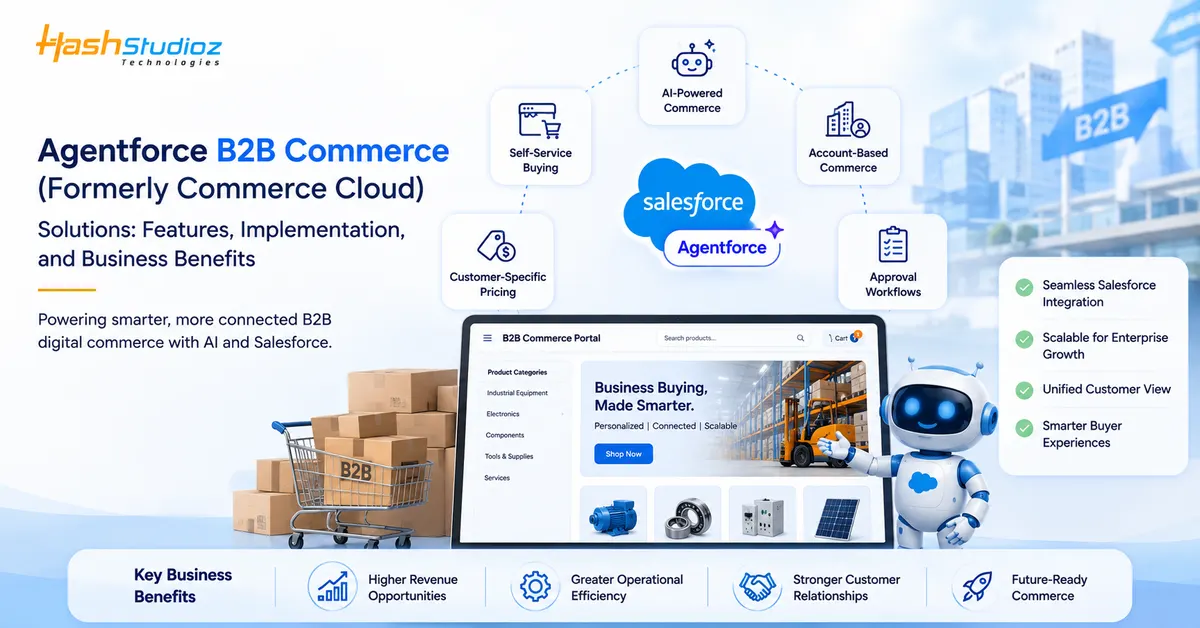
B2B commerce has changed significantly as businesses increasingly expect the same convenience and digital experiences they receive as consumers. Buyers want easy product discovery, personalized pricing, self-service ordering, real-time information, and faster purchasing processes. At the same time, B2B organizations must manage complex catalogs, account structures, approvals, contracts, bulk orders, and integrations with systems such as ERP and CRM.
Agentforce B2B Commerce, formerly Salesforce B2B Commerce within Commerce Cloud, is designed to address these requirements by combining digital commerce capabilities with Salesforce’s broader customer, data, and AI ecosystem.
Rather than treating an online B2B store as an isolated sales channel, businesses can use Agentforce B2B Commerce to create connected purchasing experiences that work alongside sales, service, marketing, inventory, and other enterprise processes.
This article explores the key features of Agentforce B2B Commerce, how implementation works, and the business benefits organizations can achieve from a connected B2B commerce strategy.
Table of Contents
What Is Agentforce B2B Commerce?
Agentforce B2B Commerce is Salesforce’s approach to digital commerce for business buyers. It supports organizations that sell products or services to other businesses and need more sophisticated purchasing workflows than typical B2C stores.
B2B buyers may purchase under a company account, use negotiated pricing, require approvals, work with multiple users, or place recurring and high-volume orders. The commerce experience therefore needs to account for both the individual buyer and the organization they represent.
Agentforce B2B Commerce can connect these commerce interactions with Salesforce data and business processes, helping organizations create a more unified view of customers and accounts.
Why B2B Businesses Need Specialized Commerce Solutions?
A traditional online store may work well for simple consumer transactions, but B2B purchasing often involves multiple layers of complexity.
A typical B2B purchase may include:
Business requirement → Product research → Account login → Contract pricing → Quote or cart → Approval → Purchase → Fulfillment → Reorder
B2B commerce solutions need to support these requirements without creating unnecessary friction for buyers. Each stage may involve different employees, systems, and business rules.
Key challenges often include:
- Complex product catalogs
- Customer-specific pricing
- Multiple buyers under one account
- Approval workflows
- Bulk purchases
- Recurring orders
- Contract-based purchasing
- ERP and inventory integration
- Sales-assisted commerce
- Account-level reporting
Agentforce B2B Commerce is designed around these types of business purchasing requirements.
Key Features of Agentforce B2B Commerce
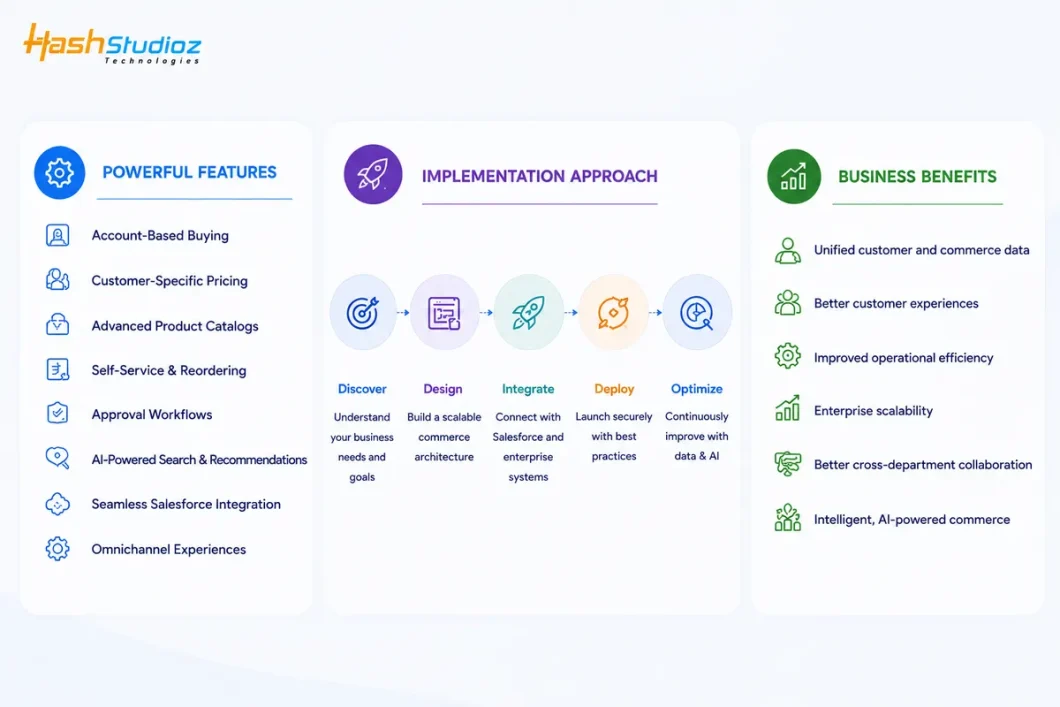
1. Account-Based Commerce
B2B buyers typically purchase on behalf of an organization rather than as individual consumers. An account may contain multiple users with different responsibilities and permissions.
For example:
- Procurement managers may place orders.
- Finance teams may review invoices.
- Employees may create shopping carts.
- Managers may approve purchases.
- Administrators may manage account settings.
An account-based commerce experience can provide each user with appropriate access while keeping purchasing activity connected to the broader business account.
2. Customer-Specific Pricing
B2B businesses frequently negotiate pricing with individual customers.
Instead of displaying one universal price, businesses may need to apply:
- Contract pricing
- Volume discounts
- Customer-specific discounts
- Negotiated rates
- Tiered pricing
- Account-based promotions
This helps businesses maintain their existing commercial agreements while providing buyers with accurate pricing through the digital commerce experience.
3. Complex Product Catalogs
B2B organizations often manage extensive product catalogs with thousands of products, configurations, specifications, and variations.
Buyers may need to search based on:
- Product specifications
- SKU
- Category
- Compatibility
- Availability
- Technical requirements
- Previous purchases
A well-designed B2B commerce experience makes it easier for buyers to find the products they need without navigating an overwhelming catalog.
4. Self-Service Purchasing
Modern B2B buyers increasingly expect to manage purchases independently.
Instead of contacting a sales representative for every transaction, customers may want to:
- Search products
- Check prices
- View availability
- Build orders
- Review order history
- Reorder products
- Track shipments
- Manage account information
Self-service capabilities can reduce repetitive work for sales teams while giving customers greater control over routine purchasing activities.
5. Bulk Ordering and Reordering
B2B customers frequently purchase products in large quantities or repeat previous orders.
A commerce solution can make this easier through features such as:
- Quick order
- Saved lists
- Reorder functionality
- Bulk quantity selection
- Previous order history
For customers who purchase the same products regularly, these capabilities can significantly reduce the time required to complete an order.
6. Approval Workflows
Many business purchases require internal approval.
For example:
Employee creates order → Manager reviews → Finance approves → Order is submitted
Approval workflows can help businesses maintain purchasing controls without forcing buyers to leave the digital commerce environment. B2B commerce needs to support these processes while maintaining a smooth customer experience.
7. Salesforce CRM Connectivity
One of the key advantages for Salesforce customers is the ability to connect commerce with CRM data.
This can help sales and service teams understand:
- Customer accounts
- Purchasing history
- Order activity
- Customer interactions
- Business relationships
- Service information
A connected commerce and CRM environment can give teams greater visibility into the customer relationship.
8. AI-Powered Commerce With Agentforce
AI is becoming increasingly important in B2B commerce. Salesforce Agentforce Commerce can support more intelligent commerce experiences by helping buyers with product discovery, information requests, and purchasing assistance.
For example, instead of searching through a large catalog manually, a buyer could describe what they need and receive guided assistance.
AI can also support merchant and operational activities, helping commerce teams manage repetitive tasks more efficiently.
Agentforce B2B Commerce Implementation
Implementing a B2B commerce platform requires more than launching an online storefront. Businesses need to consider their existing systems, data, customer journeys, business rules, and future growth.
A structured implementation process can help reduce complexity.
Step 1: Assess Business Requirements
Start by understanding how customers currently purchase products.
Review:
- Customer types
- Account structures
- Product catalogs
- Pricing models
- Ordering processes
- Approval requirements
- Sales involvement
- Fulfillment processes
This creates a foundation for designing the future commerce experience.
Step 2: Analyze the Existing Technology Ecosystem
B2B commerce usually needs to connect with several business applications.
Common systems include:
- Salesforce CRM
- ERP
- Inventory management
- Payment systems
- Marketing platforms
- Customer service systems
- Shipping and logistics platforms
- Data warehouses
- Legacy applications
Understanding these dependencies early can help businesses create a more reliable integration strategy.
Step 3: Design the Commerce Architecture
The next step is to determine how different systems will communicate.
Businesses should define:
- Data flows
- APIs
- Integration points
- Security requirements
- Customer journeys
- Account structures
- Business rules
A scalable architecture should also allow additional systems and channels to be introduced in the future.
Step 4: Configure B2B Commerce
The platform can then be configured according to business requirements.
This may include:
- Product catalogs
- Pricing
- Customer accounts
- User roles
- Checkout
- Order management
- Promotions
- Approval processes
Businesses should prioritize standard capabilities where possible and customize only where necessary.
Step 5: Integrate Enterprise Systems
Integration is critical for B2B commerce.
For example, Salesforce commerce may need to exchange information with an ERP system for:
- Product information
- Inventory
- Pricing
- Customer data
- Orders
- Invoices
For complex environments, organizations may use MuleSoft integration services to connect Salesforce with ERP, legacy applications, databases, and other enterprise systems.
Step 6: Migrate Data
Data migration may include:
- Customer accounts
- Products
- Pricing
- Orders
- Contracts
- User information
- Product relationships
Data should be cleaned and validated before migration to avoid transferring outdated or duplicate information into the new environment.
Step 7: Test the Customer Journey
Testing should cover the entire purchasing process.
Businesses should test:
- Login
- Product search
- Pricing
- Cart
- Checkout
- Approval workflows
- Payments
- Order creation
- Inventory synchronization
- Customer notifications
- Integrations
Testing real customer scenarios can help identify issues before launch.
Step 8: Launch and Optimize
After launch, businesses should monitor performance, user adoption, customer behavior, and system integrations.
Continuous optimization can help improve:
- Conversion rates
- Search experience
- Checkout
- Product discovery
- Page performance
- Customer satisfaction
- Operational efficiency
Business Benefits of Agentforce B2B Commerce
1. Improved Buyer Experience
Provide business buyers with personalized, convenient, and self-service purchasing experiences.
2. Increased Sales Opportunities
Use personalized product recommendations, relevant offers, and AI-powered assistance to support cross-selling and upselling.
3. Faster Customer Service
AI-powered agents can handle routine questions, provide product or order information, and assist customers around the clock.
4. Streamlined B2B Operations
Automate repetitive processes such as order assistance, product discovery, customer inquiries, and other routine commerce tasks.
5. Personalized B2B Experiences
Deliver account-specific catalogs, pricing, products, and recommendations based on customer relationships and purchasing behavior.
6. Better Data Visibility
Connect commerce activity with CRM and other business systems to give teams better visibility into customers, orders, and interactions.
7. Scalable Commerce Operations
Support growing product catalogs, customers, transactions, and business processes without relying entirely on manual operations.
8. Improved Employee Productivity
AI agents can assist employees with repetitive tasks, allowing sales and service teams to focus on more complex and valuable activities.
9. Stronger Customer Relationships
Combining commerce, CRM data, AI, and customer service can help businesses deliver more connected experiences throughout the buyer journey.
10. Data-Driven Decision-Making
Connected commerce and customer data can help businesses identify purchasing patterns, customer needs, and opportunities for optimization.
Agentforce B2B Commerce and ERP Integration
ERP integration is often one of the most important components of a B2B commerce strategy.
The ERP may contain critical information related to:
- Inventory
- Pricing
- Product availability
- Orders
- Invoices
- Fulfillment
- Customer accounts
Connecting ERP with commerce allows buyers and internal teams to access more accurate information.
For example:
Customer places order → Commerce platform receives order → ERP processes fulfillment → Inventory is updated → Customer receives order status
Without integration, businesses may need to manually transfer information between systems, increasing delays and errors.
Agentforce B2B Commerce vs Traditional B2B Ordering
Traditional B2B purchasing often depends heavily on sales representatives, emails, phone calls, spreadsheets, and manual order entry.
A modern B2B commerce environment can shift routine purchasing toward digital self-service.
| Traditional B2B Purchasing | Agentforce B2B Commerce |
| Manual order entry | Digital self-service ordering |
| Phone/email-based purchasing | Online account-based purchasing |
| Generic product information | Personalized catalogs |
| Manual price lookup | Account-specific pricing |
| Repetitive reorders | Quick reorder capabilities |
| Limited visibility | Connected customer and order data |
| Manual system updates | Integrated data exchange |
| Sales-heavy routine transactions | Digital + sales-assisted journeys |
This doesn’t mean sales teams become unnecessary. Instead, digital commerce can handle routine purchases while sales teams focus on complex customer relationships.
Best Practices for Agentforce B2B Commerce
1. Understand Your Buyers
Different customers may have different purchasing processes, roles, and requirements. Design journeys around actual buyer behavior.
2. Keep Account Data Accurate
Account structures, user permissions, pricing, and customer information should be regularly reviewed.
3. Prioritize Integration
Commerce should connect with critical systems such as CRM, ERP, inventory, and customer service platforms.
4. Simplify Reordering
Make it easy for repeat customers to access previous orders, saved products, and frequently purchased items.
5. Optimize Product Discovery
Large B2B catalogs should have effective search, filtering, categorization, and product information.
6. Use AI Strategically
Identify where AI can improve product discovery, customer assistance, merchandising, and repetitive business processes.
7. Plan for Scalability
Design the architecture to accommodate increasing customers, products, transactions, and integrations.
Who Can Benefit From Agentforce B2B Commerce?
Agentforce B2B Commerce can be particularly relevant for:
- Manufacturers
- Wholesalers
- Distributors
- Industrial suppliers
- Technology companies
- Healthcare suppliers
- Consumer brands with B2B channels
- Enterprises with complex purchasing processes
It can be especially valuable for organizations already using Salesforce and looking to connect commerce with their existing CRM, sales, service, and data environment.
Why Choose Professional Agentforce B2B Commerce Services?
Implementing B2B commerce can involve multiple systems, complex business rules, data migration, integrations, and customization.
Working with an experienced Agentforce Commerce services provider can help businesses plan and execute the project more effectively.
Professional support can include:
- Commerce strategy
- B2B implementation
- Salesforce integration
- ERP integration
- API development
- Data migration
- Customization
- Testing
- Performance optimization
- Ongoing maintenance
An experienced Salesforce Agentforce Commerce implementation partner can also help businesses identify opportunities to simplify their existing commerce processes before moving them into the new platform.
Conclusion
Agentforce B2B Commerce, formerly associated with Salesforce Commerce Cloud, provides businesses with a connected approach to modern B2B digital commerce. Its account-based purchasing, customer-specific pricing, complex catalog management, self-service ordering, approval workflows, CRM connectivity, and AI capabilities can help organizations create more efficient buyer experiences. The success of a B2B commerce project depends not only on platform capabilities but also on implementation strategy. Businesses should carefully assess their customer journeys, data, integrations, business rules, and long-term scalability requirements before implementation.
For organizations already invested in Salesforce, Agentforce B2B Commerce can provide an opportunity to bring commerce, CRM, customer data, and AI together within a more connected ecosystem. With the right architecture and implementation approach, businesses can reduce manual processes, improve customer experiences, support sales teams, and build a scalable foundation for future B2B growth.
FAQs
1. What is Agentforce B2B Commerce?
Agentforce B2B Commerce, formerly associated with Commerce Cloud, is Salesforce’s B2B commerce solution for managing account-based purchasing, pricing, catalogs, orders, and digital buyer experiences.
2. What are the key features of Agentforce B2B Commerce?
Key features include account-based commerce, customer-specific pricing, complex product catalogs, self-service ordering, bulk purchases, approval workflows, CRM connectivity, and AI-powered commerce.
3. What are the benefits of Agentforce B2B Commerce?
It can improve buyer experiences, reduce manual processes, increase sales efficiency, improve customer visibility, and provide a scalable digital commerce environment.
4. How is Agentforce B2B Commerce implemented?
Implementation typically involves assessing business requirements, designing the architecture, configuring commerce capabilities, integrating enterprise systems, migrating data, testing workflows, and optimizing after launch.
5. Can Agentforce B2B Commerce integrate with Salesforce CRM and ERP?
Yes. It can connect commerce with Salesforce CRM and other enterprise systems, including ERP platforms, to synchronize customer, product, pricing, inventory, and order information.