


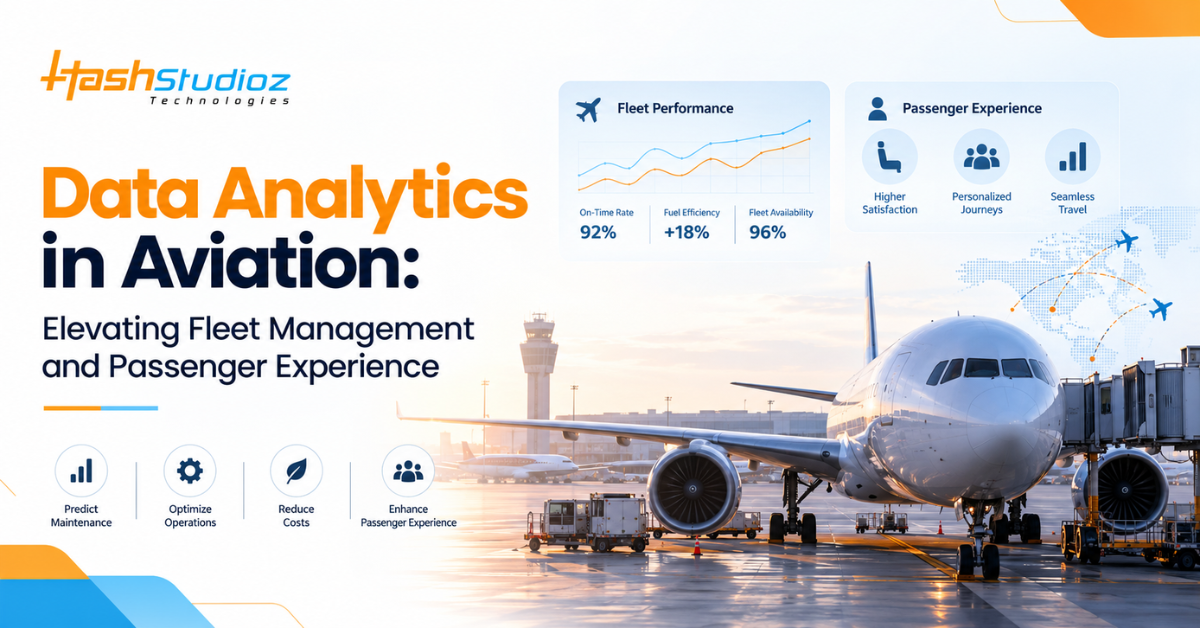
Commercial aviation generates more data than almost any other industry. Yet most carriers still make maintenance and scheduling decisions on information that’s hours old. That gap is closing fast. The global aviation analytics market will grow from $3.09 billion in 2026 to $7.09 billion by 2035. U.S. carriers already account for close to 40% of that demand. The Global Aviation Analytics Market was valued at USD 2.82 billion in 2025 and is projected to reach USD 3.09 billion in 2026. The market is expected to grow strongly, reaching USD 7.09 billion by 2035 and registering a CAGR of 9.66%, and the U.S. Aviation Analytics Market holds a dominant share, accounting for approximately 40% of the global market.
The financial pressure behind that growth is simple. A single aircraft-on-ground event on a widebody can cost upward of $150,000. Unscheduled maintenance still drives 30% to 50% of global MRO spend. Global MRO spend reached $104 billion in 2024 and is forecast to hit $124 billion by 2034, with unscheduled maintenance accounting for 30–50% of that cost. Yet fewer than one in five airlines run predictive models at fleet scale. Most carriers are still leaving measurable savings on the table.
For CIOs, CTOs, and revenue operations leaders, the question isn’t whether to invest in analytics. It’s where to start, and how fast the data foundation starts paying for itself.
Table of Contents
Why Aviation Generates So Much Data and Uses So Little of It
A single wide-body flight produces terabytes of telemetry from engines, avionics, hydraulics, and cabin systems. Add crew records, MRO logs, weather feeds, loyalty data, booking histories, and social sentiment, and the volume becomes hard to overstate. The problem was never data scarcity.
The real bottleneck sits in how carriers store and connect that data. Most legacy airlines still run maintenance records in one system, crew planning in another, and passenger data in a third. Many of these ERP platforms were never built to talk to each other. Operations teams end up piecing together a single incident, a delayed flight, a mishandled bag, a maintenance hold, from three or four disconnected reports after the fact.
Dedicated data analytics services close that gap. They don’t add another dashboard. They unify telemetry, MRO, crew, and passenger data into one analytical layer that serves fleet operations and commercial teams from the same source of truth.
Predictive Maintenance: Where the Financial Case Is Strongest
Predictive maintenance delivers the highest ROI of any analytics application in aviation. It also has the clearest, most public results.
Proven Results: Delta and Lufthansa Technik
Delta Air Lines built its APEX predictive maintenance program on Airbus Skywise and IBM analytics. The system feeds real-time sensor data from engines and components into machine learning models that flag failures before they ground an aircraft. The results won Aviation Week’s Innovation Award: engine-related cancellations dropped from roughly 5,600 a year to under 100. By integrating Airbus Skywise and IBM analytics, Delta reduced maintenance-related cancellations from 5,600 annually to under 100, drastically improving aircraft availability. One account of the same program puts the improvement even higher, citing a drop to 55 cancellations a year, a 100x gain that saved Delta eight figures annually.
Lufthansa Technik’s AVIATAR platform applies the same logic to condition monitoring and fuel analytics. United Airlines and Etihad both run it. Etihad used AVIATAR across its Boeing 777 and Airbus fleets to catch technical issues early, cut unnecessary fuel burn, and shorten line maintenance downtime. Using fuel analytics, condition monitoring, and automated planning, Etihad optimized its Boeing 777 and Airbus fleets. The system identified technical issues early, reduced unnecessary fuel consumption, and shortened line maintenance downtime
These aren’t isolated wins. Peer-reviewed research on AI-driven predictive maintenance across the sector shows consistent ranges: maintenance costs drop 12% to 18%, and unplanned downtime falls 15% to 20%.AI-driven predictive maintenance can reduce maintenance costs by 12–18% and decrease unplanned downtime by 15–20%, thereby increasing aircraft availability. Vendor benchmarks in the same space report ROI between $10 and $30 for every dollar invested. Airlines typically hit payback within 12 to 18 months.
For a CTO deciding where to place the first analytics investment, predictive maintenance is usually the answer. Sensor telemetry already exists on most modern fleets. The tooling is mature: TensorFlow, Scikit-learn, and purpose-built MRO platforms. And the business case holds up under scrutiny.
What a Predictive Maintenance Pipeline Actually Requires
Building this capability takes more than buying a model. It needs a specific stack working together.
- IoT ingestion from engine and airframe sensors, typically through Apache Kafka or a cloud IoT hub, streaming continuously rather than batched at turnaround
- A time-series or lakehouse data store (AWS Redshift, Snowflake, or Azure Synapse are common choices) that holds years of component-level history for model training
- Failure-prediction models trained on historical maintenance records paired with sensor readings, not sensor data alone
- Integration back into MRO scheduling systems (AMOS, TRAX, SAP PM), so a predicted failure automatically becomes a work order instead of an alert someone has to notice
Airlines that skip the integration step often end up with an accurate model nobody acts on in time. The value comes from closing the loop between prediction and the maintenance calendar, not from the model’s accuracy score alone.
Real-Time Operations: Turning Delay Data Into Fewer Delays
Predictive maintenance protects aircraft availability. Operations analytics protects the schedule once the aircraft is available.
Japan Airlines offers a clear example. The carrier runs more than 40 predictive models through a machine learning platform to optimize departure timing and turnaround sequencing. That work contributes to on-time performance near 100%.Japan Airlines uses dotData’s predictive platform to run 40+ models that optimize departure timing and turnaround, contributing to nearly 100% on-time performance The models pull in weather, aircraft rotation patterns, and crew readiness to flag disruption risk before it cascades through a hub.
This is where live BI dashboards earn their keep. Instead of asking “why was this flight delayed” after the fact, a unified operations view lets a duty manager see punctuality trends, MRO workload, and crew utilization on one screen, in real time, before a late departure turns into a network-wide problem. Power BI and Apache Superset are common front ends for this layer. They sit on top of the same data warehouse that feeds the predictive maintenance models.
Passenger Experience: Where Analytics Becomes a Revenue Lever
Fleet analytics protects margin. Passenger analytics grows revenue, and the numbers back that up more directly than most airlines assume.
The Revenue Case for Passenger Analytics
Carriers using AI-driven commerce build contextual offers from travel intent, journey stage, and traveler segment. Everest Group research, cited in Infosys’s 2026 airline industry analysis, found these carriers see 10% to 15% higher revenue per passenger and 5% to 10% stronger cross-sell and up-sell conversion. Airlines adopting AI-led commerce capabilities are seeing a 10–15% increase in revenue per passenger and 5–10% higher cross-sell and up-sell conversions, as per an Everest Group report
At the airport level, ACI World’s Airport Service Quality program documents the same link between satisfaction and revenue. A 1% increase in global passenger satisfaction generates, on average, 1.5% growth in non-aero revenue. That’s a direct, measurable connection between customer experience investment and commercial performance, not a soft metric buried in an annual report.
The Three Data Sources That Drive Personalization
Three data sources drive most of the gains here.
- Behavioral and loyalty data lets an airline personalize seat upgrades, inflight content, and ancillary offers instead of pushing the same generic upsell to every passenger
- NLP-based sentiment analysis scans social media, app store reviews, and post-flight surveys. It surfaces dissatisfaction patterns, inflight service quality, baggage handling, and gate communication days or weeks before they show up in a quarterly NPS report
- RFID-tagged baggage flow data, paired with predictive analytics, helped Delta cut mishandled bags by roughly 25% across its U.S. operations. IATA’s broader research backs this up: pairing RFID with analytics can cut global mishandling rates by more than 20%
Salesforce-aligned revenue operations leaders should pay close attention to passenger sentiment analysis. When loyalty, service, and sentiment data feed into the same CRM the commercial team already uses, response times to dissatisfaction patterns drop from weeks to days. Personalization stops being a marketing campaign and becomes a real-time operational capability.
Safety and Compliance Analytics
Predictive maintenance and passenger personalization get most of the attention. But analytics also carries direct regulatory weight. Airlines operating under FAA and EASA oversight need real-time, auditable visibility into how anomalies in engine performance, crew duty logs, and maintenance records map against compliance thresholds.
A well-built analytics layer handles this automatically. Anomaly detection flags a deviation. The system logs it against the relevant regulatory threshold. It generates the audit trail without a compliance officer manually cross-referencing spreadsheets. This matters more than it looks on a technology roadmap. Audit preparation that once took weeks of manual reconciliation becomes a standing report, and the risk of a missed compliance flag drops accordingly.
The Hidden Cost of Standing Still
Airlines that delay building this capability aren’t avoiding cost. They’re absorbing a different, less visible one.
Reactive maintenance culture keeps unscheduled repairs at 30% to 50% of total MRO spend industry-wide. Global MRO spend reached $104 billion in 2024 and is forecast to hit $124 billion by 2034, with unscheduled maintenance accounting for 30–50% of that cost. Fragmented inventory planning, done without predictive demand signals, leaves 22% to 30% of rotable parts inventory excess or obsolete. That ties up capital that earns nothing while still carrying full holding costs. Unscheduled labor carries roughly a 3.2x cost premium over planned work, since every reactive hour on the ramp displaces two hours of productive scheduled work.
None of this shows up as a single budget line item. It shows up as margin erosion spread across maintenance, inventory, crew overtime, and passenger compensation. That’s exactly why it tends to survive years of budget review without anyone addressing it directly.
Building the Data Foundation: What CTOs Should Get Right First
Before any predictive model or personalization engine delivers value, the underlying data architecture has to support it. Deployments across airline and MRO environments point to four elements that consistently decide whether an analytics program succeeds or stalls.
Data Ingestion and Model Infrastructure
Telemetry, MRO logs, crew schedules, and passenger data need to land in one governed environment. Four separate systems that each require a manual export to reconcile won’t work. A cloud data warehouse, Redshift, Snowflake, BigQuery, or Synapse, paired with streaming ingestion through Kafka or an IoT hub, is the standard architecture. That foundation stays the same whether the priority is predictive maintenance or passenger personalization.
Model infrastructure also needs to support retraining, not just one-time deployment. Component wear patterns and passenger behavior both shift over time. A model trained once on last year’s data degrades quietly. Teams that build automated retraining into the pipeline from day one avoid the slow, hard-to-diagnose accuracy decay that undermines confidence in predictive systems after twelve to eighteen months.
Integration and Governance
Analytics only pays off when teams use it inside their existing workflows. A predictive maintenance alert that doesn’t create a work order in AMOS or TRAX gets ignored. A sentiment signal that doesn’t reach the customer service or revenue operations team through Salesforce or an equivalent CRM doesn’t change behavior.
Compliance and data governance need a place in the architecture from day one, not as a retrofit. FAA, EASA, and region-specific frameworks like DGCA and GDPR all shape how airlines store and access flight, crew, and passenger data. Role-based access control and privacy-aware data handling belong in the initial build, not in a scramble after a regulator asks a question.
Measurable ROI: What to Expect and When
Enterprise buyers evaluating an aviation analytics investment should plan around these benchmarks, drawn from documented industry deployments:
- Predictive maintenance typically shows first measurable results within 90 days and reaches full payback within 12 to 18 months, with cost reductions between 12% and 40% depending on fleet size and prior maintenance maturity
- Unplanned downtime reductions commonly fall between 15% and 50%, with wider deployments across aircraft and ground infrastructure trending toward the higher end
- Personalization and AI-led commerce programs show revenue-per-passenger gains of 10% to 15% within the first year
- Baggage and ground operations analytics, paired with RFID tracking, can cut mishandling rates by 20% to 25%
These ranges shift with fleet size, existing data maturity, and how aggressively an airline integrates predictions into operational workflows rather than leaving them as reports. Carriers with legacy, siloed systems usually see slower initial gains but larger cumulative savings once the foundation is in place, since they’re closing a bigger gap.
Where HashStudioz Fits
HashStudioz Technologies builds this data foundation for airlines, MRO providers, and travel technology companies. The work includes IoT telemetry ingestion for engines and components, failure-prediction models built in Python with Scikit-learn and TensorFlow, live BI dashboards in Power BI for operations and MRO teams, and NLP-driven passenger sentiment analysis that connects social, review, and survey data to service quality trends.
The scope also covers cloud data warehousing (AWS Redshift, Azure, and equivalent platforms), compliance-ready data handling for FAA, EASA, and GDPR requirements, and integration with the CRM and MRO systems airlines already run. That last piece matters most: predictions and personalization signals need to reach the teams that act on them, not sit in a separate dashboard.
For carriers weighing where to start, the evidence points clearly toward predictive maintenance as the highest-confidence first project. Passenger sentiment and personalization make a strong second phase, once the underlying data pipeline is proven.
Final Thoughts
The airlines pulling ahead on cost and customer experience aren’t the ones with the most data. Nearly every carrier has that. They’re the ones that connect telemetry, maintenance, crew, and passenger data into one system that predicts problems before they ground a plane or cost a booking, and then build the operational discipline to act on those predictions in real time. Delta’s shift from 5,600 engine-related cancellations a year to under 100 isn’t an outlier. Neither is the industry-wide 10% to 15% revenue-per-passenger lift from AI-led personalization. Both show what happens when data analytics moves from a reporting function to an operational one.
For enterprise technology leaders evaluating this investment in 2026, the real question isn’t whether the ROI case holds. The case studies above already answer that. The question is which system, fleet reliability or passenger experience, has the weaker data foundation today. That’s where the first project should start.
FAQs
1. What is data analytics in aviation used for?
Airlines use it to predict component failures before they cause delays, optimize crew and turnaround scheduling in real time, personalize passenger offers, track baggage handling accuracy, and maintain audit-ready compliance records for FAA and EASA requirements.
2. How much can predictive maintenance analytics save an airline?
Documented deployments show maintenance cost reductions of 12% to 40% and unplanned downtime cuts of 15% to 50%. Most carriers reach full ROI within 12 to 18 months.
3. What data sources feed an aviation analytics platform?
Engine and airframe IoT telemetry, MRO and maintenance logs, crew scheduling records, booking and loyalty data, baggage RFID tags, and passenger feedback from surveys, app reviews, and social media.
4. Does passenger analytics actually increase revenue, or just satisfaction scores?
Both, and they’re linked. Airlines using AI-driven personalization report 10% to 15% higher revenue per passenger. ACI World data shows every 1% gain in passenger satisfaction correlates with roughly 1.5% growth in non-aero revenue.
5. How long does it take to build a working aviation analytics system?
A predictive maintenance pipeline built on existing sensor data typically shows results within 90 days. A full platform covering fleet, operations, and passenger analytics usually takes several months, depending on how fragmented the airline’s current systems are.