


In 2026, the Internet of Things is shifting from “connecting devices” to giving them the ability to decide and act. The biggest trends are agentic AI running at the edge, IoT cybersecurity laws like the EU Cyber Resilience Act becoming enforceable, AI-powered digital twins, satellite (non-terrestrial) connectivity, and unified standards like Matter that finally make devices talk to each other without friction.
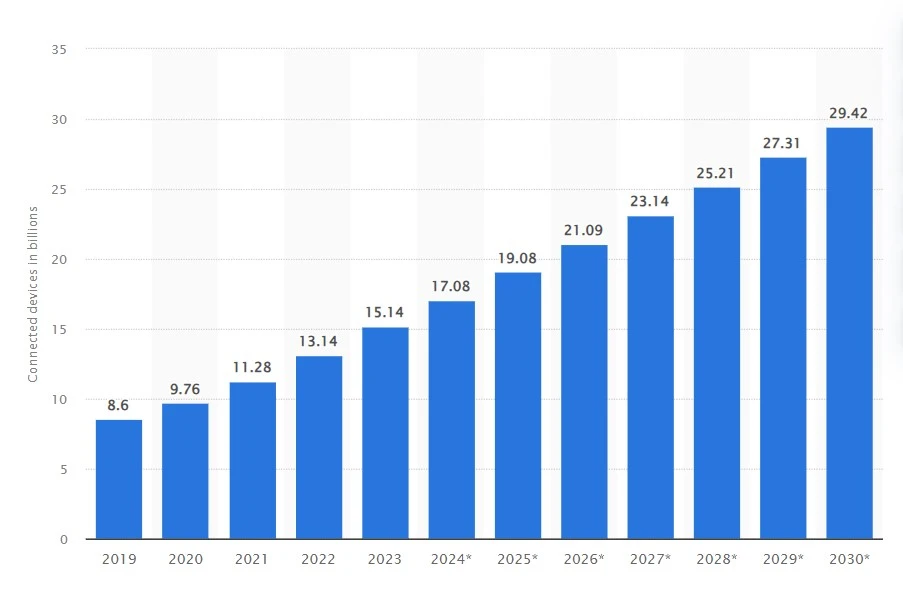
“Number of Internet of Things (IoT) connected devices worldwide from 2019 to 2023, with forecasts from 2022 to 2030. (in billions)“
Source: Statista
The Internet of Things (IoT) is a network of physical devices, sensors, machines, vehicles, and appliances that collect and exchange data over the internet. According to IoT Analytics, the number of connected IoT devices grew 14% year-over-year to reach 21.1 billion by the end of 2025, and the installed base is on track to hit 39 billion by 2030. GSMA Intelligence’s March 2026 forecast puts the figure even higher: 40.8 billion connections by 2030, with enterprise use cases like smart buildings, manufacturing, and utilities driving most of the growth.
This guide breaks down the 10 trends actually shaping IoT strategy in 2026, not the ones that were trending two years ago.
Table of Contents
Key Takeaways
- AI has moved onto the device. Agentic AI and edge AI mean IoT systems now make decisions locally, in milliseconds, instead of waiting on the cloud.
- Security is now a legal requirement, not a best practice. The EU Cyber Resilience Act’s vulnerability-reporting rules take effect on September 11, 2026, with full compliance due by December 11, 2027.
- Digital twins have gone mainstream. Grand View Research values the global digital twin market at $49.5 billion in 2026. It projects the market to reach $328.5 billion by 2033.
- Connectivity is getting a lot more flexible. 5G RedCap, satellite/NTN fallback, and unified protocols like Matter are reducing the cost and complexity of deploying IoT at scale.
- Sustainability and IIoT are converging, with smart grids and predictive maintenance now framed as ROI drivers, not just compliance checkboxes.
IoT in 2026, by the Numbers
Before the trend list, here’s the context that matters for any business case:
- 21.1 billion connected IoT devices were active by the end of 2025, projected to reach 39 billion by 2030, and over 50 billion by 2035 (IoT Analytics).
- The cellular IoT chipset market reached $4.07 billion in 2024, according to IoT Analytics. It should hit $14.08 billion by 2030, with 5G chipsets growing at a 34% CAGR.
- McKinsey Global Institute has estimated that IoT applications could unlock between $3.9 trillion and $11.1 trillion a year in global economic value, a figure still widely cited by enterprise IoT buyers building their business case.
- Analysts project IoT spending in manufacturing alone to grow from $0.49 trillion in 2025 to $1.51 trillion by 2030.
1. Agentic AI Is Turning IoT Devices Into Decision-Makers
What it is: Agentic AI systems don’t just flag a problem. They reason across multiple data sources, decide on an action, and execute it without waiting for a human. In IoT, this means a factory sensor network or a security camera can reroute a process, lock a door, or rebalance a load on its own.
Why it matters: Traditional IoT logic was rule-based — for example, “if temperature exceeds 30°C, turn on the fan.” Agentic AIoT systems work differently. They can interpret natural-language goals, search across multimodal sensor feeds, and take multi-step action. That makes them closer to a digital operations manager than a simple alarm.
Where it’s used: In manufacturing, agentic AI agents coordinate between machines and adjust production parameters in real time. When sensors detect a quality issue, the system reroutes the workflow without waiting for a supervisor. Industry analysts note that AI now comes up regularly on corporate earnings calls. That shows how central it has become to operational strategy.
Caveat worth knowing: analysts also warn that businesses could shelve over 40% of agentic AI pilot projects by the end of 2027. The reason: unclear ROI or weak governance. The trend is real, but it needs disciplined rollout, not hype-chasing.
2. Edge AI Puts Intelligence Directly on the Device
What it is: Edge AI runs machine learning models directly on the IoT device — a sensor, camera, or gateway. It skips the step of sending raw data to the cloud for processing.
Why it matters: Cloud round-trips cost time, bandwidth, and money. Edge AI cuts that latency from seconds to milliseconds. This matters when a robot has to stop before a collision. It also matters when a medical wearable has to flag an anomaly instantly. Organizations deploying edge AI report cutting data backhaul costs by roughly 80%. They do this by filtering noise at the source and transmitting only what’s actionable.
How it works: Purpose-built low-power AI chips made this shift possible. NVIDIA’s Jetson series, Google’s Edge TPU, and NPUs from Qualcomm, MediaTek, and NXP now bring real inference to small devices. Model-compression techniques like quantization and pruning add to this. They let AI models shrink from data-center scale down to a few megabytes.
Where it’s used: Industrial cameras for visual inspection, predictive-maintenance sensors on factory equipment, and on-device translation or anomaly detection in medical monitors.
3. 5G RedCap and the Road to 6G
What it is: 5G RedCap (“Reduced Capability”) is a lighter, cheaper version of 5G. It targets IoT devices that don’t need full 5G bandwidth, like industrial sensors and wearables. These devices still need better latency and battery life than 4G can offer.
Why it matters: Full 5G modules were too expensive and power-hungry for most IoT use cases. RedCap closes that gap. As of early 2026, dozens of operators across more than 20 countries are investing in RedCap. Analysts expect module prices to fall from $30–$50 to $15–$25 by late 2026 as production scales.
How it works / where it’s used: RedCap is rolling out first in industrial zones and urban 5G Standalone networks. It supports use cases like asset tracking, video surveillance, and connected logistics. It sits alongside LTE-M and NB-IoT, the default replacement for sunsetting 2G/3G networks in battery-powered deployments with multi-year lifespans.
4. Satellite IoT and Non-Terrestrial Networks (NTN)
What it is: Satellite IoT connects devices directly to satellites instead of cell towers, closing the connectivity gap in places where cellular infrastructure doesn’t reach, oceans, deserts, remote farmland, and cross-border supply routes.
Why it matters: This used to mean proprietary, expensive hardware locked to one satellite vendor. That changed with 3GPP Release 17, which standardized NTN support for NB-IoT and LTE-M, meaning the same chipset and firmware that works on a terrestrial network can now fail over to a satellite automatically.
Where it’s used: Livestock tracking, wildfire detection, pipeline and grid sensing, maritime logistics, and remote asset tracking. Chipmakers like Nordic Semiconductor have already shipped NTN-capable modules, such as the nRF9151. Analysts project satellite data costs to fall to roughly $0.50–$2.00 per megabyte for IoT use cases in 2026. That’s still a premium over cellular, but increasingly viable.
5. IoT Cybersecurity Is Now a Legal Requirement
What it is: For years, “IoT security” meant best practices that vendors could choose to follow. In 2026, that changes. The EU Cyber Resilience Act (Regulation (EU) 2024/2847) makes cybersecurity a legal precondition for selling a connected product in the EU.
Why it matters: From September 11, 2026, manufacturers must report actively exploited vulnerabilities to EU authorities (via ENISA) within 24 hours, with a full report due in 72 hours. Full compliance, including secure-by-design engineering, a software bill of materials, and CE marking, is mandatory from December 11, 2027. Fines for non-compliance can reach €15 million or 2.5% of global annual turnover.
Where it applies: The CRA covers almost anything with a network connection. That includes consumer IoT devices, industrial controllers, routers, smart home security devices, and connected vehicle components. It applies no matter where the manufacturer’s headquarters sit, as long as the product reaches the EU market. The global IoT security market reflects this urgency. Fortune Business Insights estimates it at $58.35 billion in 2026, growing to $425.7 billion by 2034.
Practical takeaway: If your product roadmap touches the EU market, security-by-design is no longer optional. The same goes for vulnerability disclosure processes and a maintained software bill of materials. These are compliance requirements now, with hard dates attached.
6. AI-Powered Digital Twins Move From Prototype to Operations
What it is: A digital twin is a live virtual replica of a physical asset, process, or system. Sensors continuously update the model with real data, so it mirrors what’s actually happening on the ground.
Why it matters: Digital twins used to be static 3D models. In 2026, AI-driven simulation changes that. A digital twin can now predict failures, run “what-if” scenarios, and recommend or trigger corrective action. That makes it closer to a live decision-support system than a visualization tool. Grand View Research values the global digital twin market at roughly $49.5 billion in 2026. It projects the market to reach $328.5 billion by 2033 at a 31.1% CAGR.
Real-world example: Energy companies have been early, visible adopters. BP has used digital twins on offshore assets to optimize operations. The result: an estimated 30,000 additional barrels of oil in the first year of deployment. Analysts credit Shell’s digital twin program with helping locate roughly 10 million barrels of oil in the Gulf of Mexico. By 2027, analysts expect more than 90% of IoT platforms to support digital twin capabilities natively.
7. Smart Cities Get More Data-Driven (and More Specific)
What it is: Smart city IoT connects traffic systems, lighting, utilities, and public safety sensors into a shared data platform. City operators can act on that data in real time.
Why it matters: This trend hasn’t slowed down — it’s gotten more concrete. Cities are no longer just “adding sensors.” They’re optimizing specific, measurable outcomes: congestion, energy waste, and emergency response time.
Where it’s used:
- Analysts credit Barcelona’s smart traffic system with cutting travel times by as much as 30%. Its Lighting Masterplan also switched street lighting to LEDs that adjust brightness based on pedestrian activity.
- Singapore’s IoT Innovation Lab coordinates smart transportation, advanced energy grids, and wearable health monitoring for older adults. It’s part of the city’s broader Smart Nation push.
- Seoul’s integrated renewable energy platform connects more than 420,000 buildings for real-time energy monitoring. The initiative cut citywide energy demand by the equivalent of one nuclear power plant’s output.
8. Industrial IoT (IIoT) and Industry 5.0
What it is: IIoT applies connected sensors and analytics to manufacturing, logistics, and heavy industry, the backbone of predictive maintenance, quality control, and supply chain visibility. Industry 5.0 builds on this by re-centering human oversight alongside automation rather than removing people from the loop entirely.
Why it matters: IIoT revenue in manufacturing alone is projected to grow from $0.49 trillion in 2025 to $1.51 trillion by 2030, and the broader IIoT market is forecast to reach roughly $1.69 trillion by 2030 at a 23.3% CAGR. Predictive maintenance, using sensor data to fix equipment before it fails, remains the single most cited ROI driver for IIoT investment.
How it works: Edge AI processes sensor data on the factory floor instead of routing everything to the cloud, secure edge data lakes keep sensitive production data on-premises for compliance, and AI agents coordinate across machines to catch quality drift or reroute work during disruptions.
9. Matter and Unified Connectivity Standards
What it is: Matter is an open smart-home and building connectivity standard developed by the Connectivity Standards Alliance (CSA, formerly the Zigbee Alliance), designed to let devices from different manufacturers’ lights, locks, thermostats, and cameras talk to each other without needing separate hubs or apps.
Why it matters: Fragmented standards (Zigbee, Z-Wave, Thread, proprietary Wi-Fi) used to mean a smart lock from one brand couldn’t talk to a smart speaker from another. Matter solves this with a shared, IP-based protocol that works across Google Home, Apple Home, Amazon Alexa, and Samsung SmartThings.
Where it’s headed: The 2026 wave of Matter expands beyond the smart home into cameras, video doorbells, irrigation systems, EV chargers, and energy management, and is starting to extend into commercial buildings and multi-unit properties, not just single homes.
10. Sustainable and Green IoT
What it is: Green IoT uses connected sensors to actively reduce energy and resource waste, smart grids, building energy management, and water/waste monitoring, rather than simply monitoring it after the fact.
Why it matters: Sustainability has shifted from a CSR talking point to a budget line with measurable payback. Smart grids embedded with IoT sensors can cut energy distribution waste by roughly 20%, and case studies from Copenhagen’s district heating systems to Oslo’s EV smart-charging network show measurable carbon and cost reductions tied directly to IoT deployment.
Where it’s used: Utility companies use IoT-enabled smart grids to balance renewable energy loads in real time, matching supply with local demand as solar and wind generation fluctuate throughout the day.
Then vs. Now: How IoT Priorities Shifted From 2025 to 2026
| Area | 2025 Framing | 2026 Framing |
| AI + IoT | AI analyzes data sent to the cloud | Agentic AI decides and acts at the edge, in real time |
| Connectivity | 5G rollout and coverage expansion | 5G RedCap + satellite NTN fallback for universal coverage |
| Security | “IoT security is an evolving concern” | Legally mandated under the EU Cyber Resilience Act, with fines |
| Digital Twins | Visualization and monitoring tool | AI-powered decision-support system with predictive simulation |
| Smart Home | Voice assistants as the main interface | Matter as the interoperability layer underneath every interface |
| Hype Trend | Metaverse positioned as an IoT growth driver | Replaced by satellite IoT and sustainable/green IoT as practical priorities |
How HashStudioz Helps You Act on These Trends
Reading about IoT trends is the easy part; implementing them without rebuilding your architecture every 18 months is the real challenge. As an IoT development company, HashStudioz works across the stack that these trends touch:
- IoT hardware prototyping and design for edge AI and sensor deployments
- Embedded software development for connectivity protocols like RedCap, NB-IoT, and Matter
- IoT dashboard and monitoring platforms for real-time operational visibility
- Industry 4.0 consulting for IIoT and predictive-maintenance rollouts
If you’re scoping an IoT investment for 2026, talk to us before you lock in an architecture. It’s easier to design for agentic AI and CRA-grade security from day one than to retrofit it later.
Conclusion: What This Means for Your IoT Strategy
IoT in 2026 looks less like “connect more devices” and more like “make the devices you already have smarter, safer, and easier to integrate.” Three shifts stand out above the rest:
- Intelligence has moved to the edge. Agentic AI and edge AI mean decisions now happen on the device, in milliseconds, instead of round-tripping to the cloud.
- Compliance is no longer optional. With the EU Cyber Resilience Act’s reporting rules live from September 11, 2026, security-by-design has shifted from a best practice to a legal deadline with real fines attached.
- The fragmentation problem is finally getting solved. Matter, 5G RedCap, and standardized satellite NTN are removing the connectivity and interoperability friction that slowed IoT rollouts for years.
None of these trends requires a business to adopt everything at once. The practical move is to map which of the 10 trends above actually intersect with your roadmap — whether that’s a manufacturing line that needs predictive maintenance, a consumer product that needs CRA compliance before it can sell in the EU, or a smart building that needs Matter-based interoperability and build for that specific outcome first.

Frequently Asked Questions
1. What is the biggest IoT trend in 2026?
Agentic AI and edge computing together create the defining shift in 2026. IoT systems are moving from simply reporting data to making decisions on their own. They now execute those decisions in real time, on the device itself.
2. Is IoT security a legal requirement now?
Yes, for products sold in the EU. The Cyber Resilience Act requires vulnerability and incident reporting starting September 11, 2026. Full compliance, including secure-by-design engineering and CE marking, is due by December 11, 2027.
3. What is the difference between edge AI and agentic AI in IoT?
Edge AI describes where processing happens: on the device instead of the cloud. Agentic AI describes what the system can do: reason across data and take autonomous, multi-step action. Most 2026 deployments combine both — agentic decision-making running on edge hardware.
4. How big is the digital twin market in 2026?
Estimates vary by research firm. Grand View Research puts the global digital twin market at approximately $49.5 billion in 2026. It projects the market to grow to $328.5 billion by 2033 at a 31.1% CAGR.
5. What is Matter, and why does it matter for IoT in 2026?
Matter is an open connectivity standard from the Connectivity Standards Alliance. It lets smart home and building devices from different brands interoperate without separate hubs. In 2026, it’s expanding from smart homes into commercial buildings, EV charging, and energy management.
6. How many IoT devices will there be by 2030?
Forecasts vary by methodology. IoT Analytics projects 39 billion devices, while GSMA Intelligence projects over 40.8 billion. Most analysts agree the installed base will roughly double from 2025 levels by 2030.