

Women’s healthcare is becoming more personalized, data-driven, and accessible through digital technologies. From menstrual cycle tracking and fertility monitoring to pregnancy care and wellness management, women increasingly rely on mobile applications to manage their health. Approximately 68.8% of women use smartphone apps to track their menstrual cycle, while over 30% of women aged 18-44 in the U.S. use fertility or menstrual tracking apps. And globally, 24.45% of females use health and fitness mobile apps monthly, consistently outpacing male usage across all age groups.
According to industry reports, the global FemTech market was valued at USD $39.29 billion in 2024 and is projected to reach USD $97.25 billion by 2030, growing at a CAGR of 16.4%. Women’s health app market size grew from $5.77 billion in 2025 to $7.11 billion in 2026 at a CAGR of 23.3%. Female users show higher wearable technology adoption at 16.41%, compared to 13.54% among male users, indicating women are more inclined toward health and fitness-focused wearables.
As this demand continues to rise, businesses are investing in mobile app development to create innovative women’s health tracking solutions that offer real-time monitoring, personalized recommendations, and improved access to healthcare services.
Table of Contents
What is FemTech?
FemTech, short for Female Technology, refers to software, digital platforms, medical devices, and healthcare solutions designed specifically to support women’s health and wellness. The term covers a wide range of services, including menstrual health tracking, fertility monitoring, pregnancy care, menopause management, mental health support, and telehealth consultations.
The growth of FemTech is transforming how women access and manage healthcare. By combining technologies such as artificial intelligence (AI), wearable devices, and data analytics, FemTech solutions help users monitor health conditions, receive personalized insights, and make informed healthcare decisions.
As awareness of preventive healthcare continues to grow, FemTech has become one of the fastest-growing segments in digital health, creating new opportunities for businesses looking to develop innovative women’s health tracking applications.
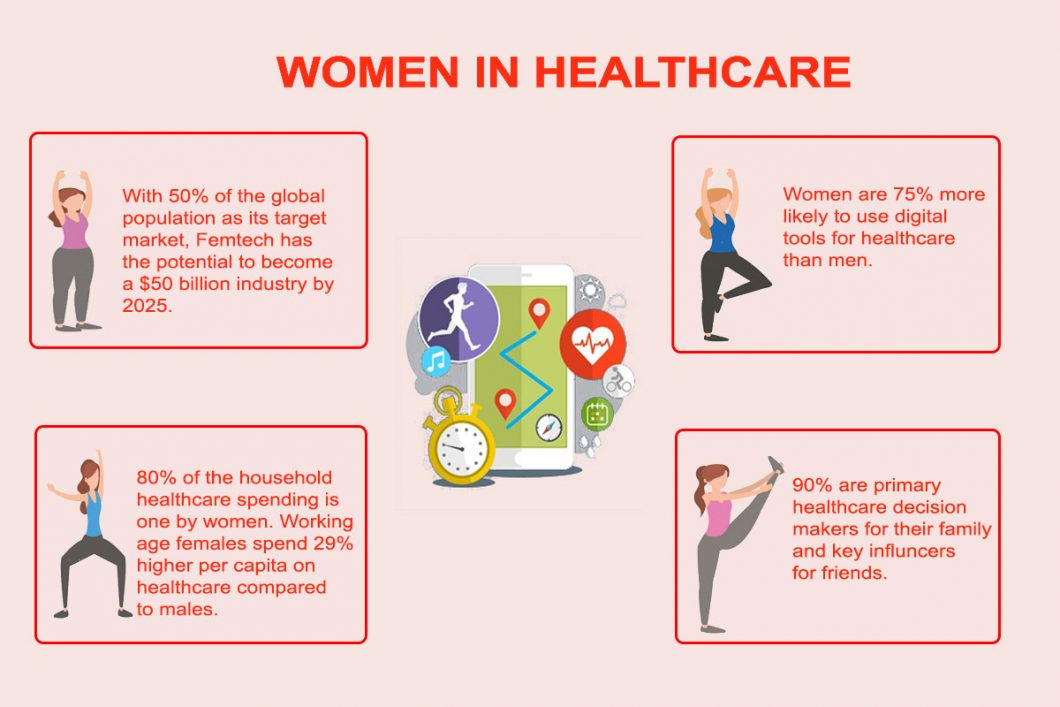
Why Should Women’s Health Tracking And Lifestyle Applications Be Developed?
Women’s health needs often change across different stages of life, from menstruation and fertility to pregnancy, postpartum care, and menopause. Managing these health factors manually can be challenging, creating a growing demand for digital solutions that provide accurate tracking and personalized guidance.
Women’s health tracking applications help users monitor symptoms, predict menstrual cycles, track fertility windows, record lifestyle habits, and receive timely health reminders. These applications also enable users to gain better insights into their overall well-being through data-driven recommendations and continuous health monitoring.
Women’s Health App Market Statistics and Trends
The demand for women’s health applications continues to grow as users seek convenient and personalized ways to manage their health. Advances in artificial intelligence, wearable technology, and telehealth services have accelerated the adoption of digital health solutions across the globe.
Here are some key statistics highlighting the growth of the FemTech industry:
- The global FemTech market is projected to exceed $100 billion by 2030, driven by increasing investment in women’s healthcare technologies.
- More than 60% of women use at least one health or wellness application to track fitness, nutrition, reproductive health, or overall well-being.
- Period and fertility tracking applications remain among the most downloaded healthcare apps worldwide.
- The growing adoption of wearable devices, such as smartwatches and fitness trackers, has increased demand for applications that provide real-time health monitoring and personalized insights.
- Telehealth and virtual healthcare services continue to expand, encouraging the integration of online consultations and remote patient monitoring features into women’s health applications.
These trends demonstrate that women’s health tracking apps are no longer limited to cycle monitoring. They have evolved into comprehensive healthcare platforms that support preventive care, symptom tracking, fertility management, pregnancy monitoring, and long-term wellness.
Types of Healthcare Application
Women’s health applications serve different healthcare needs, helping users monitor their well-being at various stages of life. Some of the most popular types of women’s health apps include:
1. Period and Fertility Tracking Apps
These applications help users track menstrual cycles, ovulation periods, fertility windows, and reproductive health patterns. They provide predictions, reminders, and personalized insights based on user data.
2. Pregnancy Tracking Apps
Pregnancy apps allow users to monitor fetal development, track pregnancy milestones, receive health tips, and stay informed throughout each stage of pregnancy.
3. Birth Control and Contraception Apps
These applications help users manage birth control schedules, set medication reminders, and track reproductive health information related to contraception.
4. Telehealth and Online Consultation Apps
Telehealth applications connect users with healthcare professionals through virtual consultations, secure messaging, appointment scheduling, and digital prescriptions.
5. Menopause Management Apps
These apps help women track menopause symptoms, hormonal changes, sleep patterns, and overall wellness while providing educational resources and personalized recommendations.
6. Mental Wellness Applications
Mental health apps focus on stress management, emotional well-being, mindfulness, mood tracking, and self-care support designed specifically for women’s health needs.
7. Wellness and Lifestyle Tracking Apps
These applications combine fitness tracking, nutrition monitoring, sleep analysis, and health goal management to support overall well-being and preventive healthcare.
Benefits of Health Tracking Application For Women:
Women’s health tracking applications help users take a more proactive approach to managing their health. By providing real-time insights, reminders, and personalized recommendations, these applications support better health outcomes and improve overall well-being.
Better Health Awareness
Users can monitor menstrual cycles, fertility windows, symptoms, and lifestyle habits from a single platform. This helps them understand their health patterns and make informed decisions.
Personalized Health Insights
Modern applications use data analytics and AI to provide tailored recommendations based on user behavior, symptoms, and health goals.
Improved Medication and Appointment Management
Automated reminders help users stay consistent with medications, health checkups, and important healthcare appointments.
Enhanced Pregnancy and Fertility Tracking
Women can track ovulation cycles, fertility periods, pregnancy milestones, and important health indicators throughout their reproductive journey.
Easy Access to Healthcare Services
Many applications integrate telemedicine features, allowing users to consult healthcare professionals, schedule appointments, and access medical guidance remotely.
Better Health Record Management
Users can securely store health data, reports, prescriptions, and medical history in one place, making it easier to share information with healthcare providers when needed.
Support for Preventive Healthcare
Continuous health monitoring helps identify potential health concerns early, encouraging timely medical intervention and long-term wellness management.
Benefits That A Service Marketplace For Doctors Provides:
As the physical patients’ attendance and check up burden keeps on escalating. A mobile app or a Online Doctor Consultation App provides the much needed relief to the doctors where they can easily attend to their patients through application and give them the required consultation. The application also provides a secure medium for them to get the payments transferred to their bank account making it a valuable and safer medium to engage well with the patients and earnings too.
Leading technologies like Internet Of Things services, Artificial Intelligence services, are providing some of the advanced integrated solutions to develop feature based doctor marketplace solutions.
The application allows doctors to manage their day-day routine, appointments calendar, online check on the inventory, staff management, and other valuable features to help you to ease out your consultation proceedings.
As per reports, around 70% doctors believe that having a feature based application for running their consultation will help them provide service to more patients and also ease in doing it.
What Are Some Of The Most Popular Female Health-Tracking Apps?

Several women’s health applications have gained popularity by offering features such as cycle tracking, fertility monitoring, pregnancy support, and personalized health insights. These apps provide valuable examples for businesses planning to develop a women’s health tracking solution.
| App | Primary Purpose | Key Features |
|---|---|---|
| Clue | Period and cycle tracking | Cycle predictions, symptom tracking, fertility insights |
| Flo | Reproductive health tracking | AI-powered cycle tracking, ovulation calendar, pregnancy mode |
| Natural Cycles | Fertility and birth control | Fertility tracking, ovulation prediction, temperature monitoring |
| Ovia | Fertility and pregnancy tracking | Fertility forecasts, pregnancy monitoring, health insights |
| Glow | Fertility management | Cycle tracking, fertility predictions, community support |
Clue
Clue is a science-based health tracking application that helps users monitor menstrual cycles, ovulation patterns, symptoms, and reproductive health trends through data-driven insights.
Flo
Flo is one of the most widely used women’s health applications, offering period tracking, fertility monitoring, pregnancy support, and personalized health recommendations powered by artificial intelligence.
Natural Cycles
Natural Cycles focuses on fertility awareness and birth control. The application uses body temperature data and cycle information to help users understand fertility patterns.
Ovia
Ovia provides fertility, pregnancy, and parenting support through personalized health tracking, educational content, and wellness insights.
Glow
Glow combines fertility tracking with community-driven support, helping users monitor reproductive health while connecting with others who share similar health goals.
Features to Include When Making A Women’s Health App
The success of a women’s health tracking application largely depends on its ability to deliver accurate health insights, a seamless user experience, and personalized support. Below are the essential features to consider when developing a modern women’s health app.
User Registration and Onboarding
A simple onboarding process helps users quickly set up their profiles and start using the application. Users should be able to register using email, phone numbers, or social login options.
Detailed User Profile
The app should allow users to create personalized profiles by adding information such as age, weight, height, medical history, lifestyle habits, and health goals. This data helps generate more accurate recommendations.
Period and Fertility Tracking
This core feature enables users to track menstrual cycles, ovulation periods, fertility windows, symptoms, and cycle irregularities. The app can also provide cycle predictions and health insights based on historical data.
Pregnancy Tracking
Pregnancy tracking features help users monitor fetal development, track pregnancy milestones, receive health updates, and access educational resources throughout pregnancy.
Reminders and Notifications
Automated notifications can remind users about medication schedules, upcoming periods, ovulation windows, appointments, and health checkups.
AI-Powered Health Insights
Artificial intelligence can analyze user data to identify patterns, provide personalized recommendations, and help users better understand changes in their health and wellness.
Wearable Device Integration
Integration with wearable devices such as smartwatches and fitness trackers enables the app to collect real-time health data, including heart rate, sleep patterns, activity levels, and other wellness metrics.
Symptom Tracking and Health Analytics
Users should be able to log symptoms and monitor health trends through visual dashboards and reports. This helps improve self-awareness and supports informed healthcare decisions.
Telemedicine and Online Consultations
The app can provide access to healthcare professionals through video consultations, secure messaging, appointment scheduling, and digital prescriptions.
Health Record Management
Users should be able to securely store medical reports, prescriptions, test results, and other health records in one centralized location.
Community Support
A community feature allows users to share experiences, discuss health topics, and receive support from others with similar health concerns.
Data Privacy and Security
Since women’s health applications handle sensitive personal information, strong security measures such as data encryption, secure authentication, and privacy controls are essential.
Health Report Sharing
Users should be able to generate and share health reports with doctors, making consultations more efficient and data-driven.
Future Trends in Women’s Health App Development
The FemTech industry continues to evolve as emerging technologies reshape how women access and manage healthcare. Modern women’s health applications are moving beyond basic tracking features and becoming comprehensive digital health platforms.
AI-Powered Personalization
Artificial intelligence is helping health applications deliver personalized recommendations based on user behavior, health history, symptoms, and wellness goals. This enables more accurate health insights and predictive monitoring.
Wearable-Driven Health Monitoring
The growing adoption of smartwatches and fitness trackers is enabling continuous monitoring of health metrics such as heart rate, sleep quality, physical activity, and stress levels. Future applications will rely more heavily on wearable-generated data.
Remote Patient Monitoring
Healthcare providers are increasingly using digital tools to monitor patients remotely. Women’s health apps can support ongoing care by sharing health data with medical professionals in real time.
Telehealth Integration
Virtual consultations are becoming a standard healthcare service. Future women’s health applications will offer seamless access to healthcare providers through video consultations, secure messaging, and digital prescriptions.
Predictive Healthcare Analytics
Advanced analytics can help identify health patterns and potential risks before they become serious concerns. This supports preventive care and encourages early intervention.
Personalized Wellness Programs
Future applications will provide customized wellness plans covering nutrition, fitness, mental health, reproductive health, and lifestyle management based on individual user needs.
Enhanced Data Privacy and Security
As users become more concerned about personal health data, developers will continue investing in stronger security measures, transparent privacy policies, and compliance with healthcare regulations.
These trends demonstrate how women’s health applications are evolving into intelligent healthcare ecosystems that support preventive care, personalized health management, and improved patient engagement.
What Are The Difficulties In Making A Women’s Health Tracking App?
Developing a women’s health tracking application involves more than building tracking features. Developers must address challenges related to data accuracy, privacy, compliance, and user engagement to deliver a reliable and secure healthcare solution.
Data Privacy and Security
Women’s health applications collect sensitive personal information, including menstrual cycles, fertility data, pregnancy records, and medical history. Protecting this data through encryption, secure authentication, and access controls is essential for building user trust.
Regulatory Compliance
Healthcare applications must comply with regulations such as HIPAA, GDPR, and other regional healthcare data protection laws. Failure to meet compliance requirements can lead to legal and financial risks.
Ensuring Data Accuracy
Users rely on health insights and predictions to make important decisions. Inaccurate tracking or recommendations can reduce trust and negatively impact the user experience. Developers must validate algorithms and health-related calculations carefully.
Wearable Device Integration
Integrating data from smartwatches, fitness trackers, and health monitoring devices can be complex due to varying device standards, APIs, and data formats.
User Retention and Engagement
Many users stop using health applications after a few weeks. Features such as personalized recommendations, reminders, progress tracking, and health insights help maintain long-term engagement.
AI Model Reliability
As AI-powered features become more common, developers must ensure that recommendations are accurate, transparent, and supported by credible health data. AI should assist users, not replace professional medical advice.
Scalability and Performance
As the user base grows, the application must be able to process large volumes of health data while maintaining fast performance, high availability, and a seamless user experience.
Building User Trust
Healthcare applications must provide transparent privacy policies, clear consent mechanisms, and reliable health information to gain and maintain user confidence.
Addressing these challenges during the development process helps create a secure, compliant, and user-friendly women’s health application that delivers long-term value to both users and healthcare providers.
Conclusion
If your business is looking to progress itself on the healthcare frontier and women health tracking application is what you are actively looking to engage your audience with.
HashStudioz Technologies is the desired company that can help you to develop an optimal and enhanced women health tracking app with its expert team of developers. The team also can help you get the consultation on your requirements that help you engage well on the other healthcare developments as well.
To know more about the leading developments taking place for growing your healthcare business and to consult on women health tracking app development, connect with us at info@localhost