


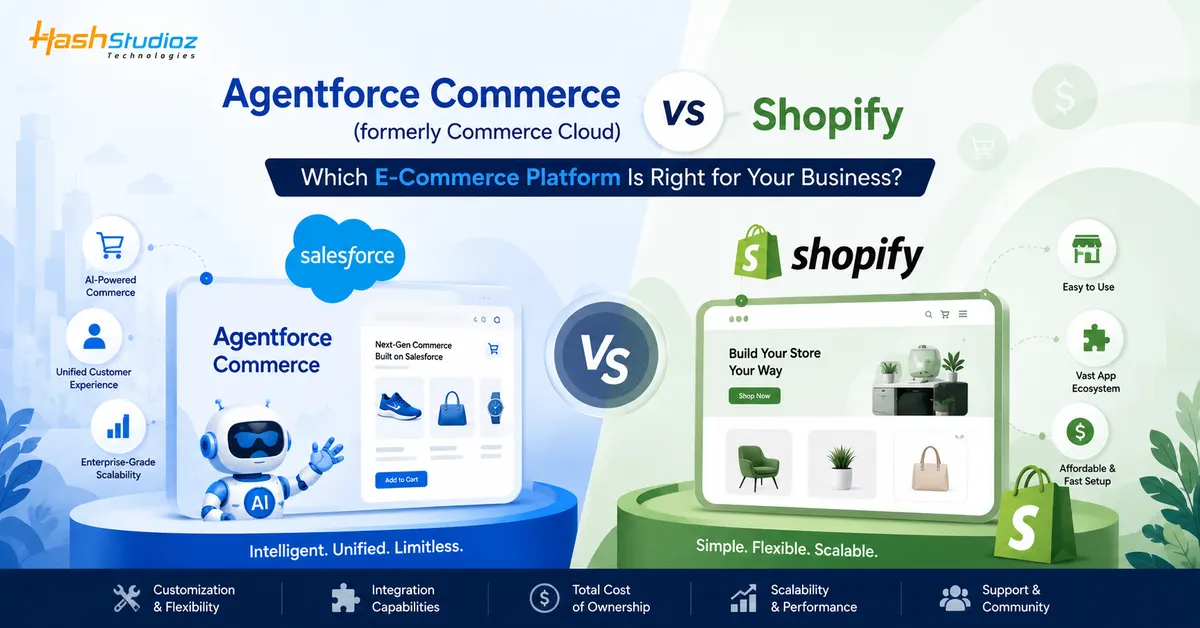
Choosing the right e-commerce platform can have a long-term impact on how a business manages products, customers, orders, marketing, and digital experiences. While Shopify has become a popular choice for businesses looking for a streamlined and easy-to-manage commerce platform, Salesforce offers a more enterprise-focused approach through Agentforce Commerce, formerly known as Commerce Cloud.
Agentforce Commerce combines digital commerce capabilities with Salesforce’s broader customer and business ecosystem. Salesforce describes it as a unified platform spanning ecommerce, point of sale, and order management, with Agentforce AI capabilities supporting shoppers and merchants.
Shopify, on the other hand, is known for its hosted commerce platform, extensive app ecosystem, and relatively straightforward store management. The better option depends less on which platform is universally “best” and more on your business size, existing technology stack, customization requirements, budget, and growth plans.
This comparison explores Agentforce Commerce vs Shopify to help businesses understand where each platform fits.
Table of Contents
What Is Agentforce Commerce?
Agentforce Commerce is the new name for Salesforce Commerce Cloud. Salesforce says the rebranding reflects the platform’s evolution toward agentic commerce, with AI capabilities designed to support guided shopping, merchandising, and commerce operations.
The platform supports both B2C and B2B commerce and includes capabilities extending from digital storefronts to back-end order management. It can also connect commerce activities with the broader Salesforce ecosystem.
One of its major differentiators is its connection with Salesforce’s customer data and AI ecosystem. This can be particularly valuable for organizations already using Salesforce CRM, Service Cloud, Marketing Cloud, or other Salesforce products.
What Does Agentforce Add to Commerce?
Agentforce introduces AI-powered capabilities into the commerce experience. Salesforce’s current commerce offering includes shopper, buyer, and merchant agents, with capabilities designed to assist customers and commerce teams.
For example, AI can help with:
- Guided shopping experiences
- Product discovery
- Merchandising activities
- Personalized recommendations
- Customer interactions
- Commerce-related tasks and workflows
This makes Agentforce Commerce more than a storefront platform, it is positioned as part of a broader AI-powered commerce ecosystem.
What Is Shopify?
Shopify is a hosted e-commerce platform that allows businesses to create and manage online stores without having to build their commerce infrastructure from scratch.
Its ecosystem includes storefront management, product management, checkout, payments, marketing capabilities, analytics, point-of-sale functionality, and an extensive marketplace of apps and integrations.
Shopify can serve businesses ranging from smaller online stores to large enterprises through Shopify Plus. Its managed SaaS model can make launching and maintaining a store comparatively straightforward.
Agentforce Commerce vs Shopify: Key Differences
Although both platforms can support online selling, their approaches are different.
| Factor | Agentforce Commerce | Shopify |
| Primary Strength | Enterprise commerce connected with Salesforce | Easy-to-manage, scalable SaaS commerce |
| CRM Ecosystem | Strong native connection with Salesforce | Requires integrations for many external CRM workflows |
| AI & Agents | Agentforce-powered commerce capabilities | Shopify offers AI features such as Shopify Magic and Sidekick |
| Customization | Strong enterprise customization and Salesforce extensibility | Extensive ecosystem, but platform boundaries apply |
| B2B Commerce | Designed to support complex B2B and B2C requirements | Strong B2B capabilities, particularly with Shopify Plus |
| Order Management | Integrated commerce and order-management capabilities | Available through Shopify’s platform and ecosystem |
| Implementation | Often requires more planning and technical expertise | Generally faster to launch |
| App Ecosystem | Salesforce ecosystem and integrations | Large Shopify app ecosystem |
| Best Fit | Salesforce-centric and complex enterprise businesses | Businesses prioritizing simplicity and speed |
| Scalability | Strong fit for complex enterprise ecosystems | Strong fit from growing businesses to enterprise |
The right choice therefore depends on the complexity of your commerce environment rather than simply the number of features each platform provides.
1. Salesforce Ecosystem vs Shopify Ecosystem
One of the biggest differences is the surrounding technology ecosystem.
Agentforce Commerce is designed to work within Salesforce’s broader environment. This can connect commerce with customer information, sales processes, service interactions, marketing activities, and other Salesforce capabilities.
Shopify has a large ecosystem of applications, agencies, developers, and technology partners. This provides flexibility and allows businesses to extend their stores through apps and integrations. For businesses already deeply invested in Salesforce, this can reduce the separation between commerce and CRM data.
Agentforce Commerce may be more suitable when, your organization already relies heavily on Salesforce.
Shopify may be more suitable when: you want a commerce-first platform with a large ecosystem of extensions and a streamlined administration experience.
2. AI and Agentic Commerce
AI is becoming an increasingly important part of e-commerce.
Agentforce Commerce places AI agents directly into the commerce experience. Salesforce currently positions Shopper Agent, Buyer Agent, and Merchant Agent as part of its agentic commerce offering. These capabilities can support both customer-facing and merchant-facing activities.
For example, a shopper could receive guided assistance while searching for products, while merchant teams could use AI capabilities to support merchandising and product-related tasks. Salesforce also highlights AI-native search and guided conversational shopping within Agentforce Commerce.
Shopify also provides AI capabilities through tools such as Shopify Magic and Sidekick, which can assist merchants with content, store management, and other tasks.
The difference is therefore not simply AI vs no AI. The more useful question is: Which AI ecosystem fits your commerce operations and customer data strategy?
For organizations already using Salesforce data and workflows, Agentforce can offer deeper alignment with the existing ecosystem.
3. Customization and Flexibility
Customization is especially important for enterprise organizations with complex catalogs, pricing rules, customer journeys, integrations, or B2B workflows.
Agentforce Commerce is designed for organizations that may need sophisticated commerce experiences and connections with other enterprise systems. Businesses can build integrations and custom processes around Salesforce APIs, data, and platform capabilities.
Shopify also provides extensive customization through themes, apps, APIs, and development tools. However, businesses need to consider Shopify’s platform architecture and determine whether it can accommodate their specific requirements without excessive third-party dependencies.
Which Is More Flexible?
There is no universal answer.
Choose Agentforce Commerce when:
- Your business has complex enterprise processes.
- You already use Salesforce extensively.
- You need deeper CRM-commerce connectivity.
- Your commerce environment requires extensive enterprise integration.
Choose Shopify when:
- You prioritize faster implementation.
- Your requirements can largely be handled through Shopify’s platform and apps.
- Your team prefers a simpler commerce administration experience.
4. B2B Commerce Capabilities
B2B commerce often involves more complex requirements than standard B2C transactions.
Businesses may need:
- Customer-specific pricing
- Account hierarchies
- Multiple buyers
- Approval workflows
- Contract-based purchasing
- Custom catalogs
- Large product assortments
- ERP integration
- Complex order management
Agentforce Commerce supports both B2B and B2C commerce scenarios, while Salesforce B2B Commerce is designed around complex business purchasing processes.
Shopify has also expanded its B2B capabilities, particularly through Shopify Plus. Therefore, businesses should evaluate their actual B2B requirements rather than assuming that one platform is automatically better.
5. Integration With Business Systems
Integration can become one of the most important factors when selecting an enterprise commerce platform.
A growing business may need to connect its commerce platform with:
- ERP
- CRM
- Payment systems
- Inventory management
- Marketing automation
- Customer service
- Data warehouses
- Logistics platforms
- Legacy applications
Agentforce Commerce can be especially attractive to businesses already operating within the Salesforce ecosystem. For organizations with complex integrations outside Salesforce, middleware and API-led integration can also play an important role.
Shopify has a large integration ecosystem and can connect with numerous third-party systems through apps, APIs, and external integration platforms. The key question is not simply whether a platform can integrate with another system, but how easily the integration can be maintained as the business grows.
6. Ease of Implementation
Implementation is another major difference.
Shopify’s hosted SaaS approach can make it relatively straightforward for businesses to launch an online store. Businesses can select a theme, configure products and payments, install required apps, and begin selling.
Agentforce Commerce is typically more appropriate for organizations with broader enterprise requirements. Implementation may involve commerce architecture, Salesforce configuration, integrations, data migration, customization, and business-process alignment.
Independent comparisons also indicate that Salesforce Commerce Cloud can involve greater implementation effort than Shopify, although actual costs and timelines vary significantly by business requirements and implementation scope. Therefore, businesses should evaluate total implementation requirements, rather than comparing platforms solely by their initial setup experience.
7. Cost and Total Cost of Ownership
Cost should be evaluated beyond the monthly platform subscription.
Consider:
- Licensing
- Implementation
- Development
- Apps and extensions
- Integrations
- Maintenance
- Support
- Data migration
- Customization
- Third-party services
Shopify generally offers more visible plan-based pricing, while Salesforce Commerce Cloud pricing is typically customized for enterprise requirements.
A business should calculate the cost of running its entire commerce ecosystem, including integrations, development, applications, and ongoing support. However, a lower initial platform cost does not automatically mean a lower total cost of ownership.
Agentforce Commerce vs Shopify: Which Is Better for Your Business?
Instead of asking which platform is universally better, businesses should identify which platform fits their requirements.
Choose Agentforce Commerce If:
- You already use Salesforce CRM or other Salesforce products.
- You need deep CRM and commerce connectivity.
- You operate complex B2B or enterprise commerce processes.
- You want AI-powered commerce capabilities integrated with Salesforce.
- You require extensive enterprise integrations.
- You need a commerce platform that can support complex customer journeys.
- Your organization has the resources for enterprise implementation and customization.
Choose Shopify If:
- You want to launch quickly.
- Ease of administration is a major priority.
- Your commerce requirements are relatively straightforward.
- You want access to a large app ecosystem.
- You prefer a managed SaaS commerce environment.
- You want predictable, plan-based pricing options.
- Your business does not require extensive Salesforce-centric architecture.
Ready to Choose the Right Commerce Platform?
Compare your business needs and growth plans to choose between Agentforce Commerce and Shopify
Agentforce Commerce vs Shopify for Different Business Types
| Business Scenario | Potentially Better Fit | Why |
| Small or growing online store | Shopify | Faster setup and simpler administration |
| Salesforce-centric enterprise | Agentforce Commerce | Strong connection with Salesforce data and workflows |
| Complex B2B business | Agentforce Commerce / Shopify Plus | Depends on specific B2B requirements |
| Fast-growing DTC brand | Shopify | Strong SaaS model and commerce ecosystem |
| Enterprise with complex integrations | Agentforce Commerce | Strong enterprise ecosystem and integration capabilities |
| Business prioritizing AI commerce | Agentforce Commerce | Native Agentforce commerce capabilities |
| Business prioritizing quick launch | Shopify | Generally simpler implementation |
| Multi-system enterprise ecosystem | Agentforce Commerce | Strong fit for Salesforce-centered architecture |
This table should be treated as a starting point rather than a universal recommendation. The right platform depends on catalog complexity, geography, B2B requirements, integrations, existing technology investments, and internal resources.
Conclusion
There is no single winner in the Agentforce Commerce vs Shopify comparison. Agentforce Commerce suits enterprises seeking advanced Salesforce connectivity, AI-powered commerce, and complex integrations, while Shopify is ideal for businesses prioritizing ease of use and faster deployment. If your business already relies on Salesforce, Agentforce Commerce Services can offer a more connected approach. The right choice ultimately depends on your business needs, scalability goals, integrations, and long-term strategy.
FAQs
1. What is the difference between Agentforce Commerce and Shopify?
Agentforce Commerce is Salesforce’s enterprise commerce platform with AI and Salesforce ecosystem connectivity, while Shopify focuses on easy-to-manage, scalable e-commerce.
2. Is Agentforce Commerce better than Shopify?
It depends on your business needs. Agentforce Commerce may be better for Salesforce-centric enterprises, while Shopify can suit businesses prioritizing simplicity and faster deployment.
3. Can Agentforce Commerce integrate with Salesforce CRM?
Yes. Agentforce Commerce is designed to work closely with the Salesforce ecosystem, enabling commerce and customer data to work together.
4. Which platform is better for enterprise e-commerce?
Agentforce Commerce can be a strong choice for enterprises with complex integrations, B2B requirements, and existing Salesforce infrastructure. Shopify Plus may also be suitable depending on business requirements.
5. Should I choose Agentforce Commerce or Shopify?
Consider your existing technology stack, integration needs, customization requirements, budget, scalability goals, and long-term e-commerce strategy before deciding.