



Industrial businesses often struggle with disconnected machines, legacy PLC systems, and isolated production data. These gaps slow decision-making and increase downtime costs. Research shows that unplanned industrial downtime can cost manufacturers thousands of dollars per hour depending on the production environment.
OPC UA helps industrial systems exchange data securely across machines, sensors, SCADA platforms, cloud systems, and analytics tools. It supports interoperability between devices from different vendors without relying on proprietary communication methods.
Modern factories now combine OPC UA with edge computing, MQTT brokers, cloud platforms, and AI-driven analytics to monitor operations in real time.
Table of Contents
What is OPC UA?
OPC UA stands for Open Platform Communications Unified Architecture. It is a machine-to-machine communication protocol for industrial automation developed by the OPC Foundation. Unlike its predecessor, OPC Classic, OPC UA is platform-independent and ensures secure and reliable data exchange in industrial automation and other domains.
Why Industrial Businesses Use OPC UA
Modern factories use PLC systems, sensors, edge devices, cloud platforms, and analytics tools that must exchange data continuously. However, many industrial environments still struggle with disconnected systems and incompatible communication protocols.
These communication gaps reduce operational visibility and slow real-time decision-making. OPC UA helps businesses connect industrial systems through secure and standardized data exchange.
Common Industrial Communication Problems
Many industrial facilities still face challenges such as:
- Legacy PLC systems cannot exchange data easily
- Different vendors use incompatible protocols
- Production data stays isolated in silos
- Cloud platforms struggle with factory-floor integration
- Real-time monitoring becomes difficult
- Manual reporting slows operational decisions
How OPC UA Solves These Problems
OPC UA creates a common communication framework for industrial systems. It allows machines, software platforms, edge gateways, and cloud applications to exchange data securely.
| Industrial Problem | How OPC UA Helps |
| Vendor lock-in | Supports interoperability |
| Isolated machine data | Connects systems centrally |
| Weak security | Uses encryption and certificates |
| Poor scalability | Supports enterprise expansion |
| Limited cloud connectivity | Integrates with Azure and AWS |
Edge-to-Cloud Connectivity in Industrial IoT
Industrial businesses now connect factory-floor systems with cloud platforms to monitor operations in real time. Edge gateways play an important role by transferring machine data securely between industrial devices and cloud infrastructure.
OPC UA supports this edge-to-cloud communication by standardizing data exchange across PLC systems, sensors, SCADA platforms, and analytics applications. This architecture improves operational monitoring and supports faster industrial decision-making.
OPC UA and Cloud Integration
Modern industrial businesses use cloud platforms for analytics, remote monitoring, predictive maintenance, and operational reporting. However, many factories still use systems that cannot connect easily with modern cloud infrastructure.
OPC UA supports secure communication between industrial devices, edge gateways, and cloud platforms. Businesses can connect factory-floor systems with platforms such as Azure IoT and AWS IoT without relying on proprietary vendor protocols.
This flexibility helps businesses expand operations, improve data visibility, and reduce vendor dependency across industrial environments.
Core Capabilities of OPC UA
OPC UA helps industrial businesses connect machines, software platforms, and cloud systems through secure and standardized communication.
1. Platform Independence
OPC UA works across different operating systems, industrial devices, and hardware environments. Businesses can integrate legacy systems with modern industrial applications more easily.
2. Secure Data Exchange
OPC UA supports encryption, authentication, and certificate-based communication. These security features help protect industrial data from unauthorized access.
3. Scalability
Businesses can use OPC UA across small production setups or large industrial environments with thousands of connected devices.
4. Interoperability
OPC UA allows systems from different vendors to exchange data through a common communication standard. This reduces integration complexity across industrial operations.
5. Real-Time Data Visibility
Industrial teams can monitor machine data, production metrics, and operational performance continuously through connected dashboards and analytics platforms.
Benefits of OPC UA in Industrial IoT
Industrial businesses need secure and reliable communication between machines, software platforms, cloud systems, and analytics tools. OPC UA helps organizations improve connectivity, operational visibility, and real-time data exchange across industrial environments.
1. Better System Connectivity
OPC UA helps industrial devices, PLC systems, cloud platforms, and software applications exchange data through a common communication standard.
2. Improved Operational Visibility
Industrial teams can monitor production data, equipment status, and operational performance in real time through connected dashboards.
3. Stronger Security
OPC UA supports encryption, authentication, and certificate-based communication to protect industrial data across connected environments.
4. Easier Cloud Integration
Businesses can connect industrial systems with platforms such as Azure IoT and AWS IoT for analytics, monitoring, and predictive maintenance.
5. Reduced Downtime
Real-time machine monitoring helps businesses identify equipment issues earlier and reduce unexpected production downtime.
OPC UA Architecture in Industrial IoT
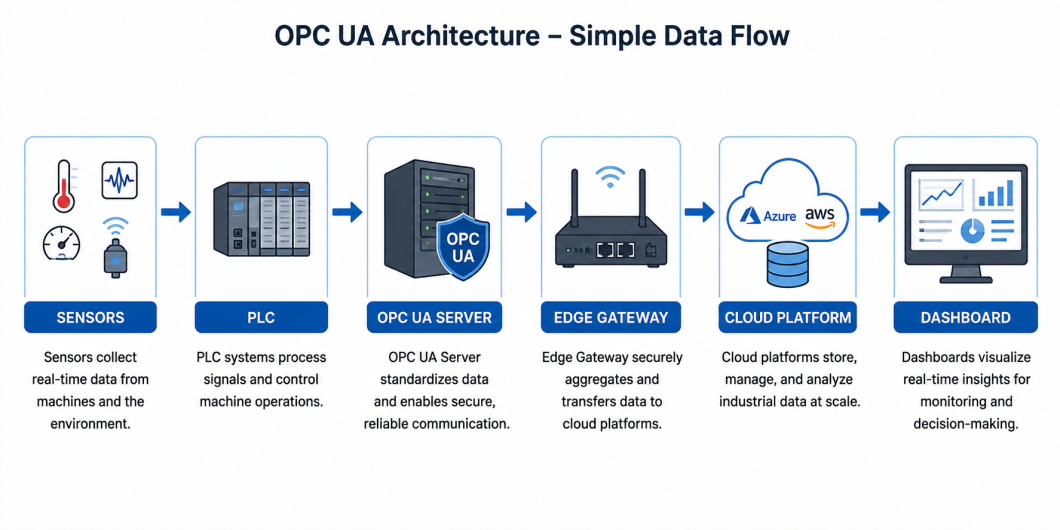
Modern industrial environments use multiple systems that must exchange data continuously. OPC UA helps connect factory-floor devices, edge gateways, cloud platforms, and analytics systems through standardized communication.
Typical OPC UA Data Flow
| Layer | Role in Industrial IoT |
| Sensors | Collect machine and environmental data |
| PLC Systems | Process operational signals |
| OPC UA Server | Standardize industrial communication |
| Edge Gateway | Transfer data securely to cloud systems |
| Cloud Platform | Store and analyze operational data |
| Analytics Dashboard | Display production and machine insights |
How the Architecture Works
- Sensors collect operational data from machines
- PLC systems process machine signals
- OPC UA servers standardize communication
- Edge gateways transfer data to cloud platforms
- Analytics dashboards display real-time insights
Applications of OPC UA in Various Industries
OPC UA supports secure communication across industrial systems, cloud platforms, and connected devices. Businesses use the protocol to improve operational visibility, equipment monitoring, and industrial automation across multiple sectors.
Industry reports suggest that industrial IoT adoption continues increasing as businesses invest in automation, predictive maintenance, and connected operations.
1. Manufacturing
Manufacturers use OPC UA to connect machinery, sensors, and control systems for real-time monitoring and production management.
2. Energy
OPC UA is used in the energy industry for monitoring and controlling power generation and distribution systems, ensuring reliable and efficient energy management.
3. Healthcare
In healthcare, OPC UA facilitates the integration of medical devices and information systems, improving patient care and operational efficiency.
4. Smart Warehouses
Warehouses use OPC UA to connect robotics systems, conveyor equipment, sensors, and inventory platforms. Real-time monitoring helps businesses improve inventory visibility and warehouse automation.
Challenges and Considerations
While OPC UA offers many benefits, businesses may still face challenges during implementation across industrial IoT environments.
1. Integration Complexity
Integrating OPC UA with existing systems and devices can be complex and may require specialized expertise.
2. Data Security
Ensuring the security of data exchanged between devices and the cloud is paramount. Organizations must implement robust security measures to protect against cyber threats.
3. Cost of Implementation
The initial cost of implementing OPC UA and developing plug & play cloud solutions can be significant, although the long-term benefits often outweigh these costs.
Future Trends in OPC UA and Industrial IoT
Industrial automation continues evolving as businesses invest in connected infrastructure, edge computing, and AI-driven analytics. OPC UA will continue supporting secure communication across industrial systems, cloud platforms, and real-time monitoring environments.
1. Edge Computing Expansion
More industrial businesses now process machine data closer to equipment through edge gateways and local computing systems. This approach improves response times and reduces cloud dependency.
2. AI-Based Predictive Maintenance
Manufacturers increasingly use AI models and machine learning tools to detect equipment issues before failures occur. OPC UA supports continuous data exchange between machines, analytics platforms, and monitoring systems.
3. Growth of Unified Namespace Architecture
Modern industrial environments now use Unified Namespace (UNS) architecture to centralize operational data across connected systems. OPC UA plays an important role in supporting standardized industrial communication within UNS environments.
4. Industrial Digital Twins
Businesses increasingly build digital replicas of machines and production environments to monitor operational performance and simulate industrial processes in real time.
5. OPC UA Over TSN
Industrial businesses continue exploring OPC UA over Time-Sensitive Networking (TSN) for faster and more reliable industrial communication in real-time automation environments.
Get Started Today!
Contact us now to discover how our OPC UA solutions can transform your business. Embrace the power of seamless connectivity and take your operations to the next level with HashStudioz.
Conclusion
OPC UA continues to play an important role in industrial automation and Industrial IoT environments. Businesses now combine OPC UA with edge computing, cloud platforms, AI-driven analytics, and real-time monitoring systems to improve operational visibility and reduce downtime.
As industrial digital transformation continues through 2026, OPC UA will remain a key technology for secure, scalable, and connected operations across manufacturing, energy, and industrial infrastructure.
FAQs
1. What is OPC UA used for in industrial automation?
OPC UA helps industrial systems exchange data securely across machines, PLC systems, SCADA platforms, cloud applications, and analytics tools. Businesses use it for real-time monitoring, predictive maintenance, and industrial connectivity.
2. Can OPC UA connect with cloud platforms?
Yes. OPC UA supports integration with cloud platforms such as Azure IoT and AWS IoT. Businesses use this connectivity for remote monitoring, operational analytics, and Industrial IoT applications.
3. What is the difference between OPC UA and OPC Classic?
OPC UA is platform-independent and includes built-in security features such as encryption and authentication. OPC Classic mainly depended on Microsoft COM/DCOM technology and offered limited scalability for modern Industrial IoT environments.
4. Is OPC UA suitable for legacy industrial systems?
Yes. Businesses can connect older PLC systems and industrial equipment to modern applications through OPC UA gateways and protocol converters.
5. Why is OPC UA important for Industrial IoT in 2026?
Industrial businesses now depend on real-time data, edge computing, AI-driven analytics, and connected operations. OPC UA supports secure and standardized communication across these Industrial IoT environments.