


Digital interaction is shifting beyond screens. Today, people do not just browse the internet. They participate in it. Work meetings happen online. Shopping happens digitally. Entertainment platforms host live virtual events. Even education and healthcare now rely on remote and immersive systems. This shift is pushing the internet toward a more interactive layer where users can experience environments instead of just viewing them.
This is where the metaverse comes in. It represents the next stage of digital interaction where physical and virtual worlds connect through immersive technologies.
It is still evolving, but it is already influencing how businesses design digital experiences, how people socialize, and how services are delivered.
Table of Contents
What is the Metaverse?
The metaverse is a persistent 3D digital environment where users interact through avatars in real time. It combines virtual reality (VR), augmented reality (AR), artificial intelligence (AI), blockchain, and cloud computing to create shared immersive spaces.
In simple terms, it is a network of virtual worlds where people can work, play, shop, learn, and socialize without physical boundaries.
The experience is not limited to one platform or device. Instead, multiple systems and technologies work together to create a continuous digital ecosystem.
How the Metaverse Works
The metaverse operates through the integration of multiple technologies:
- VR and AR create immersive environments
- AI powers intelligent interactions and virtual characters
- Blockchain enables ownership of digital assets
- Cloud computing supports large-scale connectivity
- 3D engines build realistic environments
Together, these systems allow users to enter shared virtual spaces using avatars and interact in real time.
How the Metaverse Works
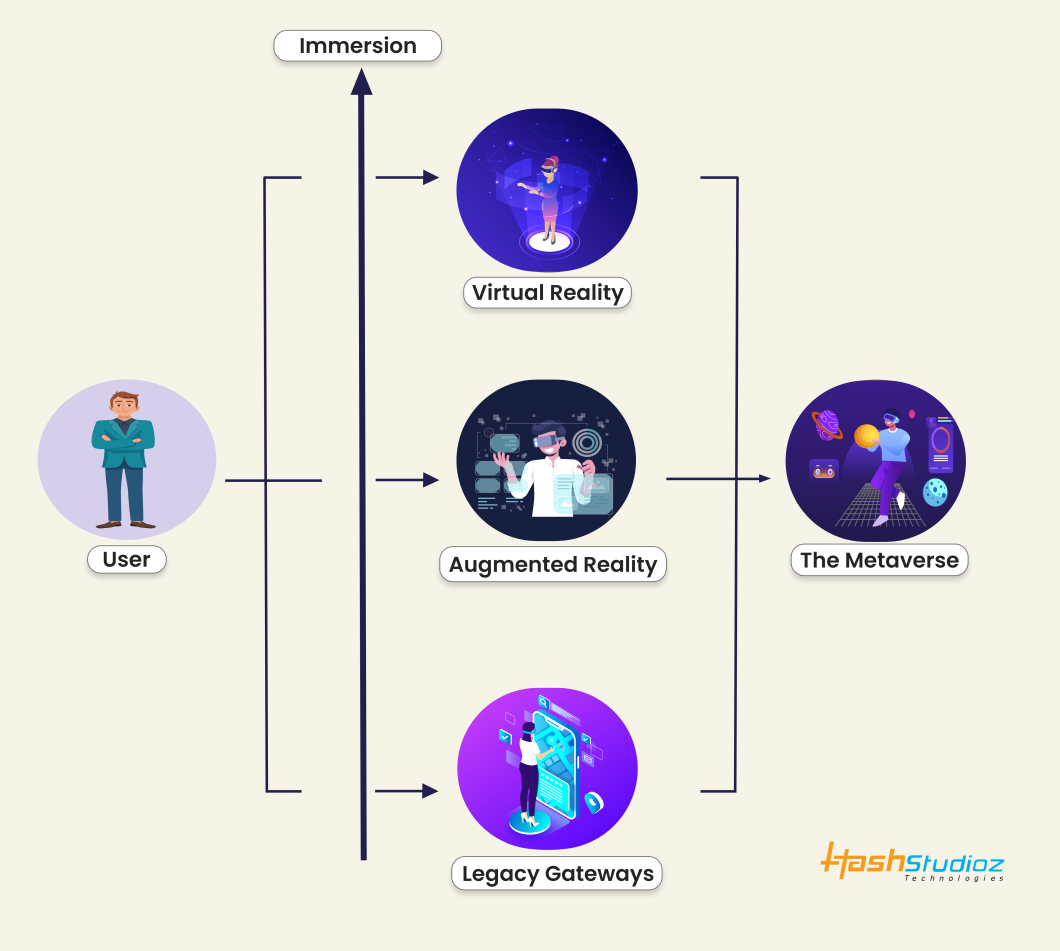
The metaverse is built by combining multiple advanced technologies that work together in real time. These technologies create a shared digital environment where users can interact through avatars.
At its core, the system depends on continuous data exchange, real-time rendering, and persistent virtual spaces.
Core Components
- 3D virtual environments create interactive digital spaces
- User avatars represent real people inside the system
- Real-time networking keeps interactions synchronized
- Cloud infrastructure supports large-scale access
- Blockchain systems manage ownership and transactions
Technology Integration Flow
- Users enter the metaverse using VR headsets, AR devices, or browsers
- AI systems generate environments, objects, and interactions
- 3D engines render the virtual world in real time
- Cloud systems process and distribute data globally
- Blockchain records ownership of digital assets and identities
Benefits of the Metaverse
The metaverse delivers value by improving how people work, learn, shop, and interact in digital environments. Its impact is strongest where real-time collaboration and immersive experiences matter.
Below are the key benefits, structured for clarity and real-world application.
Improved Remote Collaboration
The metaverse improves remote collaboration by replacing traditional video calls with immersive 3D environments. Teams can meet as avatars, interact in shared virtual spaces, and use digital tools like whiteboards and 3D models in real time. This creates a stronger sense of presence and improves communication efficiency, especially for distributed global teams.
Better Learning and Training
Education becomes more interactive in the metaverse as learners move from passive content consumption to active participation. Students can join virtual classrooms, perform simulations, and practice real-world skills in controlled digital environments. This improves engagement and helps learners retain complex concepts more effectively.
Advanced Healthcare Access
The metaverse supports healthcare by enabling virtual consultations, medical training simulations, and digital therapy environments. Doctors can interact with patients remotely while also using virtual models to study conditions or test treatments. This improves access to care, especially in remote or underserved regions.
Smarter Digital Commerce
In digital commerce, the metaverse introduces immersive shopping experiences where users can explore virtual stores and view products in 3D. This helps customers better understand products before purchasing, reducing uncertainty and improving buying confidence. It also creates new opportunities for brand engagement.
Enhanced Entertainment Experience
Entertainment becomes more interactive and social in the metaverse. Users can attend virtual concerts, watch movies with friends in shared digital theaters, and participate in immersive gaming environments. This creates a stronger sense of presence compared to traditional streaming or gaming platforms.
Virtual Tourism Access
The metaverse enables users to explore global destinations without physical travel. People can visit museums, historical sites, and landmarks through immersive virtual experiences. This improves accessibility and allows users to experience places that may otherwise be difficult to reach.
Metaverse Use Cases
The metaverse is transforming how businesses and individuals interact in digital environments. By combining immersive technologies with real-time collaboration, it creates new opportunities across industries. From gaming and healthcare to education, retail, and real estate, organizations are using the metaverse to improve user experiences, streamline operations, and develop innovative digital services.
Online Gaming Industry
The gaming industry is one of the strongest drivers of metaverse development. Games in the metaverse allow players to interact in persistent virtual worlds where assets, identities, and economies continue even when the user is offline. Many platforms also use blockchain-based systems that enable ownership of in-game items, which can be traded or sold across ecosystems. This creates a more immersive and economically active gaming environment compared to traditional models.
Healthcare Industry
In healthcare, the metaverse is used for remote consultations, medical training, and patient care simulations. Doctors can interact with patients in virtual clinics, which improves access to healthcare services in remote regions. Medical students can also practice procedures in simulated environments, reducing risk and improving training outcomes before real-world application.
Retail and E-Commerce
Retail businesses are adopting the metaverse to create immersive shopping experiences where customers can explore virtual stores and interact with products in 3D. This helps users make more informed decisions compared to static product images. It also enables brands to create interactive digital showrooms that increase engagement and improve conversion rates.
Real Estate Industry
The real estate sector uses the metaverse to offer virtual property tours that allow buyers to explore homes, offices, or commercial spaces remotely. This reduces the need for physical visits and speeds up decision-making. Buyers can also visualize customized interiors, which improves planning and investment confidence.
Education Sector
Educational institutions use the metaverse to create interactive learning environments where students can attend virtual classes, participate in simulations, and collaborate globally. This makes learning more engaging and helps explain complex subjects through visual and experiential methods rather than traditional text-based learning.
Challenges of the Metaverse
To build scalable and connected metaverse applications, businesses often rely on IoT development services that enable seamless communication between physical devices and virtual environments.
Privacy and Data Security Risks
The metaverse collects large volumes of personal data through devices like VR headsets, AR systems, and motion sensors. This includes behavioral data, biometric inputs, and location patterns. If not properly protected, this data can be exposed to breaches or misuse, raising serious privacy concerns for users and organizations.
Identity Verification and Fraud Issues
Since users interact through avatars, verifying real-world identity becomes difficult. This creates risks of impersonation, scams, and fake identities. Without strong authentication systems, malicious users can exploit anonymity to harm others or manipulate digital environments.
High Infrastructure Requirements
The metaverse depends on advanced infrastructure such as high-speed internet, powerful computing systems, and low-latency networks. These requirements increase operational costs and limit access for users in regions with weaker digital infrastructure. As a result, adoption remains uneven across global markets.
Device Dependency and Accessibility Barriers
Most metaverse experiences require specialized hardware such as VR headsets or AR-enabled devices. These devices are still expensive for mass adoption. This creates a gap between early adopters and general users, slowing down widespread usage.
Lack of Interoperability
Many metaverse platforms operate in isolated ecosystems, meaning users cannot easily transfer assets, identities, or experiences across different platforms. This fragmentation reduces the full potential of a unified digital universe and limits user freedom.
Technologies Powering the Metaverse
Artificial Intelligence (AI)
Artificial intelligence plays a central role in making metaverse environments interactive and adaptive. It powers virtual assistants, intelligent NPCs, personalized experiences, and real-time environment generation. AI also improves simulation accuracy by analyzing user behavior and adjusting virtual responses accordingly, making interactions more natural and responsive.
Blockchain Technology
Blockchain supports the metaverse by enabling secure digital ownership, transparent transactions, and decentralized identity systems. It allows users to own virtual assets such as land, avatars, and collectibles through NFTs. This ensures that ownership is verifiable and not controlled by a single centralized authority.
Augmented Reality (AR) and Virtual Reality (VR)
AR and VR act as the primary interface layers of the metaverse. VR creates fully immersive environments where users can enter digital worlds, while AR overlays digital elements onto the real world. Together, they bridge physical and virtual experiences and make interaction more immersive and intuitive.
Internet of Things (IoT)
The Internet of Things connects physical devices to digital systems, allowing real-world data to flow into the metaverse. Sensors, machines, and smart devices continuously feed information that helps create accurate digital representations of real environments. This is especially important for digital twins and simulation-based systems.
Cloud Computing and 3D Engines
Cloud computing provides the scalability required to support large numbers of users in real time, while 3D engines render realistic virtual environments. Together, they ensure smooth performance, high-quality visuals, and global accessibility across devices. These technologies form the backbone of large-scale metaverse platforms.
The Future of the Metaverse
The metaverse is steadily evolving from a futuristic concept into a practical digital ecosystem with applications across gaming, healthcare, education, retail, real estate, manufacturing, and enterprise collaboration. As technologies such as artificial intelligence, blockchain, spatial computing, and extended reality continue to advance, immersive digital experiences are expected to become more accessible and integrated into everyday life.
Although challenges such as data privacy, interoperability, and infrastructure costs still exist, ongoing innovation and industry collaboration are helping address these barriers. Businesses that begin exploring metaverse technologies today will be better positioned to deliver engaging customer experiences, improve operational efficiency, and develop new digital business models in the years ahead.
Build Innovative Metaverse Solutions with HashStudioz
At HashStudioz, we help businesses transform innovative ideas into scalable metaverse solutions. Our team specializes in AR/VR development, blockchain integration, AI-powered applications, 3D virtual environments, digital twins, and immersive enterprise platforms tailored to your business goals.
Whether you want to build a virtual marketplace, an immersive learning platform, a digital workspace, or a custom metaverse application, our experts can guide you through every stage of development—from strategy and design to deployment and ongoing support.
Ready to explore the possibilities of the metaverse? Contact HashStudioz today to discuss your project and build immersive digital experiences that prepare your business for the future.
Read More: How Does Blockchain Technology Ensure Transparency In Cryptocurrency Trade?
Conclusion:
The metaverse holds immense potential to revolutionize various aspects of our lives, from work and entertainment to education and healthcare. As technology continues to evolve and the metaverse matures, we can expect even more innovative applications and use cases to emerge.
Here are some exciting possibilities for the future of the metaverse:
- Enhanced Learning Experiences: Imagine immersive virtual classrooms where students can explore historical events firsthand or conduct virtual experiments in science labs.
- Revolutionized Healthcare: Telemedicine could reach new heights with doctors performing remote surgeries in a virtual environment or providing therapy sessions in a more controlled and interactive setting.
- Hyper-realistic Social Experiences: Imagine attending concerts or sporting events with friends from around the world in a shared virtual space, blurring the lines between physical and digital interaction.
- Seamless Integration with the Physical World: The metaverse could seamlessly integrate with the physical world through advancements in augmented reality. Imagine overlaying information and instructions onto your real-world environment for tasks like repairs or navigating unfamiliar locations.
The metaverse is still in its early stages, but the possibilities are vast. By fostering collaboration
Frequently Asked Questions (FAQs)
1. What is the metaverse in simple words?
The metaverse is a shared 3D digital environment where people interact through avatars using technologies such as virtual reality (VR), augmented reality (AR), artificial intelligence (AI), and blockchain. It enables users to work, learn, shop, play, and socialize in immersive virtual spaces.
2. What technologies are used to build the metaverse?
The metaverse is powered by several technologies, including artificial intelligence, blockchain, augmented reality, virtual reality, cloud computing, the Internet of Things (IoT), and 3D rendering engines. Together, these technologies create secure, scalable, and immersive digital experiences.
3. Which industries benefit the most from the metaverse?
The metaverse is transforming industries such as gaming, healthcare, education, retail, real estate, manufacturing, tourism, and enterprise collaboration. Businesses use immersive environments to improve customer engagement, employee training, product visualization, and remote teamwork.
4. Is the metaverse only for gaming?
No. While gaming played a major role in popularizing the metaverse, its applications now extend to virtual workplaces, online education, healthcare, retail, digital events, manufacturing, and smart city initiatives. Many enterprises are investing in metaverse technologies to support digital transformation.
5. What are the biggest challenges of the metaverse?
Some of the main challenges include data privacy, cybersecurity, identity verification, interoperability between platforms, high infrastructure costs, and the need for advanced VR or AR devices. Addressing these challenges is essential for wider adoption.
6. How can businesses use the metaverse?
Businesses can use the metaverse to build virtual stores, conduct employee training, host digital events, create immersive customer experiences, develop digital twins, and improve remote collaboration. These applications help increase engagement while supporting innovation and operational efficiency.