


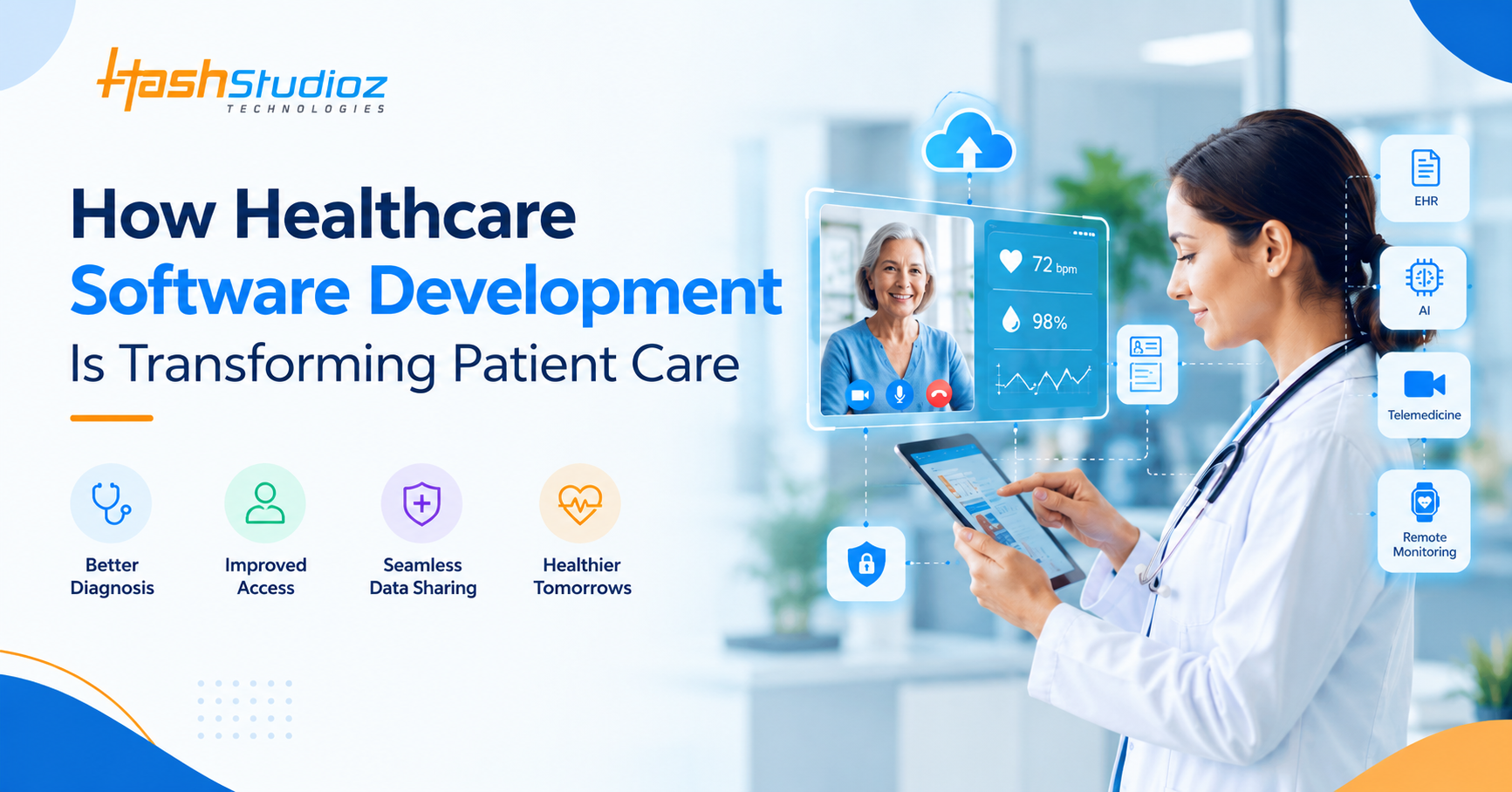
Healthcare software development is changing how providers diagnose conditions, coordinate treatment, manage patient information, and deliver care beyond hospital walls. Modern healthcare applications connect clinical records, diagnostic tools, remote monitoring devices, and patient-facing services to support informed decisions and more coordinated care.
Recent data highlights the growing adoption of digital healthcare technologies. According to the American Medical Association (AMA), 81% of surveyed physicians used artificial intelligence (AI) professionally in 2026, compared with 38% in 2023. The U.S. Office of the National Coordinator for Health Information Technology (ONC) reported that 91% of office-based physicians used certified electronic health records (EHRs) in 2024. Additionally, 76% of U.S. non-federal acute care hospitals engaged in all four measured health information exchange activities in 2025.
These statistics demonstrate the expanding role of digital healthcare infrastructure, but adoption alone does not guarantee better patient outcomes. Healthcare organizations must also prioritize interoperability, clinical safety, data protection, usability, and reliable implementation.
Table of Contents
What Is Healthcare Software Development?
Healthcare software development is the process of designing, building, integrating, and maintaining digital applications that support clinical care, patient engagement, healthcare administration, and medical data management.
These solutions range from electronic health records and hospital management systems to telemedicine platforms, remote patient monitoring applications, and clinical decision support tools. They serve different users, including physicians, nurses, patients, laboratory professionals, hospital administrators, and healthcare technology providers.
The primary goal is not simply to digitize existing processes. Effective healthcare software should help authorized users access accurate information, reduce avoidable administrative work, coordinate treatment, and make clinical workflows more reliable.
How Healthcare Software Development Is Improving Patient Care
1. AI-Assisted Diagnosis and Clinical Decision Support
Artificial intelligence can analyze medical images, laboratory results, clinical notes, and patient histories to identify patterns that clinicians may need to investigate. Healthcare applications can use AI to flag potential risks, summarize patient records, and present relevant information to support clinical decisions. Organizations planning these capabilities can explore AI development services to develop solutions suited to their clinical workflows and technical requirements.
AI also has practical applications beyond diagnosis. According to the AMA’s 2026 physician survey, 39% of surveyed physicians used AI to summarize medical research and standards of care, while 30% used it to create discharge instructions, care plans, or progress notes.
AI-powered virtual assistants can also help healthcare organizations handle routine patient queries, appointment scheduling, and basic information requests. Learn more about AI virtual assistants for healthcare and their role in patient communication.
However, AI-generated recommendations require appropriate safeguards. Developers should incorporate clinical validation, audit trails, human review, and procedures for handling uncertain or incorrect outputs. Systems must also be evaluated for performance differences across patient populations and clinical settings.
Patient-care impact: AI can help clinicians review relevant information and manage documentation more efficiently when the technology is validated for its intended use and supports rather than replaces clinical judgment.
2. Telemedicine and Virtual Care
Telemedicine software enables patients to consult healthcare professionals through video calls, secure messaging, and other remote communication tools. It can improve access for people in rural areas, patients with mobility limitations, and individuals who need regular follow-ups.
A telemedicine platform may include appointment scheduling, identity verification, consent management, electronic prescriptions where permitted, payment processing, and EHR integration. Asynchronous consultations and secure messaging can also help providers manage suitable follow-ups without requiring every interaction to take place through a live video session.
AI-based analysis can further support virtual care by helping healthcare teams assess patient information, identify relevant patterns, and prioritize follow-up activities. Explore AI-driven decision intelligence in telehealth to understand how data-supported decisions can contribute to chronic disease management.
Virtual care must connect with the broader treatment process. If consultation notes, prescriptions, and test results remain isolated from a patient’s primary medical record, clinicians may have to repeat work or make decisions with incomplete information.
Patient-care impact: Connected virtual care can improve access and continuity when providers coordinate remote consultations with in-person services, medical records, and follow-up monitoring.
3. Electronic Health Records and Interoperability
Electronic health records centralize information such as medical histories, diagnoses, allergies, medications, test results, and treatment plans. They help authorized clinicians review relevant information and coordinate care across encounters.
An electronic medical record (EMR) generally focuses on a patient’s records within a particular practice or healthcare setting, while an EHR is designed to support a broader view of health information across care settings. The exact capabilities depend on the product.
The next challenge is interoperability: enabling different healthcare systems to exchange and interpret information correctly. Standards such as HL7 FHIR and other HL7 interfaces help applications exchange clinical data. Terminology standards and appropriate data mapping are also important for consistent interpretation of diagnoses, procedures, and laboratory results.
Implementing an API or adopting FHIR does not automatically guarantee interoperability. Developers must address identity matching, duplicate records, consent, authorization, conflicting information, and the correct mapping of clinical fields.
Patient-care impact: Reliable interoperability helps care teams access more complete patient histories and supports safer transitions between providers.
4. Remote Patient Monitoring and the Internet of Medical Things
Remote patient monitoring uses connected medical devices and software to collect health measurements outside traditional clinical settings. Depending on the use case, a system may capture blood pressure, glucose levels, oxygen saturation, heart rate, or other relevant indicators.
The software receives device readings, checks them against configured thresholds, displays trends, and routes alerts to the appropriate care team. More advanced systems can prioritize alerts using patient-specific rules and historical patterns.
Healthcare organizations can learn more about IoMT and remote patient monitoring to understand how connected medical devices support digital care. Purpose-built remote patient monitoring solutions can also help healthcare teams review patient measurements, monitor trends, and manage alerts through centralized dashboards.
Successful implementation requires more than connecting a sensor to an application. Teams must consider device accuracy, connectivity interruptions, battery life, data transmission security, missing readings, and alert fatigue. Healthcare providers also need defined procedures for reviewing alerts and responding to potential clinical risks.
Patient-care impact: Remote monitoring can support chronic disease management and earlier intervention when measurements are reliable and a defined clinical workflow acts on the information.
5. Mobile Health Applications and Patient Engagement
Mobile health applications give patients convenient access to healthcare services through smartphones and other supported devices. Common features include appointment booking, prescription and medication reminders, access to test results, digital health records, secure messaging, and follow-up notifications. Some applications also connect with wearable devices or home monitoring equipment, allowing patients to track selected health measurements and share relevant information with their healthcare providers.
Well-designed applications can help patients stay informed about care plans and make routine interactions with healthcare organizations easier. However, usability is essential. Complicated navigation, inaccessible interfaces, unclear instructions, and frequent technical issues can discourage adoption, particularly among older adults and people with limited digital literacy. Applications should also protect sensitive health information through appropriate authentication, access controls, secure storage, and data transmission safeguards.
Healthcare organizations should select the right development approach based on their audience, functionality, integration requirements, and maintenance needs. Progressive web apps for healthcare offer a web-based approach that can provide app-like experiences across supported devices without requiring users to install a traditional application in every case. Regardless of the technology selected, accessibility, privacy, interoperability, and a consistent patient experience should guide the development process.
6. Cloud Computing and Integrated Healthcare Platforms
Healthcare analytics combines clinical records, laboratory findings, treatment histories, and other authorized data to help providers understand patient needs. Analytical tools can identify care gaps, monitor population-level trends, and support risk stratification when the available data is sufficiently reliable. Healthcare data analytics services can support the development of reporting and analytical capabilities tailored to clinical and operational requirements.
Personalized medicine may also use genomic information, biomarkers, and individual treatment responses to inform specific clinical decisions. These capabilities require careful interpretation because an association in historical data does not necessarily establish causation or prove that a treatment will work for an individual patient.
Developers should build data provenance, validation processes, and clear explanations of analytical limitations into these systems. Genomic and other sensitive information also requires appropriate consent and privacy controls.
Patient-care impact: Well-validated analytics can help care teams identify patterns and tailor interventions to patient needs without overstating what the data can establish.
7. Personalized Treatment and Healthcare Analytics
Hospitals often depend on established EHRs, laboratory systems, billing applications, and medical devices. Replacing everything at once can be expensive and disruptive.
Integration layers, standards-based APIs, staged migration, and data reconciliation can help organizations modernize incrementally. Addressing healthcare data integration challenges is important when connecting systems that store information in different formats or use incompatible data structures. Testing should confirm not only that data transfers successfully but also that the receiving system interprets it correctly.
Essential Types of Healthcare Software
Healthcare organizations often combine several applications rather than relying on a single platform.
| Software type | Primary purpose |
| EHR/EMR systems | Maintain and manage patient records |
| Hospital management systems | Coordinate appointments, admissions, billing, and operations |
| Telemedicine platforms | Support remote consultations and follow-ups |
| Remote patient monitoring systems | Collect and review health measurements outside clinical facilities |
| Clinical decision support systems | Present relevant information, alerts, and decision assistance |
| Patient portals and mobile apps | Provide access to records, services, and care instructions |
| Laboratory information systems | Manage laboratory workflows and test results |
| Healthcare analytics platforms | Support reporting, risk analysis, and operational planning |
The right combination depends on an organization’s clinical specialties, existing technology, patient population, regulatory obligations, and integration requirements.
Key Benefits of Healthcare Software Development
When healthcare applications fit clinical workflows and operate reliably, they can create value across patient care and healthcare operations.
- Better care coordination: Shared records and connected workflows help reduce information gaps between departments and providers.
- More informed decisions: Clinicians can review relevant patient information and validate decision-support recommendations.
- Improved access to services: Telehealth and mobile applications can reduce barriers to appropriate consultations and follow-ups.
- Reduced administrative workload: Automation can assist with scheduling, documentation, data entry, and routine communications.
- Greater operational visibility: Reporting tools help managers monitor appointment delays, resource utilization, and process bottlenecks.
- More consistent follow-up: Reminders, care plans, and monitoring workflows can help teams track outstanding patient needs.
These benefits depend on implementation quality. Poor usability, unreliable integrations, or excessive alerts can create additional work and undermine the intended improvements.
Challenges in Healthcare Software Development
Healthcare software operates in an environment where data quality, patient safety, privacy, and availability have direct consequences. Addressing these concerns during design is more effective than treating them as final-stage checks.
Data Privacy and Cybersecurity
Healthcare applications handle sensitive personal and clinical information. Developers should implement encryption, least-privilege access, multifactor authentication where appropriate, audit logging, secure APIs, vulnerability management, and tested backup and recovery procedures.
Compliance depends on the application, organization, jurisdiction, and how information is handled. For example, HIPAA applies to covered entities and business associates within its scope. GDPR and India’s Digital Personal Data Protection framework have separate applicability requirements. Encryption alone does not make an application compliant.
Organizations should also define incident-response procedures, third-party access controls, data retention policies, and processes for reviewing security risks throughout the product lifecycle.
Integration With Legacy Systems
Hospitals often depend on established EHRs, laboratory systems, billing applications, and medical devices. Replacing everything at once can be expensive and disruptive.
Integration layers, standards-based APIs, staged migration, and data reconciliation can help organizations modernize incrementally. Testing should confirm not only that data transfers successfully but also that the receiving system interprets it correctly.
Clinical Usability and Adoption
A technically sound product may fail if it adds unnecessary steps to a clinician’s workflow. Developers should involve physicians, nurses, administrators, and patients during requirements gathering and usability testing.
Training, feedback channels, and change management are equally important after launch. Teams should monitor whether users adopt the system as intended and identify workflow issues that require improvement.
Data Quality and AI Reliability
Missing records, inconsistent terminology, biased datasets, and outdated information can affect analytical results. AI features require testing against representative data, monitoring after deployment, and clear procedures for correcting errors or disabling unsafe functionality.
Where an application may qualify as regulated medical software, the team must assess its intended use and applicable regulatory requirements early in development.
Reliability and Business Continuity
Healthcare applications may be required during time-sensitive clinical workflows. Downtime, failed integrations, or inaccessible records can interrupt care.
Teams should define availability requirements, test backup restoration, document recovery procedures, and establish safe fallback workflows. Resilience should be treated as a core product requirement rather than an optional infrastructure feature.
How to Develop Healthcare Software: A Practical Process
A structured development process helps teams manage clinical, technical, and regulatory requirements.
1. Define the Clinical Problem
Identify the users, care setting, current workflow, and specific problem the application should address. Establish measurable goals before choosing technologies.
2. Map Requirements and Risks
Document functional requirements, data flows, access permissions, integration needs, accessibility, and relevant regulatory obligations. Identify risks to patient safety, privacy, and operational continuity.
3. Design the Architecture
Select appropriate technologies, hosting arrangements, interoperability standards, and security controls. Consider whether the product may qualify as regulated medical software and whether additional validation or regulatory review is necessary.
4. Build and Integrate in Stages
Develop core workflows first, validate interfaces with existing systems, and test data accuracy before expanding functionality. Use controlled releases to reduce disruption to established clinical operations.
5. Validate Clinical and Technical Performance
Conduct functional, security, usability, integration, performance, and recovery testing. Validate clinical algorithms against appropriate evidence and their intended use. Include realistic scenarios involving incomplete data, incorrect inputs, and system failures.
6. Pilot With Real Workflows
Start with a controlled group or setting, train users, collect feedback, and compare results with a documented baseline. Resolve critical issues before expanding deployment.
7. Deploy and Monitor Continuously
Track system availability, errors, security events, adoption, clinical workflow effects, and user feedback. Establish a process for updates, incident response, and ongoing validation.
A phased approach allows teams to identify problems before a wider rollout and make decisions based on evidence rather than assumptions.
Measuring ROI and Patient-Care Impact
Healthcare software ROI should reflect the problem the product was designed to solve. Financial savings alone may not capture improvements in access, documentation quality, or care coordination.
Useful measures include:
- Documentation time: Average time spent creating and completing clinical notes.
- Appointment access: Waiting time, missed appointments, and time to follow-up.
- Workflow efficiency: Staff hours spent on manual processes and repeated data entry.
- Care coordination: Delays in receiving test results, completing referrals, or reconciling medication information.
- System reliability: Application uptime, integration failures, and incident recovery time.
- Patient engagement: Completion of care tasks, follow-up attendance, and use of relevant patient services.
A 2025 multicenter quality-improvement study published in JAMA Network Open evaluated ambient AI scribes among 263 clinicians across six healthcare systems. After 30 days of use, the adjusted proportion of clinicians reporting burnout decreased from 51.9% to 38.8% among those included in the relevant analysis. The findings suggest that ambient AI documentation tools may help reduce administrative burden, although the study design does not establish that AI alone caused the improvement.
For a financial assessment, teams can compare measured annual benefits with implementation, licensing, integration, training, and ongoing operating costs:
ROI (%) = (Net financial benefit ÷ Total investment) × 100
Establish a baseline before deployment, measure the same indicators afterward, and account for changes in patient volume, staffing, and workflow. Clinical outcomes and financial returns should be evaluated separately when they cannot be reliably converted into monetary values.
Emerging Directions in Healthcare Software Development
Several developments are influencing how healthcare software teams design and maintain digital systems.
Generative and Ambient AI
AI tools can assist with clinical documentation, record summarization, and administrative workflows. Their implementation requires appropriate consent, privacy safeguards, output verification, and human oversight.
Standards-Based Interoperability
FHIR-based interfaces and related interoperability standards help applications exchange structured clinical data. Effective implementations also require appropriate authorization, terminology mapping, and data-quality controls.
Privacy-Focused Data Architecture
Healthcare organizations increasingly need architectures that support data minimization, controlled access, auditability, and appropriate protection of sensitive information throughout its lifecycle.
Connected Care Ecosystems
Combining remote monitoring, telehealth, patient applications, and clinical systems can help providers coordinate care across different settings. The value depends on reliable data exchange and clearly defined clinical responsibilities.
Continuous Validation and Monitoring
AI performance, software security, data quality, and workflow outcomes can change after deployment. Continuous monitoring helps teams identify emerging risks and determine when a system needs correction or reassessment.
The central priority is not adopting every emerging technology. Healthcare organizations should select capabilities that address defined clinical or operational needs and can be validated in their intended environment.
Healthcare Software Development Services at HashStudioz
HashStudioz Technologies works with businesses seeking to develop and integrate digital products for healthcare and connected care environments. Depending on project requirements, development may involve healthcare applications, patient-facing mobile solutions, telemedicine workflows, remote patient monitoring, system integrations, and AI-enabled features.
The process begins with understanding intended users, existing systems, data requirements, security needs, and operational goals. This helps organizations plan solutions around practical requirements rather than adding technology without a defined purpose.
Ready to Build Your Healthcare Software Solution?
Turn your healthcare software idea into a practical, secure, and scalable solution with HashStudioz. Connect with our team to discuss your requirements and plan your next steps.
Conclusion
Healthcare software development can improve patient care by connecting clinical information, expanding access to services, supporting informed decisions, and reducing avoidable administrative work. Achieving these results requires more than adding AI or moving applications to the cloud. Interoperability, clinical usability, security, validation, and continuous monitoring must remain central throughout the software lifecycle.
Healthcare organizations that define measurable goals, involve end users, and validate solutions in real workflows are better positioned to turn digital investments into meaningful improvements for patients and care teams.
Frequently Asked Questions
1. What is healthcare software development?
Healthcare software development is the process of building, integrating, and maintaining digital applications that support clinical care, patient engagement, healthcare administration, and medical data management. Examples include EHR systems, telemedicine platforms, patient portals, and remote monitoring applications.
2. How does healthcare software development improve patient care?
It can improve access to services, connect patient records, support clinical decisions, enable remote monitoring, and help care teams coordinate treatment. The impact depends on data quality, system integration, clinical validation, and how effectively the software fits existing workflows.
3. What technologies are used in healthcare software development?
Common technologies include cloud computing, AI and machine learning, mobile application development, the Internet of Medical Things (IoMT), healthcare APIs, and interoperability standards such as HL7 FHIR. The appropriate technology depends on the product’s intended use, data requirements, and regulatory obligations.
4. How do developers protect patient data?
Developers use measures such as encryption, access controls, authentication, audit logging, secure API design, vulnerability testing, and incident-response procedures. Organizations must also address consent, data retention, third-party access, and applicable privacy laws.
5. How much does healthcare software development cost?
Costs depend on the application’s scope, clinical complexity, integrations, security requirements, regulatory classification, testing, and maintenance needs. A basic patient-facing application generally requires a different investment from an EHR-integrated or regulated clinical decision support product. A requirements assessment is the best starting point for a reliable estimate.