


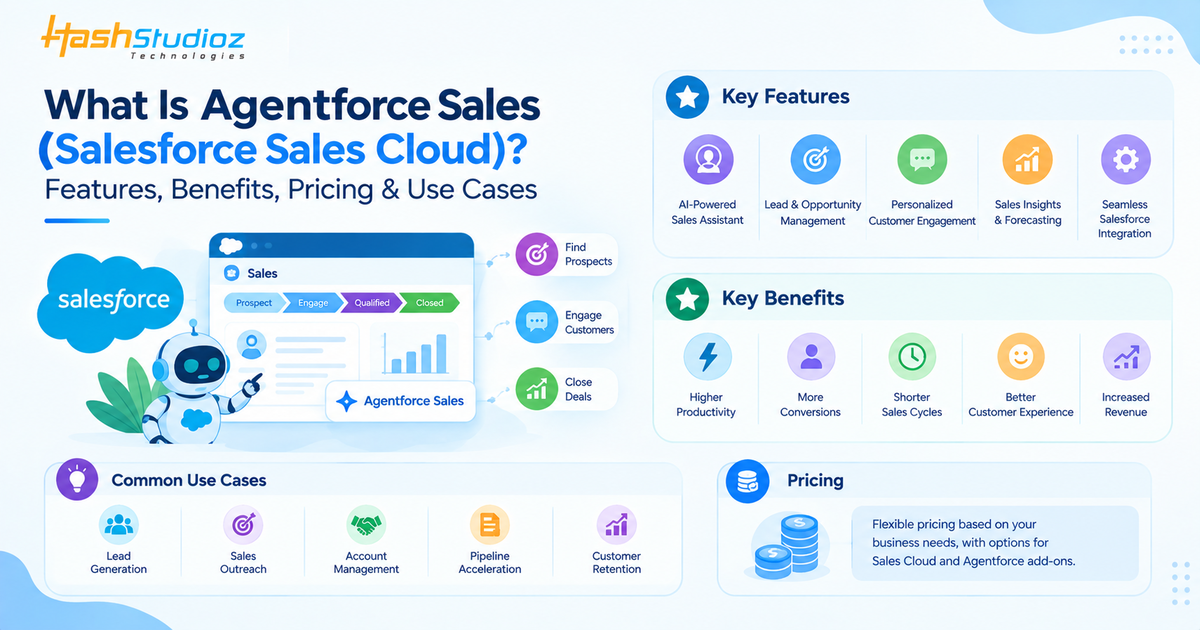
Managing leads, customer relationships, sales activities, and revenue forecasts becomes increasingly difficult as a business grows. Sales teams often work with disconnected spreadsheets, emails, CRM records, and other tools, making it harder to understand where opportunities stand and which leads need attention.
Agentforce Sales is designed to centralize these sales activities within one CRM environment. It helps businesses manage leads, accounts, contacts, opportunities, sales pipelines, activities, forecasting, reporting, and automation.
Beyond basic CRM functionality, It can also support AI-powered insights and automation, helping sales teams spend less time on repetitive tasks and more time engaging with customers.
This guide explains what Agentforce Sales is, how it works, its key features and benefits, pricing considerations, implementation process, and how to determine whether it is right for your business.
Table of Contents
Agentforce Sales at a Glance
| Aspect | Overview |
| Purpose | Manage and optimize sales processes |
| Primary users | Sales representatives, managers, and leadership teams |
| Core functions | Leads, accounts, contacts, opportunities, pipeline, forecasting, and reporting |
| Automation | Automates repetitive sales activities and workflows |
| Analytics | Reports, dashboards, forecasting, and sales insights |
| AI capabilities | Supports AI-powered recommendations, insights, and sales assistance |
| Integrations | Can connect with Salesforce products and third-party business systems |
| Best suited for | Businesses looking to centralize and scale their sales operations |
What Is Agentforce Sales?
Agentforce Sales is a CRM solution that helps businesses manage their sales processes and customer relationships from lead generation through opportunity conversion and beyond.
Instead of keeping customer information across different spreadsheets, emails, and applications, Agentforce Sales Cloud provides a centralized environment where sales teams can manage important customer and sales information.
A typical sales process can involve:
Lead → Qualification → Account & Contact → Opportunity → Sales Activities → Forecast → Closed Deal
Agentforce Sales Cloud helps teams track these stages and gives managers greater visibility into sales performance.
It can be used by businesses across industries and can be customized around different sales processes, customer types, and organizational requirements.
What Problems Does Agentforce Sales Cloud Solve?
As sales operations grow, businesses can face problems that make it difficult for sales teams to work efficiently. Agentforce Sales Cloud addresses several of these challenges.
Disconnected Customer and Lead Data
- When customer information is stored across spreadsheets, emails, documents, and different applications, sales representatives may not have a complete picture of a prospect or customer.
- Agentforce Sales Cloud provides a centralized place for managing leads, accounts, contacts, and opportunity information.
- This allows sales teams to access relevant information without constantly switching between systems.
Limited Sales Pipeline Visibility
- Without a structured CRM, sales managers may struggle to understand how many opportunities are active, which deals are progressing, and where potential bottlenecks exist.
- Agentforce Sales Cloud provides pipeline views and reporting capabilities that can help managers monitor opportunities across different stages.
Manual Sales Processes
- Sales representatives often spend considerable time performing repetitive activities such as updating records, assigning tasks, sending follow-ups, and entering information.
- Agentforce Sales Cloud automation can help reduce some of this manual work and allow teams to focus more on selling and customer relationships.
Poor Lead Follow-Up
- A lead can lose value when sales teams don’t respond quickly or fail to follow up consistently.
- Agentforce Sales Cloud can help organize lead information, activities, tasks, and follow-up processes so sales representatives can manage prospects more systematically.
Difficult Sales Forecasting
- Sales leaders need accurate information to estimate future revenue and make business decisions.
- Agentforce Sales Cloud provides forecasting and reporting capabilities that can help organizations analyze pipeline activity and estimate potential revenue based on available sales data.
How Does Agentforce Sales Work?
Agentforce Sales Cloud supports the sales process by connecting customer information, sales activities, opportunities, and reporting within a centralized CRM environment.
1. Capturing and Qualifying Leads
- Leads represent potential customers who may have shown interest in a company’s products or services.
- Sales teams can capture lead information and evaluate whether a prospect is ready to move forward.
- Once a lead is qualified, it can progress into relevant account, contact, and opportunity records.
2. Managing Accounts and Contacts
- Accounts represent businesses or organizations, while contacts generally represent individuals associated with those accounts.
- Sales representatives can use these records to understand customer relationships, communication history, activities, and associated opportunities.
3. Tracking Opportunities Through the Sales Pipeline
- An opportunity represents a potential sales deal.
- Sales teams can track opportunities through different stages of the sales process, helping them understand:
- Deal progress
- Expected revenue
- Closing probability
- Next activities
- Expected closing dates
- This creates greater visibility into the sales pipeline.
4. Automating Sales Activities
- Agentforce Sales Cloud can automate selected sales processes and repetitive activities based on business rules.
- Automation can help with tasks such as:
- Record updates
- Task creation
- Notifications
- Lead assignment
- Follow-up processes
- Workflow actions
- The exact automation approach depends on the organization’s requirements and Salesforce configuration.
5. Monitoring Performance and Forecasting Revenue
- Sales managers can use dashboards, reports, and forecasting tools to monitor sales performance.
- This can help organizations identify trends, understand pipeline health, and make more informed decisions about future revenue.
Key Agentforce Sales Features
Agentforce Sales Cloud includes a range of capabilities designed to support different stages of the sales process.
Lead Management
- Lead management helps sales teams capture, organize, qualify, and track prospective customers.
- Teams can monitor lead information and activities while moving qualified prospects into the next stage of the sales process.
Account and Contact Management
- Account and contact management provides sales teams with a centralized view of organizations and the people associated with them.
- This can help representatives understand customer relationships and maintain more organized records.
Opportunity Management
- Opportunity management allows sales teams to track potential deals from early stages through closing.
- Teams can monitor opportunity value, stage, expected close date, activities, and other relevant information.
Sales Pipeline Management
- Pipeline management gives sales teams visibility into active opportunities and their current positions in the sales process.
- Managers can use this information to identify stalled deals, assess pipeline health, and prioritize sales activities.
Activity and Task Management
- Sales representatives can manage activities such as calls, meetings, emails, tasks, and follow-ups.
- This helps salespeople organize their daily activities and maintain a record of customer interactions.
Sales Forecasting
- Forecasting helps sales leaders estimate future revenue based on sales pipeline information and other relevant data.
- It can support sales planning and help leadership understand potential revenue performance.
Reports and Dashboards
- Agentforce Sales Cloud provides reporting and dashboard capabilities that allow businesses to analyze sales data.
- Teams can monitor metrics such as:
- Lead conversion
- Opportunity pipeline
- Sales performance
- Revenue
- Win rates
- Forecasts
Sales Automation
- Automation can reduce repetitive work by triggering actions based on predefined processes and business rules.
- This can help sales teams improve efficiency while maintaining consistent workflows.
AI-Powered Sales Insights
- Salesforce continues to incorporate AI capabilities into its CRM ecosystem.
- AI can assist sales teams with areas such as recommendations, insights, summaries, forecasting support, and productivity.
- The value of AI depends heavily on the quality of business data, configuration, and the specific use cases implemented.
Email and Conversation Intelligence
- Sales teams can use Salesforce Agentforce Cloud capabilities to capture and analyze relevant communication and activity information.
- Conversation intelligence and related AI capabilities can help teams identify useful insights from sales interactions and improve follow-up and coaching processes.
What Are the Benefits of Agentforce Sales?
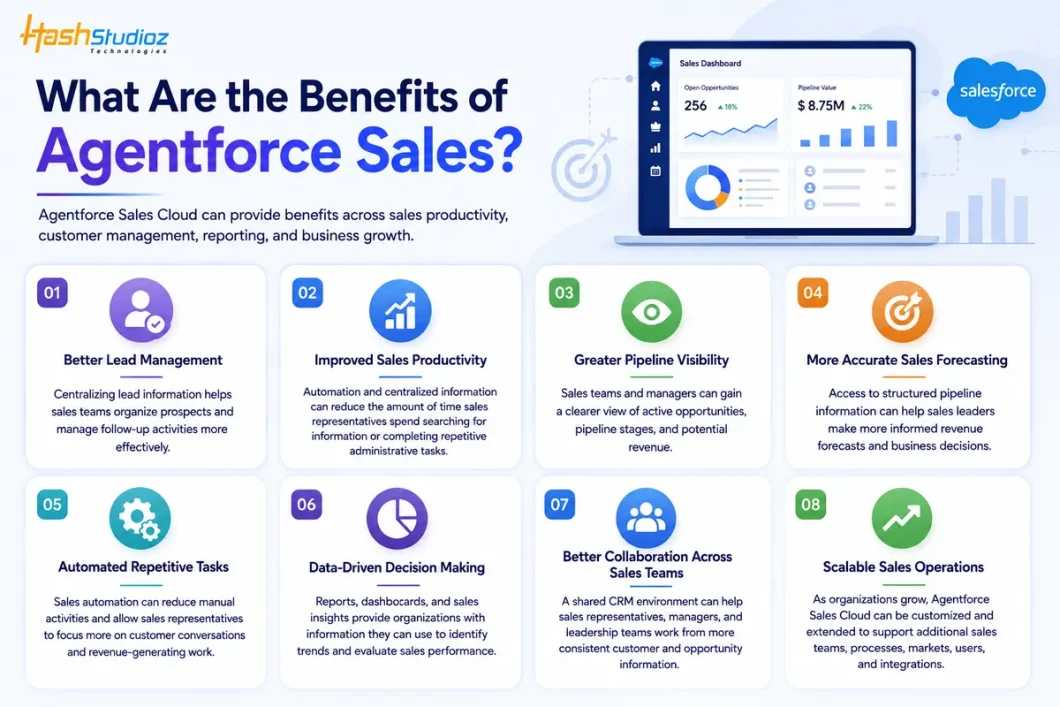
Agentforce Sales Cloud can provide benefits across sales productivity, customer management, reporting, and business growth.
Better Lead Management
Agentforce Sales can help sales teams organize and manage lead information more effectively. By keeping prospect details, interactions, activities, and qualification information within a connected CRM environment, representatives can better understand where each lead stands and determine the appropriate next step. AI-assisted workflows can also support lead qualification and follow-up activities, helping teams manage larger volumes of prospects more efficiently.
Improved Sales Productivity
Sales representatives often spend significant time searching for customer information, updating CRM records, preparing summaries, and completing administrative tasks. Agentforce Sales can help reduce this workload by assisting with routine activities and surfacing relevant information when needed. This allows sales professionals to spend more time on customer conversations, relationship building, and closing opportunities.
Greater Pipeline Visibility
A clear view of the sales pipeline is important for both representatives and sales managers. Agentforce Sales can work with Salesforce opportunity and customer data to provide greater visibility into active deals, pipeline stages, upcoming activities, and potential opportunities. This helps sales teams prioritize their efforts and allows managers to identify stalled opportunities or areas that may require attention.
More Accurate Sales Forecasting
Sales forecasting depends on reliable pipeline and opportunity data. Agentforce Sales can support sales teams by making relevant information easier to analyze and helping managers understand current pipeline conditions. Better access to structured sales information can support more informed forecasting and help leadership make decisions around revenue planning, resource allocation, and sales strategy.
Automated Repetitive Tasks
Repetitive administrative activities can take valuable time away from selling. Agentforce Sales can support automation across suitable sales workflows, such as updating records, creating tasks, assisting with follow-ups, generating summaries, and triggering defined actions. Reducing this manual work can improve operational efficiency while allowing sales representatives to focus on higher-value activities.
Data-Driven Decision Making
Sales teams generate large amounts of information through leads, accounts, opportunities, activities, and customer interactions. Agentforce Sales can help organizations make better use of this information through Salesforce reporting, dashboards, analytics, and AI-powered insights. Sales leaders can use these insights to identify trends, evaluate performance, understand pipeline health, and make more informed business decisions.
Better Collaboration Across Sales Teams
A centralized CRM environment allows sales representatives, managers, and leadership teams to work with more consistent customer and opportunity information. Agentforce Sales can further support collaboration by making relevant information easier to access and summarize. This can help teams coordinate follow-ups, understand account activity, and maintain better visibility across the sales process.
Scalable Sales Operations
As a business grows, managing more leads, customers, opportunities, and sales representatives can increase operational complexity. Agentforce Sales can be configured and extended to support changing sales processes, additional teams, markets, integrations, and use cases. This provides businesses with a foundation for introducing AI and automation as their sales operations evolve.
How Does Agentforce Sales Cloud Fit Into the Salesforce Ecosystem?
Agentforce Sales Cloud is part of the broader Salesforce ecosystem and can work alongside other Salesforce products and business systems.
For example, a business may connect sales operations with:
- Agentforce Sales Cloud + Service Cloud: Sales and service teams can work with connected customer information.
- Agentforce Sales Cloud + Marketing: Marketing and sales teams can coordinate around prospects and customer journeys.
- Agentforce Sales Cloud + Commerce: Sales teams can gain greater visibility into commerce-related customer interactions and purchases.
- Agentforce Sales Cloud + Data Cloud: Customer data from different sources can be brought together to create a more connected customer view.
- Agentforce Sales Cloud + Agentforce: AI agents and Salesforce AI capabilities can support sales productivity, customer engagement, and automation.
This ecosystem approach allows businesses to expand their Salesforce environment as their requirements evolve.
Agentforce Sales Pricing: What Should Businesses Consider?
Agentforce Sales pricing depends on the edition, number of users, features, add-ons, and implementation requirements.
Businesses should consider more than the basic subscription cost when planning their budget.
Important cost factors include:
- Salesforce edition
- Number of users
- Additional Salesforce products
- AI capabilities
- Customization
- Third-party integrations
- Data migration
- Implementation services
- Training
- Ongoing support
For this reason, businesses should evaluate the total cost of ownership rather than comparing only license prices.
How to Implement Agentforce Sales?
A successful Agentforce Sales Cloud implementation requires more than configuring the platform. Businesses should first understand their sales processes and then align Salesforce with those requirements.
Step 1: Define Sales Requirements
Identify your existing sales process, customer journey, teams, reporting requirements, automation needs, and business challenges.
Step 2: Plan Data and CRM Architecture
Determine how customer, lead, account, contact, and opportunity data should be structured within Salesforce.
Step 3: Configure Sales Processes
Configure objects, fields, sales stages, workflows, permissions, dashboards, and other features according to business requirements.
Step 4: Migrate Existing Data
Clean, map, and migrate relevant customer and sales information from spreadsheets, legacy CRMs, or other systems.
Step 5: Integrate Business Systems
Connect Salesforce with ERP, marketing platforms, communication tools, finance systems, or other applications that need to exchange data.
Step 6: Test and Validate Workflows
Test lead management, opportunity processes, automation, permissions, integrations, reports, and other important workflows before deployment.
Step 7: Train Sales Teams
Training helps users understand how to manage records, follow sales processes, use dashboards, and adopt new workflows.
Step 8: Monitor and Optimize
After implementation, review system performance, user adoption, sales processes, automation, and reporting to identify opportunities for improvement.
How HashStudioz Can Help With the Agentforce Sales?
Implementing Salesforce successfully requires the right combination of CRM strategy, configuration, customization, integration, and ongoing optimization.
HashStudioz can help businesses with Salesforce-related services, including Agentforce Sales Cloud integration, implementation, customization, integration, migration, automation, and optimization.
Conclusion
Agentforce Sales provides businesses with a centralized environment for managing leads, accounts, contacts, opportunities, sales activities, pipelines, forecasting, reporting, and automation.
Its value becomes more apparent as sales operations grow more complex and businesses need better visibility, productivity, and scalability. However, Agentforce Sales Cloud also requires investment in implementation, customization, training, and ongoing management. Businesses should therefore evaluate their specific sales requirements before adopting it.
For organizations looking to build a scalable and connected sales operation, Agentforce Sales can provide a strong foundation for managing customer relationships and supporting long-term sales growth.
FAQs
1. What is Agentforce Sales used for?
Agentforce Sales is primarily used to manage sales processes and customer relationships. It helps businesses manage leads, accounts, contacts, opportunities, activities, pipelines, forecasting, reporting, and sales automation.
2. What are the main features of Agentforce Sales Cloud?
Key features include lead management, account and contact management, opportunity management, pipeline management, sales forecasting, reports and dashboards, sales automation, and AI-powered sales capabilities.
3. Who should use Agentforce Sales?
Agentforce Sales Cloud can be used by small, mid-sized, and enterprise organizations that need structured sales and CRM management. It is particularly useful for businesses with growing sales teams or complex sales processes.
4. How much does Agentforce Sales cost?
Pricing depends on the Salesforce edition, number of users, required features, add-ons, customization, integrations, implementation, and support. Businesses should consider the total cost of ownership when budgeting.
5. Is Agentforce Sales suitable for small businesses?
Yes, Salesforce offers solutions for businesses of different sizes. However, smaller businesses with very simple sales requirements should compare the platform’s capabilities and costs against their actual CRM needs before investing.