


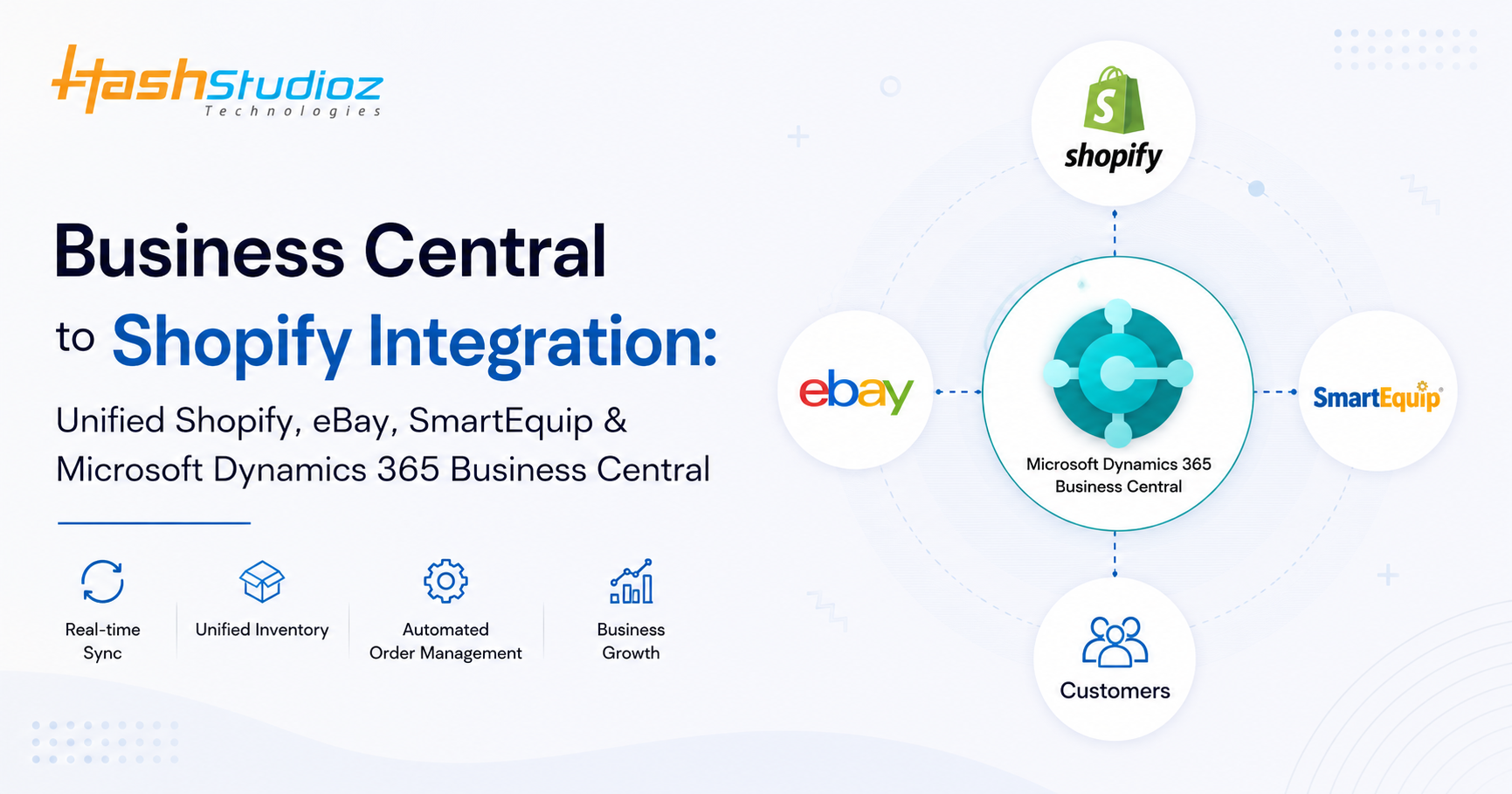
A leading industrial parts and equipment distributor was managing thousands of products across multiple digital sales and discovery channels, including Shopify, eBay, and SmartEquip.
The organization already relied on Microsoft Dynamics 365 Business Central to manage its products, inventory, pricing, customers, and order fulfillment. However, maintaining consistent and accurate information across multiple customer-facing platforms had become increasingly challenging.
The client needed a centralized solution that could eliminate duplicate product management, synchronize inventory, automate order processing, and provide customers with a consistent experience across every sales channel.
Table of Contents
The Business Challenge
The organization operated several digital channels, each serving a different purpose:
- Shopify – Direct-to-consumer online sales
- eBay – Marketplace sales and customer acquisition
- SmartEquip – Equipment parts discovery and service-part ordering
- Microsoft Dynamics 365 Business Central – ERP, product, inventory, pricing, and order management
As the number of products and sales channels grew, so did the complexity of keeping information synchronized.
The key challenges included:
- Maintaining accurate product information across all platforms
- Synchronizing inventory between multiple sales channels
- Managing multiple manufacturer and supplier part numbers for the same product
- Avoiding duplicate product records and manual data entry
- Keeping pricing consistent across channels
- Improving product discoverability through different reference numbers
- Automatically transferring online orders into the ERP
- Reducing the operational effort required to maintain product data
The client therefore needed a centralized architecture in which Business Central served as the system of record, while Shopify, eBay, and SmartEquip acted as customer-facing channels.
The Solution
Microsoft Dynamics 365 Business Central as the Single Source of Truth
To address the client’s challenges, Maxify designed a centralized commerce integration architecture with Microsoft Dynamics 365 Business Central at its core.
Business Central became the authoritative source for:
- Product master data
- Item references
- Inventory quantities
- Pricing
- Product attributes
- Product images
- Customer information
- Sales orders
- Fulfillment information
Instead of maintaining product information separately in each platform, updates could originate from Business Central and be automatically synchronized with the connected commerce channels.
This approach created a single, standardized product and inventory management process across the entire digital ecosystem.
Multi-Channel Commerce Architecture
The solution followed a hub-and-spoke integration model, with Business Central functioning as the central data hub.
Shopify
Shopify served as the organization’s direct online storefront, supporting:
- Product browsing
- Online purchasing
- Shopping cart and checkout
- Customer-facing product information
eBay
eBay expanded the distributor’s digital reach through:
- Marketplace product listings
- Online sales
- Product distribution
- Customer acquisition
SmartEquip
SmartEquip provided a specialized experience for:
- Equipment parts lookup
- Service-part discovery
- Product identification
- Parts ordering
Business Central
At the center of the architecture, Business Central controlled the underlying:
Product → Inventory → Pricing → Customer → Order → Fulfillment data
This separation allowed each customer-facing platform to focus on its specific role while Business Central maintained centralized control over core business information.
Advanced Item Reference Management
One of the most important requirements was the ability to manage multiple references for a single product.
Industrial products can often be identified using different numbers, including:
- OEM part numbers
- Manufacturer reference numbers
- Supplier part numbers
- Internal item codes
Using Business Central Item References, multiple external identifiers were linked to a single master product record.
This allowed customers to find the same product using different manufacturer, supplier, or OEM references while the organization continued to maintain one inventory-controlled item in Business Central.
The result was better product discoverability without creating unnecessary duplicate records.
Automated Product Synchronization
The integration framework automated the synchronization of critical product information between Business Central and the connected commerce platforms.
The synchronized data included:
- Products
- Inventory
- Categories
- Collections
- Images
- Product descriptions
- Shipping information
- Product attributes
- Item references
- Pricing information
This significantly reduced the need for duplicate data entry and manual updates.
When product information changed in Business Central, the connected channels could receive the updated information automatically, helping ensure that customers saw accurate and consistent information.
End-to-End Order Orchestration
The solution also automated the flow of customer orders from Shopify, eBay, and SmartEquip into Business Central.
Order Workflow
1. Customer places an order: A customer purchases a product through Shopify, eBay, or SmartEquip.
2. Order is synchronized with Business Central: The order is automatically transferred to the ERP system.
3. Inventory is validated: Business Central checks inventory availability and manages reservation.
4. Sales order is created: The corresponding sales order is generated within Business Central.
5. Fulfillment is processed: Order fulfillment and shipment processes are managed through the ERP.
6. Status is synchronized back: Order and shipment updates are communicated back to the relevant platform.
Technology Landscape
| Platform | Purpose |
| Microsoft Dynamics 365 Business Central | Master data and ERP system |
| Shopify | Direct-to-consumer eCommerce |
| eBay | Online marketplace channel |
| SmartEquip | Parts discovery and ordering platform |
| Integration Layer | Data synchronization and automation |
| Business Central APIs | Product, inventory, and order integration |
Business Outcomes
1. Single Source of Truth
Business Central became the authoritative system for all core business data.
2. Consistent Customer Experience
Accurate product and pricing data across all channels.
3. Improved Inventory Accuracy
Reduced overselling and stock mismatches.
4. Increased Operational Efficiency
Less manual work and fewer repetitive updates.
5. Better Product Discoverability
Multiple references improved searchability without duplicating products.
6. Scalable Multi-Channel Commerce
Easily extendable to new marketplaces and platforms.
Why Choose HashStudioz?
Choosing the right integration partner is critical for a Business Central to Shopify integration and multi-channel commerce setup.
1. Expertise in Business Central Integration
Deep experience in connecting Microsoft Dynamics 365 Business Central with eCommerce and marketplace platforms.
2. Shopify & Multi-Channel Commerce Knowledge
Proven capability in Shopify, eBay, and other digital commerce integrations.
3. Custom Integration Architecture
Tailored solutions based on business workflows, not generic templates.
4. Scalable & Future-Ready Solutions
Architecture designed to support growing product catalogs and new sales channels.
5. End-to-End Implementation Support
From planning and development to deployment and optimization.
Conclusion
This Business Central to Shopify integration enabled a fully unified multi-channel commerce ecosystem where Business Central became the central system of record while Shopify, eBay, and SmartEquip operated as connected sales channels.
The result was improved accuracy, automation, scalability, and a seamless customer experience across all platforms.
FAQ
1. What is Business Central to Shopify integration?
Business Central to Shopify integration connects Microsoft Dynamics 365 Business Central with Shopify to synchronize products, inventory, pricing, and orders between ERP and eCommerce systems.
2. Why is Business Central to Shopify integration important?
It ensures a single source of truth for product and inventory data, reduces manual work, improves accuracy, and enables automated order processing between Shopify and ERP.
3. Can inventory be synchronized in real time?
Yes. Inventory updates in Business Central can be automatically reflected in Shopify and other connected channels depending on the integration design.
4. Can multiple product numbers be managed in Business Central?
Yes. Business Central supports item references, allowing multiple OEM, manufacturer, and supplier numbers to be linked to a single product.
5. Can Shopify orders be sent to Business Central automatically?
Yes. Orders placed in Shopify can be automatically transferred to Business Central for processing, fulfillment, and tracking.
6. Can Business Central integrate with eBay and SmartEquip as well?
Yes. A centralized integration architecture can connect Business Central with multiple platforms including Shopify, eBay, and SmartEquip.