


Artificial Intelligence has enabled applications that understand natural language, generate content, and answer complex questions. However, Large Language Models (LLMs) still face an important limitation: their responses can be inaccurate, outdated, or disconnected from an organization’s private data.
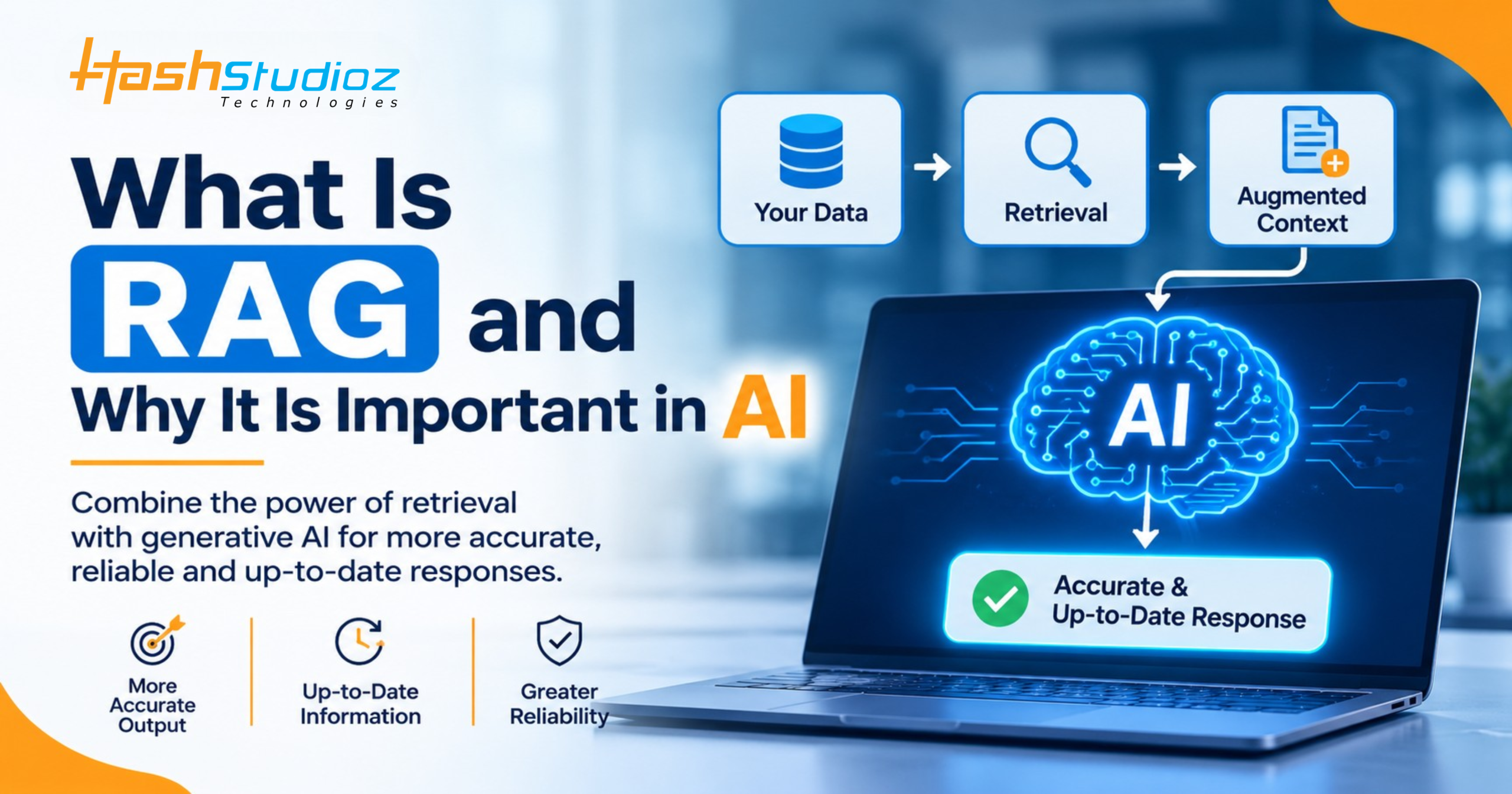
Retrieval-Augmented Generation (RAG) addresses this limitation by connecting generative AI models to external knowledge sources. Instead of relying solely on its own training data, an AI application retrieves relevant information from documents, databases, and knowledge repositories before generating an answer.
RAG in Artificial Intelligence is particularly valuable for enterprise applications that require accurate, context-aware, and data-grounded responses.
For example, a customer support chatbot powered by RAG can retrieve information from product manuals, company policies, and support documentation to answer customer questions using the latest available information.
Table of Contents
What Is Retrieval-Augmented Generation (RAG) in AI?
Retrieval-Augmented Generation (RAG) is an AI architecture that combines information retrieval with Large Language Models (LLMs) to generate responses grounded in external knowledge sources.
It allows an AI application to search relevant information from an external knowledge base and provide that information to an LLM as additional context before generating a response.
Unlike a standalone LLM, which primarily relies on knowledge acquired during training, a RAG-powered application can access updated information from connected data sources without requiring the entire model to be retrained.
For example, when an employee asks an internal AI assistant about a company’s leave policy, the RAG system retrieves the relevant policy document and provides its contents to the language model. The model then generates an answer based on the retrieved information.
The three fundamental stages of RAG are:
- Retrieval: Find relevant information from connected knowledge sources.
- Augmentation: Combine the retrieved information with the user’s question.
- Generation: Use an LLM to generate a context-aware response.
RAG helps reduce hallucinations and improves access to organization-specific information, although it does not guarantee that every generated response will be correct.
How Does RAG Work in Artificial Intelligence?
A typical RAG application follows a retrieval-and-generation workflow. It involves preparing knowledge sources, processing user queries, retrieving relevant information, and generating responses.
1. Data Collection and Preparation
The first step is collecting information from relevant knowledge sources.
These sources may include:
- PDF files and technical documentation.
- Internal company databases.
- Customer support records.
- Product manuals.
- Knowledge management systems.
- Websites and content repositories.
- Structured business information.
The collected information is cleaned, converted into suitable formats, and prepared for indexing.
2. Document Chunking
Large documents are divided into smaller sections called chunks. Chunking makes it easier for the retrieval system to locate specific information without processing entire documents for every query.
For example, a 100-page employee handbook can be divided into smaller sections covering leave policies, payroll, workplace rules, and employee benefits.
Developers should consider chunk size, overlapping content, document structure, and metadata when designing the chunking strategy.
3. Embedding Generation and Vector Storage
After chunking, an embedding model converts each text segment into a numerical representation called a vector embedding. These embeddings capture semantic relationships between pieces of information. The generated vectors are stored in a vector database or search index, along with relevant metadata and document references. Common vector database technologies include Pinecone, Weaviate, Milvus, and Chroma.
4. User Query Processing
When a user submits a question, the application processes the query and converts it into a suitable representation for retrieval.
For example, a user might ask:
“What is the company’s work-from-home policy?”
The system interprets the question and searches the connected knowledge base for relevant policy documents.
5. Information Retrieval
The retrieval system searches the indexed knowledge base to identify the most relevant information.
Depending on the architecture, it may use:
- Vector search.
- Keyword-based search.
- Semantic search.
- Hybrid search.
The retrieved information is ranked according to relevance so that the most useful passages can be passed to the language model.
6. Contextual Augmentation
The application combines the user’s original question with the retrieved information. This combined input provides the LLM with relevant context that may not have been available in its original training data.
Developers can also include instructions that tell the model to prioritize the supplied information, avoid unsupported claims, and provide source references.
7. Response Generation
The LLM processes the augmented prompt and generates a natural-language response. Depending on the application, the response may include a direct answer, a summary, references to source documents, or recommended next steps.
The application can also validate the generated response before presenting it to the user.
What Are the Main Components of RAG Architecture?
A RAG architecture consists of several interconnected components that work together to retrieve relevant information and generate responses.
1. Data Sources
Data sources contain the information used to ground AI-generated responses. These may include structured databases, unstructured documents, cloud storage, internal knowledge repositories, and external information systems.
2. Document Processing Pipeline
This component prepares raw information for retrieval. It typically handles document extraction, text cleaning, chunking, metadata extraction, and embedding generation.
3. Embedding Model
An embedding model converts text into numerical vectors that represent semantic meaning. These vectors allow the retrieval system to identify conceptually related information even when the user’s wording differs from the original document.
4. Vector Database or Search Index
A vector database stores embeddings and supports similarity-based information retrieval. A search index may additionally support keyword search, filtering, metadata queries, and hybrid retrieval.
5. Retriever and Reranker
The retriever identifies potentially relevant content from the knowledge base. A reranker then evaluates the retrieved results and prioritizes the passages most relevant to the user’s query.
6. Large Language Model
The LLM uses the retrieved context to generate an understandable response. It is responsible for interpreting the question, combining information, and producing natural-language output.
7. Application and Orchestration Layer
The orchestration layer manages communication between the user interface, retrieval system, embedding model, and LLM. It also handles permissions, conversation history, logging, and response delivery.
What Are the Different Types of RAG Architecture?
RAG systems can be designed in different ways depending on application requirements, data complexity, and retrieval needs.
1. Naive or Basic RAG
Basic RAG follows a straightforward retrieval-generation workflow. The application retrieves relevant document chunks, adds them to the prompt, and sends the combined input to an LLM. It is suitable for relatively simple knowledge-based chatbots and document question-answering applications.
2. Advanced RAG
Advanced RAG introduces improvements to both document preparation and retrieval. It may include query rewriting, hybrid search, metadata filtering, reranking, contextual compression, and improved chunking strategies. These techniques help improve retrieval relevance and response quality.
3. Modular RAG
Modular RAG uses separate components that can be combined and adjusted according to application requirements. Developers can introduce different retrieval strategies, query-processing modules, external tools, and generation components. This flexibility makes it useful for complex enterprise applications.
4. Agentic RAG
Agentic RAG uses AI agents to plan and manage more complex retrieval workflows. Instead of relying on a single search operation, an agent can break a question into smaller queries, retrieve information from multiple sources, evaluate results, and decide whether additional retrieval is necessary.
For example, an enterprise assistant answering a financial performance question may retrieve sales figures, compare historical reports, and summarize the findings. Agentic RAG is useful when questions require multiple retrieval steps or information from different knowledge sources.
What Is the Difference Between RAG, Fine-Tuning, and Prompt Engineering?
RAG, fine-tuning, and prompt engineering are different approaches to improving the performance of AI applications.
| Parameter | RAG | Fine-Tuning | Prompt Engineering |
| Primary purpose | Connect models to external knowledge | Adapt model behavior | Guide model responses |
| Uses external data | Yes | Not necessarily at inference time | Only when provided in prompts |
| Updates information | Update the knowledge base | May require additional training | Update the prompt or supplied context |
| Training required | Not necessarily | Yes | No |
| Common application | Knowledge-based assistants | Specialized model behavior | Formatting and task instructions |
RAG is generally appropriate when applications need access to frequently updated or private information. Fine-tuning is more useful when developers need to adapt a model to specific tasks, response patterns, or domain-specific behavior.
Prompt engineering helps guide model behavior through carefully designed instructions and contextual inputs. These techniques are not mutually exclusive. A production AI application may combine all three depending on its requirements.
What Are the Benefits of RAG in Artificial Intelligence?
RAG provides several advantages for organizations building AI-powered applications.
1. Improved Response Accuracy
RAG provides the language model with relevant information retrieved from external knowledge sources. This grounding can reduce unsupported responses and improve factual consistency. However, accuracy still depends on retrieval quality, source reliability, and the model’s ability to interpret the retrieved context.
2. Access to Updated Information
Organizations can update their knowledge repositories without retraining the entire language model. For example, a company can update its product documentation, pricing information, or internal policies and make the revised information available through the retrieval system.
3. Better Data Customization
RAG enables AI applications to use private or organization-specific information. Businesses can connect their applications to internal documentation, databases, and knowledge repositories while maintaining appropriate access controls.
4. Reduced Model Retraining Requirements
Traditional model retraining can require significant computing resources and operational planning. RAG allows many knowledge updates to happen at the retrieval layer rather than through repeated model training.
5. Greater Transparency
RAG applications can associate generated responses with the documents and passages used as supporting context. This allows users to verify important information and helps organizations improve accountability.
6. Flexible Enterprise Integration
RAG can connect with existing enterprise systems, including document management platforms, CRM systems, databases, and internal knowledge repositories. This flexibility makes it suitable for a wide range of business applications.
What Are the Real-World Applications of RAG?
RAG can improve AI applications across industries where users need accurate answers based on specialized or frequently updated information.
1. Customer Support Chatbots
RAG-powered chatbots can retrieve answers from product manuals, FAQs, troubleshooting guides, and support documentation.
For example, a customer asking how to reset a connected device can receive instructions from the latest product manual rather than relying on generic model knowledge.
Businesses looking to implement intelligent customer support systems can combine RAG technology with AI chatbot development services. This approach enables chatbots to retrieve relevant information from product documentation, FAQs, and internal knowledge repositories before generating contextual responses to customer questions.
2. Healthcare Information Systems
Healthcare organizations can use RAG to retrieve relevant information from clinical guidelines, medical research, and approved internal documentation.
Such applications can assist healthcare professionals with information discovery, but generated responses must be validated and should not replace qualified clinical judgment.
3. Legal Research Applications
Legal research systems can retrieve relevant regulations, case documents, contracts, and legal precedents. This helps legal professionals locate relevant information more efficiently while maintaining access to original source documents for verification.
4. Financial Research and Analysis
Financial institutions can use RAG to retrieve information from financial reports, internal research, regulatory documentation, and approved market data. It can help analysts summarize large information collections and locate relevant supporting documents.
5. Education and Learning Platforms
Educational applications can use RAG to retrieve relevant information from textbooks, lecture materials, course documents, and research papers. Students can ask questions about their learning materials and receive contextual explanations based on the available content.
6. Enterprise Knowledge Management
Organizations often store information across multiple departments and platforms. RAG can connect these knowledge sources and provide employees with a centralized conversational interface for finding internal information.
How to Implement RAG in an AI Application
Building a reliable RAG application requires careful planning across data preparation, retrieval, generation, and evaluation.
A practical implementation process includes:
- Define the use case: Identify the questions users should be able to ask and the information sources required to answer them.
- Prepare the knowledge base: Collect relevant documents, clean the data, remove unnecessary content, and extract useful metadata.
- Choose an embedding model: Select an embedding model based on language requirements, retrieval quality, and operational constraints.
- Select a retrieval database: Choose a vector database or search platform that supports the required retrieval capabilities.
- Build the retrieval pipeline: Implement chunking, embedding generation, indexing, and query processing.
- Integrate an LLM: Connect the retrieved context to a language model through an orchestration layer.
- Add security controls: Implement authentication, authorization, encryption, and document-level access permissions.
- Evaluate the application: Test retrieval relevance, response accuracy, latency, and source attribution before production deployment.
The best implementation approach depends on the size of the knowledge base, complexity of user questions, data sensitivity, and expected application workload.
Illustrative Enterprise Example: An Internal Policy Assistant
Consider an organization that wants employees to find answers across its HR handbook, travel and expense policy, IT security guidance, and operational procedures. A RAG-based internal assistant could retrieve relevant passages from these approved documents and use them as context when answering employee questions.
Before retrieved content reaches the language model, the application should authenticate the user and enforce document-level permissions using verified identity and authorization information. For example, an employee should not receive HR records or restricted management documents unless their role permits access. The response can include references to the source document and relevant section so the employee can check the policy.
The organization should test the assistant with representative questions before release. Acceptance checks could include confirming that an employee cannot retrieve restricted HR documents, that an outdated policy is not treated as current, and that the assistant declines or escalates questions when the approved documents do not contain sufficient information.
RAG Implementation Best Practices
A technically functional RAG application is not necessarily a reliable production application. Developers should follow several best practices to improve retrieval quality, security, and scalability.
1. Use an Appropriate Chunking Strategy
Avoid splitting every document into arbitrary text lengths. Use document structure, headings, paragraphs, and semantic boundaries to create meaningful chunks. The ideal chunk size depends on document type, retrieval strategy, and the complexity of user questions.
2. Combine Keyword and Vector Search
Vector search identifies semantically similar content, while keyword search helps locate exact terms, identifiers, and technical expressions. Hybrid search combines these approaches to improve retrieval coverage.
3. Apply Metadata Filtering
Metadata such as document type, department, publication date, and access permissions can help narrow retrieval results. This improves relevance and prevents unnecessary documents from entering the generation context.
4. Use Reranking
A reranking model can reorder retrieved passages according to their relevance to the original query. This helps the LLM receive more useful context instead of relying only on the initial retrieval ranking.
5. Protect Sensitive Information
Implement access controls at the retrieval layer. A user should only retrieve documents they are authorized to access. Encrypt sensitive data, protect credentials, and treat retrieved documents as untrusted input.
6. Monitor and Update Knowledge Sources
Outdated documents can produce outdated answers. Establish processes for updating indexes, removing obsolete records, tracking document versions, and monitoring ingestion failures.
7. Evaluate Continuously
Test the system using realistic questions and verified reference answers. Evaluate retrieval quality and generated response quality separately so that developers can identify whether an issue originates in document retrieval or response generation.
How Do You Measure RAG Performance?
RAG evaluation should examine both the retrieval component and the generation component.
Important evaluation metrics include:
| Metric | What It Measures |
| Recall@K | Whether relevant documents appear in the top K retrieved results |
| Precision@K | How many retrieved results are relevant |
| Mean Reciprocal Rank (MRR) | How highly the first relevant result appears |
| Normalized Discounted Cumulative Gain (NDCG) | The quality of the ranking of relevant results |
| Faithfulness | Whether generated claims are supported by retrieved context |
| Answer Relevance | Whether the response addresses the user’s question |
| Context Relevance | Whether retrieved passages are useful for answering the query |
| Latency | How long the system takes to return a response |
Developers should also measure operational factors such as token consumption, retrieval cost, embedding costs, error rates, and system availability. A useful evaluation dataset should contain representative user questions, expected answers, relevant source documents, and examples of queries that should not receive an answer.
This makes it easier to identify weaknesses and improve the system over time.
What Are the Main Challenges of RAG?
Despite its advantages, RAG introduces technical and operational challenges.
1. Poor Data Quality
Outdated, incomplete, or duplicated documents can negatively affect retrieval quality. Organizations should maintain clean, verified, and regularly updated knowledge sources.
2. Retrieval Accuracy
A RAG system may retrieve documents that contain similar terminology but do not answer the actual question. Hybrid search, query rewriting, metadata filtering, and reranking can help address this problem.
3. Privacy and Security Risks
Connecting LLMs to private knowledge bases introduces risks related to unauthorized document access, sensitive data exposure, and malicious content. Document-level authorization, secure data handling, and prompt-injection defenses should be included in the architecture.
4. Increased Latency
RAG introduces additional processing steps, including query embedding, retrieval, reranking, and response generation. Caching, efficient indexing, optimized retrieval, and controlled context size can help reduce response time.
5. Hallucinations Despite Retrieval
Retrieving relevant information does not guarantee that the LLM will interpret it correctly. Developers should use source-grounded prompts, citations, response validation, and fallback mechanisms when sufficient evidence is unavailable.
When Should You Use RAG in an AI Application?
RAG is a suitable approach when an AI application needs to answer questions using external, private, or frequently updated information.
Consider implementing RAG when:
- Your organization maintains large document collections.
- Users need answers based on internal company information.
- Knowledge changes more frequently than model training cycles.
- Responses should include references to supporting documents.
- Different users require different levels of data access.
- You need conversational search across multiple knowledge sources.
However, RAG may not be necessary for every AI application.
If an application only needs to perform simple text classification, basic content generation, or tasks that do not require external knowledge, a standalone LLM may be sufficient. The architecture should be selected according to actual business and technical requirements rather than adopting RAG simply because it is a popular AI approach.
What Is the Future of RAG in Artificial Intelligence?
RAG continues to evolve as developers work toward more capable and reliable AI applications.
Several developments are shaping its future.
1. Agentic RAG
Agentic RAG is part of a broader shift toward AI systems that can plan tasks, use external tools, and execute multi-step workflows. Understanding the differences between Generative AI vs Agentic AI vs AI Agents can help businesses identify how these technologies fit into their AI adoption strategies.
It is particularly useful for questions that require multi-step reasoning and information gathering.
2. Multimodal RAG
Multimodal RAG extends retrieval beyond text by supporting information from images, audio, video, and other data formats.
For example, an industrial support assistant could retrieve relevant information from equipment manuals, diagrams, and maintenance images.
3. Improved Hybrid Retrieval
Combining keyword search, vector search, and semantic ranking can improve the ability to retrieve relevant information from complex knowledge bases.
This is particularly useful for enterprise environments containing technical terminology and structured information.
4. Better RAG Evaluation
As RAG becomes more widely adopted, evaluation frameworks will play an increasingly important role in measuring retrieval quality, answer faithfulness, and application reliability.
5. Stronger Data Governance
Future RAG systems will need more advanced controls for permissions, data privacy, source tracking, and regulatory compliance. These capabilities will be essential for organizations using AI with sensitive enterprise information.
How HashStudioz Helps Businesses Build RAG-Powered AI Solutions
Implementing Retrieval-Augmented Generation requires more than integrating a Large Language Model with a vector database. Businesses need a well-planned architecture that connects relevant data sources, retrieves accurate information, maintains data security, and generates reliable responses.
HashStudioz helps businesses explore and implement AI-powered solutions tailored to their operational and technical requirements. With expertise in AI, machine learning, and software development, HashStudioz supports organizations in developing intelligent applications that combine enterprise data with Generative AI capabilities.
Its RAG implementation approach can cover several important areas:
1. Custom RAG Application Development
Every business has different data requirements and workflows. HashStudioz can help develop custom RAG-powered applications that connect enterprise knowledge bases, internal documents, databases, and other relevant information sources.
These applications can support use cases such as internal knowledge assistants, intelligent document search, and AI-powered customer support.
2. Vector Database and Knowledge Base Integration
A reliable RAG application depends on how effectively information is processed, indexed, and retrieved.
HashStudioz can help businesses integrate vector database technologies and develop document processing pipelines that support semantic search, information retrieval, and contextual response generation.
3. LLM Integration and Workflow Development
Selecting and integrating the appropriate language model is an important part of RAG development. HashStudioz can help organizations integrate suitable LLMs and develop retrieval workflows that connect user queries with relevant enterprise information.
4. Secure and Scalable AI Architecture
Enterprise AI applications must consider data privacy, access permissions, infrastructure requirements, and application performance. A well-designed RAG architecture should include appropriate authentication, document-level access controls, secure data handling, and monitoring mechanisms.
HashStudioz can help businesses incorporate these considerations into their AI application development processes.
5. AI Application Optimization and Maintenance
RAG applications require continuous evaluation to maintain retrieval quality and response accuracy. This includes improving document chunking, optimizing retrieval strategies, monitoring application performance, updating knowledge sources, and evaluating generated responses. By addressing these requirements throughout the development lifecycle, businesses can build RAG-powered applications that better support their evolving operational needs.
Organizations exploring enterprise AI assistants, intelligent knowledge management platforms, or custom Generative AI applications can connect with HashStudioz to discuss their RAG implementation requirements.
HashStudioz supports businesses exploring intelligent automation, enterprise AI applications, and Generative AI adoption. Organizations can explore its AI services and solutions to understand how AI technologies can be incorporated into their existing business processes and digital products.
Conclusion
Retrieval-Augmented Generation has become an important architecture for building AI applications that require access to external and organization-specific information. By combining information retrieval with large language models, RAG enables applications to generate more relevant, context-aware, and verifiable responses without requiring continuous model retraining whenever knowledge changes.
However, successful RAG implementation involves more than connecting a vector database to an LLM. Developers must carefully design document processing, chunking, embedding generation, retrieval strategies, access controls, evaluation methods, and monitoring processes.
As agentic retrieval, multimodal search, and advanced evaluation techniques continue to develop, RAG will remain an important approach for building practical enterprise AI applications.
Organizations should focus on selecting the right architecture, maintaining reliable knowledge sources, and continuously evaluating application performance to get meaningful results from RAG.
Frequently Asked Questions About RAG in AI
1. What does RAG stand for in artificial intelligence?
RAG stands for Retrieval-Augmented Generation. It is an AI architecture that combines information retrieval with large language models to generate responses grounded in external knowledge sources.
2. How does RAG reduce AI hallucinations?
RAG retrieves relevant information from trusted knowledge sources and supplies it to an LLM as contextual information. This gives the model factual material to reference, reducing its dependence on internally generated assumptions. However, it cannot eliminate hallucinations.
3. Does RAG require fine-tuning?
No. RAG does not inherently require fine-tuning. It can connect an existing language model to external knowledge sources through a retrieval pipeline. Fine-tuning can be added when an application also requires specialized model behavior.
4. Which vector databases are commonly used for RAG?
Commonly used vector database technologies include Pinecone, Weaviate, Milvus, and Chroma. The right choice depends on scalability, filtering capabilities, deployment requirements, integrations, and operational costs.
5. What is the difference between vector search and RAG?
Vector search retrieves information based on the similarity between numerical representations of queries and documents. RAG uses retrieval as part of a larger architecture that also provides the retrieved information to a language model for response generation.
6. Is RAG suitable for enterprise applications?
Yes. RAG can support enterprise applications such as internal knowledge assistants, customer support systems, document search platforms, and research tools. Successful implementation requires appropriate security, access controls, monitoring, and data governance.
7. Can RAG work with real-time data?
Yes, depending on the architecture. RAG can retrieve recently updated information when its connected data sources and indexes are refreshed appropriately. The freshness of the answer depends on the data ingestion and synchronization process.
8. What are the biggest limitations of RAG?
Common limitations include poor document quality, irrelevant retrieval results, increased latency, additional infrastructure costs, security risks, and inaccurate responses despite retrieved context.
9. What is an agentic RAG?
Agentic RAG is an advanced retrieval approach in which AI agents plan and execute multiple retrieval steps to answer complex questions. It can use query decomposition, multiple knowledge sources, and iterative retrieval.
10. How can RAG improve customer experience?
RAG can help customer support applications retrieve accurate product information, troubleshooting instructions, and updated policies. This enables more relevant responses and reduces the need for users to search through multiple information sources manually.
